
Recent from talks
Blyth Power Station
Knowledge base stats:
Talk channels stats:
Members stats:
Blyth Power Station
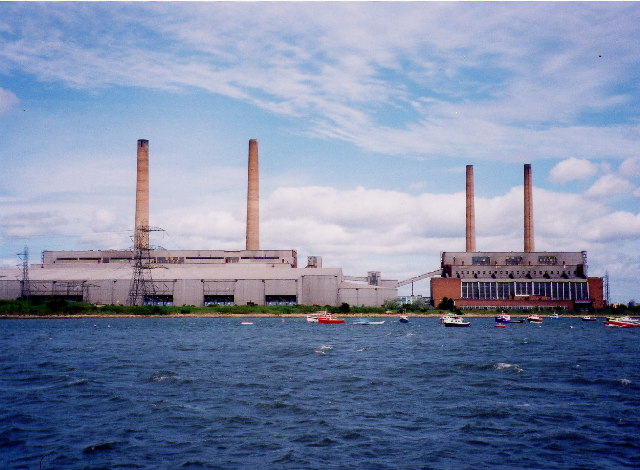
Blyth Power Station (also known as Cambois Power Station) refers to a pair of now demolished coal-fired power stations, which were located on the Northumberland coast in North East England. The two stations were built alongside each other on a site near Cambois in Northumberland, on the northern bank of the River Blyth, between its tidal estuary and the North Sea. The stations took their name from the town of Blyth on the opposite bank of the estuary. Blyth A Power Station was built and opened first but had a smaller generating capacity than its sister station, Blyth B Power Station, which was built to its west four years later. The power stations' four large chimneys were a landmark of the Northumberland skyline for over 40 years; the A Station's two chimneys each stood at 140 metres (460 ft); the B Station's two chimneys were taller, at 170 metres (560 ft) each.
Construction of the B Station began shortly after the A station was completed. The stations were built during a period in which there were great advances in power station technology, and in the scale of production, which led to them having a variety of intermediate generator set sizes along with a mix of design styles. Blyth A had a generating capacity of 480 megawatts (MW) and the B Station 1,250 MW. Their combined capacity of 1,730 MW briefly made Blyth Power Station the largest electricity generation site in England, until Ferrybridge C Power Station came into full operation in 1966. The stations were capable of generating enough electricity to power 300,000 homes.
The A Station first generated electricity in 1958, a year after the creation of the Central Electricity Generating Board, and the stations operated until 2001. They were operated by the successors of the CEGB, including National Power, following the privatisation of the UK's power industry. After their closure in 2001, the stations were demolished over the course of two years, ending with the demolition of the stations' chimneys on 7 December 2003. RWE Npower proposed the construction of a clean coal-fired power station on the site, but the plans were postponed. In December 2020, the site was confirmed as the location for a new automotive battery manufacturing plant.
Following the Second World War the demand for electricity increased in the United Kingdom. In North East England, this led to the construction of two new power stations at Stella, along with the expansion of stations at Dunston and Billingham, to meet the demand for power quickly. At Blyth, a larger and more efficient plant was planned, consisting of six 100 megawatts (MW) generating units. This increased to six 120 MW units, before increasing again in the final proposal for an A station consisting of four 120 MW units and a B station consisting of two 275 MW units and two 350 MW units. This gave the A and B stations generating capacities of 480 MW and 1,250 MW respectively. The first generating set at Blyth A was commissioned in December 1958 and the other sets in 1959–60. In the 1960s Blyth A was in the CEGB's list of the 20 power stations with the highest thermal efficiencies. The electricity output, load and thermal efficiency are shown the following table.
The Blyth Power Stations were to be an experiment, using a variety of generating set sizes at a time when engineers were trying to standardise power station plant and layout. Blyth was the first in the UK to use generating sets larger than the then standard 30 MW and 60 MW. The station's location was chosen because of its position within the super grid, rather than to be near a load centre.
The site chosen for the construction of the power stations was close to the coal mining town of Cambois. Ordnance Survey maps as far back as 1860 show that before building work began the land had been used as open farmland, with fields of varying shapes and sizes.
Permission for Blyth A Power Station to be built was granted in February 1955, and its construction took place between 1955 and 1960. The station's first unit went into operation in December 1958, and the A Station was fully operational by June 1960. Its four 120 MW sets were the first commissioned in Britain of what became for a time that standardised size. The construction of the B Station began on 4 December 1961. Its first unit was commissioned in December 1962, and the rest of the station was fully operational by September 1966. The station had a total generating capacity of 1,730 MW, the highest of any site in the UK until later in the same year, when Ferrybridge C Power Station came into full operation. Blyth B was the first power station in Britain to have 275 MW sets installed. Its two 350 MW sets were an intermediate stage toward the 500 MW standard, so very few of the 350 MW sets were ever commissioned in the UK. Both of the stations were designed by L J Couves & Partners. They were engineered by Merz & McLellan and built by the Cleveland Bridge Company.
The large 98-hectare (240-acre) site was separated by Bedlington-Cambois Road, with the stations' main buildings, admin blocks and ash dock to the south of the road, and coal storage area and railway sidings to the north. The ground to the south of this road consisted of a 21-metre (69 ft) thick layer of boulder clay, overlaying sandstone and coal. The main foundations of the buildings were spread out, giving a load of about 2.3 tonnes (2.264 long tons; 2.535 short tons) per square foot.
Hub AI
Blyth Power Station AI simulator
(@Blyth Power Station_simulator)
Blyth Power Station
Blyth Power Station (also known as Cambois Power Station) refers to a pair of now demolished coal-fired power stations, which were located on the Northumberland coast in North East England. The two stations were built alongside each other on a site near Cambois in Northumberland, on the northern bank of the River Blyth, between its tidal estuary and the North Sea. The stations took their name from the town of Blyth on the opposite bank of the estuary. Blyth A Power Station was built and opened first but had a smaller generating capacity than its sister station, Blyth B Power Station, which was built to its west four years later. The power stations' four large chimneys were a landmark of the Northumberland skyline for over 40 years; the A Station's two chimneys each stood at 140 metres (460 ft); the B Station's two chimneys were taller, at 170 metres (560 ft) each.
Construction of the B Station began shortly after the A station was completed. The stations were built during a period in which there were great advances in power station technology, and in the scale of production, which led to them having a variety of intermediate generator set sizes along with a mix of design styles. Blyth A had a generating capacity of 480 megawatts (MW) and the B Station 1,250 MW. Their combined capacity of 1,730 MW briefly made Blyth Power Station the largest electricity generation site in England, until Ferrybridge C Power Station came into full operation in 1966. The stations were capable of generating enough electricity to power 300,000 homes.
The A Station first generated electricity in 1958, a year after the creation of the Central Electricity Generating Board, and the stations operated until 2001. They were operated by the successors of the CEGB, including National Power, following the privatisation of the UK's power industry. After their closure in 2001, the stations were demolished over the course of two years, ending with the demolition of the stations' chimneys on 7 December 2003. RWE Npower proposed the construction of a clean coal-fired power station on the site, but the plans were postponed. In December 2020, the site was confirmed as the location for a new automotive battery manufacturing plant.
Following the Second World War the demand for electricity increased in the United Kingdom. In North East England, this led to the construction of two new power stations at Stella, along with the expansion of stations at Dunston and Billingham, to meet the demand for power quickly. At Blyth, a larger and more efficient plant was planned, consisting of six 100 megawatts (MW) generating units. This increased to six 120 MW units, before increasing again in the final proposal for an A station consisting of four 120 MW units and a B station consisting of two 275 MW units and two 350 MW units. This gave the A and B stations generating capacities of 480 MW and 1,250 MW respectively. The first generating set at Blyth A was commissioned in December 1958 and the other sets in 1959–60. In the 1960s Blyth A was in the CEGB's list of the 20 power stations with the highest thermal efficiencies. The electricity output, load and thermal efficiency are shown the following table.
The Blyth Power Stations were to be an experiment, using a variety of generating set sizes at a time when engineers were trying to standardise power station plant and layout. Blyth was the first in the UK to use generating sets larger than the then standard 30 MW and 60 MW. The station's location was chosen because of its position within the super grid, rather than to be near a load centre.
The site chosen for the construction of the power stations was close to the coal mining town of Cambois. Ordnance Survey maps as far back as 1860 show that before building work began the land had been used as open farmland, with fields of varying shapes and sizes.
Permission for Blyth A Power Station to be built was granted in February 1955, and its construction took place between 1955 and 1960. The station's first unit went into operation in December 1958, and the A Station was fully operational by June 1960. Its four 120 MW sets were the first commissioned in Britain of what became for a time that standardised size. The construction of the B Station began on 4 December 1961. Its first unit was commissioned in December 1962, and the rest of the station was fully operational by September 1966. The station had a total generating capacity of 1,730 MW, the highest of any site in the UK until later in the same year, when Ferrybridge C Power Station came into full operation. Blyth B was the first power station in Britain to have 275 MW sets installed. Its two 350 MW sets were an intermediate stage toward the 500 MW standard, so very few of the 350 MW sets were ever commissioned in the UK. Both of the stations were designed by L J Couves & Partners. They were engineered by Merz & McLellan and built by the Cleveland Bridge Company.
The large 98-hectare (240-acre) site was separated by Bedlington-Cambois Road, with the stations' main buildings, admin blocks and ash dock to the south of the road, and coal storage area and railway sidings to the north. The ground to the south of this road consisted of a 21-metre (69 ft) thick layer of boulder clay, overlaying sandstone and coal. The main foundations of the buildings were spread out, giving a load of about 2.3 tonnes (2.264 long tons; 2.535 short tons) per square foot.
Recent media