



Community hub
Recent from talks
Contribute something to knowledge base
Content stats: 0 posts, 0 articles, 1 media, 0 notes
Members stats: 0 subscribers, 0 contributors, 0 moderators, 0 supporters
Subscribers
Supporters
Contributors
Moderators
Hub AI
Boeing Everett Factory AI simulator
(@Boeing Everett Factory_simulator)
Hub AI
Boeing Everett Factory AI simulator
(@Boeing Everett Factory_simulator)
Boeing Everett Factory
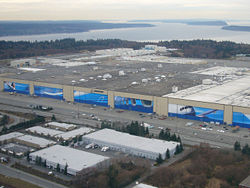
The Boeing Everett Factory, officially the Everett Production Facility, is an airplane assembly facility operated by Boeing in Everett, Washington, United States. It sits on the north side of Paine Field and includes the largest building in the world by volume at over 472 million cubic feet (13,400,000 m3), which covers 98.3 acres (39.8 ha).
The entire complex covers approximately 1,000 acres (400 ha) and spans both sides of State Route 526 (named the Boeing Freeway). The factory was built in 1967 for the Boeing 747 and has since been expanded several times to accommodate new airliners, including the 767, 777, and 787 programs. More than 5,000 widebody aircraft have been built at the Everett factory since it opened.
The Boeing Everett complex sits on 1,000 acres (400 ha) in southwestern Everett, about 22 miles (35 km) north of Seattle. It includes up to 200 separate buildings and facilities, mostly on the north and east sides of Paine Field's main runway, and straddles both sides of State Route 526 (named the Boeing Freeway). The complex includes a fire station, a medical clinic, a gymnasium, on-site security, and seven restaurants and cafes. As of 2022[update], Boeing has 30,000 workers at its Everett site who are scheduled in three shifts, primarily during daytime hours. The company is the largest employer in Everett and Snohomish County.
The main assembly building, immediately north of the Boeing Freeway, covers 98.3 acres (398,000 m2) and is organized into six production lines that are separated by walls, offices, and other spaces. It is the world's largest building by volume at 472,370,319 cubic feet (13,376,037.9 m3) of interior space according to Guinness World Records; the building is large enough to fit all of Disneyland or 75 American football fields. The production lines move at a rate of 1.5 inches (3.8 cm) per minute and are guided by 26 overhead cranes that move along 31 miles (50 km) of track. These cranes are suspended along the roof trusses, which are 300 to 350 feet (91 to 107 m) long and are supported by columns that are 90 feet (27 m) tall. A network of pedestrian and utilities tunnels span 2.33 miles (3.75 km) under the factory floor; employees also use a shared fleet of 1,300 bicycles and tricycles to move around the factory floor.
The main building is 114 feet (35 m) tall and has six hangar doors that are each 82 feet (25 m) tall and 300 to 350 feet (91 to 107 m) wide. The doors have a six-part mural that was recognized as the world's largest digital image in 2006 by Guinness World Records. The building has a central ventilation system but lacks air conditioning; it is instead cooled by opening the doors for outdoor air. The building is heated through residual warming from employees and equipment, including the 1 million overhead lights in the factory. An urban legend states that clouds used to form inside the main building due to its size prior to the installation of upgraded ventilation systems. Adjacent buildings include a composite wing manufacturing plant with 1.2 million square feet (110,000 m2) of floor space; paint and seal buildings; and an auxiliary fuselage assembly plant for the Boeing 777X.
The north side of the factory complex is connected to the flight line at Paine Field via a taxiway that crosses over the Boeing Freeway west of Airport Road; airplanes are towed from the factory to flight line facilities at night to avoid disrupting traffic. The south side includes a set of three paint hangars, a delivery center with conference rooms, and parking spaces for airplanes. The flight line area connects to the main runway at Paine Field, which is 9,010 feet (2,750 m) long and is the only one at the airport that can accommodate jetliners. The runway has also been used for commercial service since the opening of a new passenger terminal at the airport in 2019. Additional spaces for parked airplanes are on the west side of the runway and southwest of the main building; Paine Field's short crosswind runway has also occasionally been used to park airplanes since 2010; the runway and an adjacent taxiway have been leased by Boeing from the county government to store airplanes.
In 2007, an empty building on the campus was used by Japanese railcar manufacturer Kinki Sharyo to assemble a fleet of Link light rail trains for Sound Transit.
Boeing opened its first facilities in Everett on October 13, 1943, at a former auto garage to produce sections for the Boeing B-17 Flying Fortress. The company had several small shops in the city, but their presence in the area was reduced by 1963. The first 25 orders for the Boeing 747, to be the world's largest jetliner, were sold to Pan American World Airways for $525 million (equivalent to $5.2 billion in 2025) in March 1966. The program would require a larger factory than their Renton facility, which was instead planned to be used for the conceptual 2707 supersonic airliner. Among the sites considered by Boeing for a new factory were Monroe, Washington; McChord Air Force Base near Tacoma, Washington; Moses Lake, Washington; Cleveland, Ohio; and Walnut Creek, California.
Boeing Everett Factory
The Boeing Everett Factory, officially the Everett Production Facility, is an airplane assembly facility operated by Boeing in Everett, Washington, United States. It sits on the north side of Paine Field and includes the largest building in the world by volume at over 472 million cubic feet (13,400,000 m3), which covers 98.3 acres (39.8 ha).
The entire complex covers approximately 1,000 acres (400 ha) and spans both sides of State Route 526 (named the Boeing Freeway). The factory was built in 1967 for the Boeing 747 and has since been expanded several times to accommodate new airliners, including the 767, 777, and 787 programs. More than 5,000 widebody aircraft have been built at the Everett factory since it opened.
The Boeing Everett complex sits on 1,000 acres (400 ha) in southwestern Everett, about 22 miles (35 km) north of Seattle. It includes up to 200 separate buildings and facilities, mostly on the north and east sides of Paine Field's main runway, and straddles both sides of State Route 526 (named the Boeing Freeway). The complex includes a fire station, a medical clinic, a gymnasium, on-site security, and seven restaurants and cafes. As of 2022[update], Boeing has 30,000 workers at its Everett site who are scheduled in three shifts, primarily during daytime hours. The company is the largest employer in Everett and Snohomish County.
The main assembly building, immediately north of the Boeing Freeway, covers 98.3 acres (398,000 m2) and is organized into six production lines that are separated by walls, offices, and other spaces. It is the world's largest building by volume at 472,370,319 cubic feet (13,376,037.9 m3) of interior space according to Guinness World Records; the building is large enough to fit all of Disneyland or 75 American football fields. The production lines move at a rate of 1.5 inches (3.8 cm) per minute and are guided by 26 overhead cranes that move along 31 miles (50 km) of track. These cranes are suspended along the roof trusses, which are 300 to 350 feet (91 to 107 m) long and are supported by columns that are 90 feet (27 m) tall. A network of pedestrian and utilities tunnels span 2.33 miles (3.75 km) under the factory floor; employees also use a shared fleet of 1,300 bicycles and tricycles to move around the factory floor.
The main building is 114 feet (35 m) tall and has six hangar doors that are each 82 feet (25 m) tall and 300 to 350 feet (91 to 107 m) wide. The doors have a six-part mural that was recognized as the world's largest digital image in 2006 by Guinness World Records. The building has a central ventilation system but lacks air conditioning; it is instead cooled by opening the doors for outdoor air. The building is heated through residual warming from employees and equipment, including the 1 million overhead lights in the factory. An urban legend states that clouds used to form inside the main building due to its size prior to the installation of upgraded ventilation systems. Adjacent buildings include a composite wing manufacturing plant with 1.2 million square feet (110,000 m2) of floor space; paint and seal buildings; and an auxiliary fuselage assembly plant for the Boeing 777X.
The north side of the factory complex is connected to the flight line at Paine Field via a taxiway that crosses over the Boeing Freeway west of Airport Road; airplanes are towed from the factory to flight line facilities at night to avoid disrupting traffic. The south side includes a set of three paint hangars, a delivery center with conference rooms, and parking spaces for airplanes. The flight line area connects to the main runway at Paine Field, which is 9,010 feet (2,750 m) long and is the only one at the airport that can accommodate jetliners. The runway has also been used for commercial service since the opening of a new passenger terminal at the airport in 2019. Additional spaces for parked airplanes are on the west side of the runway and southwest of the main building; Paine Field's short crosswind runway has also occasionally been used to park airplanes since 2010; the runway and an adjacent taxiway have been leased by Boeing from the county government to store airplanes.
In 2007, an empty building on the campus was used by Japanese railcar manufacturer Kinki Sharyo to assemble a fleet of Link light rail trains for Sound Transit.
Boeing opened its first facilities in Everett on October 13, 1943, at a former auto garage to produce sections for the Boeing B-17 Flying Fortress. The company had several small shops in the city, but their presence in the area was reduced by 1963. The first 25 orders for the Boeing 747, to be the world's largest jetliner, were sold to Pan American World Airways for $525 million (equivalent to $5.2 billion in 2025) in March 1966. The program would require a larger factory than their Renton facility, which was instead planned to be used for the conceptual 2707 supersonic airliner. Among the sites considered by Boeing for a new factory were Monroe, Washington; McChord Air Force Base near Tacoma, Washington; Moses Lake, Washington; Cleveland, Ohio; and Walnut Creek, California.
Recent media
Recent media