



Community hub
Recent from talks
Contribute something to knowledge base
Content stats: 0 posts, 0 articles, 1 media, 0 notes
Members stats: 0 subscribers, 0 contributors, 0 moderators, 0 supporters
Subscribers
Supporters
Contributors
Moderators
Hub AI
Bog AI simulator
(@Bog_simulator)
Hub AI
Bog AI simulator
(@Bog_simulator)
Bog
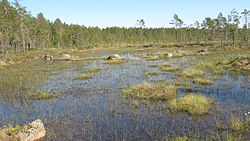
A bog or bogland is a wetland that accumulates peat as a deposit of dead plant materials – often mosses, typically sphagnum moss. It is one of the four main types of wetlands. Other names for bogs include mire, mosses, quagmire, and muskeg; alkaline mires are called fens.[clarification needed] A bayhead is another type of bog found in the forest of the Gulf Coast states in the United States. They are often covered in heath or heather shrubs rooted in the sphagnum moss and peat. The gradual accumulation of decayed plant material in a bog functions as a carbon sink.
Bogs occur where the water at the ground surface is acidic and low in nutrients. A bog usually is found at a freshwater soft spongy ground that is made up of decayed plant matter which is known as peat. They are generally found in cooler northern climates and are formed in poorly draining lake basins. In contrast to fens, they derive most of their water from precipitation rather than mineral-rich ground or surface water. Water flowing out of bogs has a characteristic brown colour, which comes from dissolved peat tannins. In general, the low fertility and cool climate result in relatively slow plant growth, but decay is even slower due to low oxygen levels in saturated bog soils. Hence, peat accumulates. Large areas of the landscape can be covered many meters deep in peat.
Bogs have distinctive assemblages of animal, fungal, and plant species, and are of high importance for biodiversity, particularly in landscapes that are otherwise settled and farmed.
Bogs are widely distributed in cold, temperate climes, mostly in boreal ecosystems in the Northern Hemisphere. The world's largest wetland is the peat bogs of the Western Siberian Lowlands in Russia, which cover more than a million square kilometres. Large peat bogs also occur in North America, particularly the Hudson Bay Lowland and the Mackenzie River Basin. They are less common in the Southern Hemisphere, with the largest being the Magellanic moorland, comprising some 44,000 square kilometres (17,000 sq mi) in southern South America. Sphagnum bogs were widespread in northern Europe but have often been cleared and drained for agriculture. A paper led by Graeme T. Swindles in 2019 showed that peatlands across Europe have undergone rapid drying in recent centuries owing to human impacts including drainage, peat cutting and burning. A 2014 expedition leaving from Itanga village, Republic of the Congo, discovered a peat bog "as big as England" which stretches into neighboring Democratic Republic of Congo.
Like all wetlands, it is difficult to rigidly define bogs for a number of reasons, including variations between bogs, the in-between nature of wetlands as an intermediate between terrestrial and aquatic ecosystems, and varying definitions between wetland classification systems. However, there are characteristics common to all bogs that provide a broad definition:
Because all bogs have peat, they are a type of peatland. As a peat-producing ecosystem, they are also classified as mires, along with fens. Bogs differ from fens, in that fens receive water and nutrients from mineral-rich surface or groundwater, while bogs receive water and nutrients from precipitation. Because fens are supplied with mineral-rich water, they tend to range from slightly acidic to slightly basic, while bogs are always acidic because precipitation lacks the dissolved minerals (e.g. calcium, magnesium, carbonate) that act to buffer the natural acidity of atmospheric carbon dioxide. Geography and geology both impact the hydrology: as groundwater mineral content reflects the bedrock geology, there can be great deal of variability in some common ions (e.g. manganese, iron) while proximity to coastal areas is associated with higher sulfate and sodium concentrations.
There are many highly specialized animals, fungi, and plants associated with bog habitat. Most are capable of tolerating the combination of low nutrient levels and waterlogging. Sphagnum is generally abundant, along with ericaceous shrubs. The shrubs are often evergreen, which may assist in conservation of nutrients. In drier locations, evergreen trees can occur, in which case the bog blends into the surrounding expanses of boreal evergreen forest. Sedges are one of the more common herbaceous species. Carnivorous plants such as sundews (Drosera) and pitcher plants (for example Sarracenia purpurea) have adapted to the low-nutrient conditions by using invertebrates as a nutrient source. Orchids have adapted to these conditions through the use of mycorrhizal fungi to extract nutrients. Some shrubs such as Myrica gale (bog myrtle) have root nodules in which nitrogen fixation occurs, thereby providing another supplemental source of nitrogen.
Bogs are recognized as a significant/specific habitat type by a number of governmental and conservation agencies. They can provide habitat for mammals, such as caribou, moose, and beavers, as well as for species of nesting shorebirds, such as Siberian cranes and yellowlegs. Bogs contain species of vulnerable reptilians such as the bog turtle. Bogs even have distinctive insects; English bogs give a home to a yellow fly called the hairy canary fly (Phaonia jaroschewskii), and bogs in North America are habitat for a butterfly called the bog copper (Lycaena epixanthe). In Ireland, the viviparous lizard, the only known reptile in the country, dwells in bogland.
Bog
A bog or bogland is a wetland that accumulates peat as a deposit of dead plant materials – often mosses, typically sphagnum moss. It is one of the four main types of wetlands. Other names for bogs include mire, mosses, quagmire, and muskeg; alkaline mires are called fens.[clarification needed] A bayhead is another type of bog found in the forest of the Gulf Coast states in the United States. They are often covered in heath or heather shrubs rooted in the sphagnum moss and peat. The gradual accumulation of decayed plant material in a bog functions as a carbon sink.
Bogs occur where the water at the ground surface is acidic and low in nutrients. A bog usually is found at a freshwater soft spongy ground that is made up of decayed plant matter which is known as peat. They are generally found in cooler northern climates and are formed in poorly draining lake basins. In contrast to fens, they derive most of their water from precipitation rather than mineral-rich ground or surface water. Water flowing out of bogs has a characteristic brown colour, which comes from dissolved peat tannins. In general, the low fertility and cool climate result in relatively slow plant growth, but decay is even slower due to low oxygen levels in saturated bog soils. Hence, peat accumulates. Large areas of the landscape can be covered many meters deep in peat.
Bogs have distinctive assemblages of animal, fungal, and plant species, and are of high importance for biodiversity, particularly in landscapes that are otherwise settled and farmed.
Bogs are widely distributed in cold, temperate climes, mostly in boreal ecosystems in the Northern Hemisphere. The world's largest wetland is the peat bogs of the Western Siberian Lowlands in Russia, which cover more than a million square kilometres. Large peat bogs also occur in North America, particularly the Hudson Bay Lowland and the Mackenzie River Basin. They are less common in the Southern Hemisphere, with the largest being the Magellanic moorland, comprising some 44,000 square kilometres (17,000 sq mi) in southern South America. Sphagnum bogs were widespread in northern Europe but have often been cleared and drained for agriculture. A paper led by Graeme T. Swindles in 2019 showed that peatlands across Europe have undergone rapid drying in recent centuries owing to human impacts including drainage, peat cutting and burning. A 2014 expedition leaving from Itanga village, Republic of the Congo, discovered a peat bog "as big as England" which stretches into neighboring Democratic Republic of Congo.
Like all wetlands, it is difficult to rigidly define bogs for a number of reasons, including variations between bogs, the in-between nature of wetlands as an intermediate between terrestrial and aquatic ecosystems, and varying definitions between wetland classification systems. However, there are characteristics common to all bogs that provide a broad definition:
Because all bogs have peat, they are a type of peatland. As a peat-producing ecosystem, they are also classified as mires, along with fens. Bogs differ from fens, in that fens receive water and nutrients from mineral-rich surface or groundwater, while bogs receive water and nutrients from precipitation. Because fens are supplied with mineral-rich water, they tend to range from slightly acidic to slightly basic, while bogs are always acidic because precipitation lacks the dissolved minerals (e.g. calcium, magnesium, carbonate) that act to buffer the natural acidity of atmospheric carbon dioxide. Geography and geology both impact the hydrology: as groundwater mineral content reflects the bedrock geology, there can be great deal of variability in some common ions (e.g. manganese, iron) while proximity to coastal areas is associated with higher sulfate and sodium concentrations.
There are many highly specialized animals, fungi, and plants associated with bog habitat. Most are capable of tolerating the combination of low nutrient levels and waterlogging. Sphagnum is generally abundant, along with ericaceous shrubs. The shrubs are often evergreen, which may assist in conservation of nutrients. In drier locations, evergreen trees can occur, in which case the bog blends into the surrounding expanses of boreal evergreen forest. Sedges are one of the more common herbaceous species. Carnivorous plants such as sundews (Drosera) and pitcher plants (for example Sarracenia purpurea) have adapted to the low-nutrient conditions by using invertebrates as a nutrient source. Orchids have adapted to these conditions through the use of mycorrhizal fungi to extract nutrients. Some shrubs such as Myrica gale (bog myrtle) have root nodules in which nitrogen fixation occurs, thereby providing another supplemental source of nitrogen.
Bogs are recognized as a significant/specific habitat type by a number of governmental and conservation agencies. They can provide habitat for mammals, such as caribou, moose, and beavers, as well as for species of nesting shorebirds, such as Siberian cranes and yellowlegs. Bogs contain species of vulnerable reptilians such as the bog turtle. Bogs even have distinctive insects; English bogs give a home to a yellow fly called the hairy canary fly (Phaonia jaroschewskii), and bogs in North America are habitat for a butterfly called the bog copper (Lycaena epixanthe). In Ireland, the viviparous lizard, the only known reptile in the country, dwells in bogland.
Recent media
Recent media