


Community hub
Recent from talks
Contribute something to knowledge base
Content stats: 0 posts, 0 articles, 1 media, 0 notes
Members stats: 0 subscribers, 0 contributors, 0 moderators, 0 supporters
Subscribers
Supporters
Contributors
Moderators
Hub AI
Sphagnum AI simulator
(@Sphagnum_simulator)
Hub AI
Sphagnum AI simulator
(@Sphagnum_simulator)
Sphagnum
Sphagnum is a genus of approximately 380 accepted species of mosses, commonly known as sphagnum moss, also bog moss and quacker moss (although that term is also sometimes used for peat). Accumulations of Sphagnum can store water, since both living and dead plants can hold large quantities of water inside their cells; plants may hold 16 to 26 times as much water as their dry weight, depending on the species. The empty cells help retain water in drier conditions.
As Sphagnum moss grows, it can slowly spread into drier conditions, forming larger mires, both raised bogs and blanket bogs. Thus, Sphagnum can influence the composition of such habitats, with some describing Sphagnum as 'habitat manipulators' or 'autogenic ecosystem engineers'. These peat accumulations then provide habitat for a wide array of peatland plants, including sedges and ericaceous shrubs, as well as orchids and carnivorous plants.
Sphagnum and the peat formed from it do not decay readily because of the phenolic compounds embedded in the moss's cell walls. In addition, bogs, like all wetlands, develop anaerobic soil conditions, which produces slower anaerobic decay rather than aerobic microbial action. Peat moss can also acidify its surroundings by taking up cations, such as calcium and magnesium, and releasing hydrogen ions.
Under the right conditions, peat can accumulate to a depth of many meters. Different species of Sphagnum have different tolerance limits for flooding and pH, and any one peatland may have a number of different Sphagnum species.
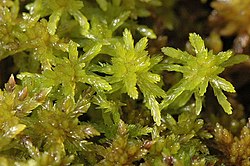
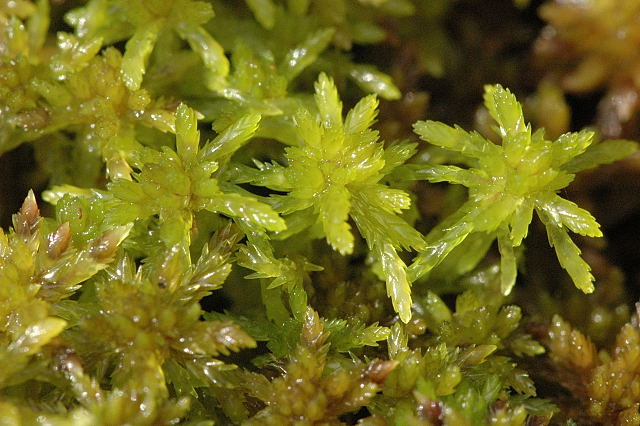
An individual Sphagnum plant consists of a main stem, with tightly arranged clusters of branch fascicles usually consisting of two or three spreading branches and two to four hanging branches. The top of the plant (capitulum) has compact clusters of young branches that give the plant its characteristic tuft-like appearance. Along the stem are scattered leaves of various shapes, named stem leaves; the shape varies according to species.
Sphagnum has a distinctive cellular structure. The stem portion consists of two important sections. The pith which is the site of food production and storage, and the cortical layer which serves to absorb water and protect the pith. Mosses have no vascular system to move water and nutrients around the plant. Thus tissues are thin and usually one cell thick to allow them to diffuse easily. Sphagnum mosses have two distinct cell types. There are small, green, living cells with chlorophyll (chlorophyllose cells) that produce food for the plant. Additionally, there are larger hyaline or retort cells that are barrel shaped and have a pore at one end to allow for water absorption and improved water-holding capacity. These unique cells help Sphagnum to retain water during prolonged UV exposure.
Sphagnum, like all other land plants, has an alternation of generations; like other bryophytes, the haploid gametophyte generation is dominant and persistent. Unlike other mosses, the long-lived gametophytes do not rely upon rhizoids to assist in water uptake.
Sphagnum species can be unisexual (male or female, dioecious) or bisexual (male and female gametes produced from the same plant; monoecious); In North America, 80% of Sphagnum species are unisexual.
Sphagnum
Sphagnum is a genus of approximately 380 accepted species of mosses, commonly known as sphagnum moss, also bog moss and quacker moss (although that term is also sometimes used for peat). Accumulations of Sphagnum can store water, since both living and dead plants can hold large quantities of water inside their cells; plants may hold 16 to 26 times as much water as their dry weight, depending on the species. The empty cells help retain water in drier conditions.
As Sphagnum moss grows, it can slowly spread into drier conditions, forming larger mires, both raised bogs and blanket bogs. Thus, Sphagnum can influence the composition of such habitats, with some describing Sphagnum as 'habitat manipulators' or 'autogenic ecosystem engineers'. These peat accumulations then provide habitat for a wide array of peatland plants, including sedges and ericaceous shrubs, as well as orchids and carnivorous plants.
Sphagnum and the peat formed from it do not decay readily because of the phenolic compounds embedded in the moss's cell walls. In addition, bogs, like all wetlands, develop anaerobic soil conditions, which produces slower anaerobic decay rather than aerobic microbial action. Peat moss can also acidify its surroundings by taking up cations, such as calcium and magnesium, and releasing hydrogen ions.
Under the right conditions, peat can accumulate to a depth of many meters. Different species of Sphagnum have different tolerance limits for flooding and pH, and any one peatland may have a number of different Sphagnum species.
An individual Sphagnum plant consists of a main stem, with tightly arranged clusters of branch fascicles usually consisting of two or three spreading branches and two to four hanging branches. The top of the plant (capitulum) has compact clusters of young branches that give the plant its characteristic tuft-like appearance. Along the stem are scattered leaves of various shapes, named stem leaves; the shape varies according to species.
Sphagnum has a distinctive cellular structure. The stem portion consists of two important sections. The pith which is the site of food production and storage, and the cortical layer which serves to absorb water and protect the pith. Mosses have no vascular system to move water and nutrients around the plant. Thus tissues are thin and usually one cell thick to allow them to diffuse easily. Sphagnum mosses have two distinct cell types. There are small, green, living cells with chlorophyll (chlorophyllose cells) that produce food for the plant. Additionally, there are larger hyaline or retort cells that are barrel shaped and have a pore at one end to allow for water absorption and improved water-holding capacity. These unique cells help Sphagnum to retain water during prolonged UV exposure.
Sphagnum, like all other land plants, has an alternation of generations; like other bryophytes, the haploid gametophyte generation is dominant and persistent. Unlike other mosses, the long-lived gametophytes do not rely upon rhizoids to assist in water uptake.
Sphagnum species can be unisexual (male or female, dioecious) or bisexual (male and female gametes produced from the same plant; monoecious); In North America, 80% of Sphagnum species are unisexual.
Recent media
Recent media