Hubbry Logo
Root noduleRoot noduleMain
Open search
Root nodule
Community hub
Root nodule
logo
8 pages, 0 posts
0 subscribers
Be the first to start a discussion here.
Root nodule
Root nodule
from Wikipedia
A simplified diagram of the relation between the plant and the symbiotic bacteria (cyan) in the root nodules

Root nodules are found on the roots of plants, primarily legumes, that form a symbiosis with nitrogen-fixing bacteria.[1] Under nitrogen-limiting conditions, capable plants form a symbiotic relationship with a host-specific strain of bacteria known as rhizobia.[2] This process has evolved multiple times within the legumes, as well as in other species found within the Rosid clade.[3] Legume crops include beans, peas, and soybeans.

Within legume root nodules, nitrogen gas (N2) from the atmosphere is converted into ammonia (NH3), which is then assimilated into amino acids (the building blocks of proteins), nucleotides (the building blocks of DNA and RNA as well as the important energy molecule ATP), and other cellular constituents such as vitamins, flavones, and hormones.[citation needed] Their ability to fix gaseous nitrogen makes legumes an ideal agricultural organism as their requirement for nitrogen fertilizer is reduced. Indeed, high nitrogen content blocks nodule development as there is no benefit for the plant of forming the symbiosis. The energy for splitting the nitrogen gas in the nodule comes from sugar that is translocated from the leaf (a product of photosynthesis). Malate as a breakdown product of sucrose is the direct carbon source for the bacteroid. Nitrogen fixation in the nodule is very oxygen sensitive. Legume nodules harbor an iron containing protein called leghaemoglobin, closely related to animal myoglobin, to facilitate the diffusion of oxygen gas used in respiration.

Symbiosis

[edit]
Nitrogen is the most commonly limiting nutrient in plants. Legumes use nitrogen fixing bacteria, specifically symbiotic rhizobia bacteria, within their root nodules to counter the limitation. Rhizobia bacteria convert nitrogen gas (N2) to ammonia (NH3) in a process called nitrogen fixation. Ammonia is then assimilated into nucleotides, amino acids, vitamins and flavones which are essential to the growth of the plant. The plant root cells convert sugar into organic acids which then supply to the rhizobia in exchange, hence a symbiotic relationship between rhizobia and the legumes.

Leguminous family

[edit]

Plants that contribute to N2 fixation include the legume family – Fabaceae – with taxa such as kudzu, clovers, soybeans, alfalfa, lupines, peanuts, and rooibos. They contain symbiotic bacteria called rhizobia within the nodules, producing nitrogen compounds that help the plant to grow and compete with other plants. When the plant dies, the fixed nitrogen is released, making it available to other plants, and this helps to fertilize the soil.[4][5] The great majority of legumes have this association, but a few genera (e.g., Styphnolobium) do not. In many traditional farming practices, fields are rotated through various types of crops, which usually includes one consisting mainly or entirely of a leguminous crop such as clover, in order to take advantage of this.[citation needed]

Non-leguminous

[edit]

Although by far the majority of plants able to form nitrogen-fixing root nodules are in the legume family Fabaceae, there are a few exceptions:

  • Actinorhizal plants such as alder and bayberry can form (less complex) nitrogen-fixing nodules, thanks to a symbiotic association with Frankia bacteria. These plants belong to 25 genera distributed among 8 plant families.[6] According to a count in 1998, it includes about 200 species and accounts for roughly the same amount of nitrogen fixation as rhizobial symbioses. An important structural difference is that in these symbioses the bacteria are never released from the infection thread.[7]
  • Parasponia, a tropical genus in the Cannabaceae is also able to interact with rhizobia and form nitrogen-fixing nodules. As related plants are actinorhizal, it is believed that the plant "switched partner" in its evolution.[8]

The ability to fix nitrogen is far from universally present in these families. For instance, of 122 genera in the Rosaceae, only 4 genera are capable of fixing nitrogen. All these families belong to the orders Cucurbitales, Fagales, and Rosales, which together with the Fabales form a nitrogen-fixing clade (NFC) of eurosids. In this clade, Fabales were the first lineage to branch off; thus, the ability to fix nitrogen may be plesiomorphic and subsequently lost in most descendants of the original nitrogen-fixing plant; however, it may be that the basic genetic and physiological requirements were present in an incipient state in the last common ancestors of all these plants, but only evolved to full function in some of them:[citation needed]

Family: Genera

Betulaceae: Alnus (alders)

Cannabaceae: Trema

Casuarinaceae:

Allocasuarina
Casuarina
Ceuthostoma
Gymnostoma

......


Coriariaceae: Coriaria

Datiscaceae: Datisca

Elaeagnaceae:

Elaeagnus (silverberries)
Hippophae (sea-buckthorns)
Shepherdia (buffaloberries)

......


Myricaceae:

Comptonia (sweetfern)
Morella
Myrica (bayberries)

......


Rhamnaceae:

Ceanothus
Colletia
Discaria
Kentrothamnus
Retanilla
Talguenea
Trevoa

......


Rosaceae:

Cercocarpus (mountain mahoganies)
Chamaebatia (mountain miseries)
Dryas
Purshia/Cowania (bitterbrushes/cliffroses)

Classification

[edit]
Indeterminate nodules growing on the roots of Medicago italica

Two main types of nodule have been described in legumes: determinate and indeterminate.[9]

Determinate nodules are found on certain tribes of tropical legume such as those of the genera Glycine (soybean), Phaseolus (common bean), and Vigna. and on some temperate legumes such as Lotus. These determinate nodules lose meristematic activity shortly after initiation, thus growth is due to cell expansion resulting in mature nodules which are spherical in shape. Another type of determinate nodule is found in a wide range of herbs, shrubs and trees, such as Arachis (peanut). These are always associated with the axils of lateral or adventitious roots and are formed following infection via cracks where these roots emerge and not using root hairs. Their internal structure is quite different from those of the soybean type of nodule.[10]

Indeterminate nodules are found in the majority of legumes from all three sub-families, whether in temperate regions or in the tropics. They can be seen in Faboideae legumes such as Pisum (pea), Medicago (alfalfa), Trifolium (clover), and Vicia (vetch) and all mimosoid legumes such as acacias, the few nodulated caesalpinioid legumes such as partridge pea. They earned the name "indeterminate" because they maintain an active apical meristem that produces new cells for growth over the life of the nodule. This results in the nodule having a generally cylindrical shape, which may be extensively branched.[10] Because they are actively growing, indeterminate nodules manifest zones which demarcate different stages of development/symbiosis:[11][12][13]

Diagram illustrating the different zones of an indeterminate root nodule (see text).
  • Zone I—the active meristem. This is where new nodule tissue is formed which will later differentiate into the other zones of the nodule.
  • Zone II—the infection zone. This zone is permeated with infection threads full of bacteria. The plant cells are larger than in the previous zone and cell division is halted.
    • Interzone II–III—Here the bacteria have entered the plant cells, which contain amyloplasts. They elongate and begin terminally differentiating into symbiotic, nitrogen-fixing bacteroids.
  • Zone III—the nitrogen fixation zone. Each cell in this zone contains a large, central vacuole and the cytoplasm is filled with fully differentiated bacteroids which are actively fixing nitrogen. The plant provides these cells with leghemoglobin, resulting in a distinct pink color.
  • Zone IV—the senescent zone. Here plant cells and their bacteroid contents are being degraded. The breakdown of the heme component of leghemoglobin results in a visible greening at the base of the nodule.

This is the most widely studied type of nodule, but the details are quite different in nodules of peanut and relatives and some other important crops such as lupins where the nodule is formed following direct infection of rhizobia through the epidermis and where infection threads are never formed. Nodules grow around the root, forming a collar-like structure. In these nodules and in the peanut type the central infected tissue is uniform, lacking the uninfected ells seen in nodules of soybean and many indeterminate types such as peas and clovers.[citation needed]

Alder tree root nodule
Sectioned alder root nodule
Sectioned
Whole alder root nodule
Whole

Actinorhizal-type nodules are markedly different structures found in non-legumes. In this type, cells derived from the root cortex form the infected tissue, and the prenodule becomes part of the mature nodule. Despite this seemingly major difference, it is possible to produce such nodules in legumes by a single homeotic mutation.[14]

Nodulation

[edit]
Cross section through a soybean root nodule. The bacterium, Bradyrhizobium japonicum, colonizes the roots and establishes a nitrogen fixing symbiosis. This high magnification image shows part of a cell with single bacteroids within their symbiosomes. In this image, endoplasmic reticulum, dictysome and cell wall can be seen.
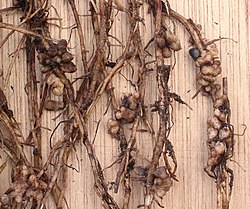
Nitrogen-fixing nodules on a clover root.

Legumes release organic compounds as secondary metabolites called flavonoids from their roots, which attract the rhizobia to them and which also activate nod genes in the bacteria to produce nod factors and initiate nodule formation.[15][16] These nod factors initiate root hair curling. The curling begins with the very tip of the root hair curling around the Rhizobium. Within the root tip, a small tube called the infection thread forms, which provides a pathway for the Rhizobium to travel into the root epidermal cells as the root hair continues to curl.[17]

Partial curling can even be achieved by nod factor alone.[16] This was demonstrated by the isolation of nod factors and their application to parts of the root hair. The root hairs curled in the direction of the application, demonstrating the action of a root hair attempting to curl around a bacterium. Even application on lateral roots caused curling. This demonstrated that it is the nod factor itself, not the bacterium that causes the stimulation of the curling.[16]

When the nod factor is sensed by the root, a number of biochemical and morphological changes happen: cell division is triggered in the root to create the nodule, and the root hair growth is redirected to curl around the bacteria multiple times until it fully encapsulates one or more bacteria. The bacteria encapsulated divide multiple times, forming a microcolony. From this microcolony, the bacteria enter the developing nodule through the infection thread, which grows through the root hair into the basal part of the epidermis cell, and onwards into the root cortex; they are then surrounded by a plant-derived symbiosome membrane and differentiate into bacteroids that fix nitrogen.[18]

Effective nodulation takes place approximately four weeks after crop planting, with the size, and shape of the nodules dependent on the crop. Crops such as soybeans, or peanuts will have larger nodules than forage legumes such as red clover, or alfalfa, since their nitrogen needs are higher. The number of nodules, and their internal color, will indicate the status of nitrogen fixation in the plant.[19]

Nodulation is controlled by a variety of processes, both external (heat, acidic soils, drought, nitrate) and internal (autoregulation of nodulation, ethylene). Autoregulation of nodulation[20] controls nodule numbers per plant through a systemic process involving the leaf. Leaf tissue senses the early nodulation events in the root through an unknown chemical signal, then restricts further nodule development in newly developing root tissue. The Leucine rich repeat (LRR) receptor kinases (NARK in soybean (Glycine max); HAR1 in Lotus japonicus, SUNN in Medicago truncatula) are essential for autoregulation of nodulation (AON). Mutation leading to loss of function in these AON receptor kinases leads to supernodulation or hypernodulation. Often root growth abnormalities accompany the loss of AON receptor kinase activity, suggesting that nodule growth and root development are functionally linked. Investigations into the mechanisms of nodule formation showed that the ENOD40 gene, coding for a 12–13 amino acid protein [41], is up-regulated during nodule formation [3].

Connection to root structure

[edit]

Root nodules apparently have evolved three times within the Fabaceae but are rare outside that family. The propensity of these plants to develop root nodules seems to relate to their root structure. In particular, a tendency to develop lateral roots in response to abscisic acid may enable the later evolution of root nodules.[21]

Nodule-like structures

[edit]

Some fungi produce nodular structures known as tuberculate ectomycorrhizae on the roots of their plant hosts. Suillus tomentosus, for example, produces these structures with its plant host lodgepole pine (Pinus contorta var. latifolia). These structures have, in turn, been shown to host nitrogen fixing bacteria, which contribute a significant amount of nitrogen and allow the pines to colonize nutrient-poor sites.[22]

[edit]

See also

[edit]

References

[edit]
[edit]
Revisions and contributorsEdit on WikipediaRead on Wikipedia
from Grokipedia
Root nodules are specialized, microscopic structures that develop on the roots of leguminous plants and certain other species through a mutualistic with nitrogen-fixing , primarily from the family Rhizobiaceae. These nodules serve as sites for biological , where the convert atmospheric dinitrogen (N₂) into bioavailable ammonia (NH₃) using the enzyme , providing the plant with essential nitrogen for growth while receiving carbohydrates from the host in return. The formation of root nodules, or nodulation, is initiated by a molecular dialogue between the plant and . Plant exude that trigger bacterial synthesis of lipochitooligosaccharide signals known as Nod factors, which are recognized by plant LysM receptor-like kinases, leading to curling, cortical , and bacterial entry through infection threads into root cells. Within the nodule, differentiate into nitrogen-fixing bacteroids enclosed in membrane-bound compartments called symbiosomes, and the nodules develop vascular connections to transport fixed throughout the plant. Active nodules typically appear pink or red due to , a plant-produced oxygen carrier that protects the oxygen-sensitive enzyme while regulating oxygen levels. Root nodules exhibit morphological diversity, with determinate nodules forming spherical shapes in plants like soybeans through equal meristematic activity, and indeterminate nodules developing elongated, finger-like structures in species such as via persistent apical meristems. This , which evolved approximately 110 million years ago in the order and convergently in other lineages like and , supports inputs of 25–75 pounds per acre in natural ecosystems and up to 250–500 pounds per acre in agricultural settings, significantly enhancing and reducing reliance on synthetic fertilizers. Inefficient or inactive nodules may appear green, white, or grey, indicating halted fixation often due to environmental stresses like nutrient deficiencies or suboptimal .

Definition and Overview

Structure and Function

Root nodules are specialized organs that develop on the roots of certain through symbiotic interactions with diazotrophic or actinomycetes, primarily functioning to house and support nitrogen-fixing microorganisms. These structures form as visible swellings on the , often appearing spherical or elongated depending on the host and symbiont, with typical sizes ranging from 1 mm to 2–3 cm in diameter. Active nodules exhibit a characteristic or coloration, attributed to , a heme-containing protein that binds oxygen to regulate its availability within the nodule while preventing inactivation of the oxygen-sensitive . The primary function of root nodules is to facilitate the biological fixation of atmospheric dinitrogen (N₂) into (NH₃), a bioavailable form of nitrogen that the host can assimilate for growth and metabolism, particularly in nitrogen-poor soils. This process occurs within the nodule's infected cells, where the symbionts are enclosed in membrane-bound compartments called symbiosomes, optimizing the microaerobic environment required for activity. This symbiosis represents a mutualistic exchange: the plant provides the microbes with energy-rich carbon compounds derived from photosynthesis, while the nitrogen-fixing symbionts deliver fixed nitrogen to the plant, ultimately contributing to improved through organic matter incorporation. Common symbiotic partners include bacteria in , with actinomycetes such as in certain non-legume trees, as detailed in subsequent sections on symbiotic relationships.

Ecological and Agricultural Significance

Root nodules play a pivotal role in the global by facilitating biological , which converts atmospheric dinitrogen into bioavailable forms, thereby preventing nutrient depletion in diverse . In natural settings such as forests and grasslands, symbiotic associations involving root nodules—particularly with in grasslands and actinorhizal in forests—contribute substantial amounts of fixed , supporting productivity and microbial diversity while maintaining long-term . For instance, actinorhizal , which form nodules with bacteria, act as in nutrient-poor or disturbed , enhancing inputs and aiding restoration by mitigating fertility loss. This process is especially critical in preventing depletion in marginal environments like boreal forests and arid grasslands, where external sources are limited. The discovery of the link between root nodules and nitrogen fixation is attributed to Martinus Beijerinck, who in 1888 isolated the bacterium Bacillus radicicola (now Rhizobium) from legume root nodules, establishing the foundation for understanding symbiotic nitrogen fixation and paving the way for modern agricultural inoculant practices that introduce effective rhizobia to crops. In agriculture, root nodules significantly reduce reliance on synthetic fertilizers; for example, incorporating soybeans into crop rotations can provide residual nitrogen credits of 50-100 kg N/ha to subsequent crops like maize, enhancing soil health and promoting sustainable rotation systems with legumes. Globally, symbiotic fixation via root nodules supplies 50-90% of the nitrogen requirements for legume crops, with fixation rates often ranging from 50 to 300 kg N/ha/year depending on species and conditions, underscoring their efficiency in nitrogen provisioning. These mechanisms hold particular promise for in developing regions, where access to affordable synthetic s is limited, as legume-based systems with root nodules can boost crop yields and without heavy external inputs, supporting smallholder farming and reducing risks in nitrogen-deficient soils. By integrating such practices, agricultural systems in these areas can achieve greater , aligning with broader goals of reducing dependency and environmental impacts from nitrogen runoff.

Symbiotic Relationships

With Legumes

The symbiotic relationship between root nodules and legumes primarily involves bacteria from the genera Rhizobium and Bradyrhizobium, which form mutualistic associations with plants in the Fabaceae family, such as soybeans (Glycine max), alfalfa (Medicago sativa), and peas (Pisum sativum). These rhizobia infect legume roots, leading to the development of nodules that serve as specialized sites for biological nitrogen fixation. This interaction is highly specific, with over 90% of the approximately 19,000 legume species capable of forming such nodules. In crop legumes like the common bean (Phaseolus vulgaris) and forage species like alfalfa, infection typically occurs through root hairs, where bacteria enter via infection threads that guide them into cortical cells. In this mutualism, supply with energy-rich compounds, primarily sugars derived from , along with essential nutrients, enabling bacterial survival and activity within the nodule environment. In return, the bacteroids—differentiated forms of housed in plant-derived membranes called symbiosomes—convert atmospheric dinitrogen (N₂) into through activity, providing the plant with a bioavailable source that supports growth without synthetic fertilizers. Under optimal field conditions, this process can fix 100–300 kg of per annually, significantly enhancing and crop productivity in legume-based systems. The specificity of this symbiosis is governed by a molecular dialogue initiated by exuded from roots, which are perceived by the bacterial NodD protein, triggering the expression of nodulation (nod) genes responsible for synthesizing Nod factors—lipochitooligosaccharide signals that induce root hair curling and cortical for nodule . This host-symbiont recognition ensures compatibility, restricting effective nodulation to matched pairs and preventing unproductive infections, thereby optimizing resource allocation in diverse soil microbiomes.

With Non-Legumes

Root nodules in non-legume plants represent a distinct form of symbiotic , primarily occurring in actinorhizal species and the unique case of Parasponia. Actinorhizal plants, belonging to approximately 200 species across eight families such as (e.g., Alnus spp.) and (e.g., spp.), form mutualistic associations with the actinomycete genus , enabling these plants to thrive in nutrient-deficient soils. In contrast, the non-legume genus Parasponia in the family engages in nodulation with rhizobial bacteria similar to those in , but through an independently evolved pathway. These symbioses differ from legume systems by involving actinomycetes or broader bacterial compatibility, allowing adaptation to diverse environmental stresses. Nodules in actinorhizal plants are typically larger and more branched than those in legumes, often developing on lateral roots rather than primary ones, which facilitates extensive colonization in poor soils. For instance, Alnus nodules can reach several centimeters in length and exhibit a coralloid structure due to repeated branching, housing Frankia hyphae within modified cortical cells. In nitrogen-poor environments such as coastal dunes or post-fire landscapes, these nodules support nitrogen fixation rates of up to 150 kg N ha⁻¹ year⁻¹, contributing significantly to plant growth and soil fertility recovery. Parasponia nodules, while smaller and less branched, similarly form on lateral roots and achieve comparable fixation efficiency through rhizobial infection. A key uniqueness of non-legume nodules lies in their infection mechanisms and microbial accommodations. In actinorhizal systems, often penetrates roots intercellularly or via deformed root hairs, leading to intracellular housing where bacteria differentiate into nitrogen-fixing vesicles—specialized, thick-walled structures that protect from oxygen. These vesicles enable efficient fixation in aerobic nodule environments, a feature less common in legume rhizobial symbioses. Parasponia exhibits a broader host range for , accepting diverse strains beyond legume-specific ones, which underscores its evolutionary convergence with while maintaining non-legume traits. Overall, these associations occur in about 200 non-legume species across eight families, expanding beyond the . Ecologically, non-legume root nodules play crucial roles as pioneer mechanisms in harsh habitats. Actinorhizal plants like Alnus dominate boreal forests and glacial till sites, where they enrich soils with fixed to facilitate succession by other . Similarly, species stabilize tropical dunes and support systems by improving soil in eroded or sandy areas. Parasponia contributes to forest understories in , enhancing availability in low-fertility tropical soils. These symbioses thus promote resilience in nitrogen-limited, disturbed environments worldwide.

Classification

Determinate Nodules

Determinate nodules are characterized by a transient that ceases activity early in development, resulting in spherical or coral-like structures with uniform size, typically ranging from 1 to 5 mm in . Unlike other nodule types, they exhibit no persistent apical , leading to a lack of longitudinal growth and an absence of distinct developmental zones, where all infected cells reach similar maturation stages synchronously. This morphology arises primarily from initial cell divisions in the middle or outer root cortex, followed by cell enlargement rather than continued proliferation. These nodules form in various legumes, such as Glycine max (soybean), Phaseolus vulgaris (common bean), and Lotus japonicus. In these host plants, nodule primordia develop through synchronous divisions in cortical cells, initiated by rhizobial signals, with infection typically occurring via root hairs that form threads guiding bacterial entry into host cells. The absence of a persistent meristem limits ongoing growth, producing compact nodules suited to the growth habits of these species. Development of determinate nodules concludes with after approximately 10 to 12 weeks, marked by radial progression from the central zone outward, during which declines as early as 3 to 5 weeks post-inoculation. This lifespan contrasts with longer-lived nodule types but enables rapid formation, which is advantageous for short-season crops like that require quick establishment of nitrogen-fixing in time-limited growing periods.

Indeterminate Nodules

Indeterminate nodules are cylindrical or branched structures formed on the roots of certain , distinguished by their possession of a persistent apical that facilitates continuous, indefinite growth throughout the nodule's lifespan. This drives the development of distinct longitudinal zones within the nodule, including a distal zone (rhizobia-free), an infection zone where bacterial entry and initial differentiation occur, a nitrogen fixation zone with mature bacteroids, and a proximal senescence zone where symbiotic activity declines. Unlike other nodule types, this zoned architecture allows for ongoing tissue production and spatial separation of symbiotic processes. These nodules are primarily hosted by temperate legumes in the Faboideae subfamily, such as Pisum sativum (pea) and Medicago truncatula. In these species, the nodules develop in cooler climates and are adapted to perennial or annual growth cycles typical of temperate regions. The development of indeterminate nodules begins with bacterial infection at the root surface, leading to the establishment of a nodule meristem that persists and promotes elongation. This continuous meristematic activity enables the nodule to grow longitudinally, often reaching lengths of several centimeters as new cells are added apically while older tissues senesce basally. The nodule's lifespan is closely linked to the host plant's overall growth phase and environmental conditions, typically ranging from 10 to 12 weeks in fast-growing herbaceous legumes under non-stressful conditions. Due to their prolonged activity and persistent , indeterminate nodules offer a higher potential for sustained output over time, as the fixation zone remains active longer than in nodules without indefinite growth. However, this ongoing development imposes a greater energy demand on the host , requiring substantial allocation of photosynthates to support continuous , bacteroid maintenance, and processes.

Formation and Development

Infection Process

The infection process in root nodule formation begins with chemical signaling between legume roots and rhizobial . Roots exude , such as or naringenin, which are perceived by the bacterial NodD protein, activating transcription of nod genes that direct the synthesis of Nod factors—lipochitooligosaccharides consisting of a backbone with acyl and sometimes host-specific substituents. These Nod factors, in turn, bind to LysM receptor kinases on the plant's surface, initiating symbiotic responses including the deformation and curling of root hairs to entrap bacteria, typically within 6–12 hours of exposure.00290-3) Following root hair curling, compatible induce the formation of an infection thread, a tubular of the plasma membrane lined with plant-derived matrix material that encapsulates the . The multiply within this , which elongates through successive cortical cell layers toward the inner cortex via tip-focused growth, allowing controlled entry without breaching cell walls; this progression relies on bacterial type III secretion systems to suppress plant defenses and facilitate cell traversal. The plant host responds to Nod factors with rapid intracellular changes, including calcium influx followed by sustained oscillations (spiking) in the root hair nucleus and , which decode the signal via calcium- and calmodulin-dependent (CCaMK) to activate downstream . This leads to the upregulation of early nodulin (ENOD) genes, such as ENOD11 and ENOD40, which encode proteins that accommodate bacterial entry and prepare cortical cells for infection thread passage, with these responses unfolding over 1–3 days post-signaling. Host specificity in the infection process is enforced by structural variations in Nod factors that match plant receptors, preventing incompatible strains from progressing beyond initial attachment; for instance, Sinorhizobium meliloti produces sulfated Nod factors tailored for (), enabling efficient infection while excluding mismatched rhizobia like Rhizobium leguminosarum.00290-3)

and Maturation

Following bacterial entry via infection threads, cortical cells surrounding the infection site undergo , re-entering the to form a meristem-like tissue that initiates the within 3-7 days post-inoculation. This process involves reactivation of division in differentiated cortical cells, driven by symbiotic signals that reprogram quiescent tissues into proliferative states, leading to the outgrowth of the from the inner cortex. As the expands, maturation proceeds through distinct stages, including the differentiation of endosymbiotic bacteria into enlarged bacteroids capable of and the development of vascular strands that integrate the nodule with the host root's . Bacteroid differentiation occurs as within plant cells enlarge and terminally differentiate under host control, typically in the central zone, while vascular bundles—comprising , , and associated tissues—form to facilitate exchange, with full nodule maturity achieved in 2-4 weeks post-inoculation. Hormonal regulation is critical throughout organogenesis and maturation, with auxins and cytokinins promoting , primordium growth, and vascular patterning.00156-6) Auxins, transported via PIN proteins, drive polar growth and maintenance, while cytokinins activate transcription factors like NODULE INCEPTION to coordinate tissue differentiation.00156-6)31165-0) Autoregulation prevents excessive nodulation through CLE peptides, which are root-derived signals that induce shoot cytokinin production via receptors like HAR1, systemically limiting primordium initiation. The overall timeline for nodule development spans approximately 14-28 days from planting to functional maturity, varying by host type; determinate nodules in species like mature more rapidly due to early meristem exhaustion after initial divisions, compared to the persistent meristematic growth in indeterminate nodules of plants like .

Anatomy and Physiology

Internal Zonation

Root nodules exhibit a compartmentalized internal structure that facilitates their symbiotic functions, with zonation most pronounced in indeterminate nodules formed by many such as peas and . These nodules are elongated and cylindrical, featuring distinct longitudinal zones that reflect progressive stages of development and activity. The apical distal , or Zone I, consists of actively dividing cells that drive longitudinal nodule growth, maintaining its indeterminate nature throughout the plant's life. Adjacent to this is the infection zone, or Zone II, where infection threads penetrate plant cells, releasing that initiate into host cells. The central nitrogen-fixing zone, or Zone III, contains enlarged infected cells filled with symbiosomes—organelle-like structures enclosing differentiated bacteroids within a plant-derived peribacteroid —where atmospheric is reduced to . These infected cells significantly enlarge and become packed with symbiosomes, while interspersed uninfected cells provide and metabolic contributions. , an oxygen-binding protein, is predominantly distributed in the cytoplasm of these infected cells in Zone III, facilitating oxygen delivery to bacteroids while limiting free oxygen to protect the oxygen-sensitive enzyme. Proximal to this is the senescence zone, or Zone IV, where infected cells degrade, symbiosomes break down, and nutrients are recycled, marking the end of nodule productivity. In contrast, determinate nodules, typical in soybeans and other tropical , display less distinct zonation due to the absence of a persistent , resulting in a more spherical shape with all infected cells developing more synchronously. Here, infection and occur in a central zone where processes are intermixed, with symbiosomes forming throughout the infected without clear spatial separation into invasion and fixation subregions. Infected cells still enlarge and host symbiosomes, supported by uninfected cells, but the overall architecture lacks the longitudinal gradients seen in indeterminate types, leading to more uniform starting from the center. In non-legume actinorhizal nodules formed with , such as those on trees, the internal zonation mirrors indeterminate nodules in having a meristematic tip, infection region, fixation zone with hypertrophied infected cells containing Frankia hyphae and vesicles, and a senescence zone. reveals electron-dense vesicles in the fixation zone, which are specialized structures housing and exhibiting septa and laminae for protection under varying oxygen conditions. These vesicles differentiate terminally from hyphae within host cells, analogous to bacteroids but adapted to the actinobacterial symbiont.

Vascular Integration with Roots

The vascular system of root nodules develops from the base of the nodule, where and strands form and connect directly to the host 's , enabling bidirectional between the nodule and the . These strands originate from the pericycle opposite the protoxylem pole, forming a nodule vascular trace (NVT) that integrates with the 's vascular cylinder to facilitate the influx of photosynthates, primarily , from the to supply energy for within the nodule. In return, fixed nitrogen compounds, such as converted to ureides or amides, are exported from the nodule via the to the aerial parts of the . This integration exhibits a distinct polarity that ensures efficient resource exchange, with photosynthates flowing inward through the and fixed outward through the , a process regulated by transport proteins like PIN2 that direct vascular differentiation. Disruptions in this polarity, such as impaired phloem loading or xylem unloading, can lead to reduced delivery and subsequent nodule abortion, as seen in mutants with altered vascular signaling. Anatomically, the nodule's vascular tissue is enveloped by a continuous endodermal layer derived from the root's endodermis, which includes modifications to the Casparian strip that restrict apoplastic leakage and promote symplastic transport of solutes across the vascular boundary. This endodermal sheath, comprising both cortical and vascular endodermis, maintains barrier integrity while allowing selective nutrient passage, preventing uncontrolled diffusion of fixed nitrogen back into the soil. In indeterminate nodules, vascular integration is more complex due to the persistent apical meristem driving longitudinal elongation, resulting in an extended network of vascular bundles that radiate from the central NVT and adapt dynamically to nodule growth. Determinate nodules, by contrast, feature a simpler, spherical vascular arrangement with less elongation, reflecting their globular development without sustained meristematic activity.

Nitrogen Fixation

Biochemical Mechanism

The biochemical mechanism of nitrogen fixation in root nodules centers on the enzyme complex, which catalyzes the reduction of atmospheric dinitrogen (N₂) to (NH₃). This complex consists of two main metalloproteins: the molybdenum-iron (MoFe) protein, encoded by the nifD and nifK genes (collectively NifDK), which serves as the site of N₂ binding and reduction, and the iron (Fe) protein, encoded by nifH, which acts as the to the MoFe protein. The overall reaction is highly energy-demanding, requiring the transfer of eight electrons and eight protons, along with the of 16 ATP molecules per N₂ molecule reduced: N2+8H++8e+16ATP2NH3+H2+16ADP+16Pi\mathrm{N_2 + 8H^+ + 8e^- + 16ATP \rightarrow 2NH_3 + H_2 + 16ADP + 16P_i} This process occurs exclusively within the bacteroids, the differentiated form of rhizobial , and produces (H₂) as an obligate byproduct due to the enzyme's mechanism. The nitrogenase reaction takes place in the specialized known as the symbiosome, where bacteroids are enclosed by a plant-derived peribacteroid that regulates exchange and maintains a microoxic environment essential for the oxygen-sensitive . Leghemoglobin, a plant-synthesized abundant in the nodule (reaching millimolar concentrations), facilitates oxygen delivery to support bacteroid respiration while buffering free oxygen levels to 10-50 nM, thereby protecting from inactivation. This low-oxygen regime (approximately 10-40 nM in various species) ensures efficient ATP production via bacteroid without compromising the enzyme's activity. The ammonia generated by nitrogenase diffuses from the bacteroids into the plant cytosol, where it is rapidly assimilated to prevent toxicity via the glutamine synthetase/glutamate synthase (GS/GOGAT) cycle. In this pathway, glutamine synthetase (GS) catalyzes the ATP-dependent amidation of glutamate with ammonium to form glutamine (Glu + NH₄⁺ + ATP → Gln + ADP + Pᵢ), while glutamate synthase (GOGAT), typically the ferredoxin- or NADH-dependent isoform in nodules, reduces glutamine with α-ketoglutarate to produce two molecules of glutamate (Gln + α-KG + 2Fd(red) → 2Glu + 2Fd(ox) or equivalent with NADH). The resulting glutamine and glutamate serve as primary nitrogen transport forms, exported from the nodule to the host plant for further metabolism into amino acids, proteins, and other compounds. This assimilation is predominantly plant-mediated in the nodule cytosol, with GS isoforms (especially cytosolic GS1) upregulated to handle the high ammonia flux from fixation. The demands of this mechanism are substantial, as nodules can consume 10-20% of the host 's total photosynthates, primarily in the form of dicarboxylic acids like malate, which fuel bacteroid respiration to generate the required ATP and reducing equivalents. Additionally, H₂ evolution represents an inefficiency, as it accounts for at least 25% of the electrons transferred by in many systems; however, some rhizobial strains possess an uptake that recycles this H₂, recovering and improving fixation efficiency by up to 30% in compatible symbioses. These costs underscore the symbiotic , where the invests significant carbon resources to acquire fixed .

Regulation and Environmental Influences

The autoregulation of nodulation (AON) pathway in employs shoot-root signaling to restrict nodule organ number and maintain symbiotic efficiency in response to the plant's status. Root-derived CLE peptides, such as MtCLE12 and MtCLE13 in , are induced upon rhizobial infection and translocated to the shoot, where they are perceived by receptor kinases like (a NARK homolog). This perception triggers a signal that returns to the root, downregulating nodulation genes such as NFP (encoding the perception receptor) and upregulating inhibitors like TML1/TML2, thereby limiting excessive nodule formation when availability is sufficient. In -limited conditions, this mechanism ensures to a optimal number of nodules, preventing energy waste on superfluous symbioses. Environmental factors profoundly influence nodule performance and nitrogen fixation efficiency. Optimal conditions include of 6.0-7.0, which supports rhizobial survival and nodulation, while temperatures of 20-30°C maximize fixation rates in crops like and common bean; deviations, such as below 5.5 or temperatures exceeding 35°C, impair symbiont activity and reduce nodulation. at 50-70% of is ideal for nodule development and function, but stress can decrease fixation by 50-80% through reduced nodule permeability and nitrogenase activity, as observed in and under water deficits. These stressors highlight the need for adaptive management to sustain symbiotic productivity. Oxygen regulation within nodules balances respiratory demands with nitrogenase protection, primarily through a variable diffusion barrier and . The cortical diffusion barrier, formed by thickened cell walls in uninfected cells, restricts O₂ influx to maintain free O₂ concentrations at 20-50 nM in the infected zone, preventing inactivation while facilitating ATP production; this barrier adjusts dynamically via physiological signals like increased respiration under stress. facilitates of O₂ to bacteroids, binding it reversibly to sustain respiration rates without excess exposure to . High levels further inhibit nodulation by activating NIN transcription factors, which interact with NIN-like proteins (NLPs) to repress symbiotic genes and promote assimilation pathways. Nitrogen fixation efficiency, measured as specific activity (nmol N fixed per hour per gram nodule fresh weight), varies by symbiont and conditions, typically ranging from 5,000-10,000 nmol N h⁻¹ g⁻¹ in well-nodulated legumes. Symbioses with Bradyrhizobium spp., such as in soybean, often exhibit higher efficiency (up to 7,000-8,000 nmol N h⁻¹ g⁻¹) due to enhanced bacteroid differentiation and hydrogenase activity, compared to faster-growing rhizobia like Rhizobium.

Evolutionary and Genetic Aspects

Evolutionary Origins

Root nodule symbiosis traces its origins to the period, with the common ancestor of nodulating plants estimated to have emerged around 100 million years ago within the nitrogen-fixing (NFC) of angiosperms, encompassing orders such as , , , and . This ancestral predisposition likely involved the co-option of pre-existing genetic modules rather than de novo gene invention, facilitating the integration of bacterial into plant roots. Fossil records provide direct evidence of nodulated dating back approximately 60 million years to the early , shortly after the Cretaceous-Paleogene boundary, indicating that the symbiosis had already stabilized in the family by this time. A pivotal aspect of this evolutionary history is the role of (HGT) of bacterial nod genes, which encode enzymes for producing signaling molecules essential for host recognition and ; such transfers among rhizobial strains likely occurred in the bacterial lineages associated with the NFC common ancestor, promoting the spread and refinement of symbiotic capabilities. Key genetic events included the duplication and diversification of symbiosis-related genes from the ancient arbuscular mycorrhizal (AM) pathway, with the common symbiosis (SYM) signaling cascade—shared between root nodules and AM fungi—emerging as a conserved module that regulates thread formation and cortical cell reprogramming in nodulating . These duplications predated the divergence of major nodulating lineages and provided a flexible framework for adapting AM-derived mechanisms to intracellular bacterial accommodation. The exhibits patterns of , with independent origins in (utilizing Nod factor-mediated signaling for precise host specificity) and actinorhizal (relying on diffusible, non-lipochitooligosaccharide signals for ), reflecting convergent adaptations to limitation across disparate NFC branches. Nodulation is distributed among roughly 10% of angiosperm , predominantly concentrated in the (over 19,000 across nearly all genera) and eight actinorhizal families (, , Coriariaceae, Datiscaceae, , , , and , encompassing about 260 ). This capability is absent in most monocots and the majority of outside the NFC, underscoring its phylogenetic restriction despite recurrent losses in nodulating lineages.

Genetic Control of Nodulation

The genetic control of nodulation involves coordinated regulation by both plant and bacterial genes, enabling the establishment of symbiotic in . In plants, the NODULE INCEPTION (NIN) plays a central role in integrating signaling from , activating downstream pathways that initiate cortical cell divisions and nodule primordia formation. NIN is induced by signaling and recruits components of the developmental program to adapt root architecture for , while its proteolytic processing releases a fragment that fine-tunes later stages of nodule maturation and nitrogen-fixing capacity. Additionally, NIN coordinates signaling via C-terminally encoded peptides (CEPs) and CLE peptides to maintain optimal nodule numbers through autoregulation. Complementing NIN, the nuclear factor Y (NF-Y) heterotrimeric complex, comprising NF-YA, NF-YB, and NF-YC subunits, is directly targeted by NIN to promote cortical essential for nodule . In , NF-YA1 acts downstream of initial cell divisions to drive nodule differentiation, ensuring efficient symbiotic progression. In soybeans, the Rj4 gene encodes a thaumatin-like protein (TLP) that contributes to nodulation specificity. Thaumatin-like protein accumulation generally has no direct influence on root nodulation, which is primarily regulated by local root signals like Nod factors and systemic autoregulation of nodulation (AON) involving CLE peptides transported via phloem; however, the Rj4 TLP, expressed in roots post-inoculation, triggers defense responses in certain soybean genotypes that restrict compatibility with specific Bradyrhizobium elkanii strains, leading to inhibited nodulation or incompatibility. On the bacterial side, rhizobial nodulation (nod) genes clustered in symbiotic islands encode enzymes for biosynthesis, which serve as host-specific signals triggering plant responses. The core nodABC genes are conserved across : nodA acylates the Nod factor backbone, nodB deacetylates chitooligosaccharide oligomers, and nodC assembles the glucosamine chain, collectively producing lipochitooligosaccharides that elicit curling and cortical divisions in compatible hosts. For nitrogen fixation within mature nodules, nif genes encode the enzyme complex, while fix genes regulate its expression under microaerobic conditions; notably, the fixLJ two-component system senses oxygen levels, with FixL phosphorylating FixJ to activate nifA and fixK transcription factors that induce nif and other fix operons. Recent advances in have leveraged / to dissect and enhance nodulation efficiency. Editing the NARK (Nodule Autoregulation Receptor ) gene, a leucine-rich repeat receptor involved in systemic autoregulation, disrupts negative feedback to induce hypernodulation, increasing nodule number and potentially in soybeans without yield penalties under low-nitrogen conditions. Homeotic mutations, such as in the NOOT1 (NODULE ROOT1) , alter nodule identity by converting determinate nodules into indeterminate actinorhizal-like structures, revealing conserved developmental modules that could inform of nodulation in non-. These CRISPR-based studies post-2020 have also targeted GRAS transcription factors like NSP1 to modulate signaling, improving symbiotic efficiency in model . A key feature of nodulation is the conservation of the common signaling (CSS) pathway, shared between rhizobial and arbuscular mycorrhizal symbioses, which facilitates potential into cereals. The CSS pathway, involving motif receptor kinases (e.g., NFP/LYR3) and calcium-calmodulin-dependent kinases, decodes Nod factors and mycorrhizal signals via nuclear calcium oscillations to activate common transcription factors like CYCLOPS/IPD3, enabling nutrient exchange programs. This overlap has allowed activation of CSS components in cereals like and by exogenous Nod factors or lipochitooligosaccharides, inducing symbiotic and early cortical responses that support efforts to introduce nitrogen-fixing nodules into non-legumes.

Applications and Challenges

Role in Sustainable Agriculture

Root nodules play a pivotal role in by enabling biological , which reduces reliance on synthetic fertilizers and enhances . Commercial inoculants, such as peat-based formulations containing or strains, are routinely applied to seeds to promote effective nodulation in nitrogen-deficient soils. These inoculants can boost crop yields by 20-50% or more, particularly in fields where are planted for the first time, by ensuring efficient supply and minimizing the need for external inputs. In integrated crop systems, root nodules facilitate nitrogen transfer from legumes to non-legume companions, supporting sustainable rotations and intercropping. For instance, in maize-soybean intercropping, fixed nitrogen from soybean nodules transfers to maize at rates of approximately 20-30 kg N/ha, enhancing cereal productivity and reducing fertilizer requirements by up to 26% globally. Similarly, legume cover crops like clover, which form nodules to fix 50-150 kg N/ha, are used to amend soil nitrogen levels between main crops, improving long-term soil health and suppressing weeds without tillage. Breeding programs target the development of superior rhizobial strains to optimize nodule function under stress conditions, advancing sustainable practices in resource-limited regions. Efforts include selecting drought-tolerant strains, such as SEMIA 5080, which enhance nodule performance and plant resilience to water deficits, benefiting African farming systems where erratic rainfall is common. These initiatives pair improved symbionts with promiscuous varieties to maximize in low-input environments. On a global scale, root nodule-mediated nitrogen fixation underpins the annual production of over 500 million tons of grain legumes, primarily through crops like soybeans (approximately 420 million tons as of 2024), providing a natural alternative to synthetic s and yielding estimated global savings of tens of billions of dollars in fertilizer costs each year. This process not only lowers economic burdens for farmers but also mitigates environmental impacts from fertilizer runoff, promoting resilient agricultural systems worldwide.

Limitations and Future Research

Root nodule symbiosis faces notable limitations imposed by adverse soil conditions, which can severely impair nodulation and efficiency. The process is highly sensitive to and extremes; for instance, elevated salt levels inhibit rhizobial infection and nodule development, while acidic conditions below pH 5.5 can reduce by over 30% due to decreased rhizobial survival and symbiotic performance. Furthermore, the symbiosis performs poorly in flooded or compacted soils, where waterlogging leads to oxygen deficiency that halts bacteroid respiration and activity, often resulting in nodule . Climate change exacerbates these vulnerabilities, with projected increases in warming and expected to diminish efficiency through disrupted nodule function and reduced legume-rhizobial compatibility. Recent post-2020 research has targeted these issues by isolating and characterizing heat-tolerant rhizobial strains capable of maintaining symbiotic efficiency under elevated temperatures up to 43°C. Emerging research directions aim to overcome these constraints by extending nodulation to non-legume crops; for example, efforts to engineer root nodules in via insertion of the symbiotic (SYM) pathway have advanced to field trials since 2022, with 2025 studies demonstrating higher grain yields through of nodulation signaling genes. Parallel investigations into nodule enhancements, including the integration of non-rhizobial endophytes, show promise for bolstering resilience against abiotic stresses like and . Key knowledge gaps persist, particularly in the incomplete genomic characterization of nodulation pathways in non-legumes, which hinders engineering applications. Additionally, there is a pressing need for AI-driven modeling to predict nodulation responses under diverse climate scenarios, enabling more precise interventions for .

References

Add your contribution
Related Hubs
User Avatar
No comments yet.