Hubbry Logo
Bolo punchBolo punchMain
Open search
Bolo punch
Community hub
Bolo punch
logo
8 pages, 0 posts
0 subscribers
Be the first to start a discussion here.
Contribute something
Bolo punch
Bolo punch
from Wikipedia
Bolo punch
Bolo punch in Burmese boxing
Also known asFrance: Semi-circulaire

Serbia: Фрљотка

Romania: Semi-circulară

Thailand: Mat Wiyeng San

Burma: Wai Latt-di
FocusStriking
CreatorPhilippines

A bolo punch is a punch used in martial arts. The bolo punch is not among the traditional boxing punches (jab, uppercut, hook and cross).

Bolo is a Filipino single-edged knife similar to the machete.[1] The primary use for the bolo is clearing vegetation.[1] However, it is also one of the most important weapons in Filipino martial arts. After the United States defeated Spain in the Spanish–American War, they took over occupation of the Philippine Islands. Many Filipinos began emigrating to the United States, mostly California and Hawaii, as farm laborers. These immigrants were practitioners of the Filipino martial arts which included the boxing art known as Suntukan, Panantukan, and Pangamot. Many of these Filipino fighters gravitated towards the local sport boxing matches because they could earn more from one boxing match than working a week on the farms. Some used false names and traveled around so they could get around the boxing commission rules and fight more often without any restrictions. They would often use an unorthodox punch that the non-Filipino boxers had never seen before. It became known as the "bolo punch" because the movement was similar to swinging a bolo machete when working to cut down crops like sugar cane when working in the fields.[2][unreliable source?][1]

Ceferino Garcia is commonly referred to as the inventor of the bolo punch,[1] though a 1924 article appearing in the Tacoma News-Tribune reported a Filipino boxer named Macario Flores to be using it. Garcia, Kid Gavilán, Sugar Ray Robinson,[3] Sugar Ray Leonard and Pedro Carrasco are widely recognized as some of the best bolo punchers in boxing history. Roy Jones Jr. and Joe Calzaghe also use the bolo punch frequently.

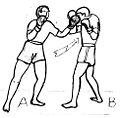
When used in boxing, the bolo punch's range of motion is like that of a hook combined with an uppercut.[1] As such, the punch should be thrown at 4–5 o'clock from an orthodox boxer's perspective. Its most important aspect is a circular motion performed with one arm to distract an opponent,[1] causing the opponent to either take his eyes off the attacker's other arm or actually focus on the fighter's circling arm. When the opponent concentrates on the hand that is circling, the bolo puncher will usually sneak in a punch with the opposite hand. When the rival concentrates on the hand that is not moving, the bolo puncher will usually follow through with a full punch.

Three of the most famous cases of a fighter using the bolo punch were when Leonard avenged his loss to Roberto Durán in "The No Más Fight", when Leonard drew with Thomas Hearns in their second fight, and when Ike Ibeabuchi knocked out Chris Byrd with a left-handed bolo punch during their 1999 heavyweight contest.

References

[edit]
[edit]
Revisions and contributorsEdit on WikipediaRead on Wikipedia
from Grokipedia
The bolo punch is a flashy and unorthodox technique that combines elements of a and an , executed with a wide, circular wind-up motion resembling the swing of a Filipino known as a bolo, typically used to distract opponents or deliver a powerful strike to the head or body. Originating among Filipino immigrants in the United States following the Spanish-American War, the punch draws from the labor-intensive task of cutting sugar cane with a bolo machete in regions like and , where it was adapted into the Filipino boxing style of Panantukan or before integrating into Western rules. It gained prominence in during the early , with Filipino boxer Ceferino credited as its popularizer; Garcia, a world champion in 1939, incorporated the punch into his arsenal. The technique involves a deceptive setup, often with the non-punching arm extended in a circular feint to draw the opponent's guard high, followed by a whip-like rotation of the hips and shoulders to generate power from a low-to-high arc, making it effective against defensive lapses but risky due to its telegraphed wind-up. Notable practitioners beyond Garcia include Cuban welterweight Kid Gavilan, who used it to secure 28 knockouts in a career record of 108-30-5 through 1958, as well as Sugar Ray Leonard, who employed it effectively in his 1980 rematch against Roberto Duran, and later fighters like Roy Jones Jr. and Joe Calzaghe. Today, the bolo punch remains a staple in mixed martial arts (MMA), Muay Thai, and modern boxing for its element of surprise, though it is infrequently used in amateur competitions due to its unorthodox nature.

History

Origins in Martial Arts

The bolo punch traces its roots to , particularly and Eskrima, where practitioners developed techniques mimicking the circular, whipping swing of the —a traditional single-edged used for agricultural tasks like clearing vegetation and in . This motion, characterized by a powerful overhead arc, was adapted into empty-hand striking methods within these systems, emphasizing fluid, weapon-derived movements for close-quarters fighting. Earlier uses of the technique in have been documented among Filipino fighters as early as 1924, with some sources attributing its creation to Macario Flores before Ceferino Garcia's popularization. In the early , Filipino immigrants, many of whom were laborers on and farms in , brought these influences to American gyms during the and . As sakadas (contract workers) skilled in Eskrima, they integrated bolo-inspired swings into their boxing styles, contributing to a wave of Filipino fighters who trained in local stables and competed in regional bouts, such as Battling Bolo's successes in California around 1928. This cultural exchange helped blend traditional Filipino techniques with Western boxing, laying the groundwork for the punch's recognition in professional rings. Ceferino Garcia, a Filipino middleweight boxer active in the 1930s and 1940s, is widely regarded as the "father" of the bolo punch in Western boxing, having refined and popularized it after drawing from his experiences as a sugarcane harvester wielding a bolo knife. Born in Naval, Biliran, in 1906, Garcia emigrated to the United States and built a formidable career, defeating top contenders and culminating in his victory over Fred Apostoli on October 2, 1939, to claim the New York State Athletic Commission-recognized world middleweight title—a reign that lasted until 1940. His innovative use of the punch, noted for its devastating power in fights against skilled opponents like Holman Williams, marked its debut in mainstream boxing media during this era. Garcia's contributions were later built upon by fighters such as Kid Gavilan, who further mainstreamed the technique post-World War II.

Popularization in Professional Boxing

The bolo punch gained significant traction in professional boxing during the mid-20th century, largely through the efforts of Cuban Kid Gavilan, who actively promoted and employed it as a signature technique throughout the 1940s and 1950s. Gavilan, born Gerardo González in 1926, earned the nickname "The Cuban Hawk" for his aggressive, swarming style and is widely recognized for popularizing the sweeping, machete-like strike, which he claimed to have refined from swinging a blade in Cuban sugar cane fields during his youth. His prolific use of the punch not only dazzled audiences but also helped integrate unconventional flair into the sport's technical repertoire, drawing from earlier foundational applications by Filipino boxer in the 1930s. Gavilan's breakthrough came on May 18, 1951, when he captured the National Boxing Association (NBA) title by defeating Johnny Bratton via unanimous 15-round decision at in , a victory where ringside accounts emphasized the bolo punch as his standout weapon for disrupting Bratton's rhythm and landing unexpected blows. This win marked the punch's elevation from a niche maneuver to a celebrated element in title bouts, as Gavilan defended the crown seven times over the next three years against top contenders, consistently showcasing the bolo to generate excitement and secure points through its unorthodox arc. His success, including high-profile fights that drew record gates for events, solidified the technique's place in mainstream boxing promotions. The punch's broader acceptance was bolstered by the post-World War II of the sport, which saw an influx of Latin American and fighters introducing vibrant, culturally influenced styles to American and international rings. This era's expansion, fueled by increased migration, international tours, and media coverage, allowed talents like Gavilan to thrive in major venues, transforming from a predominantly U.S.-centric pursuit into a more diverse spectacle where innovative punches like the bolo gained legitimacy and fan appeal. In the 1960s and 1970s, further amplified the bolo punch's cultural visibility through occasional deployment as a theatrical flourish, employing its exaggerated windup to taunt opponents and entertain crowds, though he relied more on speed and footwork as core weapons.

Technique

Basic Mechanics

The bolo punch is characterized by a low starting position of the arm near the , initiating a wide, that rises upward toward the target, distinguishing it from more direct linear strikes. This motion generates power primarily through rotation and shoulder torque, allowing for a whipping action that builds momentum over the extended path rather than relying on straight-line extension. Unlike standard hooks, which emphasize shorter lateral arcs, or uppercuts, which focus on compact vertical drives, the bolo punch functions as a hybrid, combining the hook's sideways with the uppercut's upward trajectory. In an , with feet shoulder-width apart and knees slightly bent for balance, the rear arm executes the primary swing while the core muscles engage to stabilize the torso against rotational forces. This positioning ensures efficient energy transfer, preventing loss of balance during the exaggerated wind-up. The punch leverages the kinetic chain, beginning with the legs pushing off the ground to initiate ground reaction force, which propagates through the hips and before culminating in the arm's delivery, thereby maximizing and overall impact force.

Execution Steps

To execute the bolo punch effectively, begin by assuming an orthodox boxing stance, with the left foot forward, knees slightly bent for balance, and the rear (right) hand positioned low near the belt line to disguise the impending wind-up and reduce telegraphing. Often, the lead (left) arm is extended in a circular to distract the opponent and draw their guard high. This setup allows for a deceptive start while maintaining a stable base. Next, initiate the motion by dropping the rear slightly and rotating the hips clockwise, which generates for power—drawing from mechanics of hip-driven punches—while swinging the right arm in a wide underhand circle backward and downward to build momentum. The circular wind-up must be feinted with subtle movements like a jab or shoulder twitch to mask intentions and prevent the opponent from anticipating the strike. Then, accelerate the fist upward along a semi-circular path, aiming toward the opponent's or midsection, while snapping the upon impact to maximize transfer. This whipping action combines elements of a and , ensuring the punch travels from low to high in a fluid arc. Finally, recover by retracting the arm swiftly to the guard position, simultaneously shifting weight back onto the lead foot to preserve balance and prepare for defensive maneuvers or follow-ups. Proper recovery minimizes vulnerability during the punch's extended range.

Usage and Effectiveness

Advantages in Combat

The bolo punch offers a strategic edge in through its element of surprise, stemming from the exaggerated wind-up that mimics a or deceptive motion, often distracting opponents and creating openings for follow-up combinations. This unconventional setup misleads fighters about the incoming trajectory, exploiting gaps in standard defensive postures as the punch arcs in from an unexpected angle. When timed precisely, it disrupts an opponent's rhythm, allowing the user to transition seamlessly into more conventional strikes. In mid-distance infighting, the bolo punch excels by covering effective range to target vulnerable areas such as the or solar plexus, delivering a whipping force that leverages full-body rotation for enhanced impact. The technique's looping path generates through and , producing a potent strike that can land with greater concussive effect than more linear punches when executed correctly. This rotational power contributes to its high potential, as the accumulated velocity amplifies force delivery to critical points. Beyond physical advantages, the bolo punch carries significant psychological weight, with its flashy execution serving as showmanship that can demoralize opponents by unsettling their focus and confidence. The dramatic motion also energizes crowds and influences the fight's atmosphere, potentially swaying judges or pressuring the adversary in high-stakes bouts. Overall, its tactical value lies in blending deception with raw power, making it a versatile tool for skilled boxers seeking to dominate through unpredictability.

Limitations and Risks

The bolo punch's distinctive wide wind-up motion significantly increases the risk of telegraphing, making it easier for opponents to anticipate and counter the strike, particularly against faster or more defensively skilled fighters. This exaggerated exposes the thrower's body for a brief but , allowing savvy adversaries to slip or block and respond with straight punches or hooks. In bouts, this vulnerability has led to notable counters, as the punch's setup demands commitment that can leave the user off-balance if missed. In addition to its defensive shortcomings, the bolo punch is notably energy-inefficient compared to linear strikes like jabs or crosses, as the sweeping arm path requires greater muscular exertion and setup time, depleting stamina more rapidly during extended exchanges. This inefficiency limits its frequency in prolonged fights, where boxers must conserve energy for sustained output; the whipping motion engages more core and shoulder muscles, accelerating in high-volume scenarios. As a result, it is typically reserved for opportunistic moments rather than as a primary tool in a fighter's arsenal. While generally permitted in , the bolo punch is less commonly used in amateur contexts under (IBA) guidelines due to its unorthodox looping trajectory, which may lead to cautions if referees interpret it as uncontrolled. Enforcement varies by official, but it is not explicitly prohibited. Repetitive use of the bolo punch also poses risks to the thrower's , with the circular stress potentially causing strains or impingements from the overhead whipping action. For instance, Alex experienced a shoulder twinge specifically from practicing the overhead right variant of the bolo in 2014, underscoring the potential for acute flare-ups even in prepared athletes.

Notable Instances

Iconic Performers

became synonymous with an exaggerated, taunting variation of the bolo punch during the 1980s, integrating it into his flamboyant style as both a provocative and a scoring weapon. In the November 25, 1980, title rematch against Roberto Duran in New Orleans, Leonard wound up his right hand in a dramatic bolo motion to mock Duran's machismo, only to snap a sharp left jab to the face, heightening Duran's frustration and contributing to his eventual surrender in the eighth round with the famous "No más." This psychological edge, combined with the punch's deceptive setup, allowed Leonard to mystify opponents and follow up with combinations, making the bolo a hallmark of his ring artistry. Ike Ibeabuchi showcased the bolo punch's raw power in the heavyweight division with a devastating left-handed delivery that floored Chris Byrd in the fifth round of their March 20, 1999, bout at the Emerald Queen Casino in Tacoma, Washington, securing a knockout victory and marking one of Byrd's few defeats. This moment highlighted Ibeabuchi's explosive potential before his career was derailed by legal issues. Roy Jones Jr. and Joe Calzaghe frequently incorporated the bolo punch into their dynamic styles during the 1990s and 2000s, using its sweeping motion to create openings and deliver powerful strikes in title fights. Jones Jr. employed it in his flashy combinations to overwhelm opponents, while Calzaghe used it to complement his high-volume southpaw offense in super middleweight defenses.

Famous Fight Applications

One of the most notorious applications of the bolo punch occurred during the 1980 rematch between and , known as the "No Más" fight. In the seventh round, Leonard wound up his right hand in an exaggerated bolo motion to taunt Durán, only to follow with a sharp left jab to the face, further frustrating the aggressive challenger. This psychological ploy, part of Leonard's overall strategy of showboating and body targeting earlier in the bout, exacerbated Durán's mounting irritation after losing the first encounter five months prior. Durán quit on his stool after the eighth round, handing Leonard a technical knockout victory and reclaiming the WBC welterweight title. Kid Gavilán popularized the bolo punch throughout the 1950s in numerous title defenses and non-title bouts, often using its sweeping arc to stagger opponents and control the pace. A notable instance came in his October 1954 title fight against Johnny Saxton in , where Gavilán landed a bolo that briefly staggered Saxton amid a competitive exchange, though the bout ended in a controversial loss for Gavilán after 15 rounds, stripping him of the crown. Gavilán's frequent deployment of the punch in this era, drawing from his Cuban sugar cane-cutting background, showcased its role in setting up combinations and wearing down foes over distance. In heavyweight action, Ike Ibeabuchi delivered one of the punch's most devastating implementations against on March 20, 1999, at the Emerald Queen Casino in . With Byrd employing a defensive, movement-based style to frustrate the aggressive Ibeabuchi over the first four rounds, Ibeabuchi connected with a left-handed bolo punch in the fifth, followed by a right , that dropped Byrd face-first to the canvas at 2:59. The strike caused significant disorientation and swelling, prompting the referee to halt the contest via technical knockout, marking Byrd's first professional defeat. This bolo, often hailed as one of the most effective in boxing history, highlighted Ibeabuchi's raw power despite his unorthodox technique. Muhammad Ali incorporated a rare bolo feint into his arsenal during the iconic 1974 "Rumble in the Jungle" against George Foreman in Kinshasa, Zaire. Prior to the fight, Ali publicly announced he would employ a renamed version of Kid Gavilán's bolo punch, dubbing it the "Ghetto Whopper," to distract and unsettle the powerful champion. Throughout the bout, Ali used such feints—winding up dramatically without fully committing—to bait Foreman into overcommitting punches, preserving energy for his rope-a-dope strategy and setting up counterstrikes that led to Foreman's eighth-round knockout. While not landing as a direct strike, the feint exemplified Ali's psychological edge in reclaiming the heavyweight title.

References

Add your contribution
Related Hubs
Contribute something
User Avatar
No comments yet.