Recent from talks
Bombay cat
Knowledge base stats:
Talk channels stats:
Members stats:
Bombay cat
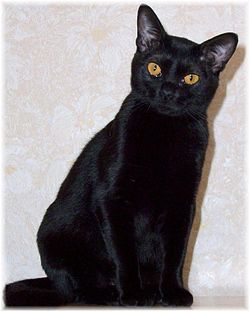
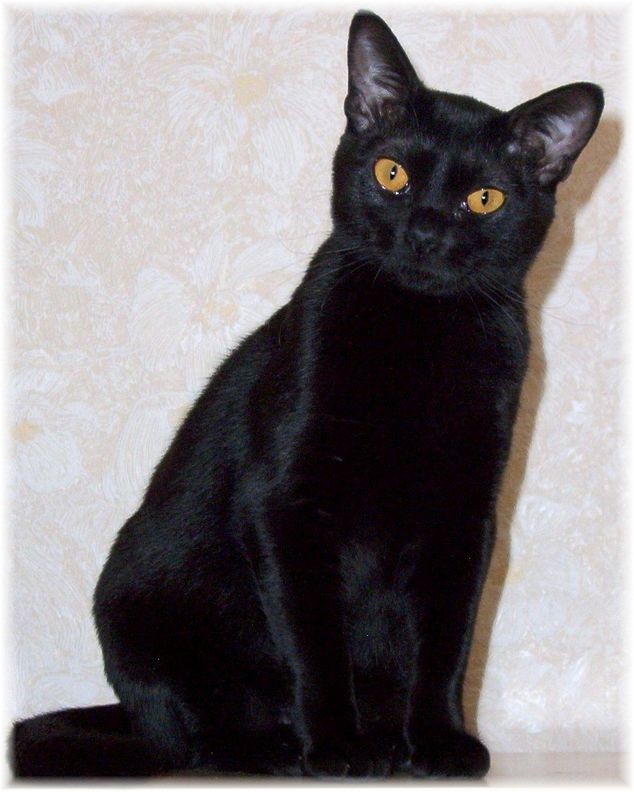
The Bombay cat is a short-haired breed of domestic cat. Bombays are glossy solid black cats with a muscular build, and have characteristic large bright copper-golden eyes. The breed is named after the Indian city of Bombay (Mumbai), referring to the habitat of the Indian black leopard.
There exist two different variants of Bombay breed: the American Bombay and the British Bombay. US-type Bombays were developed by crossbreeding sable American Burmese and black American Shorthair cats, to produce a cat of mostly Burmese type, but with a sleek, panther-like black coat with copper-golden eyes. UK-type Bombays are solid black-coloured Asian Self cats under the Asian group, a group of European Burmese and chinchilla Persian crosses. The UK-type Bombay originated from three mismatings of European Burmese with black domestic short-haired cats.
Both types of Bombay cats are selectively bred by breeders and pedigreed in multiple major cat fancier and breeder organisations. Similar to other officially recognised cat breeds, the term "Bombay" is only meant to be used for cats from this specific breed, which are by definition all purebred cats with a known and formally registered ancestry, also known as the cat's pedigree or "paperwork".
Starting in 1958, the US-type Bombay breed was developed by Nikki Horner, a breeder from Louisville, Kentucky, USA, who attempted to create a breed of cat that resembled a miniature black panther. The first attempt was a failure, but the second, in 1965, was successful.
The US-type breed was officially recognised and registered by the Cat Fanciers' Association (CFA) in 1970 and The International Cat Association (TICA) in 1979. Within the Fédération Internationale Féline (FIFe), the Bombay only holds preliminary recognition status.
The UK-type is registered as the Asian Self under the Asian group with the Governing Council of the Cat Fancy (GCCF), which is the sole registry that recognises the British Bombay and operates in the UK.
The Bombay cat is a relatively rare breed among pedigree cats, both in the US and UK types. All the UK-type Bombays are pedigreed with the GCCF as the Asian Self under the Asian group. In 2023, only 160 kittens of the entire Asian group were pedigreed. There is no data available for the British Bombay specifically.
The US-type is notably more popular than the UK-type, although still rare. In France specifically, an average of 45 Bombay kittens were born annually between 2003 and 2022. In 2024, only 13 Bombay kittens were registered with the major global registry FIFe, representing less than 0,1% of their total registrations and ranking place 49th out of the 54 breeds in popularity. Data from TICA, one of the largest cat registries globally, indicates that between 1979 and 2013, a total of 1085 Bombay cats (32 on average annually) were registered with them. PawPeds is the largest cat pedigree database worldwide, which contains data on both living and deceased cats across all pedigree organisations. As of June 2024, PawPeds reported a total of 1717 registered Bombay cats, with 406 of those born after January 2000.
Hub AI
Bombay cat AI simulator
(@Bombay cat_simulator)
Bombay cat
The Bombay cat is a short-haired breed of domestic cat. Bombays are glossy solid black cats with a muscular build, and have characteristic large bright copper-golden eyes. The breed is named after the Indian city of Bombay (Mumbai), referring to the habitat of the Indian black leopard.
There exist two different variants of Bombay breed: the American Bombay and the British Bombay. US-type Bombays were developed by crossbreeding sable American Burmese and black American Shorthair cats, to produce a cat of mostly Burmese type, but with a sleek, panther-like black coat with copper-golden eyes. UK-type Bombays are solid black-coloured Asian Self cats under the Asian group, a group of European Burmese and chinchilla Persian crosses. The UK-type Bombay originated from three mismatings of European Burmese with black domestic short-haired cats.
Both types of Bombay cats are selectively bred by breeders and pedigreed in multiple major cat fancier and breeder organisations. Similar to other officially recognised cat breeds, the term "Bombay" is only meant to be used for cats from this specific breed, which are by definition all purebred cats with a known and formally registered ancestry, also known as the cat's pedigree or "paperwork".
Starting in 1958, the US-type Bombay breed was developed by Nikki Horner, a breeder from Louisville, Kentucky, USA, who attempted to create a breed of cat that resembled a miniature black panther. The first attempt was a failure, but the second, in 1965, was successful.
The US-type breed was officially recognised and registered by the Cat Fanciers' Association (CFA) in 1970 and The International Cat Association (TICA) in 1979. Within the Fédération Internationale Féline (FIFe), the Bombay only holds preliminary recognition status.
The UK-type is registered as the Asian Self under the Asian group with the Governing Council of the Cat Fancy (GCCF), which is the sole registry that recognises the British Bombay and operates in the UK.
The Bombay cat is a relatively rare breed among pedigree cats, both in the US and UK types. All the UK-type Bombays are pedigreed with the GCCF as the Asian Self under the Asian group. In 2023, only 160 kittens of the entire Asian group were pedigreed. There is no data available for the British Bombay specifically.
The US-type is notably more popular than the UK-type, although still rare. In France specifically, an average of 45 Bombay kittens were born annually between 2003 and 2022. In 2024, only 13 Bombay kittens were registered with the major global registry FIFe, representing less than 0,1% of their total registrations and ranking place 49th out of the 54 breeds in popularity. Data from TICA, one of the largest cat registries globally, indicates that between 1979 and 2013, a total of 1085 Bombay cats (32 on average annually) were registered with them. PawPeds is the largest cat pedigree database worldwide, which contains data on both living and deceased cats across all pedigree organisations. As of June 2024, PawPeds reported a total of 1717 registered Bombay cats, with 406 of those born after January 2000.