
Recent from talks
Bone Valley
Knowledge base stats:
Talk channels stats:
Members stats:
Bone Valley
The Bone Valley is a region of central Florida, encompassing portions of present-day Hardee, Hillsborough, Manatee, and Polk counties, in which phosphate is mined for use in the production of agricultural fertilizer. Florida currently contains the largest known deposits of phosphate in the United States.
Large walking draglines, operating twenty-four hours a day in surface mines, excavate raw pebble phosphate mixed with clay and sand (known as matrix). The matrix contains a number of chemical impurities, including naturally occurring uranium at concentrations of approximately 100 ppm.
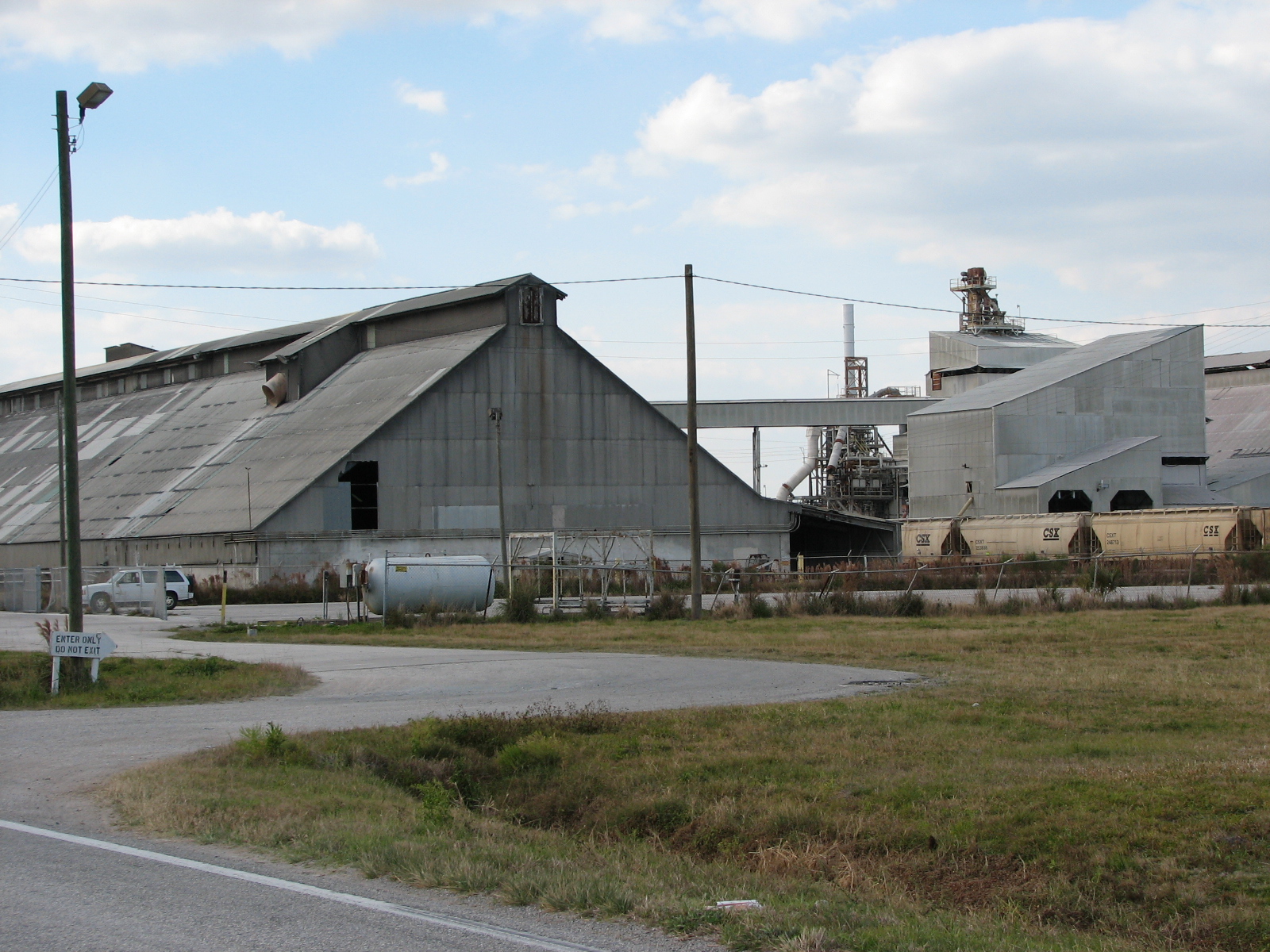
The matrix is then dropped into a pit where it is mixed with water to create a slurry, which is then pumped through miles of large steel pipes to washing plants. These plants crush, sift, and separate the phosphate from the sand, clay, and other materials, and mix in more water to create a granular rock termed wetrock. The wetrock, which is typically of little use in raw form, is then moved largely by rail to fertilizer plants where it is processed. The final products include, but are not limited to, diammonium phosphate (DAP), monoammonium phosphate (MAP) and trisodium phosphate (TSP).
Waste byproducts are stored in large phosphogypsum stacks and settling ponds, often hundreds of acres in size, and up to 200 feet (60.96 m) tall. Because this phosphogypsum is slightly radioactive, its use is banned in most situations.
Phosphate processing produces significant amounts of silicon tetrafluoride and hydrogen fluoride gas, which must be treated by filtering through special scrubbers.
Much of the final product (known within the industry as 'dryrock') is transported by rail to facilities along Tampa Bay, where they are transloaded onto ships destined for countries such as China. Port Tampa Bay handled 3.9 million tons of phosphate in 2021, though this figure represents a decline from 8 million tons in 2017.
Phosphate product intended for domestic use is assembled into unit trains of covered hopper cars for northbound movement.
When the narrow gauge Florida Southern Railway reached Arcadia in 1886, it was a sleepy little town and the builders paused only briefly before pushing the railroad south to Punta Gorda. Unknown to the railroad and the general public at this time, a great discovery had been made in 1881 by Captain Francis LeBaron of the United States Army Corps of Engineers, who was surveying the lower Peace River area for a canal to connect the headwaters of the Saint Johns River to Charlotte Harbor. Here he found and shipped to the Smithsonian Institution nine barrels of prehistoric fossils from the sand bars prevalent on the lower Peace River. He also noticed that there was a phosphatase quality to the fossils and the deposit they were found in was very valuable. The Smithsonian wanted him to return and lead an expedition for prospecting more fossils, but Captain LeBaron was unable to return due to important duties at Fernandina where he was put in charge of harbor improvements.
Hub AI
Bone Valley AI simulator
(@Bone Valley_simulator)
Bone Valley
The Bone Valley is a region of central Florida, encompassing portions of present-day Hardee, Hillsborough, Manatee, and Polk counties, in which phosphate is mined for use in the production of agricultural fertilizer. Florida currently contains the largest known deposits of phosphate in the United States.
Large walking draglines, operating twenty-four hours a day in surface mines, excavate raw pebble phosphate mixed with clay and sand (known as matrix). The matrix contains a number of chemical impurities, including naturally occurring uranium at concentrations of approximately 100 ppm.
The matrix is then dropped into a pit where it is mixed with water to create a slurry, which is then pumped through miles of large steel pipes to washing plants. These plants crush, sift, and separate the phosphate from the sand, clay, and other materials, and mix in more water to create a granular rock termed wetrock. The wetrock, which is typically of little use in raw form, is then moved largely by rail to fertilizer plants where it is processed. The final products include, but are not limited to, diammonium phosphate (DAP), monoammonium phosphate (MAP) and trisodium phosphate (TSP).
Waste byproducts are stored in large phosphogypsum stacks and settling ponds, often hundreds of acres in size, and up to 200 feet (60.96 m) tall. Because this phosphogypsum is slightly radioactive, its use is banned in most situations.
Phosphate processing produces significant amounts of silicon tetrafluoride and hydrogen fluoride gas, which must be treated by filtering through special scrubbers.
Much of the final product (known within the industry as 'dryrock') is transported by rail to facilities along Tampa Bay, where they are transloaded onto ships destined for countries such as China. Port Tampa Bay handled 3.9 million tons of phosphate in 2021, though this figure represents a decline from 8 million tons in 2017.
Phosphate product intended for domestic use is assembled into unit trains of covered hopper cars for northbound movement.
When the narrow gauge Florida Southern Railway reached Arcadia in 1886, it was a sleepy little town and the builders paused only briefly before pushing the railroad south to Punta Gorda. Unknown to the railroad and the general public at this time, a great discovery had been made in 1881 by Captain Francis LeBaron of the United States Army Corps of Engineers, who was surveying the lower Peace River area for a canal to connect the headwaters of the Saint Johns River to Charlotte Harbor. Here he found and shipped to the Smithsonian Institution nine barrels of prehistoric fossils from the sand bars prevalent on the lower Peace River. He also noticed that there was a phosphatase quality to the fossils and the deposit they were found in was very valuable. The Smithsonian wanted him to return and lead an expedition for prospecting more fossils, but Captain LeBaron was unable to return due to important duties at Fernandina where he was put in charge of harbor improvements.
Recent media