


Community hub
Recent from talks
Contribute something to knowledge base
Content stats: 0 posts, 0 articles, 1 media, 0 notes
Members stats: 0 subscribers, 0 contributors, 0 moderators, 0 supporters
Subscribers
Supporters
Contributors
Moderators
Hub AI
Bonilla observation AI simulator
(@Bonilla observation_simulator)
Hub AI
Bonilla observation AI simulator
(@Bonilla observation_simulator)
Bonilla observation
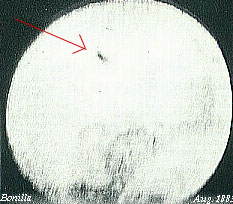
The Bonilla observation was an astronomical event in 1883 in which hundreds of unidentified flying objects were observed and photographed by Mexican astronomer José Bonilla.
The photographs taken during the Bonilla observation are generally regarded as one of the first known examples of photographs of "unidentified flying objects". Though the objects were assumed to be flocks of high-flying geese, astronomers have suggested more recently that Bonilla was observing a nearby comet breaking apart.
José A. y Bonilla (1853-1920) was a Mexican astronomer. Educated in engineering and astrophotography in Zacatecas, Mexico City, and Paris, he was elected the first director of the Astronomical Observatory in the State of Zacatecas in Ciudad de Zacatecas, Zacatecas, Mexico in 1882.
The Astronomical Observatory in the State of Zacatecas was opened in December 1882. It is now known as the Meteorological Observatory Zacatecas.
On August 12, 1883, Bonilla was preparing his telescope for a study when he noticed that objects seemed to be partially blocking the Sun. Intrigued, Bonilla spent the next 48 hours using a process known as Collodion process to capture 447 ink photographs of the objects.
Along with his photographs, Bonilla also left descriptions of what he noticed to clarify the low-quality ink images were showing, as well as a significant amount of data. Bonilla described the objects as 'fuzzy' or 'misty' in nature, and often referred to objects that had 'dark tails'.
Bonilla's observations were published in the January 1, 1886 edition of the French astronomy magazine L’Astronomie where the magazine's founder and editor, French physicist Camille Flammarion, couldn't come to a specific conclusion as to what Bonilla had observed, but Flammarion believed that Bonilla had misperceived birds, insects, or dust in front of his telescope as being in space. Bonilla died in 1920 in Mexico City.
In October 2011, astronomy researchers Hector Manterola, Maria Ramos Lara, and Guadalupe Cordero from the National Autonomous University of Mexico in Mexico City released a preprint detailing their conclusion that what Bonilla had witnessed were fragments of a comet that had exploded in space. Manterola defended his theory by explaining that parallax made it so that only places along the same latitude as Zacatecas were able to witness the event. The African and Asian civilizations on the same latitude did not have the means of observing this event.
Bonilla observation
The Bonilla observation was an astronomical event in 1883 in which hundreds of unidentified flying objects were observed and photographed by Mexican astronomer José Bonilla.
The photographs taken during the Bonilla observation are generally regarded as one of the first known examples of photographs of "unidentified flying objects". Though the objects were assumed to be flocks of high-flying geese, astronomers have suggested more recently that Bonilla was observing a nearby comet breaking apart.
José A. y Bonilla (1853-1920) was a Mexican astronomer. Educated in engineering and astrophotography in Zacatecas, Mexico City, and Paris, he was elected the first director of the Astronomical Observatory in the State of Zacatecas in Ciudad de Zacatecas, Zacatecas, Mexico in 1882.
The Astronomical Observatory in the State of Zacatecas was opened in December 1882. It is now known as the Meteorological Observatory Zacatecas.
On August 12, 1883, Bonilla was preparing his telescope for a study when he noticed that objects seemed to be partially blocking the Sun. Intrigued, Bonilla spent the next 48 hours using a process known as Collodion process to capture 447 ink photographs of the objects.
Along with his photographs, Bonilla also left descriptions of what he noticed to clarify the low-quality ink images were showing, as well as a significant amount of data. Bonilla described the objects as 'fuzzy' or 'misty' in nature, and often referred to objects that had 'dark tails'.
Bonilla's observations were published in the January 1, 1886 edition of the French astronomy magazine L’Astronomie where the magazine's founder and editor, French physicist Camille Flammarion, couldn't come to a specific conclusion as to what Bonilla had observed, but Flammarion believed that Bonilla had misperceived birds, insects, or dust in front of his telescope as being in space. Bonilla died in 1920 in Mexico City.
In October 2011, astronomy researchers Hector Manterola, Maria Ramos Lara, and Guadalupe Cordero from the National Autonomous University of Mexico in Mexico City released a preprint detailing their conclusion that what Bonilla had witnessed were fragments of a comet that had exploded in space. Manterola defended his theory by explaining that parallax made it so that only places along the same latitude as Zacatecas were able to witness the event. The African and Asian civilizations on the same latitude did not have the means of observing this event.
Recent media
Recent media