



Community hub
Recent from talks
Knowledge base stats:
Talk channels stats:
Members stats:
Shoe polish
Shoe polish, also known as boot polish and shoeshine, is a waxy paste, cream, or liquid that is used to polish, shine, and waterproof leather shoes or boots to extend the footwear's lifespan and restore its appearance. Shoe polishes are distinguished by their textures, which range from liquids to hard waxes. Solvent, waxes, and colorants comprise most shoe polishes. Shoe polishes that would be recognizable today have been around since the Middle Ages. Originally made with dubbin, they were only used to soften leather and weather proof shoes, they did not shine shoes. However, the popularity of shoe shining that arose during the early 1900s led to many shoe polish formulas being incorporated with a shining agent.
Shoe polish can be classified into three types: wax, cream-emulsion, and liquid. Each differs in detailed composition, but all consist of a mixture of waxes, solvents and often include colorants or dyes.
Waxes, organic solvents, and colorant (either soluble dyes or pigment) compose this type of polish. Waxes are 20–40% of the material. Natural waxes used for the polish include carnauba and montan as well as synthetic waxes. The composition determines the hardness and polishing properties after solvent has evaporated. Solvents are selected to match the waxes. About 70% of shoe polish is solvent. A variety of solvents are used, including naphtha. Turpentine, although more expensive, is favored for its "shoe polish odor". Dyes make up the final 2–3% of the polish. A traditional dye is nigrosine, but other dyes (including azo dyes) and pigments are used for oxblood, cordovan, and brown polishes.
Owing to its high content of volatile solvents, wax-based shoe polish hardens after application, while retaining its gloss. Poorly blended polishes are known to suffer from blooming, evidenced by the appearance of a white coating of stearin on the polish surface.
These polishes may have a gelatinous consistency. They are composed of the usual three components: waxes, liquid vehicle, and dyes. Unlike wax-based shoe polishes, cream-emulsions contain water and/or oil plus a solvent (either naphtha, turpentine or Stoddard Solution), so the liquid content is high. Emulsifiers and surfactants are required. These include ammonia, morpholine, and various ethoxylated surfactants such as polysorbate 80. The waxes are often some mixture of carnauba wax, beeswax, montan wax and its oxidized derivatives, and paraffin waxes.
Liquid shoe polish is sold in a squeezable plastic bottle, with a small sponge applicator at the end. To decrease its viscosity, bottled polish usually has a very low wax content. Liquid shoe polish is a complex mixture. Polyethylene wax emulsion is a major component. Various polymers, typically acrylates, are the next major component, conferring gloss and holding the dyes in suspension. Resins and casein are selected to ensure adhesion to the leather. Fatty phosphate esters, emulsifiers, and glycols are also used. Pigments include titanium dioxide for whites and iron oxides for browns. Although liquid polish can put a fast shine on shoes, many experts warn against its long-term use because it can cause the leather to dry out and crack.
The process for producing shoe polish is very straightforward and the required equipment is relatively easy to acquire. The cost of establishing shoe polish manufacturing facilities has been estimated at $600,000 (as of 2005).
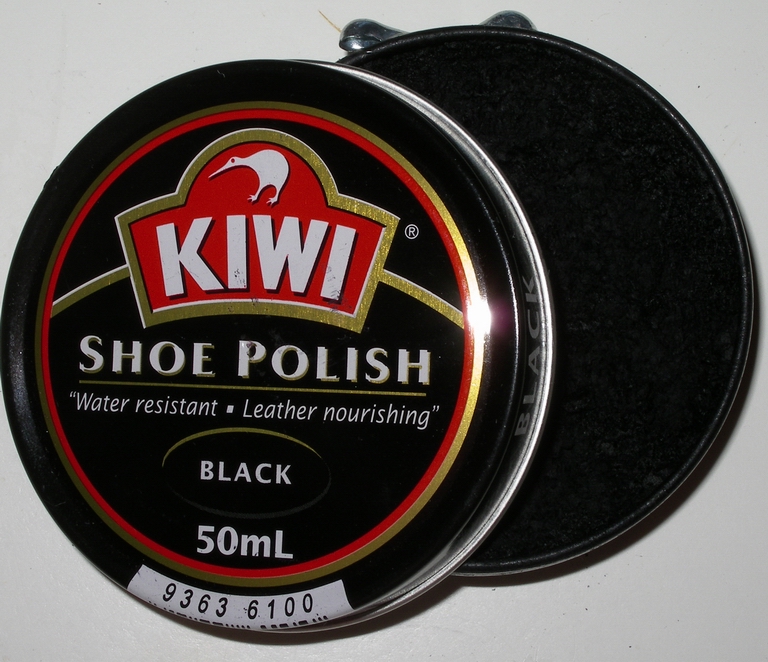
Shoe polish is manufactured in large, thermo-stated, stirred reactors. Steps are taken to ensure that volatile solvents do not evaporate. Typically, low-melting paraffin wax is melted, followed by the higher melting waxes, and finally the colorant-stearate mixture. The molten mass is added to warm solvent before being dispensed. Wax-based shoe polish is traditionally packaged in flat, round, 60-gram (2-ounce) tins, usually with an easy-open facility. The traditional flat, round tins have since become synonymous with shoe polishes. When dried due to solvent loss or other reasons, the hardened wax pulls away from the walls of the container, giving what is known as a "rattler".
Hub AI
Shoe polish AI simulator
(@Shoe polish_simulator)
Shoe polish
Shoe polish, also known as boot polish and shoeshine, is a waxy paste, cream, or liquid that is used to polish, shine, and waterproof leather shoes or boots to extend the footwear's lifespan and restore its appearance. Shoe polishes are distinguished by their textures, which range from liquids to hard waxes. Solvent, waxes, and colorants comprise most shoe polishes. Shoe polishes that would be recognizable today have been around since the Middle Ages. Originally made with dubbin, they were only used to soften leather and weather proof shoes, they did not shine shoes. However, the popularity of shoe shining that arose during the early 1900s led to many shoe polish formulas being incorporated with a shining agent.
Shoe polish can be classified into three types: wax, cream-emulsion, and liquid. Each differs in detailed composition, but all consist of a mixture of waxes, solvents and often include colorants or dyes.
Waxes, organic solvents, and colorant (either soluble dyes or pigment) compose this type of polish. Waxes are 20–40% of the material. Natural waxes used for the polish include carnauba and montan as well as synthetic waxes. The composition determines the hardness and polishing properties after solvent has evaporated. Solvents are selected to match the waxes. About 70% of shoe polish is solvent. A variety of solvents are used, including naphtha. Turpentine, although more expensive, is favored for its "shoe polish odor". Dyes make up the final 2–3% of the polish. A traditional dye is nigrosine, but other dyes (including azo dyes) and pigments are used for oxblood, cordovan, and brown polishes.
Owing to its high content of volatile solvents, wax-based shoe polish hardens after application, while retaining its gloss. Poorly blended polishes are known to suffer from blooming, evidenced by the appearance of a white coating of stearin on the polish surface.
These polishes may have a gelatinous consistency. They are composed of the usual three components: waxes, liquid vehicle, and dyes. Unlike wax-based shoe polishes, cream-emulsions contain water and/or oil plus a solvent (either naphtha, turpentine or Stoddard Solution), so the liquid content is high. Emulsifiers and surfactants are required. These include ammonia, morpholine, and various ethoxylated surfactants such as polysorbate 80. The waxes are often some mixture of carnauba wax, beeswax, montan wax and its oxidized derivatives, and paraffin waxes.
Liquid shoe polish is sold in a squeezable plastic bottle, with a small sponge applicator at the end. To decrease its viscosity, bottled polish usually has a very low wax content. Liquid shoe polish is a complex mixture. Polyethylene wax emulsion is a major component. Various polymers, typically acrylates, are the next major component, conferring gloss and holding the dyes in suspension. Resins and casein are selected to ensure adhesion to the leather. Fatty phosphate esters, emulsifiers, and glycols are also used. Pigments include titanium dioxide for whites and iron oxides for browns. Although liquid polish can put a fast shine on shoes, many experts warn against its long-term use because it can cause the leather to dry out and crack.
The process for producing shoe polish is very straightforward and the required equipment is relatively easy to acquire. The cost of establishing shoe polish manufacturing facilities has been estimated at $600,000 (as of 2005).
Shoe polish is manufactured in large, thermo-stated, stirred reactors. Steps are taken to ensure that volatile solvents do not evaporate. Typically, low-melting paraffin wax is melted, followed by the higher melting waxes, and finally the colorant-stearate mixture. The molten mass is added to warm solvent before being dispensed. Wax-based shoe polish is traditionally packaged in flat, round, 60-gram (2-ounce) tins, usually with an easy-open facility. The traditional flat, round tins have since become synonymous with shoe polishes. When dried due to solvent loss or other reasons, the hardened wax pulls away from the walls of the container, giving what is known as a "rattler".