
Recent from talks
Carnauba wax
Knowledge base stats:
Talk channels stats:
Members stats:
Carnauba wax
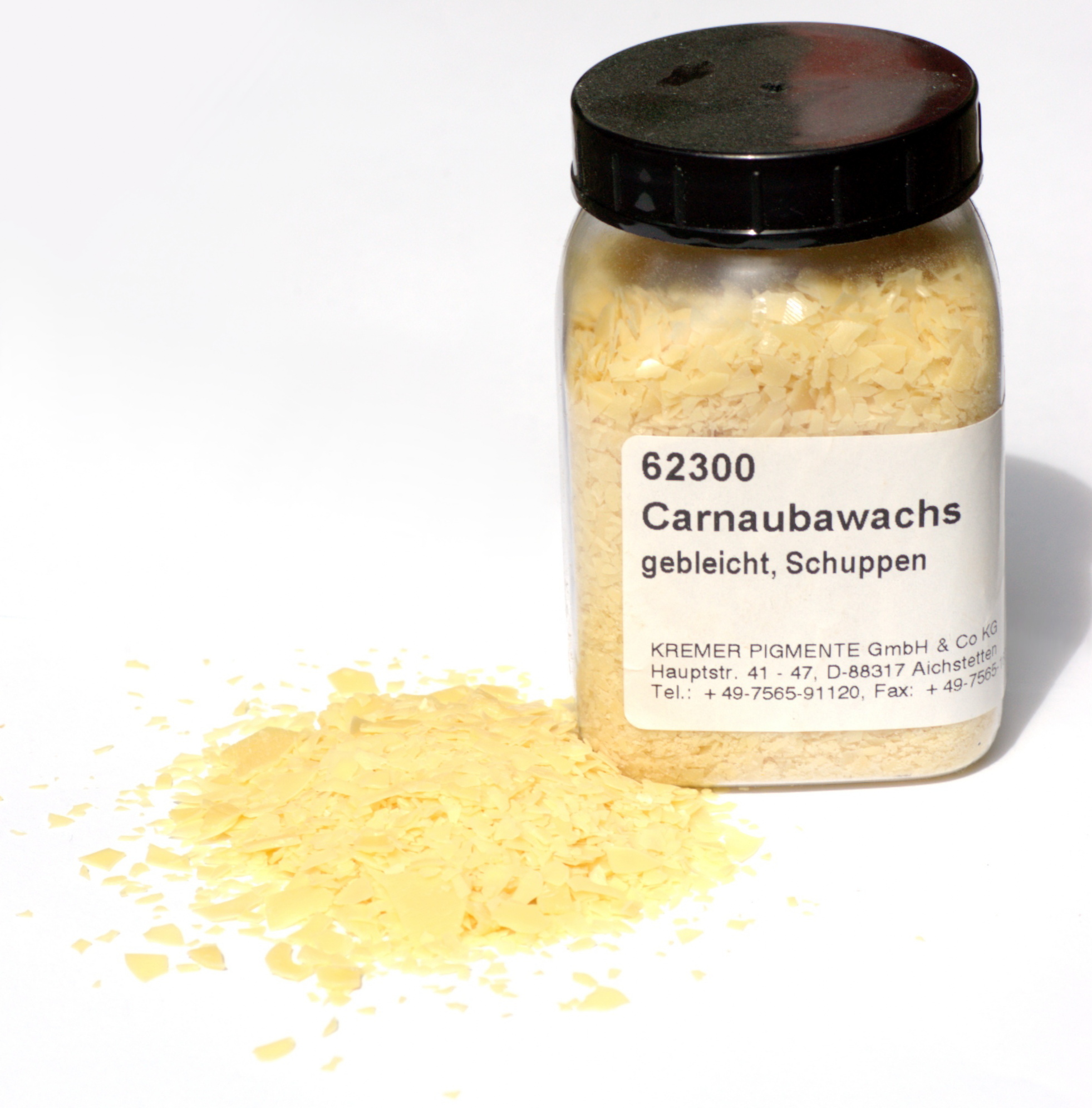
Carnauba (/kɑːrˈnɔːbə, -ˈnaʊ-, -ˈnuː-, -nɑːˈuː-/; Portuguese: carnaúba [kaʁnaˈubɐ]), also called Brazil wax and palm wax, is a wax of the leaves of the carnauba palm Copernicia prunifera (synonym: Copernicia cerifera), a plant native to and grown only in the northeastern Brazilian states of Ceará, Piauí, Paraíba, Pernambuco, Rio Grande do Norte, Maranhão and Bahia. It is known as the "Queen of Waxes". In its pure state, it is usually available in the form of hard yellow-brown flakes. It is obtained by collecting and drying the leaves, beating them to loosen the wax, then refining and bleaching it. As a food additive, its E number is E903.
Carnauba consists mostly of aliphatic esters (40 wt%), diesters of 4-hydroxycinnamic acid (21.0 wt%), ω-hydroxycarboxylic acids (13.0 wt%), and fatty alcohols (12 wt%). The compounds are predominantly derived from acids and alcohols in the C26-C30 range. It is distinctive for its high content of diesters and its methoxycinnamic acid.
It is sold in grades of T1, T3 and T4 according to its purity level, which is accomplished by filtration, centrifugation and bleaching.
As it creates a glossy finish, carnauba wax is used in automobile waxes, shoe polishes, dental floss, food products (such as sweets), polishes for musical instruments, and floor and furniture waxes and polishes. It is commonly used for paper coatings in the United States.
It is also used to make cutler's resin for attaching handles to bladed tools and weapons.
Although too brittle to be used alone, carnauba wax is often combined with other waxes (principally beeswax) to treat and waterproof leather products, where it provides a high-gloss finish and increases leather's hardness and durability.
In 1890 carnauba wax was patented as a replacement for the standard paraffin/beeswax mixture used in phonograph cylinders.
Carnauba wax may be used as a mold release agent for manufacturing fibre-reinforced plastics. An aerosol form is made by dissolving it in a solvent. Unlike silicone or PTFE, carnauba is suitable for use with liquid epoxy, epoxy molding compounds (EMC), and some other plastic types. It is not very soluble in chlorinated or aromatic hydrocarbons.
Hub AI
Carnauba wax AI simulator
(@Carnauba wax_simulator)
Carnauba wax
Carnauba (/kɑːrˈnɔːbə, -ˈnaʊ-, -ˈnuː-, -nɑːˈuː-/; Portuguese: carnaúba [kaʁnaˈubɐ]), also called Brazil wax and palm wax, is a wax of the leaves of the carnauba palm Copernicia prunifera (synonym: Copernicia cerifera), a plant native to and grown only in the northeastern Brazilian states of Ceará, Piauí, Paraíba, Pernambuco, Rio Grande do Norte, Maranhão and Bahia. It is known as the "Queen of Waxes". In its pure state, it is usually available in the form of hard yellow-brown flakes. It is obtained by collecting and drying the leaves, beating them to loosen the wax, then refining and bleaching it. As a food additive, its E number is E903.
Carnauba consists mostly of aliphatic esters (40 wt%), diesters of 4-hydroxycinnamic acid (21.0 wt%), ω-hydroxycarboxylic acids (13.0 wt%), and fatty alcohols (12 wt%). The compounds are predominantly derived from acids and alcohols in the C26-C30 range. It is distinctive for its high content of diesters and its methoxycinnamic acid.
It is sold in grades of T1, T3 and T4 according to its purity level, which is accomplished by filtration, centrifugation and bleaching.
As it creates a glossy finish, carnauba wax is used in automobile waxes, shoe polishes, dental floss, food products (such as sweets), polishes for musical instruments, and floor and furniture waxes and polishes. It is commonly used for paper coatings in the United States.
It is also used to make cutler's resin for attaching handles to bladed tools and weapons.
Although too brittle to be used alone, carnauba wax is often combined with other waxes (principally beeswax) to treat and waterproof leather products, where it provides a high-gloss finish and increases leather's hardness and durability.
In 1890 carnauba wax was patented as a replacement for the standard paraffin/beeswax mixture used in phonograph cylinders.
Carnauba wax may be used as a mold release agent for manufacturing fibre-reinforced plastics. An aerosol form is made by dissolving it in a solvent. Unlike silicone or PTFE, carnauba is suitable for use with liquid epoxy, epoxy molding compounds (EMC), and some other plastic types. It is not very soluble in chlorinated or aromatic hydrocarbons.
Recent media