Hubbry Logo
Borgward P100Borgward P100Main
Open search
Borgward P100
Community hub
Borgward P100
logo
8 pages, 0 posts
0 subscribers
Be the first to start a discussion here.
Borgward P100
Borgward P100
from Wikipedia
Borgward P100
Overview
ManufacturerCarl F. W. Borgward GmbH
Also calledBorgward 230
ProductionJune 1959–1961
2,530 [1] built by Borgward
Body and chassis
Body style4-door sedan
LayoutFR layout
Powertrain
Engine2,240 cc straight-6
Transmission4-speed
all-synchromesh manual
Dimensions
Wheelbase2,650 mm (104.3 in)
Length4,715 mm (185.6 in)
Width1,738 mm (68.4 in)
Height1,420 mm (55.9 in)
Curb weight1,650 kg (3,638 lb) (loaded)
Chronology
PredecessorBorgward Hansa 2400 Pullman

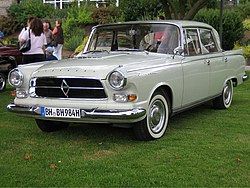
The Borgward P100 is a large four-door sedan first presented in September 1959[2] at the Frankfurt Motor Show, and produced by the Bremen based auto-manufacturer Carl F. W. Borgward GmbH between January 1960 and July 1961.

Design and engineering

[edit]
Rear view

The design featured the ponton, three-box design pioneered by Borgward in 1949, but now filled out to the relatively angular corners, reminiscent of the style being popularised by Pininfarina with designs such as that of the Fiat 1800, the Peugeot 404 or the Austin Westminster. Like the Farina designs, the P100 featured small angular tailfins.

The P100 followed the structural approach of the existing Isabella, incorporating an integral chassis.[2]

The straight-6 2240 cc engine derived from that fitted in earlier Borgward six-cylinder sedans, of which the most recent had been the Borgward Hansa 2400 Pullman. Advertised performance figures included a power output of 100 bhp (75 kW) and a maximum speed of around 100 mph (161 km/h).

Contemporary publicity material highlighted the car’s revolutionary self-levelling air suspension.

Commercial

[edit]

The P100 was competing in the six-cylinder sedan sector which through the 1950s had become ever more dominated by Mercedes-Benz, whose 220SE model also received a modern chiselled body shape in 1960. Borgward’s previous six-cylinder sedans had achieved only limited market penetration, and early reports that the P100 was confirming Borgward’s reputation for introducing new models beset by teething troubles suggested that despite its technically adventurous suspension and modern style, the P100 might struggle to compete against Stuttgart’s well established reputation for producing dependable sedans. Nevertheless, during its nineteen months in production, the P100 notched up over 2,500 cars produced, putting it on course usefully to outperform earlier six-cylinder Borgwards in the market place. The bankruptcy[3] of the business in August 1961 brought P100 production to an end, although the plant did complete another 47 cars in the days following the bankruptcy.[4]

The model enjoyed a brief afterlife: the production line was sold and shipped to Mexico by Grupo Industrial Ramirez in Monterrey NL, where between 1967 and 1970 more than 2,000 additional P100s were produced.

References

[edit]
Revisions and contributorsEdit on WikipediaRead on Wikipedia
from Grokipedia
The is a full-size luxury sedan manufactured by the German automaker from 1960 to 1961, notable as the company's final passenger car model before its bankruptcy. It was introduced at the 1959 Motor Show as the successor to the Borgward 2400 Pullman, featuring advanced air suspension and a refined in a contemporary three-box design with subtle tailfins. Only 2,530 units were produced in , making it a rare classic today, with an additional approximately 2,000 assembled in from 1967 to 1970 under license. Powered by a 2,240 cc overhead-valve with an iron block and alloy , the P100 delivered 100 at 5,100 rpm through a single Solex , enabling a top speed of 100 mph (160 km/h) and 0-60 mph acceleration in 14.6 seconds. The car utilized a four-speed all-synchromesh and , paired with independent front suspension via double wishbones and a rear swing-axle setup. Its standout feature was the standard "Air Swing" self-leveling pneumatic suspension, introduced as optional in April 1960 and powered by a crankshaft-driven with Bosch leveling valves and Firestone air bags, which provided exceptional ride comfort and handling for the era. Measuring 15 ft 5½ in (4,712 mm) in length on an 8 ft 8½ in (2,650 mm) , the P100 weighed 2,862 lb (1,298 kg) and offered fuel economy of 16-26 mpg, positioning it as a direct competitor to the 220SE in the upper-middle luxury segment. Despite its technical sophistication and competitive pricing, the P100 struggled amid Borgward's financial woes, exacerbated by and market saturation, leading to the firm's in 1961. The model's production in , rebadged as the Borgward 230, extended its lifespan but could not revive the original brand, which lay dormant until a brief modern revival from 2015 to 2022 backed by a Chinese company and focused on SUVs including electric vehicles, before another . Today, surviving examples—estimated at around 20 globally—are prized by collectors for their and as a poignant emblem of German automotive ambition.

Development

Origins and design goals

In the post-World War II era, the company, founded by Carl F. W. in 1924, experienced significant expansion during the as West Germany's recovered and boomed. By 1955, had become the nation's second-largest carmaker behind , operating multiple divisions including Borgward-Hansa, , and Lloyd to maximize production and resource allocation. This growth was fueled by the success of mid-range models like the Isabella, introduced in late 1954, which sold over 200,000 units by dominating the 1.5-liter segment with its reliable engineering and stylish design, enabling to target higher market segments. Building on this momentum, sought to compete directly with established luxury brands like by developing a flagship six-cylinder sedan, the P100, conceptualized in the late 1950s as a modern successor to the Hansa 2400 Pullman limousine produced from to 1959. The Hansa 2400 had been an earlier attempt at a premium offering but achieved limited commercial success with only around 1,400 units sold, highlighting the need for a more contemporary four-door sedan to capture the executive market. The P100 project received a substantial investment of DM 30 million, reflecting Borgward's ambition to elevate its status in the premium segment. The design goals for the P100 centered on integrating advanced technology, superior comfort, and strong performance to position as an innovative force in Germany's recovering automotive landscape, directly challenging models like the 220. Unveiled at the September 1959 Motor Show with production commencing in early 1960, the vehicle aimed to blend engineering sophistication—such as optional for enhanced ride quality—with a focus on luxury and reliability to appeal to affluent buyers seeking alternatives to traditional giants. This strategic push underscored 's vision of bridging mid-market accessibility with high-end aspirations in the post-war economic upswing.

Engineering innovations

The Borgward P100 featured a , which provided a balanced and facilitated the integration of advanced suspension components. This configuration employed independent front suspension with double wishbones and telescopic dampers, initially using coil springs for precise handling and road isolation. The rear suspension utilized swing axles, also with telescopic dampers, contributing to the car's overall stability in a conventional German engineering approach of the era. A key engineering highlight was the introduction of self-levelling , which became standard equipment later in 1960, marking the first such system in a European production car. Developed in collaboration with suppliers like Bosch and Firestone, it incorporated a belt-driven mounted in the compartment, a under the hood with air filters, rolling-pack air springs (or "mitten-type" ) at each wheel, and height-sensing control valves for automatic levelling. This system maintained consistent regardless of load or road conditions, effectively reducing body roll during cornering and nose dive under braking, while enhancing passenger comfort on uneven surfaces. The P100's chassis adopted an integral body-chassis construction in a ponton-style design, where the body panels formed a stressed structure to improve torsional rigidity and reduce overall weight compared to separate frame designs. This unibody approach, building on Borgward's earlier models like the Isabella, allowed for a lighter yet robust platform that supported the sophisticated suspension without compromising structural integrity. Among optional features, power-assisted steering was available via a hydraulic system, providing lighter effort for the driver despite the car's size, though reviews noted it could feel somewhat heavy at low speeds. Similarly, the hydraulic drum brakes included assistance as an option, aiding while mitigating fade on prolonged use. These elements underscored Borgward's ambition to deliver luxury-level refinements in a competitive segment.

Design and specifications

Exterior styling

The Borgward P100 adopted a ponton three-box body style, characterized by its integrated fenders and relatively angular corners that evolved from Borgward's earlier designs introduced in 1949. This configuration included subtle tailfins on the rear wings, drawing inspiration from American automotive trends of the late while maintaining a more restrained European elegance through clean, horizontal lines and minimal side sculpting. With a of 2,650 , overall length of 4,712 , width of 1,727 , height of 1,435 , and weight of 1,298 kg, the P100 presented generous proportions for a luxury sedan of its era, emphasizing spaciousness and presence on the road. The body utilized a unibody construction for enhanced rigidity, accented by chrome trim on the distinctive grille—featuring a diamond-shaped emblem and elongated headlamps—along with bumpers and side details that added a touch of sophistication. Available exclusively as a four-door sedan, the design incorporated a slightly wrapped and for a modern profile, with round rear light assemblies framed by rounded-rectangular chrome work. Aerodynamic considerations were evident in the sloped hood and gently tapered rear, which contributed to smoother compared to more boxy contemporaries, aligning with the era's growing emphasis on in luxury vehicles.

Interior and features

The Borgward P100 offered a spacious four-door cabin designed to accommodate five passengers comfortably, with excellent headroom and a roomy rear compartment well-suited for three occupants. Upholstery consisted of soft nap cloth as standard, with available as an option to align with the model's premium luxury goals. The front seats were fully adjustable, allowing for personalized positioning to enhance and comfort. The featured a logical, ergonomic layout centered around a large analog flanked by three smaller gauges monitoring fuel level, temperature, and amperage, providing clear readability during operation. Optional equipment included a radio and heater, with the ventilation delivering effective airflow for occupant comfort, complemented by deep carpet underlays throughout the cabin. Safety and ride quality benefited from comprehensive sound insulation that ensured a quiet interior environment, while the trunk provided generous, cavernous storage space for luggage, emphasizing the vehicle's versatility as a luxury sedan.

Engine and drivetrain

The Borgward P100 was powered by a 2,240 cc inline-six cylinder engine featuring an overhead-valve design. This engine delivered 100 bhp at 5,100 rpm and 116 lb-ft (158 Nm) of torque at 2,000 rpm, providing adequate propulsion for the sedan's luxury-oriented performance. The fuel system employed a single Solex downdraft , contributing to smooth operation and contributing to the vehicle's performance metrics of 14.6 seconds for 0-60 mph acceleration and a top speed of 100 mph (161 km/h). Fuel economy was approximately 16-26 in mixed conditions. The drivetrain utilized a standard 4-speed all-synchromesh . Power was transmitted to the rear wheels via a hypoid differential, ensuring reliable distribution in this rear-wheel-drive configuration.

Production and market

Manufacturing and output

The Borgward P100 was produced at the company's main facility in Sebaldsbrück, , , from early to July 1961, with a total of 2,547 units completed, including 47 vehicles assembled in the days following the firm's declaration in 1961. Production commenced shortly after the model's public debut at the 1959 Motor Show, with initial output ramping up gradually in early as the assembly process stabilized. The manufacturing process utilized a conventional setup typical of mid-20th-century European automakers, where body panels and major components were welded into a structure before sequential installation of the , , and interior elements. Luxury-oriented details, such as chrome trim and , received additional hand-finishing to meet the model's premium positioning, contributing to its reputation for refined build quality despite the short production run. Only a single body style—a four-door sedan—was offered, though the self-leveling "Air Swing" pneumatic suspension system was introduced as an option starting in April 1960 before becoming standard equipment later that year to enhance ride comfort and handling. placed a strong emphasis on during P100 production, incorporating advanced features like the ahead of competitors, but the program's development faced notable challenges, including cost overruns totaling 30 million Deutsche Marks. These expenses, combined with the complexity of integrating innovative components, strained resources at the plant and limited overall output scalability.

Sales and competition

The Borgward P100 was priced at DM 12,500 in upon its launch in 1960, positioning it as a direct competitor to established luxury saloons such as the 220S and the 2600. This premium pricing reflected its advanced features, including standard and a 100 hp inline-six engine, but it placed the P100 in a highly competitive segment dominated by brands with deeper . Sales were primarily concentrated in , with the majority occurring in where fewer than 3,000 units were sold between mid-1960 and mid-1962. Exports were limited, reaching markets like the and in small numbers, while penetration into the remained negligible due to the model's late introduction and Borgward's faltering export infrastructure. Total production reached 2,547 units, underscoring the P100's commercial underperformance amid Borgward's broader financial pressures. Market reception was generally positive in the motoring press, which lauded the P100's innovative engineering and performance for its class, though critics noted minor reliability issues like suspension leaks. However, its high cost and Borgward's less prestigious brand image compared to Mercedes hindered broader appeal, contributing to sluggish uptake. In competition analysis, the P100 aimed to challenge Mercedes-Benz's dominance in the luxury saloon market with superior ride quality and modern styling, yet it was outsold by more reliable incumbents like the series and even mass-market options such as the . Borgward's mounting financial instability further eroded consumer confidence, preventing the P100 from gaining significant traction against these established rivals.

Legacy

Bankruptcy impact

The Borgward P100's production was abruptly terminated in August 1961 when the company filed for bankruptcy, just 19 months after the model's launch in early 1960. This collapse followed a controversial exposé in Der Spiegel magazine in December 1960, which alleged financial mismanagement and triggered a crisis of creditor confidence, leading the Bremen Senate to intervene and place the firm under administration before ordering its liquidation. The directly curtailed the P100's short run, with only 2,530 units produced in total, including 47 additional assembled from existing parts and after the official halt. Remaining unsold stock was sold off during the process to settle debts. The model's high development costs of DM 30 million had exacerbated the company's financial strain, compounded by overexpansion across multiple brands and models like the Lloyd Arabella, which faced recalls and poor sales. The fallout severely impacted workers and suppliers, as the Bremen factory closure resulted in the dismissal of approximately 20,000 employees, marking one of Germany's largest industrial insolvencies. Suppliers were left with unpaid invoices amid the asset , further straining the local automotive ecosystem. Despite the controversy—Carl Borgward maintained until his death in 1963 that the firm was solvent and creditors were eventually paid in full—the event ended German production of the P100 and reshaped 's manufacturing landscape.

Mexican production

Following the 1961 bankruptcy of Carl F. W. , the production machinery and tooling for the P100 were acquired by Impulsora Mexicana Automotriz, a consortium led by entrepreneur Gregorio Ramírez González, and shipped to in March 1963. This group, which later evolved into Fábrica Nacional de Automóviles, S.A. (FANASA) and became associated with Grupo Industrial Ramírez, established a facility in Escobedo, , near , to revive manufacturing. The acquisition aimed to leverage the P100's design for local production, with the transfer enabling the continuation of the model's six-cylinder platform despite the original company's collapse. Production of the P100 in Mexico commenced in August 1967 and continued until 1970, resulting in 2,267 units assembled. Marketed primarily as the Borgward 230 or P100 230GL, the vehicles included both luxury variants with enhanced trim and more basic models without rear fins, alongside specialized limousine versions extended by 30 cm. Output averaged around 100 units per month, falling short of the targeted 1,500 units monthly at full capacity, due to logistical challenges and market constraints. Adaptations for production emphasized local assembly, with up to 85% national content through sourcing of components like 99.5% Mexican steel for bodywork, while retaining the core mechanical design, updated badging, and minor trim adjustments to align with regional preferences. These changes allowed for cost reductions suited to Latin American economics, positioning the model to compete against imports like and in domestic and export markets across the region. However, high production costs and limited demand ultimately led to the program's closure after three years.

Collectibility and preservation

The Borgward P100 is highly regarded among collectors due to its extreme rarity, with only around 20 original German-built examples believed to survive worldwide today. In the , just four are estimated to remain , underscoring its status as one of the nation's rarest . Mexican-produced versions, built from 1967 to 1970 using transferred tooling, number 2,267 units in total production and are somewhat more prevalent among survivors, though they remain scarce owing to age and limited documentation. Restored examples command significant value at auctions, often fetching £9,000 to £45,000 or more as of 2025, reflecting demand from enthusiasts drawn to its innovative features like self-leveling . Preservation efforts are supported by dedicated groups such as the Drivers’ Club in the UK, which facilitates parts sharing, events, and technical advice to keep these vehicles roadworthy. Owners frequently undertake older restorations, as seen in a 1990s rebuild by specialists in , but face ongoing challenges from parts scarcity exacerbated by the company's 1961 bankruptcy. Restoration presents particular difficulties, including the sourcing of specialized components for the system, where recent replacements for bags alone can cost €3,000. Enthusiasts often describe hunting for spares as a "fulfilling ," leading to common modifications such as upgraded suspension elements or electrical systems to enhance reliability without compromising originality. As 's final model before , the P100 holds cultural significance as the marque's ambitious swansong, embodying late-1950s German innovation in a luxury sedan format. The saw a brief revival in 2015 under Chinese ownership, focusing on electric vehicles, but filed for again in 2022. It occasionally appears in automotive media, shows, and enthusiast gatherings like the Borgward World Meeting, where both German and Mexican variants draw admiration for their distinctive tailfin styling and smooth ride quality.

References

Add your contribution
Related Hubs
User Avatar
No comments yet.