Hubbry Logo
Precision engineeringPrecision engineeringMain
Open search
Precision engineering
Community hub
Precision engineering
logo
8 pages, 0 posts
0 subscribers
Be the first to start a discussion here.
Contribute something
Precision engineering
from Wikipedia
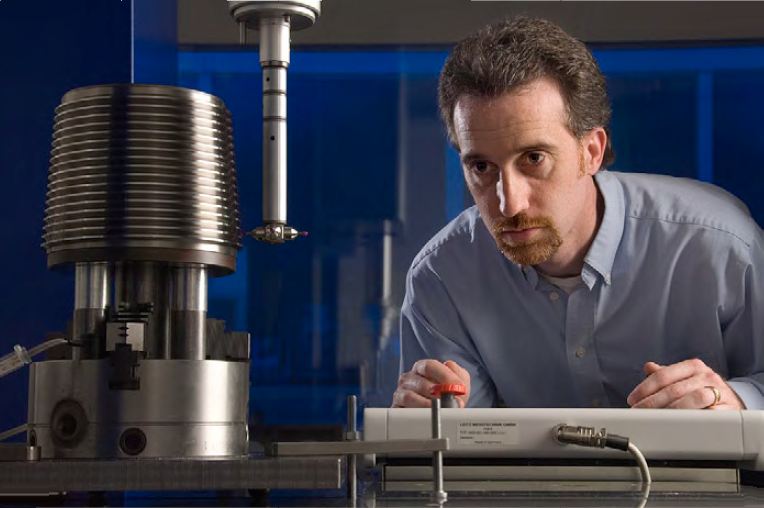
NIST Precision engineering research. Measurement of API Rotary Master Gauge on CMM.[1]

Precision engineering is a subdiscipline of electrical engineering, software engineering, electronics engineering, mechanical engineering, and optical engineering concerned with designing machines, fixtures, and other structures that have exceptionally low tolerances, are repeatable, and are stable over time. These approaches have applications in machine tools, MEMS, NEMS, optoelectronics design, and many other fields.

Precision engineering is a branch of engineering that focuses on the design, development and manufacture of product with high levels of accuracy and repeatability.

It involves the use of advanced technologies and techniques to achieve tight tolerance and dimensional control in the manufacturing process.

Overview

[edit]

Professors Hiromu Nakazawa and Pat McKeown provide the following list of goals for precision engineering:

  1. Create a highly precise movement.
  2. Reduce the dispersion of the product's or part's function.
  3. Eliminate fitting and promote assembly, especially automatic assembly.
  4. Reduce the initial cost.
  5. Reduce the running cost.
  6. Extend the life span.
  7. Enable the design safety factor to be lowered.
  8. Improve interchangeability of components so that corresponding parts made by other factories or firms can be used in their place.
  9. Improve quality control through higher machine accuracy capabilities and hence reduce scrap, rework, and conventional inspection.
  10. Achieve a greater wear/fatigue life of components.
  11. Make functions independent of one another.
  12. Achieve greater miniaturization and packing densities.
  13. Achieve further advances in technology and the underlying sciences.[2]

Technical Societies

[edit]

See also

[edit]

References

[edit]
[edit]
Revisions and contributorsEdit on WikipediaRead on Wikipedia
from Grokipedia
Precision engineering is a multidisciplinary field that encompasses the design, manufacture, , and application of components, machines, and systems achieving high levels of accuracy, often at nanometer or subnanometer scales, to ensure deterministic control over s and optimal performance. It integrates principles from , physics, , and advanced to produce reliable and repeatable outcomes in diverse applications, emphasizing error budgeting, optimization, and stability. This discipline enables the creation of precision instruments and structures that span length scales from to large-scale systems like telescopes, supporting innovations in science and industry. The roots of precision engineering trace back over a thousand years, drawing from fields such as astronomy, , fundamental standards, and to address societal needs through innovative technological linkages. Historical advancements include early precision mechanisms for timekeeping, such as John Harrison's in the 18th century, which revolutionized by achieving unprecedented accuracy in mechanical systems. In the modern era, the field formalized in the late with contributions from institutions like , where systematic design principles were applied to projects such as diamond-turning machines for optics production. These developments highlight an evolutionary progression from empirical craftsmanship to science-based , balancing technological convergence for innovation with economic optimization in . Key principles guiding precision engineering include the Abbe principle for alignment to minimize measurement errors, exact-constraint design to avoid over-constraining and residual stresses, and optimal stiffness to direct loads through tension or compression rather than bending. Techniques such as kinematic couplings for repeatable positioning, flexure stages for controlled motion, and reversal methods for error separation ensure high repeatability and stability, often validated through finite element analysis and volumetric error mapping. Thermal management and preloading further mitigate distortions and backlash, enabling machines to achieve accuracies like 28 nm root-mean-square in large fabrication. Applications of precision engineering are pivotal in advancing multiple sectors, including astronomy for constructing large telescopes that detect exoplanets, and high-power systems for fusion research requiring subnanometer . In healthcare, it facilitates the production of ultra-precise implants and diagnostic devices at cellular scales, enhancing treatment efficacy. Additional domains encompass semiconductors, , renewable systems, and , where precision manufacturing of like ceramics supports high-performance components. These applications underscore the field's role as an enabler of scientific discovery and , with ongoing challenges in multi-disciplinary and sustainable practices.

Fundamentals

Definition and Scope

Precision engineering is the multidisciplinary discipline focused on the , manufacture, and of components and systems to achieve exceptionally high levels of accuracy, typically with tolerances on the order of micrometers or less, and often emphasizing sub-micron precision in mechanical systems. This field applies deterministic principles to control cause-and-effect relationships in , enabling the creation of instruments, mechanisms, and structures that maintain positions, paths, or measurements with minimal . Unlike broader practices, it prioritizes systematic identification, quantification, and compensation to ensure predictable outcomes, drawing on advanced and fabrication techniques to realize these goals. The scope of precision engineering encompasses a wide range of interdisciplinary fields, including , , control systems, physics, chemistry, and , often requiring collaborative teams to integrate these domains for optimal performance. It addresses scales from macro-level applications, such as aircraft components requiring stable, large-volume structures (e.g., working volumes up to 600 mm × 600 mm × 600 mm), to nano-scale devices like microelectromechanical systems () that demand nanometer-level accuracy (e.g., 0.1 nm rms surface figure for extreme ultraviolet lithography optics). This breadth allows precision engineering to support diverse applications, from opto-mechanical systems and to ultra-precision machine tools, while maintaining focus on functional requirements through techniques like error budgeting and kinematic design. Key characteristics of precision engineering include high , where systems achieve consistent results across multiple cycles (e.g., micron-level positioning errors in kinematic couplings), minimal variation through exact-constraint designs that avoid overconstraints and , and seamless integration with for sustained output stability. These attributes are realized via principles such as the and Bryan rules for error minimization and finite element for structural optimization, ensuring low distortion under thermal, inertial, or dynamic loads. In contrast to , which emphasizes high-volume output with looser tolerances for cost efficiency, precision engineering targets low-volume, high-value items where ultraprecision directly impacts performance, such as in semiconductor fabrication or aerospace assemblies, often at the expense of scalability.

Importance and Impact

Precision engineering significantly bolsters the global economy, with the precision turned product manufacturing sector alone projected to reach USD 121.05 billion in 2025, fueling growth in high-value industries such as semiconductors and automotive that collectively drive substantial GDP contributions. In the semiconductor field, precision fabrication techniques are indispensable for producing nanoscale components, supporting an industry whose market expansion has outpaced global GDP growth at a 7.5% compound annual rate from 1990 to 2020, thereby enhancing economic productivity through technological innovation. Similarly, in automotive manufacturing, precision-engineered parts improve vehicle efficiency and safety, underpinning a sector that historically accounts for 3-3.5% of worldwide GDP through direct employment and supply chain effects. As a key technological enabler, precision engineering facilitates across consumer and medical devices, leading to superior performance and reliability. In smartphones, it enables the integration of compact processors, sensors, and connectors that support advanced features like high-resolution displays and efficient within slim form factors. For medical implants, such as pacemakers and neurostimulators, precise machining allows for smaller, biocompatible designs that reduce invasiveness while maintaining functionality, ultimately extending patient lifespans and improving treatment efficacy. The societal impacts of precision engineering extend to healthcare and environmental sustainability, yielding transformative benefits. In healthcare, advancements in precision-engineered prosthetics incorporate materials and integration to mimic natural movement, restoring independence for millions of amputees worldwide and enhancing overall . In environmental technology, it optimizes components for , such as blades and gearboxes, achieving energy conversion efficiencies of 35-50% in modern designs, approaching the theoretical Betz limit of 59%, and supporting global efforts to reduce carbon emissions through reliable, low-maintenance infrastructure. Precision engineering's interdependence with emerging fields amplifies its influence, particularly in underpinning Industry 4.0 through and digital twins. These technologies rely on high-accuracy components to enable synchronization between physical assets and virtual models, optimizing production processes, , and resource efficiency in interconnected factories. This synergy not only accelerates innovation but also fosters scalable, adaptive systems that address complex challenges in global supply chains.

History

Early Developments

The roots of precision engineering trace back to ancient civilizations, where remarkable feats of accuracy were achieved without modern tools. In , the construction of the pyramids at , particularly the Great Pyramid of Khufu around 2560 BCE, demonstrated extraordinary precision in alignment and geometry; the structure is oriented to with an error of less than 3 arcminutes and its base leveled to within 2 cm across 13 acres. This level of exactitude in surveying and stonework laid early foundations for controlled measurement and fabrication techniques essential to the field. Similarly, the , an ancient Greek analog computer recovered from a and dated to circa 100 BCE, exemplifies advanced mechanical precision; its intricate gear train enabled accurate predictions of astronomical positions, showcasing early mastery of geared systems for computational purposes. During the , precision engineering advanced significantly through horological innovations that addressed navigational challenges. English clockmaker developed a series of marine chronometers in the 1730s, culminating in H4 (completed in 1759), which maintained accuracy to within 39 seconds over a six-week voyage, solving the longitude problem at sea by providing a reliable time standard for calculating position. This breakthrough relied on novel materials like gridiron compensation to minimize errors, marking a pivotal shift toward repeatable, high-tolerance mechanical design. In the late , American inventor pioneered the concept of in 1798 while fulfilling a U.S. government contract to produce 10,000 muskets; although full interchangeability was not fully realized in his initial output, his use of specialized jigs and gauges to standardize components represented a foundational step in through uniform manufacturing. The further propelled precision engineering with key inventions in tooling and . In 1800, British engineer invented the screw-cutting lathe, equipped with a micrometer accurate to 1/10,000 inch, which enabled the production of uniform screw threads essential for interchangeable assembly and machine reproducibility. Building on this, standardized screw threads in Britain in 1841 through his "On an Uniform System of Screw Threads," establishing the thread form with a 55-degree angle and rounded roots, which became the world's first national standard and facilitated consistent mechanical fastening across industries. also advanced measurement tools, developing early micrometers and comparators in the mid-19th century capable of resolving differences to one-millionth of an inch, which supported finer control in and gauging. These developments transitioned craftsmanship toward systematic precision, setting the stage for broader industrial applications.

Modern Evolution

During and the immediate post-war period, precision engineering saw pivotal advancements driven by military needs, particularly in automating complex machining tasks. In the late 1940s, the Servomechanisms Laboratory at the (MIT), funded by the U.S. Air Force, initiated research into (NC) systems to address the labor-intensive production of intricate components. This effort culminated in the development of the first NC in 1952, which used to direct servomotors for precise tool movements, achieving tolerances on the order of 0.001 inches and revolutionizing efficiency. In the , post-war innovations extended to for optical applications, with significant progress in growing synthetic crystals for lenses and coatings in precision instruments. These developments, pursued at facilities like Radar Establishment in Malvern, , enabled higher-resolution for military and scientific uses, supporting advancements in and early prototypes. The and 1970s marked the transition from NC to computer numerical control (CNC) machining, where minicomputers replaced tape-based systems, allowing real-time programming and multi-axis operations for complex geometries. By the 1980s, CNC systems had become widespread in industry, integrating microprocessors for faster computation and error correction, which reduced setup times in aerospace manufacturing. Concurrently, finite element analysis (FEA) emerged as a key simulation tool; pioneered by researchers like Ray Clough at UC Berkeley in the late and formalized in the , FEA enabled virtual stress and deformation modeling of precision components, minimizing physical prototypes and improving predictions for structural integrity. In the late 20th century, the field formalized with systematic design principles applied at institutions like , where diamond-turning machines were developed for producing high-precision optics. transformed precision engineering with the invention of the (STM) in 1981 by and at Zurich, which visualized atomic-scale surfaces using quantum tunneling currents with sub-angstrom resolution. This breakthrough earned them the in 1986, shared with , and laid the foundation for atomic manipulation in fabrication. Paralleling this, additive manufacturing, or , gained traction in the 1990s for rapid prototyping; technologies like , patented by in 1986, evolved to produce functional parts with layer thicknesses as fine as 0.1 mm, accelerating design iterations in automotive and medical sectors. Post-2000 developments have integrated (AI) for in precision systems, enabling machine tools to self-adjust parameters in real-time based on feedback, improving in dynamic environments like high-speed milling. As of 2025, quantum has advanced measurement precision beyond classical limits, with entangled sources achieving phase sensitivities 10 times higher than standard interferometers, applied in detection and inspection.

Core Principles

Accuracy and Precision Metrics

In precision engineering, accuracy refers to the degree of closeness of a measured or produced value to the true or specified value, while precision describes the consistency or of measurements or es under unchanged conditions. These distinctions are fundamental, as a can be precise but inaccurate if it consistently deviates from the target, or accurate on average but imprecise due to high variability. Statistically, precision is often quantified by the dispersion of repeated measurements around their , distinguishing it from accuracy, which involves relative to an accepted standard. Key metrics in precision engineering include dimensional tolerance, which specifies the allowable deviation from a nominal dimension, such as ±0.001 mm for high-precision components to ensure interchangeability. Surface finish metrics, like the arithmetic average roughness (), measure the average deviation of surface profile from the mean line, typically expressed in micrometers (e.g., Ra 0.1–0.4 μm for optical surfaces). Form error metrics assess deviations from ideal geometric shapes, such as cylindricity, which quantifies the variation of a 's surface from a perfect cylinder within a specified zone. Precision is commonly assessed using the standard deviation (σ), a statistical measure of the spread of repeated measurements around their , where lower values indicate higher ; for a set of N measurements xix_i with μ\mu, it is calculated as σ=1Ni=1N(xiμ)2.\sigma = \sqrt{\frac{1}{N} \sum_{i=1}^{N} (x_i - \mu)^2}.
Add your contribution
Related Hubs
Contribute something
User Avatar
No comments yet.