


Community hub
Recent from talks
Contribute something to knowledge base
Content stats: 0 posts, 0 articles, 1 media, 0 notes
Members stats: 0 subscribers, 0 contributors, 0 moderators, 0 supporters
Subscribers
Supporters
Contributors
Moderators
Hub AI
Borobudur ship AI simulator
(@Borobudur ship_simulator)
Hub AI
Borobudur ship AI simulator
(@Borobudur ship_simulator)
Borobudur ship
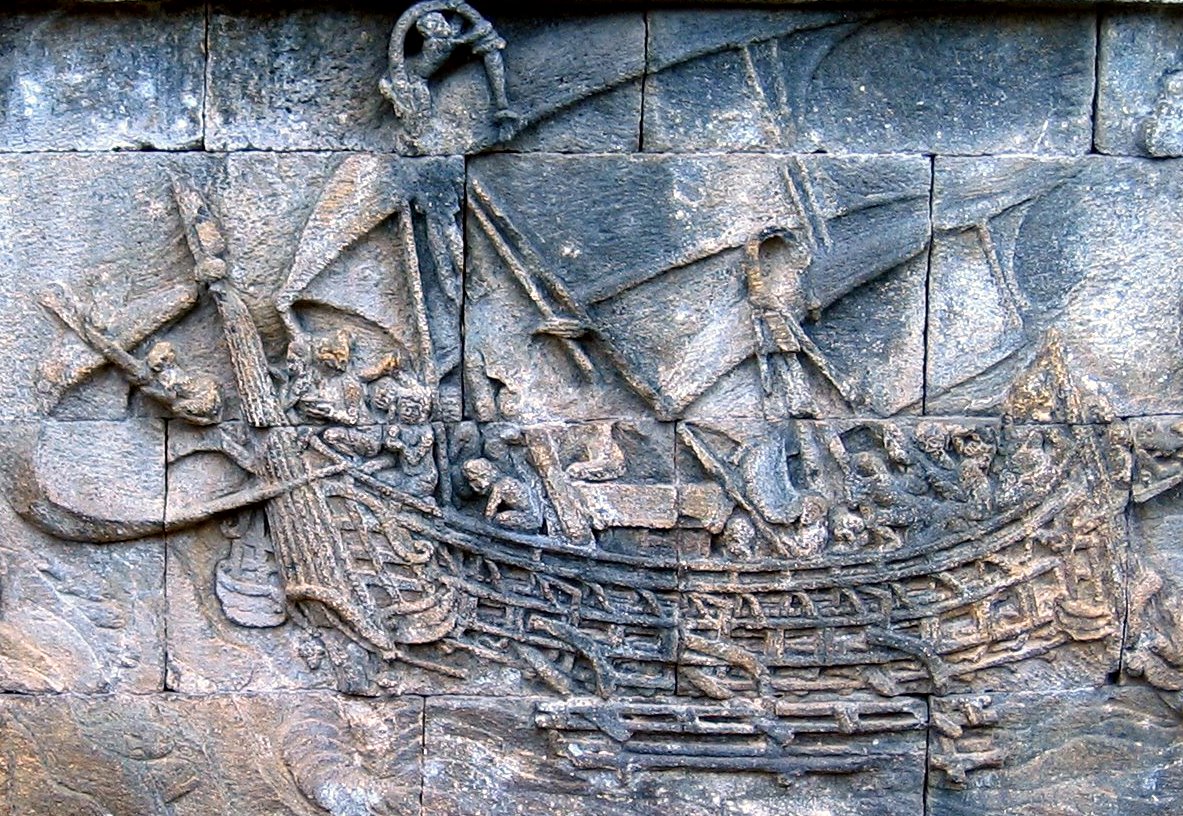
A Borobudur ship is an 8th to 9th-century wooden double outrigger sailing vessel of Maritime Southeast Asia, depicted in some bas-reliefs of the Borobudur Buddhist monument in Central Java, Indonesia. It is a ship of the Javanese people, and derivative vessels of similar size continued to be used in East Java coastal trade at least until the 1940s.
The characteristics of the ships of the Borobudur temple include: Having outriggers that are not as long as their hulls, bipod or tripod mast with a canted square sail (tanja sail), a bowsprit with a spritsail, rowing gallery (where people row by sitting or standing), deckhouse, have oculi (carved/bossed eyes), and quarter rudders. Some ships are depicted with oars, numbering at least 6, 8, or 9, and some others have none.
There are several misunderstandings about the true identity of the ships carved at Borobudur. One of the earliest misconceptions was that the ship depicted in the carving was an Indian ship. This opinion is supported by Indian and Dutch scholars who attribute the influence of India to the kingdoms of the Nusantara Archipelago ("Indianization"), so the ship depicted in the temple must have come from India. This also stems from the notion that Javanese ships are inferior to Indian ships. This argument has been debunked, the Javanese were experienced navigators and built large ships, as early as the first millennium CE (see kolandiaphonta). The characteristics actually indicate Austronesian origin: The presence of outriggers, the use of canted sails with a lower boom, the use of bipod and tripod mast, and rowing galleries.
The second opinion states that this ship may be a ship from Srivijaya or Malay. There is absolutely no evidence to support this statement. Epigraphical records of Srivijaya rarely recorded the types of watercraft, the type of Malay boat recorded is the samvau (modern Malay: Sampan) on the Kedukan Bukit inscription (683 AD) in Sumatra. Another recorded watercraft is the lancang, from 2 inscriptions on the northern coast of Bali written in the Old Balinese language dated 896 and 923 AD. Meanwhile, the Borobudur ship is only found in the Borobudur temple, which is a Javanese heritage, not Sumatran or Malay. Lastly, and most commonly believed, is the assumption that the Borobudur ship was a Majapahit ship. In fact, historical accounts of the main ships of Majapahit mention the jong, malangbang, and kelulus, all of which do not have outriggers.
Renderings of the five ships with outriggers in the Borobudur bas-reliefs (out of seven ships depicted in total) in Conradus Leemans's Boro-Boedoer (1873). Note that the ships are of different types.
Note: The following two links are dead. Could someone help please?
Borobudur ship
A Borobudur ship is an 8th to 9th-century wooden double outrigger sailing vessel of Maritime Southeast Asia, depicted in some bas-reliefs of the Borobudur Buddhist monument in Central Java, Indonesia. It is a ship of the Javanese people, and derivative vessels of similar size continued to be used in East Java coastal trade at least until the 1940s.
The characteristics of the ships of the Borobudur temple include: Having outriggers that are not as long as their hulls, bipod or tripod mast with a canted square sail (tanja sail), a bowsprit with a spritsail, rowing gallery (where people row by sitting or standing), deckhouse, have oculi (carved/bossed eyes), and quarter rudders. Some ships are depicted with oars, numbering at least 6, 8, or 9, and some others have none.
There are several misunderstandings about the true identity of the ships carved at Borobudur. One of the earliest misconceptions was that the ship depicted in the carving was an Indian ship. This opinion is supported by Indian and Dutch scholars who attribute the influence of India to the kingdoms of the Nusantara Archipelago ("Indianization"), so the ship depicted in the temple must have come from India. This also stems from the notion that Javanese ships are inferior to Indian ships. This argument has been debunked, the Javanese were experienced navigators and built large ships, as early as the first millennium CE (see kolandiaphonta). The characteristics actually indicate Austronesian origin: The presence of outriggers, the use of canted sails with a lower boom, the use of bipod and tripod mast, and rowing galleries.
The second opinion states that this ship may be a ship from Srivijaya or Malay. There is absolutely no evidence to support this statement. Epigraphical records of Srivijaya rarely recorded the types of watercraft, the type of Malay boat recorded is the samvau (modern Malay: Sampan) on the Kedukan Bukit inscription (683 AD) in Sumatra. Another recorded watercraft is the lancang, from 2 inscriptions on the northern coast of Bali written in the Old Balinese language dated 896 and 923 AD. Meanwhile, the Borobudur ship is only found in the Borobudur temple, which is a Javanese heritage, not Sumatran or Malay. Lastly, and most commonly believed, is the assumption that the Borobudur ship was a Majapahit ship. In fact, historical accounts of the main ships of Majapahit mention the jong, malangbang, and kelulus, all of which do not have outriggers.
Renderings of the five ships with outriggers in the Borobudur bas-reliefs (out of seven ships depicted in total) in Conradus Leemans's Boro-Boedoer (1873). Note that the ships are of different types.
Note: The following two links are dead. Could someone help please?
Recent media
Recent media