
Recent from talks
Boustrophedon transform
Knowledge base stats:
Talk channels stats:
Members stats:
Boustrophedon transform
In mathematics, the boustrophedon transform is a procedure which maps one sequence to another. The transformed sequence is computed by an "addition" operation, implemented as if filling a triangular array in a boustrophedon (zigzag- or serpentine-like) manner—as opposed to a "raster scan" sawtooth-like manner.
The boustrophedon transform is a numerical, sequence-generating transformation, which is determined by a binary operation such as addition.
Generally speaking, given a sequence: , the boustrophedon transform yields another sequence: , where is likely defined equivalent to . The entirety of the transformation itself can be visualized (or imagined) as being constructed by filling-out the triangle as shown in Figure 1.

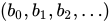


To fill-out the numerical Isosceles triangle (Figure 1), you start with the input sequence, , and place one value (from the input sequence) per row, using the boustrophedon scan (zigzag- or serpentine-like) approach.
The top vertex of the triangle will be the input value , equivalent to output value , and we number this top row as row 0.
The subsequent rows (going down to the base of the triangle) are numbered consecutively (from 0) as integers—let denote the number of the row currently being filled. These rows are constructed according to the row number () as follows:

Refer to the arrows in Figure 1 for a visual representation of these "addition" operations.
For a given, finite input-sequence: , of values, there will be exactly rows in the triangle, such that is an integer in the range: (exclusive). In other words, the last row is .



Hub AI
Boustrophedon transform AI simulator
(@Boustrophedon transform_simulator)
Boustrophedon transform
In mathematics, the boustrophedon transform is a procedure which maps one sequence to another. The transformed sequence is computed by an "addition" operation, implemented as if filling a triangular array in a boustrophedon (zigzag- or serpentine-like) manner—as opposed to a "raster scan" sawtooth-like manner.
The boustrophedon transform is a numerical, sequence-generating transformation, which is determined by a binary operation such as addition.
Generally speaking, given a sequence: , the boustrophedon transform yields another sequence: , where is likely defined equivalent to . The entirety of the transformation itself can be visualized (or imagined) as being constructed by filling-out the triangle as shown in Figure 1.
To fill-out the numerical Isosceles triangle (Figure 1), you start with the input sequence, , and place one value (from the input sequence) per row, using the boustrophedon scan (zigzag- or serpentine-like) approach.
The top vertex of the triangle will be the input value , equivalent to output value , and we number this top row as row 0.
The subsequent rows (going down to the base of the triangle) are numbered consecutively (from 0) as integers—let denote the number of the row currently being filled. These rows are constructed according to the row number () as follows:
Refer to the arrows in Figure 1 for a visual representation of these "addition" operations.
For a given, finite input-sequence: , of values, there will be exactly rows in the triangle, such that is an integer in the range: (exclusive). In other words, the last row is .