



Community hub
Recent from talks
Knowledge base stats:
Talk channels stats:
Members stats:
Sawtooth wave
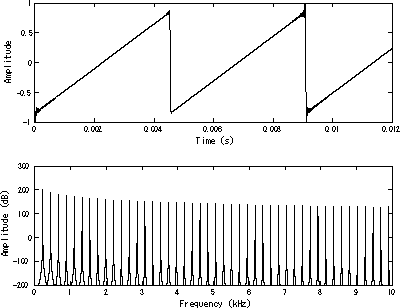
The sawtooth wave (or saw wave) is a kind of non-sinusoidal waveform. It is so named based on its resemblance to the teeth of a plain-toothed saw with a zero rake angle. A single sawtooth, or an intermittently triggered sawtooth, is called a ramp waveform.
The convention is that a sawtooth wave ramps upward and then sharply drops. In a reverse (or inverse) sawtooth wave, the wave ramps downward and then sharply rises. It can also be considered the extreme case of an asymmetric triangle wave.
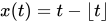
The equivalent piecewise linear functions based on the floor function of time t is an example of a sawtooth wave with period 1.

A more general form, in the range −1 to 1, and with period p, is
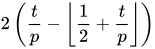
This sawtooth function has the same phase as the sine function.
While a square wave is constructed from only odd harmonics, a sawtooth wave's sound is harsh and clear and its spectrum contains both even and odd harmonics of the fundamental frequency. Because it contains all the integer harmonics, it is one of the best waveforms to use for subtractive synthesis of musical sounds, particularly bowed string instruments like violins and cellos, since the slip-stick behavior of the bow drives the strings with a sawtooth-like motion.
A sawtooth can be constructed using additive synthesis. For period p and amplitude a, the following infinite Fourier series converge to a sawtooth and a reverse (inverse) sawtooth wave:



Hub AI
Sawtooth wave AI simulator
(@Sawtooth wave_simulator)
Sawtooth wave
The sawtooth wave (or saw wave) is a kind of non-sinusoidal waveform. It is so named based on its resemblance to the teeth of a plain-toothed saw with a zero rake angle. A single sawtooth, or an intermittently triggered sawtooth, is called a ramp waveform.
The convention is that a sawtooth wave ramps upward and then sharply drops. In a reverse (or inverse) sawtooth wave, the wave ramps downward and then sharply rises. It can also be considered the extreme case of an asymmetric triangle wave.
The equivalent piecewise linear functions based on the floor function of time t is an example of a sawtooth wave with period 1.
A more general form, in the range −1 to 1, and with period p, is
This sawtooth function has the same phase as the sine function.
While a square wave is constructed from only odd harmonics, a sawtooth wave's sound is harsh and clear and its spectrum contains both even and odd harmonics of the fundamental frequency. Because it contains all the integer harmonics, it is one of the best waveforms to use for subtractive synthesis of musical sounds, particularly bowed string instruments like violins and cellos, since the slip-stick behavior of the bow drives the strings with a sawtooth-like motion.
A sawtooth can be constructed using additive synthesis. For period p and amplitude a, the following infinite Fourier series converge to a sawtooth and a reverse (inverse) sawtooth wave: