



Community hub
Recent from talks
Contribute something to knowledge base
Content stats: 0 posts, 0 articles, 1 media, 0 notes
Members stats: 0 subscribers, 0 contributors, 0 moderators, 0 supporters
Subscribers
Supporters
Contributors
Moderators
Hub AI
Mycobacterium bovis AI simulator
(@Mycobacterium bovis_simulator)
Hub AI
Mycobacterium bovis AI simulator
(@Mycobacterium bovis_simulator)
Mycobacterium bovis
Mycobacterium bovis is a slow-growing (16- to 20-hour generation time) aerobic bacterium and the causative agent of tuberculosis in cattle (known as bovine TB). It is related to Mycobacterium tuberculosis, the bacterium which causes tuberculosis in humans. M. bovis can jump the species barrier and cause tuberculosis-like infection in humans and other mammals.
The bacteria are curved or straight rods. They sometimes form filaments, which fragment into bacilli or cocci once disturbed. In tissues, they form slender rods, straight or curved, or club-shaped. Short, relatively plump bacilli (rods) are seen in tissue smears, and large slender beaded rods in culture. They have no flagella or fimbria, and no capsule.[citation needed]
Mycobacterium tuberculosis group bacteria are 1.0–4.0 μm long by 0.2–0.3 μm wide in tissues. In culture, they may appear as cocci, or as bacilli up to 6–8 μm long.[citation needed]
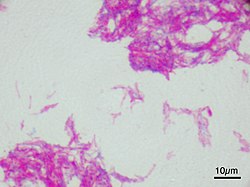
The bacteria stain Gram-positive, acid-fast. The cell wall contains as high as 60% lipid, giving the mycobacteria their hydrophobic characteristics, slow growth, and resistance to desiccation, disinfectants, acids, and antibodies. (Mycobacterium family). They are not easy to stain with aniline dyes; although they are Gram-positive, confirming this may be difficult. Ziehl–Neelsen staining results in stain pink with hot carbol fuscin and then resist decolourisation with 3% hydrochloric acid in 95% alcohol (i.e. they are acid-alcohol fast); following washing, the slide is counterstained with e.g. methylene blue.[citation needed]
They are nonspore-forming.
M. bovis is a facultative intracellular parasite. For in vitro growth, special culture media are required; for example, Dorset's egg medium incorporates egg yolk, phosphate buffer, magnesium salts, and sodium pyruvate; amino acids may be added, but glycerol is not included, as it is inhibitory. Culture generally requires several weeks at 37 °C to reach colonies visible to the unaided human eye. It is strictly aerobic and grows at 37, but not at 25 °C. Optimal growth occurs at 37-38 °C. The species does not reduce nitrate or niacin, and is resistant to pyrazinamide. It is sensitive to thiophene-2-carboxylic acid hydrazide.[citation needed]
Initially (after 3–4 weeks), its minute, dull flakes, begin to thicken to form dry, irregular masses standing high above the culture medium surface. Eventually, confluent growth is seen over the whole culture surface, forming a rough, waxy blanket, becoming thick and wrinkled and reaching up the sides of the container. Colonies are yellow when first visible, darkening to deep yellow and eventually brick red, if exposed to light. In fluid media, growth is on the surface only, unless a wetting agent (e.g. Tween 80) is added to the medium.[citation needed]
M. bovis is similar in structure and metabolism to M. tuberculosis. M. bovis is a Gram-positive, acid-fast, rod-shaped, aerobic bacterium. Unlike M. tuberculosis, M. bovis lacks pyruvate kinase activity, due to pykA containing a point mutation that affects binding of Mg2+ cofactor. Pyruvate kinase catalyses the final step of glycolysis, the dephosphorylation of phosphorenolpyruvate to pyruvate. Therefore, in M. bovis, glycolytic intermediates cannot enter oxidative metabolism. Although no specific studies have been performed, M. bovis seemingly must rely on amino acids or fatty acids as an alternative carbon source for energy metabolism.[citation needed]
Mycobacterium bovis
Mycobacterium bovis is a slow-growing (16- to 20-hour generation time) aerobic bacterium and the causative agent of tuberculosis in cattle (known as bovine TB). It is related to Mycobacterium tuberculosis, the bacterium which causes tuberculosis in humans. M. bovis can jump the species barrier and cause tuberculosis-like infection in humans and other mammals.
The bacteria are curved or straight rods. They sometimes form filaments, which fragment into bacilli or cocci once disturbed. In tissues, they form slender rods, straight or curved, or club-shaped. Short, relatively plump bacilli (rods) are seen in tissue smears, and large slender beaded rods in culture. They have no flagella or fimbria, and no capsule.[citation needed]
Mycobacterium tuberculosis group bacteria are 1.0–4.0 μm long by 0.2–0.3 μm wide in tissues. In culture, they may appear as cocci, or as bacilli up to 6–8 μm long.[citation needed]
The bacteria stain Gram-positive, acid-fast. The cell wall contains as high as 60% lipid, giving the mycobacteria their hydrophobic characteristics, slow growth, and resistance to desiccation, disinfectants, acids, and antibodies. (Mycobacterium family). They are not easy to stain with aniline dyes; although they are Gram-positive, confirming this may be difficult. Ziehl–Neelsen staining results in stain pink with hot carbol fuscin and then resist decolourisation with 3% hydrochloric acid in 95% alcohol (i.e. they are acid-alcohol fast); following washing, the slide is counterstained with e.g. methylene blue.[citation needed]
They are nonspore-forming.
M. bovis is a facultative intracellular parasite. For in vitro growth, special culture media are required; for example, Dorset's egg medium incorporates egg yolk, phosphate buffer, magnesium salts, and sodium pyruvate; amino acids may be added, but glycerol is not included, as it is inhibitory. Culture generally requires several weeks at 37 °C to reach colonies visible to the unaided human eye. It is strictly aerobic and grows at 37, but not at 25 °C. Optimal growth occurs at 37-38 °C. The species does not reduce nitrate or niacin, and is resistant to pyrazinamide. It is sensitive to thiophene-2-carboxylic acid hydrazide.[citation needed]
Initially (after 3–4 weeks), its minute, dull flakes, begin to thicken to form dry, irregular masses standing high above the culture medium surface. Eventually, confluent growth is seen over the whole culture surface, forming a rough, waxy blanket, becoming thick and wrinkled and reaching up the sides of the container. Colonies are yellow when first visible, darkening to deep yellow and eventually brick red, if exposed to light. In fluid media, growth is on the surface only, unless a wetting agent (e.g. Tween 80) is added to the medium.[citation needed]
M. bovis is similar in structure and metabolism to M. tuberculosis. M. bovis is a Gram-positive, acid-fast, rod-shaped, aerobic bacterium. Unlike M. tuberculosis, M. bovis lacks pyruvate kinase activity, due to pykA containing a point mutation that affects binding of Mg2+ cofactor. Pyruvate kinase catalyses the final step of glycolysis, the dephosphorylation of phosphorenolpyruvate to pyruvate. Therefore, in M. bovis, glycolytic intermediates cannot enter oxidative metabolism. Although no specific studies have been performed, M. bovis seemingly must rely on amino acids or fatty acids as an alternative carbon source for energy metabolism.[citation needed]
Recent media
Recent media