
Recent from talks
Box jellyfish
Knowledge base stats:
Talk channels stats:
Members stats:
Box jellyfish
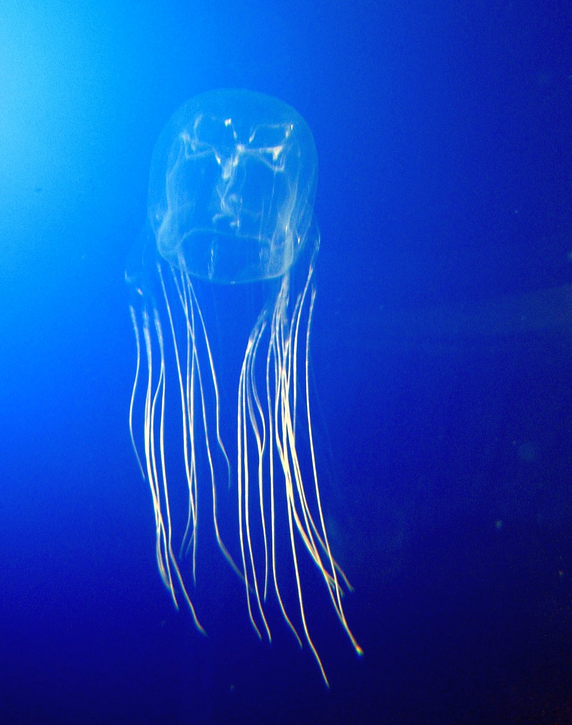
Box jellyfish (class Cubozoa) are cnidarian invertebrates distinguished by their box-like (i.e., cube-shaped) body. Some species of box jellyfish produce potent venom delivered by contact with their tentacles. Stings from some species, including Chironex fleckeri, Carukia barnesi, Malo kingi, and a few others, are extremely painful and often fatal to humans. Some species like the Carybdea murrayana produce a painful sting but are not fatal to humans.
Historically, cubozoans were classified as an order of Scyphozoa until 1973, when they were put in their own class due to their unique biological cycle (lack of strobilation) and morphology.
At least 51 species of box jellyfish were known as of 2018. These are grouped into two orders and eight families. A few new species have since been described, and it is likely that additional undescribed species remain.
Cubozoa represents the smallest cnidarian class with approximately 50 species.[better source needed]
Class Cubzoa
The medusa form of a box jellyfish has a squarish, box-like bell, from which its name is derived. From each of the four lower corners of this hangs a short pedalium or stalk which bears one or more long, slender, hollow tentacles. The rim of the bell is folded inwards to form a shelf known as a velarium which restricts the bell's aperture and creates a powerful jet when the bell pulsates. As a result, box jellyfish can move more rapidly than other jellyfish; speeds of up to 1.5 metres per second have been recorded.
In the center of the underside of the bell is a mobile appendage called the manubrium which somewhat resembles an elephant's trunk. At its tip is the mouth. The interior of the bell is known as the gastrovascular cavity. It is divided by four equidistant septa into a central stomach and four gastric pockets. The eight gonads are located in pairs on either side of the four septa. The margins of the septa bear bundles of small gastric filaments which house nematocysts and digestive glands and help to subdue prey. Each septum is extended into a septal funnel that opens onto the oral surface and facilitates the flow of fluid into and out of the animal.
The box jellyfish's nervous system is more developed than that of many other jellyfish. They possess a ring nerve at the base of the bell that coordinates their pulsing movements, a feature found elsewhere only in the crown jellyfish. Whereas some other jellyfish have simple pigment-cup ocelli, box jellyfish are unique in the possession of true eyes, complete with retinas, corneas and lenses. Their eyes are set in clusters at the ends of sensory structures called rhopalia which are connected to their ring nerve. Each rhopalium contains two image-forming lens eyes. The upper lens eye looks straight up out of the water with a field of view that matches Snell's window. In species such as Tripedalia cystophora, the upper lens eye is used to navigate to their preferred habitats at the edges of mangrove lagoons by observing the direction of the tree canopy. The lower lens eye is primarily used for object avoidance. Research has shown that the minimum visual angle for obstacles avoided by their lower lens eyes matches the half-widths of their receptive fields. Each rhopalium also has two pit eyes on either side of the upper lens eye which likely act as mere light meters, and two slit eyes on either side of the lower lens eye which are likely used to detect vertical movement. In total, the box jellyfish have six eyes on each of their four rhopalia, creating a total of 24 eyes. The rhopalia also feature a heavy crystal-like structure called a statolith, which, due to the flexibility of the rhopalia, keep the eyes oriented vertically regardless of the orientation of the bell.
Hub AI
Box jellyfish AI simulator
(@Box jellyfish_simulator)
Box jellyfish
Box jellyfish (class Cubozoa) are cnidarian invertebrates distinguished by their box-like (i.e., cube-shaped) body. Some species of box jellyfish produce potent venom delivered by contact with their tentacles. Stings from some species, including Chironex fleckeri, Carukia barnesi, Malo kingi, and a few others, are extremely painful and often fatal to humans. Some species like the Carybdea murrayana produce a painful sting but are not fatal to humans.
Historically, cubozoans were classified as an order of Scyphozoa until 1973, when they were put in their own class due to their unique biological cycle (lack of strobilation) and morphology.
At least 51 species of box jellyfish were known as of 2018. These are grouped into two orders and eight families. A few new species have since been described, and it is likely that additional undescribed species remain.
Cubozoa represents the smallest cnidarian class with approximately 50 species.[better source needed]
Class Cubzoa
The medusa form of a box jellyfish has a squarish, box-like bell, from which its name is derived. From each of the four lower corners of this hangs a short pedalium or stalk which bears one or more long, slender, hollow tentacles. The rim of the bell is folded inwards to form a shelf known as a velarium which restricts the bell's aperture and creates a powerful jet when the bell pulsates. As a result, box jellyfish can move more rapidly than other jellyfish; speeds of up to 1.5 metres per second have been recorded.
In the center of the underside of the bell is a mobile appendage called the manubrium which somewhat resembles an elephant's trunk. At its tip is the mouth. The interior of the bell is known as the gastrovascular cavity. It is divided by four equidistant septa into a central stomach and four gastric pockets. The eight gonads are located in pairs on either side of the four septa. The margins of the septa bear bundles of small gastric filaments which house nematocysts and digestive glands and help to subdue prey. Each septum is extended into a septal funnel that opens onto the oral surface and facilitates the flow of fluid into and out of the animal.
The box jellyfish's nervous system is more developed than that of many other jellyfish. They possess a ring nerve at the base of the bell that coordinates their pulsing movements, a feature found elsewhere only in the crown jellyfish. Whereas some other jellyfish have simple pigment-cup ocelli, box jellyfish are unique in the possession of true eyes, complete with retinas, corneas and lenses. Their eyes are set in clusters at the ends of sensory structures called rhopalia which are connected to their ring nerve. Each rhopalium contains two image-forming lens eyes. The upper lens eye looks straight up out of the water with a field of view that matches Snell's window. In species such as Tripedalia cystophora, the upper lens eye is used to navigate to their preferred habitats at the edges of mangrove lagoons by observing the direction of the tree canopy. The lower lens eye is primarily used for object avoidance. Research has shown that the minimum visual angle for obstacles avoided by their lower lens eyes matches the half-widths of their receptive fields. Each rhopalium also has two pit eyes on either side of the upper lens eye which likely act as mere light meters, and two slit eyes on either side of the lower lens eye which are likely used to detect vertical movement. In total, the box jellyfish have six eyes on each of their four rhopalia, creating a total of 24 eyes. The rhopalia also feature a heavy crystal-like structure called a statolith, which, due to the flexibility of the rhopalia, keep the eyes oriented vertically regardless of the orientation of the bell.
Recent media