
Recent from talks
Bozeman Trail
Knowledge base stats:
Talk channels stats:
Members stats:
Bozeman Trail
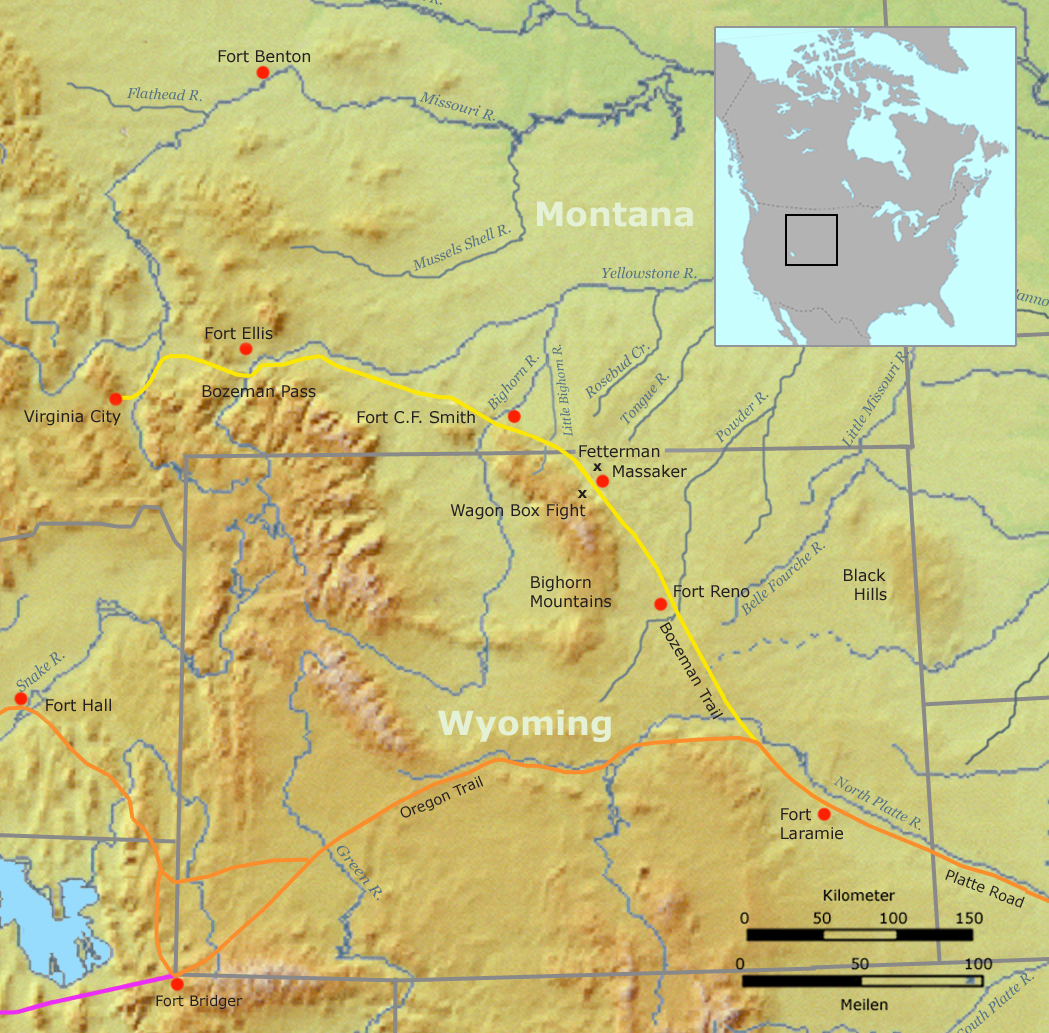
The Bozeman Trail was an overland route in the Western United States, connecting the gold rush territory of southern Montana to the Oregon Trail in eastern Wyoming. Its important period was from 1863 to 1868. While the major part of the route used by Bozeman Trail travelers in 1864 was pioneered by Allen Hurlbut, it was named after John Bozeman. Many miles of the Bozeman Trail in present Montana followed the tracks of Bridger Trail, opened by Jim Bridger in 1864.
The flow of pioneers and settlers through territory of Native Americans provoked fear and anger in the local tribes; some of whom chose to respond with aggressive, and even violent action. The challengers to the route were newly arrived Lakotas and their Native allies, the Arapahoe and the Cheyenne. The United States put emphasis on a right to "establish roads, military and other posts" as described in Article 2 in the Fort Laramie Treaty of 1851. All parties in the conflict had signed that treaty. The Crow Natives held the treaty right to the contested area and had called it their homeland for decades. They sided with the whites. The U.S. Army undertook several military campaigns against the hostile Natives to try to control the trail. Because of its association with frontier history and conflict with American Natives, various segments of the trail are listed on the National Register of Historic Places (NRHP).
In 1863, John Bozeman and John Jacobs scouted for a direct route from Virginia City, Montana to central Wyoming to connect with the Oregon Trail, then the major passage to the West Coast. Before this, most access to the southwestern Montana Territory was from St. Louis via the Missouri River to Fort Benton. Thence travelers went by the 'Benton Road,' around the Great Falls and through the Chestnut, Hilger and Prickly Pear valleys (current site of Helena and Broadwater County, Montana).
The overland Bozeman Trail followed many north–south trails the American Natives had used since prehistoric times to travel through Powder River Country. This route was more direct and better watered than any previous trail into Montana. Bozeman's and Jacobs's most important contribution was to improve the trail so that it was wide enough for wagons. But there was a major drawback — the trail passed directly through territory occupied by the Shoshone, Arapaho, and Lakota nations.
Decades before the Bozeman Trail cut through the plains of present Wyoming, the expanse "... was made busy by Crows and white trappers and traders ...". According to the Fort Laramie Treaty of 1851, most of the Bozeman Trail ran across native Crow territory established by treaty. "For the Crows, the Bozeman Trail introduced them to a relationship [emigrants and army personnel] that would profoundly affect the tribe in coming decades".
To complicate the matter, the southeastern part of the 1851 Crow domain was taken over by the Arapahoe, the Cheyenne and the Lakota. They had invaded the western Powder River area during the 1850s and after "large scale battles" won this buffalo rich Native land from the original tribe around 1860. The principal Bozeman Trail conflict took place along the roughly 250 miles (400 km) of southern wagon wheel tracks through this particular area. Usually, the emigrants could breathe again, when they started on the last nearly 190 miles (310 km) of the trail westward from the crossing of the Bighorn River to the city of Bozeman.
During the few years the trail was open to emigrants, 3,500 traveled it. Natives killed between 40 and 50 of them. The short cut was at the time "most often called the road to Montana" and not the Bozeman Trail. While short in bee line, the actual road from the Oregon Trail to the mining towns was much longer due to the hilly and undulating terrain. Shorter or longer stretches of the route were altered every year to avoid the worst stages. The journey took around eight weeks. Many of the travelers had prepared themselves for the arduous trip by reading John Lyle Campbell's popular guidebook. Drowning and fatal accidents with firearms occurred. Some travelers came down with critical diseases such as "mountain fever" (Colorado tick fever) and never made it to their destination. Game including elk, mountain sheep and bear was shot an occasion, also buffalo. "The men are killing them in large numbers. I feel sorry to see such destruction. They leave tons of good meat every day to be devoured by wolfs at night", lamented traveler Richard Owen in 1864. The travelers grouped in organized "trains" with chosen people holding posts such as captain, train marshal and orderly sergeant. One group, known as the Townsend Wagon Train, led by Captain A. A. Townsend of Wisconsin, was made up of "wagons ... 150, men ... 375, women ... 36, children ... 36, oxen ... 636". Every fifth of those crossing the plains via Bozeman Trail was a woman or a child. Each wagon paid the train pilot, maybe six dollars in 1864. Being a route used by single emigrants and small families at first, the trail transformed towards a supply route with freight wagons carrying equipment and necessities of life to the new, western towns.
Bozeman led the first wagon train on the trail in 1864. Abasalom Austin Townsend was captain of another very large wagon train (over 400 people and 150+ wagons) and had a battle with the Natives. Known as the Townsend Wagon Train Fight, the attack occurred on July 7, 1864, with casualties on both sides. Native raids on white settlers increased dramatically from 1864 to 1866, which prompted the U.S. government to order the Army to carry out military campaigns against the Shoshone. Patrick Edward Connor led several of the earliest campaigns, including the Bear River Massacre. and the Powder River Expedition of 1865. He also fought the Arapaho at the Battle of the Tongue River.
Hub AI
Bozeman Trail AI simulator
(@Bozeman Trail_simulator)
Bozeman Trail
The Bozeman Trail was an overland route in the Western United States, connecting the gold rush territory of southern Montana to the Oregon Trail in eastern Wyoming. Its important period was from 1863 to 1868. While the major part of the route used by Bozeman Trail travelers in 1864 was pioneered by Allen Hurlbut, it was named after John Bozeman. Many miles of the Bozeman Trail in present Montana followed the tracks of Bridger Trail, opened by Jim Bridger in 1864.
The flow of pioneers and settlers through territory of Native Americans provoked fear and anger in the local tribes; some of whom chose to respond with aggressive, and even violent action. The challengers to the route were newly arrived Lakotas and their Native allies, the Arapahoe and the Cheyenne. The United States put emphasis on a right to "establish roads, military and other posts" as described in Article 2 in the Fort Laramie Treaty of 1851. All parties in the conflict had signed that treaty. The Crow Natives held the treaty right to the contested area and had called it their homeland for decades. They sided with the whites. The U.S. Army undertook several military campaigns against the hostile Natives to try to control the trail. Because of its association with frontier history and conflict with American Natives, various segments of the trail are listed on the National Register of Historic Places (NRHP).
In 1863, John Bozeman and John Jacobs scouted for a direct route from Virginia City, Montana to central Wyoming to connect with the Oregon Trail, then the major passage to the West Coast. Before this, most access to the southwestern Montana Territory was from St. Louis via the Missouri River to Fort Benton. Thence travelers went by the 'Benton Road,' around the Great Falls and through the Chestnut, Hilger and Prickly Pear valleys (current site of Helena and Broadwater County, Montana).
The overland Bozeman Trail followed many north–south trails the American Natives had used since prehistoric times to travel through Powder River Country. This route was more direct and better watered than any previous trail into Montana. Bozeman's and Jacobs's most important contribution was to improve the trail so that it was wide enough for wagons. But there was a major drawback — the trail passed directly through territory occupied by the Shoshone, Arapaho, and Lakota nations.
Decades before the Bozeman Trail cut through the plains of present Wyoming, the expanse "... was made busy by Crows and white trappers and traders ...". According to the Fort Laramie Treaty of 1851, most of the Bozeman Trail ran across native Crow territory established by treaty. "For the Crows, the Bozeman Trail introduced them to a relationship [emigrants and army personnel] that would profoundly affect the tribe in coming decades".
To complicate the matter, the southeastern part of the 1851 Crow domain was taken over by the Arapahoe, the Cheyenne and the Lakota. They had invaded the western Powder River area during the 1850s and after "large scale battles" won this buffalo rich Native land from the original tribe around 1860. The principal Bozeman Trail conflict took place along the roughly 250 miles (400 km) of southern wagon wheel tracks through this particular area. Usually, the emigrants could breathe again, when they started on the last nearly 190 miles (310 km) of the trail westward from the crossing of the Bighorn River to the city of Bozeman.
During the few years the trail was open to emigrants, 3,500 traveled it. Natives killed between 40 and 50 of them. The short cut was at the time "most often called the road to Montana" and not the Bozeman Trail. While short in bee line, the actual road from the Oregon Trail to the mining towns was much longer due to the hilly and undulating terrain. Shorter or longer stretches of the route were altered every year to avoid the worst stages. The journey took around eight weeks. Many of the travelers had prepared themselves for the arduous trip by reading John Lyle Campbell's popular guidebook. Drowning and fatal accidents with firearms occurred. Some travelers came down with critical diseases such as "mountain fever" (Colorado tick fever) and never made it to their destination. Game including elk, mountain sheep and bear was shot an occasion, also buffalo. "The men are killing them in large numbers. I feel sorry to see such destruction. They leave tons of good meat every day to be devoured by wolfs at night", lamented traveler Richard Owen in 1864. The travelers grouped in organized "trains" with chosen people holding posts such as captain, train marshal and orderly sergeant. One group, known as the Townsend Wagon Train, led by Captain A. A. Townsend of Wisconsin, was made up of "wagons ... 150, men ... 375, women ... 36, children ... 36, oxen ... 636". Every fifth of those crossing the plains via Bozeman Trail was a woman or a child. Each wagon paid the train pilot, maybe six dollars in 1864. Being a route used by single emigrants and small families at first, the trail transformed towards a supply route with freight wagons carrying equipment and necessities of life to the new, western towns.
Bozeman led the first wagon train on the trail in 1864. Abasalom Austin Townsend was captain of another very large wagon train (over 400 people and 150+ wagons) and had a battle with the Natives. Known as the Townsend Wagon Train Fight, the attack occurred on July 7, 1864, with casualties on both sides. Native raids on white settlers increased dramatically from 1864 to 1866, which prompted the U.S. government to order the Army to carry out military campaigns against the Shoshone. Patrick Edward Connor led several of the earliest campaigns, including the Bear River Massacre. and the Powder River Expedition of 1865. He also fought the Arapaho at the Battle of the Tongue River.
Recent media