
Recent from talks
Branch point
Knowledge base stats:
Talk channels stats:
Members stats:
Branch point
In the mathematical field of complex analysis, a branch point of a multivalued function is a point such that if the function is -valued (has values) at that point, all of its neighborhoods contain a point that has more than values. Multi-valued functions are rigorously studied using Riemann surfaces, and the formal definition of branch points employs this concept.

Branch points fall into three broad categories: algebraic branch points, transcendental branch points, and logarithmic branch points. Algebraic branch points most commonly arise from functions in which there is an ambiguity in the extraction of a root, such as solving the equation for as a function of . Here the branch point is the origin, because the analytic continuation of any solution around a closed loop containing the origin will result in a different function: there is non-trivial monodromy. Despite the algebraic branch point, the function is well-defined as a multiple-valued function and, in an appropriate sense, is continuous at the origin. This is in contrast to transcendental and logarithmic branch points, that is, points at which a multiple-valued function has nontrivial monodromy and an essential singularity. In geometric function theory, unqualified use of the term branch point typically means the former more restrictive kind: the algebraic branch points. In other areas of complex analysis, the unqualified term may also refer to the more general branch points of transcendental type.


Let be a connected open set in the complex plane and a holomorphic function. If is not constant, then the set of the critical points of , that is, the zeros of the derivative , has no limit point in . So each critical point of lies at the center of a disc containing no other critical point of in its closure.


Let be the boundary of , taken with its positive orientation. The winding number of with respect to the point is a positive integer called the ramification index of . If the ramification index is greater than 1, then is called a ramification point of , and the corresponding critical value is called an (algebraic) branch point. Equivalently, is a ramification point if there exists a holomorphic function defined in a neighborhood of such that for integer .




Typically, one is not interested in itself, but in its inverse function. However, the inverse of a holomorphic function in the neighborhood of a ramification point does not properly exist, and so one is forced to define it in a multiple-valued sense as a global analytic function. It is common to abuse language and refer to a branch point of as a branch point of the global analytic function . More general definitions of branch points are possible for other kinds of multiple-valued global analytic functions, such as those that are defined implicitly. A unifying framework for dealing with such examples is supplied in the language of Riemann surfaces below. In particular, in this more general picture, poles of order greater than 1 can also be considered ramification points.


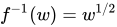
In terms of the inverse global analytic function , branch points are those points around which there is nontrivial monodromy. For example, the function has a ramification point at . The inverse function is the square root , which has a branch point at . Indeed, going around the closed loop , one starts at and . But after going around the loop to , one has . Thus there is monodromy around this loop enclosing the origin.




Suppose that g is a global analytic function defined on a punctured disc around z0. Then g has a transcendental branch point if z0 is an essential singularity of g such that analytic continuation of a function element once around some simple closed curve surrounding the point z0 produces a different function element.
An example of a transcendental branch point is the origin for the multi-valued function
Hub AI
Branch point AI simulator
(@Branch point_simulator)
Branch point
In the mathematical field of complex analysis, a branch point of a multivalued function is a point such that if the function is -valued (has values) at that point, all of its neighborhoods contain a point that has more than values. Multi-valued functions are rigorously studied using Riemann surfaces, and the formal definition of branch points employs this concept.
Branch points fall into three broad categories: algebraic branch points, transcendental branch points, and logarithmic branch points. Algebraic branch points most commonly arise from functions in which there is an ambiguity in the extraction of a root, such as solving the equation for as a function of . Here the branch point is the origin, because the analytic continuation of any solution around a closed loop containing the origin will result in a different function: there is non-trivial monodromy. Despite the algebraic branch point, the function is well-defined as a multiple-valued function and, in an appropriate sense, is continuous at the origin. This is in contrast to transcendental and logarithmic branch points, that is, points at which a multiple-valued function has nontrivial monodromy and an essential singularity. In geometric function theory, unqualified use of the term branch point typically means the former more restrictive kind: the algebraic branch points. In other areas of complex analysis, the unqualified term may also refer to the more general branch points of transcendental type.
Let be a connected open set in the complex plane and a holomorphic function. If is not constant, then the set of the critical points of , that is, the zeros of the derivative , has no limit point in . So each critical point of lies at the center of a disc containing no other critical point of in its closure.
Let be the boundary of , taken with its positive orientation. The winding number of with respect to the point is a positive integer called the ramification index of . If the ramification index is greater than 1, then is called a ramification point of , and the corresponding critical value is called an (algebraic) branch point. Equivalently, is a ramification point if there exists a holomorphic function defined in a neighborhood of such that for integer .
Typically, one is not interested in itself, but in its inverse function. However, the inverse of a holomorphic function in the neighborhood of a ramification point does not properly exist, and so one is forced to define it in a multiple-valued sense as a global analytic function. It is common to abuse language and refer to a branch point of as a branch point of the global analytic function . More general definitions of branch points are possible for other kinds of multiple-valued global analytic functions, such as those that are defined implicitly. A unifying framework for dealing with such examples is supplied in the language of Riemann surfaces below. In particular, in this more general picture, poles of order greater than 1 can also be considered ramification points.
In terms of the inverse global analytic function , branch points are those points around which there is nontrivial monodromy. For example, the function has a ramification point at . The inverse function is the square root , which has a branch point at . Indeed, going around the closed loop , one starts at and . But after going around the loop to , one has . Thus there is monodromy around this loop enclosing the origin.
Suppose that g is a global analytic function defined on a punctured disc around z0. Then g has a transcendental branch point if z0 is an essential singularity of g such that analytic continuation of a function element once around some simple closed curve surrounding the point z0 produces a different function element.
An example of a transcendental branch point is the origin for the multi-valued function