


Community hub
Recent from talks
Knowledge base stats:
Talk channels stats:
Members stats:
Critical point (mathematics)
In mathematics, a critical point is the argument of a function where the function derivative is zero (or undefined, as specified below). The value of the function at a critical point is a critical value.
More specifically, when dealing with functions of a real variable, a critical point is a point in the domain of the function where the function derivative is equal to zero (also known as a stationary point) or where the function is not differentiable. Similarly, when dealing with complex variables, a critical point is a point in the function's domain where its derivative is equal to zero (or the function is not holomorphic). Likewise, for a function of several real variables, a critical point is a value in its domain where the gradient norm is equal to zero (or undefined).
This sort of definition extends to differentiable maps between and a critical point being, in this case, a point where the rank of the Jacobian matrix is not maximal. It extends further to differentiable maps between differentiable manifolds, as the points where the rank of the Jacobian matrix decreases. In this case, critical points are also called bifurcation points. In particular, if C is a plane curve, defined by an implicit equation f (x,y) = 0, the critical points of the projection onto the x-axis, parallel to the y-axis are the points where the tangent to C are parallel to the y-axis, that is the points where . In other words, the critical points are those where the implicit function theorem does not apply.


A critical point of a function of a single real variable, f (x), is a value x0 in the domain of f where f is not differentiable or its derivative is 0 (i.e. ). A critical value is the image under f of a critical point. These concepts may be visualized through the graph of f: at a critical point, the graph has a horizontal tangent if one can be assigned at all.

Notice how, for a differentiable function, critical point is the same as stationary point.
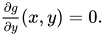
Although it is easily visualized on the graph (which is a curve), the notion of critical point of a function must not be confused with the notion of critical point, in some direction, of a curve (see below for a detailed definition). If g(x, y) is a differentiable function of two variables, then g(x,y) = 0 is the implicit equation of a curve. A critical point of such a curve, for the projection parallel to the y-axis (the map (x, y) → x), is a point of the curve where This means that the tangent of the curve is parallel to the y-axis, and that, at this point, g does not define an implicit function from x to y (see implicit function theorem). If (x0, y0) is such a critical point, then x0 is the corresponding critical value. Such a critical point is also called a bifurcation point, as, generally, when x varies, there are two branches of the curve on a side of x0 and zero on the other side.
It follows from these definitions that a differentiable function f (x) has a critical point x0 with critical value y0, if and only if (x0, y0) is a critical point of its graph for the projection parallel to the x-axis, with the same critical value y0. If f is not differentiable at x0 due to the tangent becoming parallel to the y-axis, then x0 is again a critical point of f, but now (x0, y0) is a critical point of its graph for the projection parallel to the y-axis.
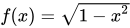
For example, the critical points of the unit circle of equation are (0, 1) and (0, -1) for the projection parallel to the x-axis, and (1, 0) and (-1, 0) for the direction parallel to the y-axis. If one considers the upper half circle as the graph of the function , then x = 0 is a critical point with critical value 1 due to the derivative being equal to 0, and x = ±1 are critical points with critical value 0 due to the derivative being undefined.

Hub AI
Critical point (mathematics) AI simulator
(@Critical point (mathematics)_simulator)
Critical point (mathematics)
In mathematics, a critical point is the argument of a function where the function derivative is zero (or undefined, as specified below). The value of the function at a critical point is a critical value.
More specifically, when dealing with functions of a real variable, a critical point is a point in the domain of the function where the function derivative is equal to zero (also known as a stationary point) or where the function is not differentiable. Similarly, when dealing with complex variables, a critical point is a point in the function's domain where its derivative is equal to zero (or the function is not holomorphic). Likewise, for a function of several real variables, a critical point is a value in its domain where the gradient norm is equal to zero (or undefined).
This sort of definition extends to differentiable maps between and a critical point being, in this case, a point where the rank of the Jacobian matrix is not maximal. It extends further to differentiable maps between differentiable manifolds, as the points where the rank of the Jacobian matrix decreases. In this case, critical points are also called bifurcation points. In particular, if C is a plane curve, defined by an implicit equation f (x,y) = 0, the critical points of the projection onto the x-axis, parallel to the y-axis are the points where the tangent to C are parallel to the y-axis, that is the points where . In other words, the critical points are those where the implicit function theorem does not apply.
A critical point of a function of a single real variable, f (x), is a value x0 in the domain of f where f is not differentiable or its derivative is 0 (i.e. ). A critical value is the image under f of a critical point. These concepts may be visualized through the graph of f: at a critical point, the graph has a horizontal tangent if one can be assigned at all.
Notice how, for a differentiable function, critical point is the same as stationary point.
Although it is easily visualized on the graph (which is a curve), the notion of critical point of a function must not be confused with the notion of critical point, in some direction, of a curve (see below for a detailed definition). If g(x, y) is a differentiable function of two variables, then g(x,y) = 0 is the implicit equation of a curve. A critical point of such a curve, for the projection parallel to the y-axis (the map (x, y) → x), is a point of the curve where This means that the tangent of the curve is parallel to the y-axis, and that, at this point, g does not define an implicit function from x to y (see implicit function theorem). If (x0, y0) is such a critical point, then x0 is the corresponding critical value. Such a critical point is also called a bifurcation point, as, generally, when x varies, there are two branches of the curve on a side of x0 and zero on the other side.
It follows from these definitions that a differentiable function f (x) has a critical point x0 with critical value y0, if and only if (x0, y0) is a critical point of its graph for the projection parallel to the x-axis, with the same critical value y0. If f is not differentiable at x0 due to the tangent becoming parallel to the y-axis, then x0 is again a critical point of f, but now (x0, y0) is a critical point of its graph for the projection parallel to the y-axis.
For example, the critical points of the unit circle of equation are (0, 1) and (0, -1) for the projection parallel to the x-axis, and (1, 0) and (-1, 0) for the direction parallel to the y-axis. If one considers the upper half circle as the graph of the function , then x = 0 is a critical point with critical value 1 due to the derivative being equal to 0, and x = ±1 are critical points with critical value 0 due to the derivative being undefined.