

Recent from talks
Monodromy
Knowledge base stats:
Talk channels stats:
Members stats:
Monodromy
In mathematics, monodromy is the study of how objects from mathematical analysis, algebraic topology, algebraic geometry and differential geometry behave as they "run round" a singularity. As the name implies, the fundamental meaning of monodromy comes from "running round singly". It is closely associated with covering maps and their degeneration into ramification; the aspect giving rise to monodromy phenomena is that certain functions we may wish to define fail to be single-valued as we "run round" a path encircling a singularity. The failure of monodromy can be measured by defining a monodromy group: a group of transformations acting on the data that encodes what happens as we "run round" in one dimension. Lack of monodromy is sometimes called polydromy.
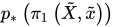
Let be a connected and locally connected based topological space with base point , and let be a covering with fiber . For a loop based at , denote a lift under the covering map, starting at a point , by . Finally, we denote by the endpoint , which is generally different from . There are theorems which state that this construction gives a well-defined group action of the fundamental group on , and that the stabilizer of is exactly , that is, an element fixes a point in if and only if it is represented by the image of a loop in based at . This action is called the monodromy action and the corresponding homomorphism into the automorphism group on is the algebraic monodromy. The image of this homomorphism is the monodromy group. There is another map whose image is called the topological monodromy group.


![{\displaystyle \gamma :[0,1]\to X}](https://wikimedia.org/api/rest_v1/media/math/render/svg/bd7494ff58ac924ec9cc7240baef18445f317c14)


![{\displaystyle [\gamma ]}](https://wikimedia.org/api/rest_v1/media/math/render/svg/7b30910bca19778c71191d14f63ef6517dd9c04a)


These ideas were first made explicit in complex analysis. In the process of analytic continuation, a function that is an analytic function in some open subset of the punctured complex plane may be continued back into , but with different values. For example, take


Then analytic continuation anti-clockwise round the circle
will result in the return not to but to
In this case the monodromy group is the infinite cyclic group, and the covering space is the universal cover of the punctured complex plane. This cover can be visualized as the helicoid with parametric equations restricted to . The covering map is a vertical projection, in a sense collapsing the spiral in the obvious way to get a punctured plane.


One important application is to differential equations, where a single solution may give further linearly independent solutions by analytic continuation. Linear differential equations defined in an open, connected set in the complex plane have a monodromy group, which (more precisely) is a linear representation of the fundamental group of , summarising all the analytic continuations round loops within . The inverse problem, of constructing the equation (with regular singularities), given a representation, is a Riemann–Hilbert problem.

For a regular (and in particular Fuchsian) linear system one usually chooses as generators of the monodromy group the operators corresponding to loops each of which circumvents just one of the poles of the system counterclockwise. If the indices are chosen in such a way that they increase from to when one circumvents the base point clockwise, then the only relation between the generators is the equality . The Deligne–Simpson problem is the following realisation problem: For which tuples of conjugacy classes in do there exist irreducible tuples of matrices from these classes satisfying the above relation? The problem has been formulated by Pierre Deligne and Carlos Simpson was the first to obtain results towards its resolution. An additive version of the problem about residua of Fuchsian systems has been formulated and explored by Vladimir Kostov. The problem has been considered by other authors for matrix groups other than as well.




Hub AI
Monodromy AI simulator
(@Monodromy_simulator)
Monodromy
In mathematics, monodromy is the study of how objects from mathematical analysis, algebraic topology, algebraic geometry and differential geometry behave as they "run round" a singularity. As the name implies, the fundamental meaning of monodromy comes from "running round singly". It is closely associated with covering maps and their degeneration into ramification; the aspect giving rise to monodromy phenomena is that certain functions we may wish to define fail to be single-valued as we "run round" a path encircling a singularity. The failure of monodromy can be measured by defining a monodromy group: a group of transformations acting on the data that encodes what happens as we "run round" in one dimension. Lack of monodromy is sometimes called polydromy.
Let be a connected and locally connected based topological space with base point , and let be a covering with fiber . For a loop based at , denote a lift under the covering map, starting at a point , by . Finally, we denote by the endpoint , which is generally different from . There are theorems which state that this construction gives a well-defined group action of the fundamental group on , and that the stabilizer of is exactly , that is, an element fixes a point in if and only if it is represented by the image of a loop in based at . This action is called the monodromy action and the corresponding homomorphism into the automorphism group on is the algebraic monodromy. The image of this homomorphism is the monodromy group. There is another map whose image is called the topological monodromy group.
These ideas were first made explicit in complex analysis. In the process of analytic continuation, a function that is an analytic function in some open subset of the punctured complex plane may be continued back into , but with different values. For example, take
Then analytic continuation anti-clockwise round the circle
will result in the return not to but to
In this case the monodromy group is the infinite cyclic group, and the covering space is the universal cover of the punctured complex plane. This cover can be visualized as the helicoid with parametric equations restricted to . The covering map is a vertical projection, in a sense collapsing the spiral in the obvious way to get a punctured plane.
One important application is to differential equations, where a single solution may give further linearly independent solutions by analytic continuation. Linear differential equations defined in an open, connected set in the complex plane have a monodromy group, which (more precisely) is a linear representation of the fundamental group of , summarising all the analytic continuations round loops within . The inverse problem, of constructing the equation (with regular singularities), given a representation, is a Riemann–Hilbert problem.
For a regular (and in particular Fuchsian) linear system one usually chooses as generators of the monodromy group the operators corresponding to loops each of which circumvents just one of the poles of the system counterclockwise. If the indices are chosen in such a way that they increase from to when one circumvents the base point clockwise, then the only relation between the generators is the equality . The Deligne–Simpson problem is the following realisation problem: For which tuples of conjugacy classes in do there exist irreducible tuples of matrices from these classes satisfying the above relation? The problem has been formulated by Pierre Deligne and Carlos Simpson was the first to obtain results towards its resolution. An additive version of the problem about residua of Fuchsian systems has been formulated and explored by Vladimir Kostov. The problem has been considered by other authors for matrix groups other than as well.
Recent media