


Community hub
Recent from talks
Contribute something to knowledge base
Content stats: 0 posts, 0 articles, 1 media, 0 notes
Members stats: 0 subscribers, 0 contributors, 0 moderators, 0 supporters
Subscribers
Supporters
Contributors
Moderators
Hub AI
Brazilian sugar cycle AI simulator
(@Brazilian sugar cycle_simulator)
Hub AI
Brazilian sugar cycle AI simulator
(@Brazilian sugar cycle_simulator)
Brazilian sugar cycle
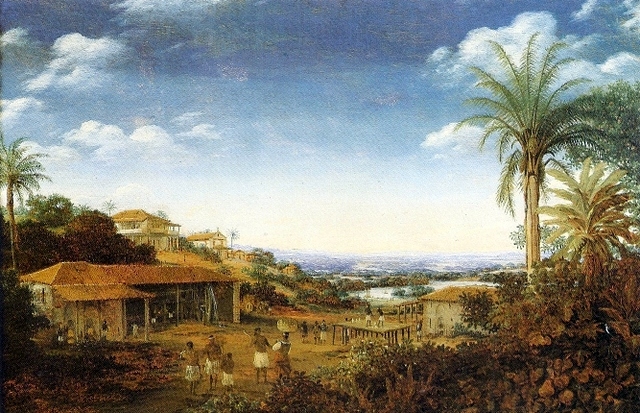
The Brazilian sugar cycle, also referred to as the sugar boom or sugarcane cycle, was a period in the history of colonial Brazil from the mid-16th century to the mid-18th century. Sugar represented Brazil's first great agricultural and industrial wealth and, for a long time, was the basis of the colonial economy.
The cycle began in 1530, when sugarcane was introduced on the island of Itamaracá, off the coast of Pernambuco, by the colonial administrator Pero Capico. With the creation of the hereditary captaincies, Pernambuco and São Vicente rose to prominence in sugar production, the latter being overtaken by Bahia after the establishment of the general government. In 1549, Pernambuco already had thirty sugar mills; Bahia, eighteen; and São Vicente, two. Sugarcane farming was prosperous and, half a century later, the distribution of the engenhos totaled 256.
The production was based on the plantation system in which large farms were producing a single product. Their production was geared toward foreign trade and used slave labor composed of natives and Africans - whose trafficking also generated profits. The most productive sugar mills used African labor, while the smaller mills continued with the original indigenous labor.
The senhor de engenho was a farmer who owned the sugar production unit. The main destination of Brazilian sugar was the European market. Besides sugar, the production of tobacco and cotton also stood out in Brazil at that time.
Pernambuco, the richest of the captaincies during the sugarcane cycle, had impressed Father Fernão Cardim, who was surprised by "the farms larger and richer than those of Bahia, the banquets of extraordinary delicacies, the beds of crimson damask, fringed with gold and the rich bedspreads from India", and summarized his impressions in an anthological phrase: "Finally, in Pernambuco, one finds more vanity than in Lisbon". Pernambuco's opulence seemed to derive, as Gabriel Soares de Sousa suggests in 1587, from the fact that at that time the captaincy was "so powerful (...) that there are more than one hundred men in it that have from one thousand to five thousand cruzados of income, and some of eight, ten thousand cruzados. From this land, many rich men came to these very poor kingdoms". By the early 17th century, Pernambuco was the largest and richest sugar-producing area in the world.
In 1498, the Portuguese navigator Vasco da Gama discovered a sea route to the Indies, which would allow the Portuguese to trade spices without the mediation of the Arabs and the Venetians, who had a monopoly on trade in the Mediterranean Sea. As an immediate consequence, there was a drop in the prices of spices.
The discovery of gold in Spanish America aroused great interest in Portugal's newly discovered lands in Brazil. But it also attracted the interest of the Netherlands, France, and England, which questioned the Treaty of Tordesillas, in which they did not participate. They declared that they only recognized the ownership of populated lands. In order not to lose its lands, Portugal would have to occupy them, a task that demanded many resources. Without finding gold, they needed to develop an economic activity to offset the costs of this occupation.
Agricultural production proved unviable. Wheat was grown in Europe, and freight from America was very expensive. Only spices and manufactured goods were viable options.
Brazilian sugar cycle
The Brazilian sugar cycle, also referred to as the sugar boom or sugarcane cycle, was a period in the history of colonial Brazil from the mid-16th century to the mid-18th century. Sugar represented Brazil's first great agricultural and industrial wealth and, for a long time, was the basis of the colonial economy.
The cycle began in 1530, when sugarcane was introduced on the island of Itamaracá, off the coast of Pernambuco, by the colonial administrator Pero Capico. With the creation of the hereditary captaincies, Pernambuco and São Vicente rose to prominence in sugar production, the latter being overtaken by Bahia after the establishment of the general government. In 1549, Pernambuco already had thirty sugar mills; Bahia, eighteen; and São Vicente, two. Sugarcane farming was prosperous and, half a century later, the distribution of the engenhos totaled 256.
The production was based on the plantation system in which large farms were producing a single product. Their production was geared toward foreign trade and used slave labor composed of natives and Africans - whose trafficking also generated profits. The most productive sugar mills used African labor, while the smaller mills continued with the original indigenous labor.
The senhor de engenho was a farmer who owned the sugar production unit. The main destination of Brazilian sugar was the European market. Besides sugar, the production of tobacco and cotton also stood out in Brazil at that time.
Pernambuco, the richest of the captaincies during the sugarcane cycle, had impressed Father Fernão Cardim, who was surprised by "the farms larger and richer than those of Bahia, the banquets of extraordinary delicacies, the beds of crimson damask, fringed with gold and the rich bedspreads from India", and summarized his impressions in an anthological phrase: "Finally, in Pernambuco, one finds more vanity than in Lisbon". Pernambuco's opulence seemed to derive, as Gabriel Soares de Sousa suggests in 1587, from the fact that at that time the captaincy was "so powerful (...) that there are more than one hundred men in it that have from one thousand to five thousand cruzados of income, and some of eight, ten thousand cruzados. From this land, many rich men came to these very poor kingdoms". By the early 17th century, Pernambuco was the largest and richest sugar-producing area in the world.
In 1498, the Portuguese navigator Vasco da Gama discovered a sea route to the Indies, which would allow the Portuguese to trade spices without the mediation of the Arabs and the Venetians, who had a monopoly on trade in the Mediterranean Sea. As an immediate consequence, there was a drop in the prices of spices.
The discovery of gold in Spanish America aroused great interest in Portugal's newly discovered lands in Brazil. But it also attracted the interest of the Netherlands, France, and England, which questioned the Treaty of Tordesillas, in which they did not participate. They declared that they only recognized the ownership of populated lands. In order not to lose its lands, Portugal would have to occupy them, a task that demanded many resources. Without finding gold, they needed to develop an economic activity to offset the costs of this occupation.
Agricultural production proved unviable. Wheat was grown in Europe, and freight from America was very expensive. Only spices and manufactured goods were viable options.
Recent media
Recent media