
Recent from talks
British Rail Class 156
Knowledge base stats:
Talk channels stats:
Members stats:
British Rail Class 156
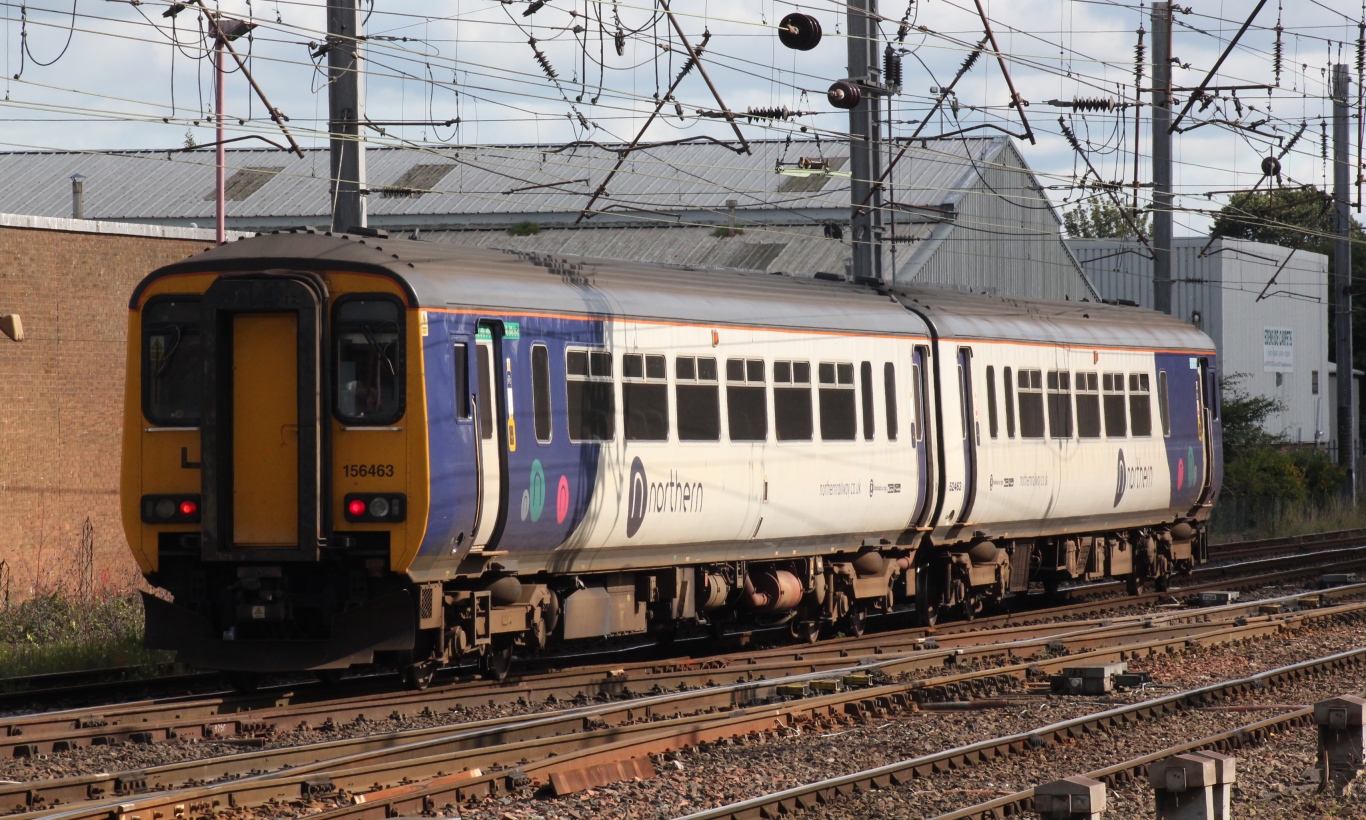
The British Rail Class 156 Super Sprinter is a diesel-hydraulic multiple unit passenger train. A total of 114 sets were built between 1987 and 1989 for British Rail by Metro-Cammell's Washwood Heath works. They were built to replace elderly first-generation DMUs and locomotive-hauled passenger trains.
By the beginning of the 1980s, British Rail (BR) operated a large fleet of first generation DMUs, which had been constructed in prior decades to various designs. While formulating its long-term strategy for this sector of its operations, British Rail planners recognised that there would be considerable costs incurred by undertaking refurbishment programmes necessary for the continued use of these ageing multiple units. Planners instead examined the prospects for the development and introduction of a new generation of DMUs to succeed the first generation.
The initial specification was relatively ambitious, calling for a maximum speed of 90 mph (145 km/h) and acceleration comparable to contemporary EMUs. This specification led to the experimental British Rail Class 210 DMU. However, it was found to be expensive, and it was recognised that a production model assembled from proven components would possess greater reliability and lower maintenance costs; an availability rate of 85 percent was forecast.
By 1983, experiences with the Class 210 had influenced BR planners to favour procuring a new generation of DMUs, but to also adopt a new specification that were somewhat less demanding than before. Specifically, it was decided to drop the top speed from 90 to 75 mph (145 to 120 km/h), as testing had revealed the higher rate to deliver no perceivable improvement in journey times due to the typically short spacing of the stations the type was intended to serve. The requests for compatibility with other rolling stock were eliminated, although auto-coupling and auto-connecting functionality was added. In addition to a good ride quality, the specification included a sound level of 90 dB when at full speed, an operational range of 1,000 miles (1,600 km), and an interval between major overhauls of five years or 350,000 miles (560,000 km).
The bid submitted by British Rail Engineering Limited (BREL) was heavily based on its successful Class 455 EMU, sharing its body and the majority of its running gear, albeit equipped with two different power trains.
The resulting Class 150 was viewed as unsatisfactory for more-upmarket services. Studies showed coaches could be stretched, providing more internal volume and thus enabling the somewhat cramped two-by-three seating arrangement of the Class 150 to be substituted with a more roomy two-by-two counterpart. These changes could be implemented without impacting much of the benefits of adopting the existing design.
It was identified that this would result in a weight increase and thus a decreased power-to-weight ratio, but it was determined that the performance of the proposed DMU was only slightly lower, and it could achieve similar journey times across the intended cross-country routes as the Class 150. It was also found that, while there was a slight increase in fuel consumption due to the changes, the envisioned DMU had lower fuel consumption than locomotive-hauled trains and lower maintenance costs. Accordingly, it was decided to proceed with developing a detailed specification and issuing it to industry. Amongst the requirements listed in the issued specification was the explicit statement of the acceptability of the proven power trains of both the Class 150 and Class 151.
The design of the Class 156 was relatively conservative in comparison to Metro-Cammell's earlier Class 151 design. Specific changes include the bodyshell being primarily composed of steel instead of aluminium; the deliberate decision was made to model the cab design on the earlier Class 150 was allegedly taken to ease union acceptance.[citation needed] Each coach is powered, being outfitted with a single six-cylinder Cummins NT855-R5 diesel engine coupled to a Voith T211r hydraulic transmission and Gmeinder final drive units. The Class 156 can achieve a top speed of 75 mph (120 km/h). Construction of the welded bodyshells was subcontracted out; 118 by Procor Engineering of Wakefield, 60 by W.H. Davis of Mansfield, and 50 by Standard Wagon of Heywood. Aston Martin Tickford were awarded the interior fitout contract.
Hub AI
British Rail Class 156 AI simulator
(@British Rail Class 156_simulator)
British Rail Class 156
The British Rail Class 156 Super Sprinter is a diesel-hydraulic multiple unit passenger train. A total of 114 sets were built between 1987 and 1989 for British Rail by Metro-Cammell's Washwood Heath works. They were built to replace elderly first-generation DMUs and locomotive-hauled passenger trains.
By the beginning of the 1980s, British Rail (BR) operated a large fleet of first generation DMUs, which had been constructed in prior decades to various designs. While formulating its long-term strategy for this sector of its operations, British Rail planners recognised that there would be considerable costs incurred by undertaking refurbishment programmes necessary for the continued use of these ageing multiple units. Planners instead examined the prospects for the development and introduction of a new generation of DMUs to succeed the first generation.
The initial specification was relatively ambitious, calling for a maximum speed of 90 mph (145 km/h) and acceleration comparable to contemporary EMUs. This specification led to the experimental British Rail Class 210 DMU. However, it was found to be expensive, and it was recognised that a production model assembled from proven components would possess greater reliability and lower maintenance costs; an availability rate of 85 percent was forecast.
By 1983, experiences with the Class 210 had influenced BR planners to favour procuring a new generation of DMUs, but to also adopt a new specification that were somewhat less demanding than before. Specifically, it was decided to drop the top speed from 90 to 75 mph (145 to 120 km/h), as testing had revealed the higher rate to deliver no perceivable improvement in journey times due to the typically short spacing of the stations the type was intended to serve. The requests for compatibility with other rolling stock were eliminated, although auto-coupling and auto-connecting functionality was added. In addition to a good ride quality, the specification included a sound level of 90 dB when at full speed, an operational range of 1,000 miles (1,600 km), and an interval between major overhauls of five years or 350,000 miles (560,000 km).
The bid submitted by British Rail Engineering Limited (BREL) was heavily based on its successful Class 455 EMU, sharing its body and the majority of its running gear, albeit equipped with two different power trains.
The resulting Class 150 was viewed as unsatisfactory for more-upmarket services. Studies showed coaches could be stretched, providing more internal volume and thus enabling the somewhat cramped two-by-three seating arrangement of the Class 150 to be substituted with a more roomy two-by-two counterpart. These changes could be implemented without impacting much of the benefits of adopting the existing design.
It was identified that this would result in a weight increase and thus a decreased power-to-weight ratio, but it was determined that the performance of the proposed DMU was only slightly lower, and it could achieve similar journey times across the intended cross-country routes as the Class 150. It was also found that, while there was a slight increase in fuel consumption due to the changes, the envisioned DMU had lower fuel consumption than locomotive-hauled trains and lower maintenance costs. Accordingly, it was decided to proceed with developing a detailed specification and issuing it to industry. Amongst the requirements listed in the issued specification was the explicit statement of the acceptability of the proven power trains of both the Class 150 and Class 151.
The design of the Class 156 was relatively conservative in comparison to Metro-Cammell's earlier Class 151 design. Specific changes include the bodyshell being primarily composed of steel instead of aluminium; the deliberate decision was made to model the cab design on the earlier Class 150 was allegedly taken to ease union acceptance.[citation needed] Each coach is powered, being outfitted with a single six-cylinder Cummins NT855-R5 diesel engine coupled to a Voith T211r hydraulic transmission and Gmeinder final drive units. The Class 156 can achieve a top speed of 75 mph (120 km/h). Construction of the welded bodyshells was subcontracted out; 118 by Procor Engineering of Wakefield, 60 by W.H. Davis of Mansfield, and 50 by Standard Wagon of Heywood. Aston Martin Tickford were awarded the interior fitout contract.
Recent media