Hubbry Logo
search
logo
2100817

British Rail Class 456

logo
Community Hub0 Subscribers

Wikipedia

from Wikipedia

British Rail Class 456
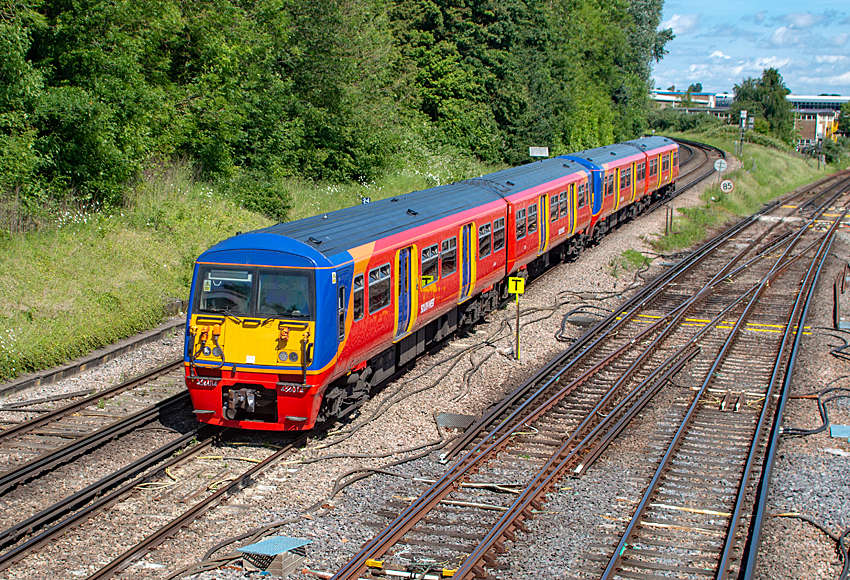
South West Trains Class 456 approaching Guildford
Interior of a South West Trains Class 456 after refurbishment
In serviceSeptember 1991 – 17 January 2022
ManufacturerBritish Rail Engineering Limited
Built atYork Carriage Works, York
Family nameBR Second Generation (Mark 3)
Constructed1990–1991
Refurbished
Scrapped2022
Number built24
Number scrapped24
SuccessorClass 377 (Southern)[1]
Formation
  • 2 cars per unit:
  • DMSO-DTSO
Fleet numbers456001–456024
Capacity152 seats
OwnersPorterbrook
Operators
Depots
Specifications
Car body constructionSteel[2]
Car length19.95 m (65 ft 5 in)[2]
Width2.82 m (9 ft 3 in)[2]
Height3.78 m (12 ft 5 in)[2]
Doors
  • Double-leaf pocket sliding
  • (2 per side per car)
Wheelbase
  • 14.17 m (46 ft 6 in)
  • (over bogie centres)
Maximum speed75 mph (121 km/h)
Weight
Power output500 hp (373 kW)
Electric system(s)750 V DC third rail
Current collectionContact shoe
Minimum turning radius71 m (232 ft 11 in)[2]
Braking system(s)Air (Westcode)
Safety system(s)
Coupling systemTightlock[2]
Multiple workingWithin class, and with Class 455
Track gauge1,435 mm (4 ft 8+12 in) standard gauge

The British Rail Class 456 was an electric multiple unit passenger train introduced by Network SouthEast on inner-suburban services in South London to replace the elderly Class 416 2EPB units.[3] Twenty-four two-car units were built by British Rail Engineering Limited's York Carriage Works in 1990 and 1991.[1]

Following the privatisation of British Rail, the fleet was sold to Porterbrook and operated by Southern up until late 2013, when they were transferred to South West Trains and heavily refurbished.[4][5] Routes that were operated by Class 456 units will be operated by new Class 701 Bombardier Aventra units in the future.[6]

Entry into service

[edit]
Class 456 in Network SouthEast livery at Wandsworth Road in 2004

While originally approved for use by Network SouthEast (NSE) on services out of Waterloo,[7] the 24 two-car units were first accepted into traffic as direct replacements for the Class 416 2EPB units on the Central Division of the Southern Region of British Rail.[8] Units were delivered into traffic painted in NSE blue, red and white livery with cabs based on the Class 321 units, and were initially based at Selhurst depot.[7] Although Network SouthEast had shifted to units painted with pale grey, the Class 456s were introduced painted with a darker grey shade to match the livery of the Class 455 units they would be working with. Units were numbered in the range 456001–456024, each unit consisting of a driving motor (DMSO) and a driving trailer (DTSO).[8]

Entry into service for the Class 456 was originally planned for 18 March 1991, with trains to be driver-only operated (without the presence of a guard). This meant that the driver had to have a clear view of the platform with a bank of CCTV cameras mounted at the platform end for this purpose, however it was discovered that the position of the CCTV cameras on the platforms were not visible from the driver's position. To resolve this Selhurst depot designed a replacement fixing for the driver's seat so that it could slide sideways, allowing a good view of the CCTV units.[9] The modified drivers' seats were installed at Fratton Depot with the work completed by the end of July 1991,[7] and services with the new units commenced in September 1991.[10]

Operations

[edit]

Connex South Central and SouthCentral/Southern

[edit]
Southern Metro Class 456 at London Bridge
The interior of a Southern refreshed Class 456

When Britain's railways were privatised, the entire Class 456 fleet passed into the South Central franchise (later known as the Southern franchise), which was originally won by Connex South Central. Only one unit, No. 456024, was repainted in white and yellow Connex livery, when it was named Sir Cosmo Bonsor after a chairman of the South Eastern Railway.[8][11] The rest of the fleet had remained in Network South East livery until summer 2006, when the fleet started to be repainted into Southern livery.

In 2000, Connex lost the South Central franchise to the Go-Ahead Group, who rebranded the company as Southern in 2004.

On 8 May 2012 it was announced by the Department for Transport that the entire fleet of 24 2-car Class 456s would transfer to South West Trains (SWT) in 2014, to be used in conjunction with South West Trains’s Class 455 fleet on London inner-suburban lines.[12]

The Southern services on the South London Line were withdrawn in 2012 and replaced by a new London Overground service, the East London Line, operated using new air-conditioned 5-car Class 378 units.[13] Southern also received 26 new 5 car Class 377/6 units and these entered service at the end of 2013, in place of 92 cascaded carriages promised for extra capacity.[14] This gives a total of 50 replacement carriages in addition to the 92 carriages for extra capacity, leaving the 48 Class 456 carriages surplus to requirements at Southern.

South West Trains and South Western Railway

[edit]
South Western Railway Class 456 at Hampton Court

The units transferred to South West Trains following their career with Southern, as their operations on its Metro routes were replaced by the class 455s, later to be replaced by the class 377/6 units. South West Trains used the 456s to enhance peak-hour Metro services through Wimbledon from 8 to 10 coaches and to provide two additional morning peak services from Raynes Park to Waterloo. These changes took place from December 2014.

Class 456s were repainted in the red "Metro" version of South West Trains livery to match the Class 455 and were refurbished to have a similar interior to the Class 455 before entering service between March 2014 and December 2014. On their transfer, their standard traction equipment was retained, leaving them as the only fleet on South West Trains to be powered by conventional DC traction gear.

The first units entered service with South West Trains on 23 March 2014 between Ascot and Guildford,[15] replacing Class 458 trains with toilets and air conditioning. They initially ran in pairs (i.e. 2 x 2 car) still in Southern's green livery, but without fleet names. 10 units were required to provide the half-hourly service. The one train per day from Clapham Junction (07:45) to Guildford via Ascot was also operated by two 456s, but the trains that ran through to Waterloo during the peak periods continued to be operated by Class 458 trains. The Class 456 trains were the main units on the line for a short time, but Class 450 sets now operate alone on the line.[16]

All units were refurbished by South West Trains.[17][18]

In August 2017, all 456 units transferred to the new South Western franchisee, South Western Railway. South Western Railway subsequently withdrew the Class 456 fleet from service on 17 January 2022.[19]

Refurbishment

[edit]

In March 2005, No. 456006 was hauled to Wolverton where it was studied for corrosion assessment. This caused some doubt as to whether they would be refurbished.[20] However, in a statement in April 2006 Southern said the class would receive a 'refresh', which meant they would not receive a refurbishment as major as the 455s, since the 456s are 10 years newer and already have high-backed seats (although of a different design). Also, new CCTV cameras and flooring were installed; this was not mentioned on the original refurbishment plan.[citation needed]

All units were instead 'refreshed' and were painted into Southern green colours.[20] No. 456006 was completed in a one-off promotional livery for rail safety on the Southern network. 456013 had an experimental cab-cooling system installed and 456022 had some experimental air-conditioning fitted, in an effort to make drivers' jobs more comfortable.

Southern removed the toilets from the trains, to provide more capacity. Despite this the Class 456 EMU trains lost two seats from each pair, due to a space being cleared for wheelchairs and pushchairs.

After the units transferred to South West Trains, a full refurbishment commenced in Wolverton where Class 456s received a new exterior livery and also a refurbished interior with new seating.[21]

Accidents and incidents

[edit]
  • On 15 August 2017, unit 456015 was damaged in a collision with an engineers train at Waterloo station, London.[22][23] The cause was a wiring error in the signalling which meant that a set of points not correctly set was not detected. This was introduced as part of the testing of the temporary changes to the signalling during a major works programme at Waterloo. This allowed the signalling logic to detect that a set of points was correctly set when in reality, the points were mid-way between either of the correct positions. A false proceed signal was shown to the driver when it should not have been possible.[23]

Fleet details

[edit]
Class Status No. Built Year built Cars per unit Unit nos.
Class 456 Scrapped 24 1990–1991 2 456001–456024[24]

References

[edit]

Grokipedia

from Grokipedia
The British Rail Class 456 was a fleet of 24 two-car electric multiple unit (EMU) passenger trains built by British Rail Engineering Limited (BREL) at York Works between 1990 and 1991 for inner-suburban services in South London.[1] These 750 V DC third-rail powered trains, based on the Mark 3 bodyshell design with a top speed of 75 mph (121 km/h), featured GEC Traction thyristor control and English Electric 507 series motors delivering 500 hp total, and were configured with 152 standard-class seats across a driving motor standard open (DMSO) coach seating 79 and a driving trailer standard open (DTSO) coach seating 73.[1][2] Designed for compatibility with the similar Class 455 units to form longer consists of up to 10 cars on busy routes, the Class 456 entered service with Network SouthEast (NSE) on 30 September 1991, initially facing reliability issues such as driver seat positioning that were quickly resolved.[1][2] Following privatisation, the fleet transferred to Connex South Central in 1996 and was refurbished at Wolverton Works starting in 2006, receiving updated interiors, new seating, and Connex/Southern livery while featuring power-operated sliding doors.[3] Under Southern operation from 2000, the units primarily served Central Division suburban routes from London Victoria and London Bridge, including services to Sutton, Epsom, and the South London Line, often running solo or coupled with Class 455s; one unit, 456024, was named Sir Cosmo Bonsor in 1997.[1] By 2013, the introduction of Class 377/6 EMUs rendered the Class 456 redundant on Southern, leading to their transfer to South West Trains (SWT) in 2014 for enhanced capacity on Surrey suburban services from London Waterloo.[4] Upon the rebranding to South Western Railway (SWR) in 2017, the 24 units—leased from Porterbrook—continued operating on short-branch and suburban lines to destinations such as Guildford, Woking, Chessington South, Hampton Court, Shepperton, Strawberry Hill, and Dorking, frequently forming 10-car trains with refurbished Class 455s to maximize platform lengths.[5] Features included power-operated sliding doors, on-board ramps, audiovisual announcements, and space for two wheelchairs and two cycles, though they lacked toilets (originally fitted but removed due to winter freezing issues) and first-class accommodation; accessibility was prioritized with Braille controls and priority seating.[5] The fleet underwent further interior updates under SWR, reporting improved reliability in later years, including an 85.4% year-on-year gain in 2021.[6] The Class 456 was withdrawn from service by SWR in January 2022 amid reduced passenger numbers due to the COVID-19 pandemic and the impending arrival of new Class 701 Aventra units, removing 2,640 seats from the network temporarily; all units were returned to Porterbrook and subsequently scrapped, marking the end of 31 years of operation.[7][5][8] Despite their short length and age, the Class 456 proved versatile across operators, contributing to capacity boosts on constrained suburban networks before their retirement.[4]

Background and Design

Procurement and Development

In the late 1980s, Network SouthEast encountered significant challenges on its South London suburban routes, where aging Class 416 2EPB units from the 1950s suffered from reliability issues and contributed to overcrowding during peak hours, exacerbating passenger dissatisfaction with suburban services in London and the south-east. The Class 456 units were built as direct replacements for these aging units.[2] These older slam-door electric multiple units, operating on busy inner-suburban lines, could no longer meet growing demand efficiently, prompting British Rail to prioritize modernization within the Network SouthEast sector to enhance capacity and service quality.[1] The procurement process began in 1989, as British Rail sought to address these shortcomings by ordering new stock tailored for high-density operations. In 1990, an order was placed for 24 two-car units with British Rail Engineering Limited (BREL) at York Works, forming part of the broader Networker program aimed at revitalizing south-east commuter rail.[2] This decision reflected a strategic focus on cost-effective expansion of existing fleets rather than full fleet replacement, allowing the new units to augment services on congested routes while maintaining compatibility with the third-rail electrified network.[1] Development specifications emphasized compatibility with the 750 V DC third-rail system prevalent on Southern Region lines, prioritizing high-capacity suburban performance through features like increased seating and improved acceleration for stop-start operations.[1] The design drew influence from the earlier Class 455 units, adopting a similar Mark 3 bodyshell profile but optimized for shorter two-car formations to enable flexible coupling into six-car trains, thereby integrating seamlessly with the existing slam-door fleet without requiring major infrastructure changes.[2]

Technical Specifications

The British Rail Class 456 units were constructed as two-car electric multiple units, comprising a Driving Motor Standard Open (DMSO) vehicle and a Driving Trailer Standard Open (DTSO) vehicle. This formation allowed for flexible operation in suburban services, with the ability to couple externally to compatible classes such as the 455 for augmented consists via gangway connections. The bodyshells were fabricated from steel, following the profile of Mark 3 coaching stock for structural integrity and aerodynamic efficiency.[1][2] Each car measured 20.18 m in length, resulting in a total unit length of 40.36 m, with a width of 2.82 m and height of 3.77 m. The empty weight was approximately 36.25 tonnes per car, or 72.5 tonnes for the complete two-car set. These dimensions and weights supported efficient platform usage on inner-suburban routes while maintaining stability under third-rail electrification.[9][1] Power was supplied via 750 V DC third rail collection, driving two English Electric 507 series-wound traction motors—one per powered bogie on the DMSO—with a combined output of 370 kW (500 hp). The units achieved a top speed of 120 km/h (75 mph) and an acceleration rate of 0.9 m/s², suitable for frequent stops in dense commuter networks. The traction system employed GTO thyristor control for smooth power delivery, with motors originally refurbished from withdrawn Class 405 stock.[1][2][10] Interior accommodation provided 152 standard-class seats across the unit, with 79 in the DMSO and 73 in the DTSO, arranged in a mix of longitudinal and transverse configurations; no first-class seating was included. Access was via manual slam doors (two per side per car), featuring external gangway connections for multi-unit working. Additional features encompassed fluorescent lighting, a public address system for announcements, and convection heating for passenger comfort.[1][2] Braking was handled by a Westinghouse electro-pneumatic system with disc actuators on P7 powered bogies and T3 trailer bogies, supplemented by Westcode air brakes for reliable stopping in urban environments. The overall design emphasized compatibility with existing Southern Region infrastructure, including tightlock couplings and high-level jumper receptacles for interworking.[1][2]

Construction and Entry into Service

Manufacturing

The British Rail Class 456 electric multiple units were constructed by British Rail Engineering Limited (BREL) at its York Carriage Works (also known as Holgate Carriage Works). The contract for 24 two-car units was awarded to BREL in 1989, with production commencing in 1990 and completing in 1991. These units, numbered 456001 to 456024, were designed to enhance operational flexibility on Network SouthEast suburban services by working in multiple with existing Class 455 stock. The first unit, 456001, was delivered on 14 December 1990.[2][1] Production proceeded at a steady rate, averaging approximately two units per month to meet the delivery schedule for entry into service in 1991. Each unit featured bodyshells based on the established BR Mark 3 coach profile, incorporating automatic sliding doors and a cab front design similar to those on Classes 320, 321, and 322. Interiors included standard BR suburban seating arrangements, with 79 seats in the driving motor standard open (DMSO) vehicle and 73 seats in the driving trailer standard open (DTSO) vehicle, totaling 152 seats per unit; unlike the related Class 455, each Class 456 unit also incorporated a toilet. Key underframe components included provisions for coupling with Class 455 units, such as cab-front pipes, and adapters for emergency operation with older Mark 1 slam-door stock.[1][2] Following assembly at York, units underwent static testing at the works before handover to Network SouthEast. Initial route proving trials were conducted on Southern Region lines, with units appearing in service trials on the South London Line by late 1991 and early 1992; commissioning and further acceptance testing occurred at Strawberry Hill depot. The fleet remained under British Rail ownership until the privatisation process, after which in 1996 the units were transferred to rolling stock operating companies (ROSCOs) for leasing to train operators, with Porterbrook becoming the long-term owner of the Class 456 fleet.[1][11][12]

Initial Deployment

The British Rail Class 456 electric multiple units entered passenger service in September 1991 under the Network SouthEast sector, initially operating on inner-suburban routes in South London. These included services from London Victoria and London Bridge via the South London Line, providing connectivity between key terminals and surrounding districts. The units were introduced to enhance flexibility on these busy commuter lines, replacing older slam-door stock such as the Class 416 2EPB.[1][13] All 24 two-car units were allocated to Selhurst depot, serving as the primary maintenance base during their early years. To meet demand on peak services, the Class 456 units were frequently coupled with existing Class 455 four-car sets, forming eight-car trains capable of accommodating larger crowds without gangway connections between vehicles. This operational practice allowed for efficient deployment across the Central Division's network.[1][5] Designed for intensive stop-start operations, the Class 456 units proved effective in handling high-frequency services and rush-hour passenger volumes on routes such as London Victoria to Sutton and London Bridge to West Croydon. Early operations saw the fleet integrate smoothly into the timetable after initial commissioning trials, supporting Network SouthEast's goal of reliable suburban travel. The units remained under Network SouthEast management until British Rail's privatization in 1996, at which point the entire fleet transferred to Connex South Central as part of the South Central franchise commencing on 26 May 1996.[13][3]

Operations

Connex South Central and Southern

Following the privatisation of British Rail in the mid-1990s, the entire fleet of 24 Class 456 units was transferred to Connex South Central, the operator awarded the Network SouthCentral franchise commencing on 26 May 1996. These units became integral to the operator's suburban services, primarily on the South London Line between London Bridge and London Victoria, where they provided frequent shuttles—often as single two-car sets off-peak and paired during rush hours to enhance capacity on busy inner-city routes. Operations expanded under Connex to include extensions beyond the core South London Line, such as services to East Croydon, allowing greater flexibility in diagrammed workings across south-east England's electrified network.[3][1] In October 2000, Connex South Central lost the franchise, which was taken over by a Govia subsidiary operating initially as South Central from 26 August 2001, completing the remaining term of the original agreement until 2003. The Class 456 fleet remained based at Selhurst depot near East Croydon, where maintenance and stabling supported their continued role in the franchise's core suburban operations. By 2004, South Central was rebranded as Southern, under which the units formed the backbone of 2+2 car formations (typically two Class 456s coupled together) for stopping services, accommodating high commuter volumes on routes serving south London and Sussex.[14][1] Despite their versatility, the Class 456 units faced minor operational challenges during this period, particularly pre-refurbishment reliability issues with door mechanisms that occasionally led to delays on high-frequency services. These were attributed to the units' age and intensive usage in stop-start suburban patterns, though overall performance exceeded franchise averages for mid-life EMUs, with casualty rates supporting reliable delivery of services. Under Southern's management at Selhurst, proactive maintenance helped mitigate such issues, ensuring the fleet's contribution to the operator's network reliability awards in the early 2010s.[1][15]

South West Trains and South Western Railway

In 2014, the entire fleet of 24 two-car Class 456 units was transferred from Southern to South West Trains (SWT) to bolster capacity on suburban services.[16] Based at Wimbledon depot, the units were primarily deployed on short-distance routes in Surrey and Hampshire, including London Waterloo to Chessington South, Shepperton via Kingston and Twickenham, Hampton Court, and Guildford via various paths such as Epsom, Cobham & Stoke d'Abernon, and Woking.[17][5] They frequently operated in four-car formations by coupling with similar Class 455 units, enabling longer trains during peak hours on these inner suburban lines.[5] The Class 456 fleet continued in service without interruption when SWT's franchise transitioned to South Western Railway (SWR) in 2017, remaining integral to the suburban network despite their advancing age.[5] Usage persisted across the same routes, often paired with Class 455 units to form six- or ten-car consists, providing essential capacity amid ongoing infrastructure challenges.[5] However, as the units approached 30 years in service, their role diminished in favor of more modern rolling stock. The final revenue-earning services for the Class 456 occurred on 17 January 2022, after which the fleet was withdrawn early due to lease expiration and the anticipated arrival of Class 701 Aventra units, supplemented by existing Class 377 EMUs on suburban duties.[18]

Refurbishment and Upgrades

Southern Refurbishment

In 2005, Southern initiated a refresh program for its fleet of 24 Class 456 units to address wear and enhance passenger facilities, with the first unit entering Wolverton Works for a C6 overhaul and corrosion repairs in March 2005. The work covered all units by mid-2007, with interior updates completed at Selhurst depot. This program was less extensive than the concurrent refurbishment of the related Class 455 units, reflecting the relatively younger age of the Class 456 fleet.[19][3] Key modifications included the replacement of the original moquette seating with new high-back seats in blue fabric, installation of CCTV systems to improve security, renewal of vinyl flooring, and addition of LED destination displays. The exterior received a new Southern livery of white with dark green doors and light green ends, while the toilets were removed from the driving trailers to increase saloon space. Safety upgrades encompassed improved door interlocks and emergency lighting to comply with post-2000 rail regulations, building on prior issues with door reliability during Connex South Central operations.[20][13] The refresh significantly boosted passenger comfort through modernized interiors and enhanced reliability via structural repairs, enabling the units to remain in frontline service on Southern's inner suburban routes until their transfer to South West Trains in late 2013. No specific cost was publicly disclosed for the Class 456 program, though it formed part of broader fleet investment under Southern's franchise.[19]

South West Trains refurbishment

In 2014, following the transfer of the 24 Class 456 units from Southern to South West Trains (SWT), a refurbishment program was initiated to adapt the fleet for suburban services radiating from London Waterloo. The work was conducted at Wabtec facilities in Doncaster and Loughborough, encompassing exterior repaints into the SWT livery of red with white and blue stripes to achieve visual consistency with the operator's Class 455 units.[12][4] Modifications were primarily cosmetic and compliance-oriented, including the installation of updated passenger information systems featuring LED screens for improved real-time announcements, alongside routine traction motor maintenance to address wear from prior operations. The units retained their no-lavatory configuration due to design constraints. These updates focused on integration rather than extensive overhauls, distinguishing them from earlier interior-focused work on the fleet.[21][5] The £65 million program, which encompassed the Class 456 refurbishments as part of broader fleet extensions adding 108 carriages overall, commenced deliveries in mid-2014 with the first units entering service by November 2014; completion occurred in November 2015. This effort enhanced the units' aesthetic alignment with SWT's suburban stock without altering their inherent two-car capacity of 110 seats, enabling reliable paired operations with Class 455 units until their withdrawal in 2022.[12][22] Under South Western Railway from 2017, the units saw no major further refurbishments but benefited from ongoing maintenance, contributing to improved reliability, including an 85.4% year-on-year gain in 2021.[6]

Incidents and Withdrawal

Accidents and Incidents

On 15 August 2017, Class 456 unit No. 456015, forming the leading portion of the 05:40 South West Trains service from London Waterloo to Guildford alongside two Class 455 units, was involved in a collision with a stationary engineering train consisting of wagons and a Class 66 locomotive on the up main fast line.[23] The incident occurred as the passenger train departed platform 13 at approximately 13 mph (21 km/h), when misaligned points (No. 1524) routed it away from the intended up main relief line and into the path of the engineering train, which was positioned as a barrier vehicle during platform extension works.[23] The driver applied emergency brakes upon realizing the route discrepancy, but the collision was unavoidable, resulting in the derailment of the leading bogie of 456015 and damage to both trains.[23] The Rail Accident Investigation Branch (RAIB) determined that the primary cause was a failure in the signaling system due to uncontrolled temporary wiring introduced during pre-commissioning tests of the points, which led to incorrect detection of the points' position and allowed a proceed aspect to be displayed despite the misalignment.[23] Contributing factors included inadequate design and testing processes for the signal test desk, as well as a lack of effective competence management for non-technical skills among Network Rail staff and contractors involved in the works.[23] No signal passed at danger (SPAD) occurred, and the driver's actions were appropriate given the circumstances.[23] No injuries were reported.[23] The collision caused significant disruption to services at Waterloo until the following day, but the Class 456 unit was subsequently repaired and returned to operational service.[23] Throughout their operational life, Class 456 units experienced occasional minor incidents typical of slam-door multiple units. The class had no fatalities recorded in service, with the 2017 collision being the only major incident.

Withdrawal and Disposal

South Western Railway withdrew its fleet of 24 Class 456 units from passenger service in January 2022, with the final revenue-earning run taking place on 17 January.[5][18] The decision advanced the end of the lease from February, amid delays to the introduction of replacement Class 701 Aventra units.[18] Following withdrawal, the units—owned by rolling stock lessor Porterbrook—were placed in storage before disposal.[12] The phase-out was driven by multiple factors, including the units' age of over 30 years since construction in 1990–1991, ongoing reliability challenges despite prior refurbishments, and reduced demand on suburban services following the COVID-19 pandemic.[24] It also aligned with Department for Transport franchise commitments to modernize the fleet by introducing the Class 701 units, which were specified to replace the Class 455, 456, 458, and 707 EMUs on inner-suburban routes from London Waterloo.[25] This cascade enabled greater operational efficiency and compliance with accessibility standards, as the slam-door Class 456 design no longer met contemporary requirements without further costly modifications.[24] All 24 units were scrapped during 2022 at Sims Metal Management's facility in Newport, Wales, with the majority transferred from storage in July and August. No preservation efforts were pursued for any vehicles, owing to their poor condition after extended service and the inherent limitations of their outdated slam-door configuration. In the aftermath, routes formerly diagrammed for Class 456 operations—such as London Waterloo to Guildford, Woking, Hampton Court, Shepperton, Chessington South, and Strawberry Hill—transitioned primarily to the incoming Class 701 fleet, supplemented by retained units like the Class 458/5 during the introduction phase.[5][26] This shift marked the complete retirement of the Class 456 as the final slam-door EMU subclass in mainline passenger use on the South Western network.

References

User Avatar
No comments yet.