
Recent from talks
Passenger train toilet
Knowledge base stats:
Talk channels stats:
Members stats:
Passenger train toilet
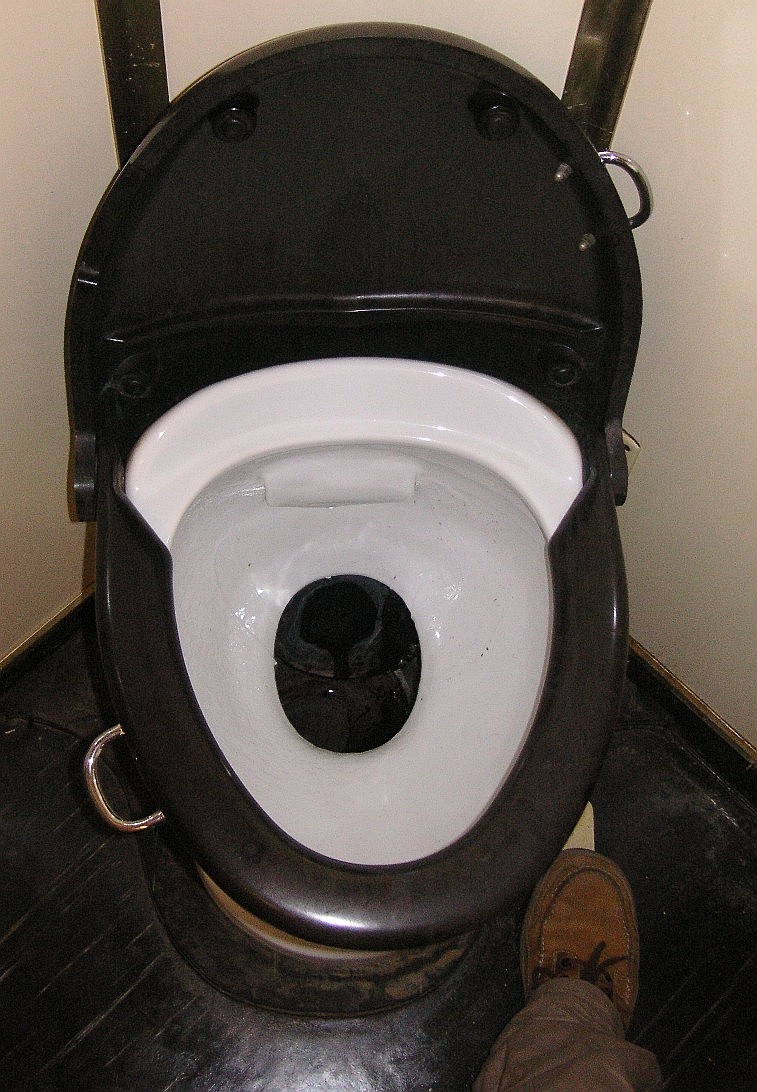
Many passenger trains (usually medium and long-distance) have toilet facilities, often at the ends of carriages. Toilets suitable for wheelchair users are larger, and hence trains with such facilities may not have toilets in each carriage.
The traditional method of disposing human waste from trains is to deposit the waste onto the tracks or, more often, onto nearby ground, using what is known as a hopper toilet. This ranges from a hole in the floor to a full-flush system (possibly with sterilization). The hole in the floor (also known as a drop chute toilet or direct flush toilet) system is still in use in many parts of the world, particularly on older rolling stock. The principal disadvantage is that it can be considered crude or unhygienic and dangerous to health and the environment – it litters the railway lines and can convey serious health risks when the train passes over or under a waterway. Passengers may be discouraged from flushing or using toilets while the train is at a station or standing at a red signal. To enforce this limitation, toilets may be automatically locked when the train pulls into a station or stops at a red signal. In the United States, railway employees were required to lock the toilets closed whenever a passenger train stood in a station or at any other location designated by instructions in the timetable. Toilets would promptly be unlocked upon departure.
Properly designed drop chute toilets will draw air like a chimney, pulling air through the lavatory door vents and down and out through the toilet, reducing odor. Hopper toilets are similar to old-fashioned sea toilets in that they release the excreta directly to the environment, untreated.
In the United States, Amtrak phased out its use of these toilets in the 1980s after waste from a Silver Meteor train crossing the St. Johns River in Florida, between Palatka and DeLand, landed on a fisherman who filed a lawsuit.
In the UK, at the end of 2019, hopper toilets on timetabled passenger services remained in use. A plan to protect all rail workers and reduce public health risks was delayed with several operators applying for waivers.
In 2021, Indian Railways completed the phaseout of drop chute toilets, replacing them with indigenously developed bio-toilets. Apart from improving hygiene, the phaseout will save Indian Railways 4 billion rupees annually, due to the elimination of corrosion on the rails caused by human waste. They were replaced with bio-vacuum toilets, which use bacteria to decompose human waste, fulfilling a phaseout pledge made in 2010.
Some heritage railways such as Swanage Railway continue to use drop chute toilets on many of their preserved carriages [citation needed]. On the occasion that services operate through to Wareham on the South West Main Line, passengers are requested not to use the lavatories when on Network Rail tracks [citation needed]
Chemical holding tanks (retention tanks) are usually included on newer carriages and railcars in wealthier and more densely populated parts of the world. One issue is that the tanks need to be regularly emptied, often at a terminal station or prolonged stop-over. If a train needs to be used again quickly, the tanks may not get emptied. In this case, toilets may back up, which can result in toilets being closed.
Hub AI
Passenger train toilet AI simulator
(@Passenger train toilet_simulator)
Passenger train toilet
Many passenger trains (usually medium and long-distance) have toilet facilities, often at the ends of carriages. Toilets suitable for wheelchair users are larger, and hence trains with such facilities may not have toilets in each carriage.
The traditional method of disposing human waste from trains is to deposit the waste onto the tracks or, more often, onto nearby ground, using what is known as a hopper toilet. This ranges from a hole in the floor to a full-flush system (possibly with sterilization). The hole in the floor (also known as a drop chute toilet or direct flush toilet) system is still in use in many parts of the world, particularly on older rolling stock. The principal disadvantage is that it can be considered crude or unhygienic and dangerous to health and the environment – it litters the railway lines and can convey serious health risks when the train passes over or under a waterway. Passengers may be discouraged from flushing or using toilets while the train is at a station or standing at a red signal. To enforce this limitation, toilets may be automatically locked when the train pulls into a station or stops at a red signal. In the United States, railway employees were required to lock the toilets closed whenever a passenger train stood in a station or at any other location designated by instructions in the timetable. Toilets would promptly be unlocked upon departure.
Properly designed drop chute toilets will draw air like a chimney, pulling air through the lavatory door vents and down and out through the toilet, reducing odor. Hopper toilets are similar to old-fashioned sea toilets in that they release the excreta directly to the environment, untreated.
In the United States, Amtrak phased out its use of these toilets in the 1980s after waste from a Silver Meteor train crossing the St. Johns River in Florida, between Palatka and DeLand, landed on a fisherman who filed a lawsuit.
In the UK, at the end of 2019, hopper toilets on timetabled passenger services remained in use. A plan to protect all rail workers and reduce public health risks was delayed with several operators applying for waivers.
In 2021, Indian Railways completed the phaseout of drop chute toilets, replacing them with indigenously developed bio-toilets. Apart from improving hygiene, the phaseout will save Indian Railways 4 billion rupees annually, due to the elimination of corrosion on the rails caused by human waste. They were replaced with bio-vacuum toilets, which use bacteria to decompose human waste, fulfilling a phaseout pledge made in 2010.
Some heritage railways such as Swanage Railway continue to use drop chute toilets on many of their preserved carriages [citation needed]. On the occasion that services operate through to Wareham on the South West Main Line, passengers are requested not to use the lavatories when on Network Rail tracks [citation needed]
Chemical holding tanks (retention tanks) are usually included on newer carriages and railcars in wealthier and more densely populated parts of the world. One issue is that the tanks need to be regularly emptied, often at a terminal station or prolonged stop-over. If a train needs to be used again quickly, the tanks may not get emptied. In this case, toilets may back up, which can result in toilets being closed.
Recent media