



Community hub
Recent from talks
Knowledge base stats:
Talk channels stats:
Members stats:
British Rail Classes 101 and 102
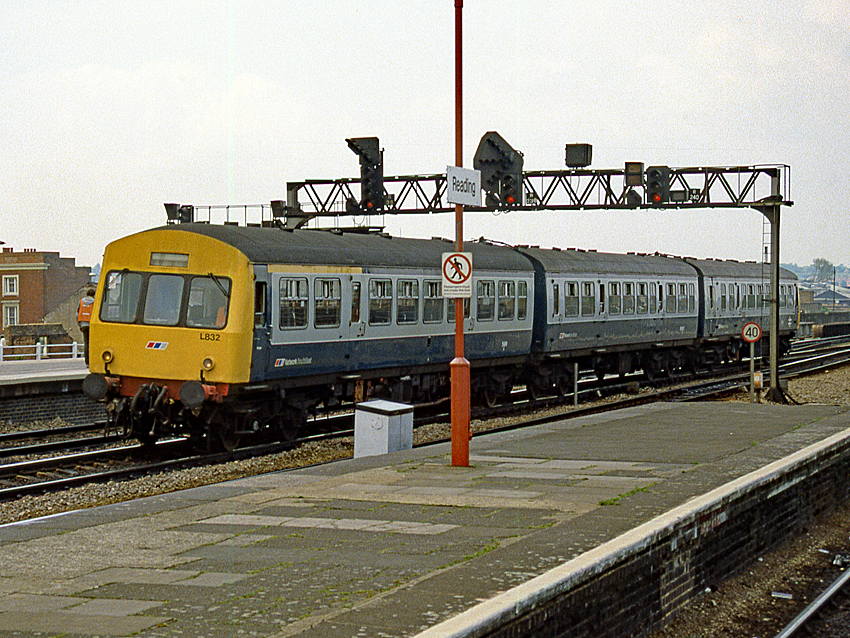
The British Rail Classes 101 and 102 diesel-mechanical multiple units were built by Metro-Cammell at Washwood Heath in Birmingham, England, from 1956 to 1959, following construction of a series of prototype units. These classes proved to be some of the most successful and longest-lived of BR's First Generation DMUs, second in longevity only to the Class 121, with the final five units being withdrawn on 24 December 2003. The oldest set was, by then, just over 47 years old.
In 1955, British Rail published a Modernisation Plan to streamline the railway network, bringing it up to date in comparison to European standards. Steam power would be phased out in favour of diesel powered railcars and locomotives, and projects were put out to tender. BR hoped that by replacing steam with DMUs, costs would be reduced sufficiently to make rural lines viable.
Since there was no time for BR to issue a standard specification, train builders were invited to submit plans on the understanding that the units could be built and put into service quickly. Having gained experience with early lightweight DMUs, Metro Cammell won a contract and put the Class 101 into production. The type featured a steel chassis with an aluminium body to reduce weight. Five orders for batches were placed for the type.[failed verification]
Metro-Cammell advertised their new train highlighting the wide availability and modern features the 101 offered. Demand was so high that at one point four cars per week were rolling off the Washwood Heath production lines. The trains underwent testing on the Sutton Park line near the works from 1956, before the sets were released to BR.
The 101s came in two, three or four car units, with two driving carriages one or two of which were powered by 11.3 litre BUT six cylinder diesel engines with epicyclic gearboxes. Being a first generation DMU, they were a prime example of a slam-door train. They had a top speed of 70 mph (110 km/h).
In the mid-1970s, the type was chosen for a refurbishment to extend their service life. Vehicle interiors were improved with the fitting of fluorescent lighting, new upholstery and carpeting, and fitting of extra heating equipment. They also had uprated engines fitted. The work was carried out by BR Doncaster.
The Class 111 was a variant of the 101, having more powerful Rolls-Royce engines. They were built to serve Greater Manchester and West Yorkshire PTE. The 111 lasted in service until 1989, fourteen years earlier than the 101.
The 101 fleet was used across much of the British Rail network (with the notable exception of the Southern Region - apart from some inter-regional workings). Notable concentration of services included:
Hub AI
British Rail Classes 101 and 102 AI simulator
(@British Rail Classes 101 and 102_simulator)
British Rail Classes 101 and 102
The British Rail Classes 101 and 102 diesel-mechanical multiple units were built by Metro-Cammell at Washwood Heath in Birmingham, England, from 1956 to 1959, following construction of a series of prototype units. These classes proved to be some of the most successful and longest-lived of BR's First Generation DMUs, second in longevity only to the Class 121, with the final five units being withdrawn on 24 December 2003. The oldest set was, by then, just over 47 years old.
In 1955, British Rail published a Modernisation Plan to streamline the railway network, bringing it up to date in comparison to European standards. Steam power would be phased out in favour of diesel powered railcars and locomotives, and projects were put out to tender. BR hoped that by replacing steam with DMUs, costs would be reduced sufficiently to make rural lines viable.
Since there was no time for BR to issue a standard specification, train builders were invited to submit plans on the understanding that the units could be built and put into service quickly. Having gained experience with early lightweight DMUs, Metro Cammell won a contract and put the Class 101 into production. The type featured a steel chassis with an aluminium body to reduce weight. Five orders for batches were placed for the type.[failed verification]
Metro-Cammell advertised their new train highlighting the wide availability and modern features the 101 offered. Demand was so high that at one point four cars per week were rolling off the Washwood Heath production lines. The trains underwent testing on the Sutton Park line near the works from 1956, before the sets were released to BR.
The 101s came in two, three or four car units, with two driving carriages one or two of which were powered by 11.3 litre BUT six cylinder diesel engines with epicyclic gearboxes. Being a first generation DMU, they were a prime example of a slam-door train. They had a top speed of 70 mph (110 km/h).
In the mid-1970s, the type was chosen for a refurbishment to extend their service life. Vehicle interiors were improved with the fitting of fluorescent lighting, new upholstery and carpeting, and fitting of extra heating equipment. They also had uprated engines fitted. The work was carried out by BR Doncaster.
The Class 111 was a variant of the 101, having more powerful Rolls-Royce engines. They were built to serve Greater Manchester and West Yorkshire PTE. The 111 lasted in service until 1989, fourteen years earlier than the 101.
The 101 fleet was used across much of the British Rail network (with the notable exception of the Southern Region - apart from some inter-regional workings). Notable concentration of services included: