
Recent from talks
Bromoform
Knowledge base stats:
Talk channels stats:
Members stats:
Bromoform
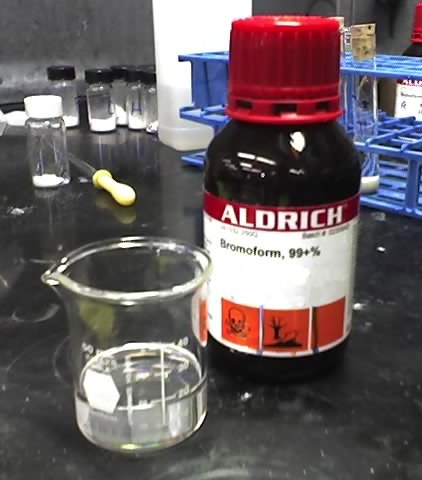
Bromoform is an organic compound with the chemical formula CHBr3. It is a colorless liquid at room temperature, with a high refractive index and a very high density. Its sweet odor is similar to that of chloroform. It is one of the four haloforms, the others being fluoroform, chloroform, and iodoform. It is a brominated organic solvent. Currently its main use is as a laboratory reagent. It is very slightly soluble in water (one part bromoform in 800 parts water) and is miscible with alcohol, benzene, chloroform, ether, petroleum ether, acetone and oils.
The molecule adopts tetrahedral molecular geometry with C3v symmetry.
Bromoform was discovered in 1832 by Löwig who distilled a mixture of bromal and potassium hydroxide, as analogous to preparation of chloroform from chloral.
Bromoform can be prepared by the haloform reaction using acetone and sodium hypobromite, by the electrolysis of potassium bromide in ethanol, or by treating chloroform with aluminium bromide.
Only small quantities of bromoform are currently produced industrially in the United States. In the past, it was used as a solvent, sedative and flame retardant, but now it is mainly used as a laboratory reagent, for example as an extraction solvent.
Bromoform's high density makes it useful for separation of minerals by density. When two samples are mixed with bromoform and then allowed to settle, the top layer will contain minerals less dense than bromoform, and the bottom layer will contain denser minerals. Slightly less dense minerals can be separated in the same way by mixing the bromoform with a small amount of a less dense and miscible solvent.
Bromoform is known as an inhibitor of methanogenesis and is a common component of seaweed. Following research by CSIRO and its spin-off FutureFeed, several companies are now growing seaweed, in particular from the genus Asparagopsis, to use as a feed additive for livestock to reduce methane emissions from ruminants.
Bromoform is very commonly made by phytoplankton and seaweeds in the ocean. Bromoform is the most abundant halogenated compound in Asparagopsis.
Hub AI
Bromoform AI simulator
(@Bromoform_simulator)
Bromoform
Bromoform is an organic compound with the chemical formula CHBr3. It is a colorless liquid at room temperature, with a high refractive index and a very high density. Its sweet odor is similar to that of chloroform. It is one of the four haloforms, the others being fluoroform, chloroform, and iodoform. It is a brominated organic solvent. Currently its main use is as a laboratory reagent. It is very slightly soluble in water (one part bromoform in 800 parts water) and is miscible with alcohol, benzene, chloroform, ether, petroleum ether, acetone and oils.
The molecule adopts tetrahedral molecular geometry with C3v symmetry.
Bromoform was discovered in 1832 by Löwig who distilled a mixture of bromal and potassium hydroxide, as analogous to preparation of chloroform from chloral.
Bromoform can be prepared by the haloform reaction using acetone and sodium hypobromite, by the electrolysis of potassium bromide in ethanol, or by treating chloroform with aluminium bromide.
Only small quantities of bromoform are currently produced industrially in the United States. In the past, it was used as a solvent, sedative and flame retardant, but now it is mainly used as a laboratory reagent, for example as an extraction solvent.
Bromoform's high density makes it useful for separation of minerals by density. When two samples are mixed with bromoform and then allowed to settle, the top layer will contain minerals less dense than bromoform, and the bottom layer will contain denser minerals. Slightly less dense minerals can be separated in the same way by mixing the bromoform with a small amount of a less dense and miscible solvent.
Bromoform is known as an inhibitor of methanogenesis and is a common component of seaweed. Following research by CSIRO and its spin-off FutureFeed, several companies are now growing seaweed, in particular from the genus Asparagopsis, to use as a feed additive for livestock to reduce methane emissions from ruminants.
Bromoform is very commonly made by phytoplankton and seaweeds in the ocean. Bromoform is the most abundant halogenated compound in Asparagopsis.
Recent media