
Recent from talks
Brothers Poem
Knowledge base stats:
Talk channels stats:
Members stats:
Brothers Poem
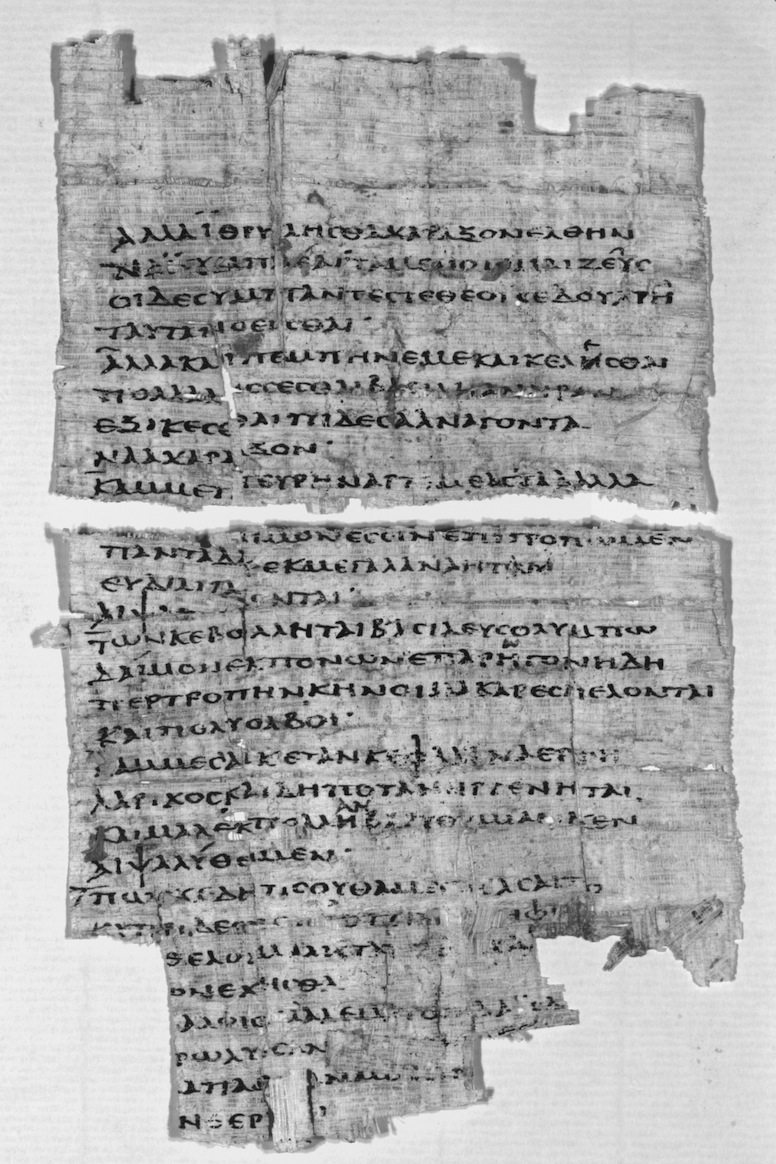
The Brothers Poem or Brothers Song is a series of lines of verse attributed to the archaic Greek poet Sappho (c. 630 – c. 570 BC), which had been lost since antiquity until being rediscovered in 2014. Most of its text, apart from its opening lines, survives. It is known only from a papyrus fragment, comprising one of a series of poems attributed to Sappho. It mentions two of her brothers, Charaxos and Larichos, the only known mention of their names in Sappho's writings, though they are known from other sources. These references, and aspects of the language and style, have been used to establish her authorship.
The poem is structured as an address – possibly by Sappho herself – to an unknown person. The speaker chastises the addressee for saying repeatedly that Charaxos will return (possibly from a trading voyage), maintaining that his safety is in the hands of the gods and offering to pray to Hera for his return. The narrative then switches focus from Charaxos to Larichos, who the speaker hopes will relieve the family of their troubles when he becomes a man.
Scholars tend to view the poem's significance more in historical rather than in literary terms. Research focuses on the identities of the speaker and the addressee, and their historical groundings. Other writers examine the poem's worth in the corpus of Sappho's poetry, as well as its links with Greek epic, particularly the homecoming stories of the Odyssey. Various reconstructions of the missing opening stanzas have been offered.
Sappho is thought to have written around 10,000 lines of poetry, of which only around 650 survive. Only one poem, the Ode to Aphrodite, is known to be complete; many preserve only a single word. In 2014, Dirk Obbink, Simon Burris, and Jeffrey Fish published five fragments of papyrus, containing nine separate poems by Sappho. Three were previously unknown, and the find amounted to the largest expansion of the surviving corpus of Sappho's work for 92 years. The most impressive is the Brothers Poem fragment, called P. Sapph. Obbink, part of a critical edition of Book I of Sappho's poetry. The remaining four fragments, P. GC. inv. 105 frr. 1–4, are written in the same hand, and have the same line-spacing.
P. Sapph. Obbink measures 176 mm × 111 mm. Carbon-dating places it as between the first and third centuries AD, which is consistent with the third century AD handwriting. The roll of which P. Sapph. Obbink was part would have been produced in Alexandria, and likely taken to Fayum. There is evidence that the roll was damaged and repaired; it was later reused as cartonnage – a material similar to papier-mâché made with linen and papyrus – which Obbink suggests was used as a book cover. P. Sapph. Obbink preserves 20 lines of the Brothers Poem, followed by 9 lines of another work by Sappho, the Kypris Poem. It is, according to author and scholar James Romm, the best-preserved extant Sappho papyrus. A second papyrus, Papyrus Oxyrhynchus 2289, published by Edgar Lobel in 1951, preserves enough of the Brothers Poem to show that at least one stanza preceded the well-preserved portion.
Soon after the discovery of P. Sapph. Obbink was made public in January 2014, scholars began to raise questions about its provenance. The initial version of Obbink's article announcing the discovery said that the papyrus was in a private collection, but did not discuss its origin or ownership history, as would be usual when reporting on a newly-discovered ancient artefact; C. Michael Sampson describes this absence as "anomalous and suspicious". Archaeologists immediately criticised this lack of transparency, and the initial version of Obbink's article was soon taken down. Since then, several contradictory claims have been made about the history of P. Sapph. Obbink.
Discussions of the provenance began shortly after the announcement of the discovery in January 2014. Bettany Hughes reported in the Sunday Times that the papyrus was originally owned by a German officer, while Obbink wrote in the Times Literary Supplement that it was found in mummy cartonnage. Obbink later claimed that the German officer mentioned by Hughes was an "imaginative fantasy", and that the original belief that the papyrus had come from mummy cartonnage was due to a misidentification. Based on information contained in a brochure for a sale of the papyrus compiled by Christie's in 2015, Sampson identifies the German officer mentioned by Hughes as Ranier Kriedel and argues that this initial story was fabricated to cover for defects in the papyrus' true provenance.
In 2015, Dirk Obbink presented a second account of the provenance in a paper delivered to the Society for Classical Studies. He claimed that the papyrus derived from the collection of David Moore Robinson, who had purchased it in 1954 from an Egyptian dealer, Sultan Maguid Sameda, and on his death left it to the University of Mississippi Library. Part of the Robinson collection was offered for sale through Christie's in 2011; Obbink reported that P. Sapph. Obbink was included in this sale, and was bought by a collector in London. It was this anonymous owner who gave Obbink, the head of Oxford University's Oxyrhynchus Papyri project, access to the papyrus and permission to publish it. However the presence of the papyrus in the 2011 sale is unverifiable. In an article for Eidolon, C. Michael Sampson and Anna Uhlig observe that no documentation supporting this account has been produced, and that the evidence for it is "principally Obbink's word". Following the publication of a 2020 article by Sampson, in which he concluded that "I doubt [Obbink's 2015 account of the provenance] is true even in part", Anton Bierl and André Lardinois published a retraction to Obbink's chapter in The Newest Sappho which repeated this account, citing the "tainted" provenance, and Obbink's failure to provide a "substantive response" to Sampson's allegations. Photographs of the Green Collection fragments, apparently taken by the dealer from which the Green Collection acquired them, can be dated by their metadata to December 2011; as the Robinson papyri were not collected from Christie's by their buyer until January 2012 the Green Collection fragments cannot have been sold as part of this lot. This discrepancy by extension casts doubt on the association of P. Sapph. Obbink with this sale.
Hub AI
Brothers Poem AI simulator
(@Brothers Poem_simulator)
Brothers Poem
The Brothers Poem or Brothers Song is a series of lines of verse attributed to the archaic Greek poet Sappho (c. 630 – c. 570 BC), which had been lost since antiquity until being rediscovered in 2014. Most of its text, apart from its opening lines, survives. It is known only from a papyrus fragment, comprising one of a series of poems attributed to Sappho. It mentions two of her brothers, Charaxos and Larichos, the only known mention of their names in Sappho's writings, though they are known from other sources. These references, and aspects of the language and style, have been used to establish her authorship.
The poem is structured as an address – possibly by Sappho herself – to an unknown person. The speaker chastises the addressee for saying repeatedly that Charaxos will return (possibly from a trading voyage), maintaining that his safety is in the hands of the gods and offering to pray to Hera for his return. The narrative then switches focus from Charaxos to Larichos, who the speaker hopes will relieve the family of their troubles when he becomes a man.
Scholars tend to view the poem's significance more in historical rather than in literary terms. Research focuses on the identities of the speaker and the addressee, and their historical groundings. Other writers examine the poem's worth in the corpus of Sappho's poetry, as well as its links with Greek epic, particularly the homecoming stories of the Odyssey. Various reconstructions of the missing opening stanzas have been offered.
Sappho is thought to have written around 10,000 lines of poetry, of which only around 650 survive. Only one poem, the Ode to Aphrodite, is known to be complete; many preserve only a single word. In 2014, Dirk Obbink, Simon Burris, and Jeffrey Fish published five fragments of papyrus, containing nine separate poems by Sappho. Three were previously unknown, and the find amounted to the largest expansion of the surviving corpus of Sappho's work for 92 years. The most impressive is the Brothers Poem fragment, called P. Sapph. Obbink, part of a critical edition of Book I of Sappho's poetry. The remaining four fragments, P. GC. inv. 105 frr. 1–4, are written in the same hand, and have the same line-spacing.
P. Sapph. Obbink measures 176 mm × 111 mm. Carbon-dating places it as between the first and third centuries AD, which is consistent with the third century AD handwriting. The roll of which P. Sapph. Obbink was part would have been produced in Alexandria, and likely taken to Fayum. There is evidence that the roll was damaged and repaired; it was later reused as cartonnage – a material similar to papier-mâché made with linen and papyrus – which Obbink suggests was used as a book cover. P. Sapph. Obbink preserves 20 lines of the Brothers Poem, followed by 9 lines of another work by Sappho, the Kypris Poem. It is, according to author and scholar James Romm, the best-preserved extant Sappho papyrus. A second papyrus, Papyrus Oxyrhynchus 2289, published by Edgar Lobel in 1951, preserves enough of the Brothers Poem to show that at least one stanza preceded the well-preserved portion.
Soon after the discovery of P. Sapph. Obbink was made public in January 2014, scholars began to raise questions about its provenance. The initial version of Obbink's article announcing the discovery said that the papyrus was in a private collection, but did not discuss its origin or ownership history, as would be usual when reporting on a newly-discovered ancient artefact; C. Michael Sampson describes this absence as "anomalous and suspicious". Archaeologists immediately criticised this lack of transparency, and the initial version of Obbink's article was soon taken down. Since then, several contradictory claims have been made about the history of P. Sapph. Obbink.
Discussions of the provenance began shortly after the announcement of the discovery in January 2014. Bettany Hughes reported in the Sunday Times that the papyrus was originally owned by a German officer, while Obbink wrote in the Times Literary Supplement that it was found in mummy cartonnage. Obbink later claimed that the German officer mentioned by Hughes was an "imaginative fantasy", and that the original belief that the papyrus had come from mummy cartonnage was due to a misidentification. Based on information contained in a brochure for a sale of the papyrus compiled by Christie's in 2015, Sampson identifies the German officer mentioned by Hughes as Ranier Kriedel and argues that this initial story was fabricated to cover for defects in the papyrus' true provenance.
In 2015, Dirk Obbink presented a second account of the provenance in a paper delivered to the Society for Classical Studies. He claimed that the papyrus derived from the collection of David Moore Robinson, who had purchased it in 1954 from an Egyptian dealer, Sultan Maguid Sameda, and on his death left it to the University of Mississippi Library. Part of the Robinson collection was offered for sale through Christie's in 2011; Obbink reported that P. Sapph. Obbink was included in this sale, and was bought by a collector in London. It was this anonymous owner who gave Obbink, the head of Oxford University's Oxyrhynchus Papyri project, access to the papyrus and permission to publish it. However the presence of the papyrus in the 2011 sale is unverifiable. In an article for Eidolon, C. Michael Sampson and Anna Uhlig observe that no documentation supporting this account has been produced, and that the evidence for it is "principally Obbink's word". Following the publication of a 2020 article by Sampson, in which he concluded that "I doubt [Obbink's 2015 account of the provenance] is true even in part", Anton Bierl and André Lardinois published a retraction to Obbink's chapter in The Newest Sappho which repeated this account, citing the "tainted" provenance, and Obbink's failure to provide a "substantive response" to Sampson's allegations. Photographs of the Green Collection fragments, apparently taken by the dealer from which the Green Collection acquired them, can be dated by their metadata to December 2011; as the Robinson papyri were not collected from Christie's by their buyer until January 2012 the Green Collection fragments cannot have been sold as part of this lot. This discrepancy by extension casts doubt on the association of P. Sapph. Obbink with this sale.
Recent media