



Community hub
Recent from talks
Contribute something to knowledge base
Content stats: 0 posts, 0 articles, 1 media, 0 notes
Members stats: 0 subscribers, 0 contributors, 0 moderators, 0 supporters
Subscribers
Supporters
Contributors
Moderators
Hub AI
Bruno Paul AI simulator
(@Bruno Paul_simulator)
Hub AI
Bruno Paul AI simulator
(@Bruno Paul_simulator)
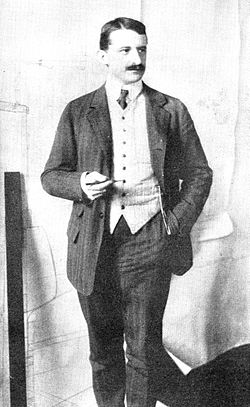
Bruno Paul
Bruno Paul (19 January 1874 – 17 August 1968) was a German architect, illustrator, interior designer, and furniture designer.
Trained as a painter in the royal academy just as the Munich Secession developed against academic art, he first came to prominence as a cartoonist and illustrator in the German fin de siècle magazine Jugend, and in the satirical Simplicissimus from 1897 through 1906, in the years where its criticism of Wilhelm II brought prosecutions from the government.
By 1907, Paul became one of the founding members of the Deutscher Werkbund, and had launched multiple careers in industrial design, interior design (notably, for Norddeutscher Lloyd's ocean liners), furniture design, and architecture. His work of the time reflects a historic stylistic transition from the curved shapes and floral imagery of Jugendstil to simpler forms, straighter lines, and an adaptation to machine production methods. By 1907, Paul had also been appointed Director of the state school for decorative arts in Munich, hired despite his earlier criticisms.
Through the next years, on parallel tracks, Paul pursued both educational reforms in applied art and large commercial architectural commissions, for example, Berlin's first high-rise, the Kathreiner-Haus of 1930. Paul's career effectively ended with the rise of National Socialism.
Among Paul's students and apprentices were Mies van der Rohe, Kem Weber, and Adolf Meyer.
Paul was born in Seifhennersdorf, a village in rural Saxony, in 1874. His father was an independent tradesman, craftsman, and dealer in building materials. At twelve years old, Paul left Seifhennersdorf for Dresden, where he briefly attended Gymnasium before entering a teacher's training school. By 1892, he was determined to pursue a career in the arts. In 1893 he was accepted as a student at the Saxon Academy of Fine Arts.
In 1894, Paul moved to Munich, the artistic capital of Wilhelmine Germany. He enrolled at the Academy of Fine Arts, Munich as a student of the painter Paul Hoecker, one of the primary figures of the Munich Secession. Hoecker provided Paul's introduction to the city's circle of progressive artists, which included his classmates Reinhold Max Eichler, Max Feldbauer, Walter Georgi, Angelo Jank, Walter Püttner, Leo Putz, and Ferdinand von Rezniçek.
In 1896, Paul left the Academy to begin an independent career. After working briefly as a studio painter, he won lasting renown as an illustrator and caricaturist. He was a regular contributor to Jugend, the magazine from which Jugendstil derived its name. The leading figures of this movement, including Peter Behrens, Bernhard Pankok, and Richard Riemerschmid, as well as the majority of the founding members of the Munich Secession, provided illustrations to Jugend. After 1897, Paul joined the staff of the satirical magazine Simplicissimus. Paul's weekly contributions to Simplicissimus between 1897 and 1906 won him international acclaim.
Bruno Paul
Bruno Paul (19 January 1874 – 17 August 1968) was a German architect, illustrator, interior designer, and furniture designer.
Trained as a painter in the royal academy just as the Munich Secession developed against academic art, he first came to prominence as a cartoonist and illustrator in the German fin de siècle magazine Jugend, and in the satirical Simplicissimus from 1897 through 1906, in the years where its criticism of Wilhelm II brought prosecutions from the government.
By 1907, Paul became one of the founding members of the Deutscher Werkbund, and had launched multiple careers in industrial design, interior design (notably, for Norddeutscher Lloyd's ocean liners), furniture design, and architecture. His work of the time reflects a historic stylistic transition from the curved shapes and floral imagery of Jugendstil to simpler forms, straighter lines, and an adaptation to machine production methods. By 1907, Paul had also been appointed Director of the state school for decorative arts in Munich, hired despite his earlier criticisms.
Through the next years, on parallel tracks, Paul pursued both educational reforms in applied art and large commercial architectural commissions, for example, Berlin's first high-rise, the Kathreiner-Haus of 1930. Paul's career effectively ended with the rise of National Socialism.
Among Paul's students and apprentices were Mies van der Rohe, Kem Weber, and Adolf Meyer.
Paul was born in Seifhennersdorf, a village in rural Saxony, in 1874. His father was an independent tradesman, craftsman, and dealer in building materials. At twelve years old, Paul left Seifhennersdorf for Dresden, where he briefly attended Gymnasium before entering a teacher's training school. By 1892, he was determined to pursue a career in the arts. In 1893 he was accepted as a student at the Saxon Academy of Fine Arts.
In 1894, Paul moved to Munich, the artistic capital of Wilhelmine Germany. He enrolled at the Academy of Fine Arts, Munich as a student of the painter Paul Hoecker, one of the primary figures of the Munich Secession. Hoecker provided Paul's introduction to the city's circle of progressive artists, which included his classmates Reinhold Max Eichler, Max Feldbauer, Walter Georgi, Angelo Jank, Walter Püttner, Leo Putz, and Ferdinand von Rezniçek.
In 1896, Paul left the Academy to begin an independent career. After working briefly as a studio painter, he won lasting renown as an illustrator and caricaturist. He was a regular contributor to Jugend, the magazine from which Jugendstil derived its name. The leading figures of this movement, including Peter Behrens, Bernhard Pankok, and Richard Riemerschmid, as well as the majority of the founding members of the Munich Secession, provided illustrations to Jugend. After 1897, Paul joined the staff of the satirical magazine Simplicissimus. Paul's weekly contributions to Simplicissimus between 1897 and 1906 won him international acclaim.
Recent media
Recent media