



Community hub
Recent from talks
Contribute something to knowledge base
Content stats: 0 posts, 0 articles, 1 media, 0 notes
Members stats: 0 subscribers, 0 contributors, 0 moderators, 0 supporters
Subscribers
Supporters
Contributors
Moderators
Hub AI
Buchaechum AI simulator
(@Buchaechum_simulator)
Hub AI
Buchaechum AI simulator
(@Buchaechum_simulator)
Buchaechum
Buchaechum (Korean: 부채춤; lit. fan dance) is a Korea fan dance originating from various traditional and religious Korean dances. It is usually performed by groups of female dancers.
Buchaechum was created in 1954 by dancer Kim Baek-bong, who drew influences from both Korean shamanic ritual dances and traditional Joseon court and folk dances. It is said that Baek-bong was inspired by the graceful movements of butterflies and wished to incorporate this beauty into traditional Korean dance.
Koreans embrace Korean heritage and culture through the arts, specifically through dance. The Buchaechum, which can also be referred to as Korean fan dancing, is a traditional, beautiful way to represent Korean culture while embracing minority empowerment, (Lim, 2015). As Buchaechums display beautiful traditional Korean clothing, and colorful Korean fans, at the same time, Buchaechums also represent family, school, and Korean communities being able to come together as well as appreciating minority empowerment.
In 1993, the Korea Dance Association designated Buchaechum as a masterpiece, while in October of 2014, Buchaechum was designated as a cultural asset.
The Korean fan dance may used to have a more traditional setting; there has been an increase in change of the setting, performers, and audience of a traditional Buchaechum, (Kim, Crump, 1993).
Since 2006, the Korean Cultural Center has opened Korean Cultural Centers all over the world. These cultural centers are normally opened in major cities around the world. The events at these cultural centers have brought Buchaechum to many people who might otherwise have never experienced this part of the Korean culture. While many people will also find Buchaechum through the ingestion of other media, such as K-pop and Korean Drama, also known as K-drama, these cultural centers will sometimes hold events that can introduce attendees to other cultural aspects of the Korean people.
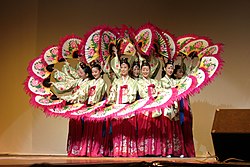
This dance is performed at many celebrations and events in Korea, and has become popular worldwide. Dancers use large fans painted with pink peony blossoms to create various formations that represent images such as birds, flowers, butterflies, dragons and waves. The dancers wear brightly coloured hanbok, the Korean traditional dress. The outfit itself is considered an essential element in the overall performance. This includes a traditional Korean hanbok that includes the Chima (skirt) and Jeogori (jacket). The accessories includes various hair accessories such as ornamental hairpins or ribbons. There is also the Buchae (fans) that are large and colorful which adds an eye-catching dynamic to the overall flow of the dance. Buchaechum is usually performed with minyo (folk song) or sanjo (instrumental solo) accompaniment, though court and ritual music is often used as well. The dance is known for showcasing the elegant and graceful aspects of classical technique in a format suitable for modern audiences.
Not only does performing Buchaechum show true Korean elegance, it also allows the audience to appreciate Korean culture, especially Korean fan dancing. This allows audiences to visually remember and take in how beautiful and calming the fan dance is, all with remembering sounds of the Korean drums played as well. Buchaechum allows individuals of other countries to celebrate Korean culture, and to celebrate multiculturalism. Not only are Buchaechums performed in Korean culture, but are celebrated in other countries such as Japan and the importance of dance in expressing identity. The Buchaechum shows grace and elegance while helping others understand the importance of being viewed to more of a modern audience. Various countries have been appreciating and understanding the importance of the Buchaechum, much more than in the past.
Buchaechum
Buchaechum (Korean: 부채춤; lit. fan dance) is a Korea fan dance originating from various traditional and religious Korean dances. It is usually performed by groups of female dancers.
Buchaechum was created in 1954 by dancer Kim Baek-bong, who drew influences from both Korean shamanic ritual dances and traditional Joseon court and folk dances. It is said that Baek-bong was inspired by the graceful movements of butterflies and wished to incorporate this beauty into traditional Korean dance.
Koreans embrace Korean heritage and culture through the arts, specifically through dance. The Buchaechum, which can also be referred to as Korean fan dancing, is a traditional, beautiful way to represent Korean culture while embracing minority empowerment, (Lim, 2015). As Buchaechums display beautiful traditional Korean clothing, and colorful Korean fans, at the same time, Buchaechums also represent family, school, and Korean communities being able to come together as well as appreciating minority empowerment.
In 1993, the Korea Dance Association designated Buchaechum as a masterpiece, while in October of 2014, Buchaechum was designated as a cultural asset.
The Korean fan dance may used to have a more traditional setting; there has been an increase in change of the setting, performers, and audience of a traditional Buchaechum, (Kim, Crump, 1993).
Since 2006, the Korean Cultural Center has opened Korean Cultural Centers all over the world. These cultural centers are normally opened in major cities around the world. The events at these cultural centers have brought Buchaechum to many people who might otherwise have never experienced this part of the Korean culture. While many people will also find Buchaechum through the ingestion of other media, such as K-pop and Korean Drama, also known as K-drama, these cultural centers will sometimes hold events that can introduce attendees to other cultural aspects of the Korean people.
This dance is performed at many celebrations and events in Korea, and has become popular worldwide. Dancers use large fans painted with pink peony blossoms to create various formations that represent images such as birds, flowers, butterflies, dragons and waves. The dancers wear brightly coloured hanbok, the Korean traditional dress. The outfit itself is considered an essential element in the overall performance. This includes a traditional Korean hanbok that includes the Chima (skirt) and Jeogori (jacket). The accessories includes various hair accessories such as ornamental hairpins or ribbons. There is also the Buchae (fans) that are large and colorful which adds an eye-catching dynamic to the overall flow of the dance. Buchaechum is usually performed with minyo (folk song) or sanjo (instrumental solo) accompaniment, though court and ritual music is often used as well. The dance is known for showcasing the elegant and graceful aspects of classical technique in a format suitable for modern audiences.
Not only does performing Buchaechum show true Korean elegance, it also allows the audience to appreciate Korean culture, especially Korean fan dancing. This allows audiences to visually remember and take in how beautiful and calming the fan dance is, all with remembering sounds of the Korean drums played as well. Buchaechum allows individuals of other countries to celebrate Korean culture, and to celebrate multiculturalism. Not only are Buchaechums performed in Korean culture, but are celebrated in other countries such as Japan and the importance of dance in expressing identity. The Buchaechum shows grace and elegance while helping others understand the importance of being viewed to more of a modern audience. Various countries have been appreciating and understanding the importance of the Buchaechum, much more than in the past.
Recent media
Recent media