Hubbry Logo
logo
Buchaechum
Community hub

Buchaechum

logo
0 subscribers
Read side by side
from Wikipedia
Buchaechum
Korean name
Hangul
부채춤
Revised RomanizationBuchaechum
McCune–ReischauerPuch'aech'um

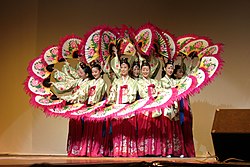
Buchaechum (Korean부채춤; lit. fan dance) is a Korea fan dance originating from various traditional and religious Korean dances. It is usually performed by groups of female dancers.

History

[edit]

Buchaechum was created in 1954 by dancer Kim Baek-bong, who drew influences from both Korean shamanic ritual dances and traditional Joseon court and folk dances.[1] It is said that Baek-bong was inspired by the graceful movements of butterflies and wished to incorporate this beauty into traditional Korean dance.[2]

Koreans embrace Korean heritage and culture through the arts, specifically through dance. The Buchaechum, which can also be referred to as Korean fan dancing, is a traditional, beautiful way to represent Korean culture while embracing minority empowerment, (Lim, 2015). As Buchaechums display beautiful traditional Korean clothing, and colorful Korean fans, at the same time, Buchaechums also represent family, school, and Korean communities being able to come together as well as appreciating minority empowerment.

In 1993, the Korea Dance Association designated Buchaechum as a masterpiece, while in October of 2014, Buchaechum was designated as a cultural asset.[3]

The Korean fan dance may used to have a more traditional setting; there has been an increase in change of the setting, performers, and audience of a traditional Buchaechum, (Kim, Crump, 1993).

Since 2006, the Korean Cultural Center has opened Korean Cultural Centers all over the world. These cultural centers are normally opened in major cities around the world. The events at these cultural centers have brought Buchaechum to many people who might otherwise have never experienced this part of the Korean culture. While many people will also find Buchaechum through the ingestion of other media, such as K-pop and Korean Drama, also known as K-drama, these cultural centers will sometimes hold events that can introduce attendees to other cultural aspects of the Korean people.

Performances

[edit]

This dance is performed at many celebrations and events in Korea, and has become popular worldwide. Dancers use large fans painted with pink peony blossoms to create various formations that represent images such as birds, flowers, butterflies, dragons and waves. The dancers wear brightly coloured hanbok, the Korean traditional dress.[4] The outfit itself is considered an essential element in the overall performance. This includes a traditional Korean hanbok that includes the Chima (skirt) and Jeogori (jacket). The accessories includes various hair accessories such as ornamental hairpins or ribbons. There is also the Buchae (fans) that are large and colorful which adds an eye-catching dynamic to the overall flow of the dance.[5] Buchaechum is usually performed with minyo (folk song) or sanjo (instrumental solo) accompaniment, though court and ritual music is often used as well. The dance is known for showcasing the elegant and graceful aspects of classical technique in a format suitable for modern audiences.[6]

Not only does performing Buchaechum show true Korean elegance, it also allows the audience to appreciate Korean culture, especially Korean fan dancing. This allows audiences to visually remember and take in how beautiful and calming the fan dance is, all with remembering sounds of the Korean drums played as well. Buchaechum allows individuals of other countries to celebrate Korean culture, and to celebrate multiculturalism. Not only are Buchaechums performed in Korean culture, but are celebrated in other countries such as Japan and the importance of dance in expressing identity. The Buchaechum shows grace and elegance while helping others understand the importance of being viewed to more of a modern audience. Various countries have been appreciating and understanding the importance of the Buchaechum, much more than in the past.

Outside Korea

[edit]

China

[edit]

According to a Hallyuism blog entry, Buchaechum is also popular in China. It is sometimes performed as a part of other spring celebrations as the movement "represents the blooming of flowers." [7]

Japan

[edit]

In Japan, many Korean cultural events took place to show their respect and allow Korean arts to stand out to others. In Japan, special events such as fairs or Korean festivals were created to help express diversity not only within the Asian community, but specifically the Korean culture. Buchaechums were one of many Korean events which took place in public areas, such as parks, schools, or community recreation centers. Participants in the Korean fan dance, which included mainly girls, hold bright colored fans as they dance to drums being played in the background. Japanese schools helped create these events to show more appreciation of traditional Korean arts. While the country of Japan housed many Korean students, schools in Japan acknowledged the lack of funding in the Korean community education system. Japanese schools also did this to show how Japanese educators who may not respect or acknowledge Korean culture appreciate Korean dance more, especially when a lot of their students participate in the Buchaechum, (Lim, 2015). The performance of the Buchaechum of Koreans living in Japan helps Korean students’ parents also realize the importance of their own culture. Korean adults who have lived in Japan with children may lose touch of their Korean culture, as they adapted to Japanese culture and customs.

Beyond Asia

[edit]

Since the beginning of Hallyu or the Korean Wave, Buchaechum has gained in both recognition and popularity outside of Asia. Buchaechum is often showcased as part of Korean cultural performances at international events, festivals, and cultural exchanges. Korean embassies, cultural centers, and performing arts groups frequently present Buchaechum in various countries to promote Korean culture and foster cultural understanding. The dance's captivating beauty, graceful movements, and vibrant costumes have resonated with audiences worldwide, leading to its popularity in countries with diverse cultural backgrounds. Buchaechum's inclusion in international cultural festivals and events has helped to raise awareness of this traditional Korean dance and its significance in Korean heritage. In cities and towns with a large presence of Korean immigrants, Buchaechum may be seen at yearly celebrations which may take place at a local church, temple, or cultural center. Not being tied to a specific religious tradition, the dance can be seen in many places as it is more of an expression of the Korean people.[8]

Moreover, the accessibility of digital and social media platforms has enabled the wider dissemination of Buchaechum performances, allowing people from different parts of the world to experience and appreciate the art form. This is normally through wide-reaching platforms such as YouTube.[9]

While Buchaechum's popularity might not be as pervasive as modern K-pop music or Korean dramas, its presence in the global cultural scene continues to grow, contributing to the appreciation and understanding of Korean traditional arts beyond Korea's borders. Some areas it could be experienced include cultural festivals, mixed celebrations and events, multicultural events that include Asian cultures, Korean-specific cultural showcases, along with religious and non-religious gatherings.

It is possible to experience Buchaechum outside of Korea in Asia and globally.

See also

[edit]

References

[edit]
Revisions and contributorsEdit on WikipediaRead on Wikipedia
from Grokipedia
Buchaechum is a neoclassical Korean fan dance performed by groups of dancers who manipulate large, colorful folding fans to create wave-like patterns and illusions of landscapes, such as mountains, oceans, and flowers, through synchronized choreography and fluid movements.[1][2] Developed in the mid-20th century, Buchaechum draws inspiration from ancient shamanic rituals, Joseon Dynasty court dances, and folk traditions, where fans were used symbolically in performances to evoke nature and emotions.[1][3] The dance was choreographed in 1954 by Kim Baek-bong, a prominent Korean dancer, initially as a solo piece that evolved into a renowned ensemble performance popularized internationally at the 1968 Mexico City Olympics by a Korean folk dance troupe.[1] Performers typically wear vibrant hanbok (traditional Korean attire) in harmonious colors, with women donning skirts and blouses that enhance the graceful, curving motions like meokgi (submerging) and pureonaegi (emerging), accompanied by traditional gugak music featuring instruments such as the gayageum and percussion.[2][4] As a symbol of Korean cultural heritage, Buchaechum embodies themes of harmony, nature, and communal expression, often featured in national festivals, diplomatic events, and educational programs to promote hallyu (the Korean Wave) worldwide.[2][5] Its designation as an important intangible cultural asset by the Korea Dance Association in 1992, and further as the 3rd Important Intangible Cultural Property of South Pyongan Province in 2014, underscores its role in preserving and innovating traditional arts amid modern influences.[6][7] Today, Buchaechum continues to captivate global audiences through performances by groups like the National Dance Company, blending timeless elegance with contemporary adaptations.[8]

Origins and History

Origins

Buchaechum draws inspiration from ancient Korean shamanic ritual dances, where performers used props to ward off evil spirits and invoke protective forces in practices embedded in folklore dating back to prehistoric and early historical periods of Korean shamanism.[9][10] These rituals, often performed by shamans known as mudang, emphasized spiritual purification and harmony with the natural world, reflecting beliefs in animistic forces that governed daily life and agricultural cycles.[3] During the Joseon Dynasty (1392–1910), influences from court dances and folk performances further shaped these traditions, incorporating fans as symbolic elements representing natural phenomena such as wind, which evoked cooling breezes and seasonal changes, and flowers, particularly peonies that signified prosperity and beauty.[3][10] In court settings, fans denoted social status through their spoke count and elaborate designs, while in folk contexts, they blended with communal dances to celebrate harvests and communal harmony.[3] These ancient and historical practices, including solo performances in religious ceremonies that enacted gestures of spiritual protection and alignment with cosmic and natural rhythms, laid the groundwork for Buchaechum's themes of personal devotion and ecological balance.[10][9]

Development and Recognition

Buchaechum was created in 1954 by renowned Korean dancer and choreographer Kim Baek-bong as a neoclassical form of dance known as shin muyong, which innovatively blended elements from Korean shamanic ritual dances—inspired by her teacher Choi Seung-hee's "Mudangchum" (shaman dance)—Joseon-era court dances, and folk traditions, while incorporating graceful, butterfly-inspired movements to evoke natural beauty and fluidity.[1][9][11] Initially conceived as a solo performance, Buchaechum underwent significant evolution in the mid-20th century, transitioning to a group format to enhance its visual impact and symbolic representation of harmony. This adaptation gained international prominence when a Korean folk dance troupe performed it as a group piece at the 1968 Summer Olympics in Mexico City, serving as a cultural ambassador that introduced Korean artistry to global audiences and solidified its role in promoting national identity abroad.[1] The dance's formal recognition began in 1993, when the Korea Dance Association designated Kim Baek-bong's Buchaechum as a masterpiece, acknowledging its artistic innovation and cultural value.[12] Further affirmation came on October 15, 2014, with its registration as the third intangible cultural property of South Pyongan Province, Kim's hometown, highlighting its enduring significance in preserving and evolving Korean dance heritage.[6]

Description and Elements

Costumes and Props

Buchaechum performers, typically female, don traditional hanbok attire to embody the dance's graceful aesthetic. The ensemble features a chima, a voluminous layered skirt that allows fluid movements, paired with a jeogori, a short jacket fastened with ribbons. These garments are crafted in vibrant hues drawn from the five directional colors of Korean cosmology, which also symbolize the seasons: blue or green for spring (east), red for summer (south), yellow for late summer (center), white for autumn (west), and black for winter (north).[13][14] The jeogori often incorporates delicate floral embroidery, enhancing the overall elegance and thematic connection to nature.[10] Central to the performance are the buchae, large folding fans measuring approximately 20 to 30 inches when open, essential for creating visual illusions of landscapes and flora. These props consist of silk or hanji paper coverings stretched over flexible bamboo ribs, enabling precise manipulations during the dance. The fans are adorned with painted motifs, commonly peonies in vivid pinks and reds, which symbolize prosperity and wealth in Korean culture.[15][10] Complementing the attire are subtle accessories that accentuate the performers' poise, including ornate hairpins such as binyeo or cheopji made of silver or gold with floral or geometric designs to secure traditional updos. Makeup is applied minimally yet strikingly, featuring a pale base to evoke porcelain-like refinement, accented by subtle rouge and defined brows to highlight facial expressions and convey serene beauty.[16][4]

Music and Choreography

Buchaechum is accompanied by traditional Korean music that enhances its graceful movements and visual harmony. The primary accompaniment consists of minyo, or folk songs, which infuse the performance with rhythmic energy and a lively, communal spirit drawn from regional traditions, particularly those of Gyeonggi-do Province.[1] These songs are typically performed on instruments such as the gayageum (a twelve-stringed zither) and daegeum (a bamboo flute), creating a melodic foundation that supports the dancers' synchronized steps.[17] For more introspective segments, sanjo—a form of solo instrumental music—provides expressive depth, allowing individual flourishes on the gayageum or daegeum to highlight the dance's emotional nuances.[18] In formal settings, elements of aak, or court music, may be incorporated to convey elegance and ritualistic poise, aligning with the dance's neoclassical roots.[19] This varied musical palette ensures the accompaniment mirrors the dance's blend of folk vitality and refined artistry. The choreography of Buchaechum follows a structured sequence designed for group synchronization, originally conceived as a solo by Kim Baek-bong in 1954 and later adapted for ensemble performances, such as at the 1968 Mexico Olympics.[1] Dancers manipulate large, peony-painted fans to form dynamic visual patterns, evoking natural motifs like waves, flowers, butterflies, and mountains through precise, flowing transitions.[20] These formations build a narrative progression, emphasizing unity and harmony among the performers. Performances typically span 10-15 minutes, with rhythmic patterns rooted in traditional Korean jangdan (rhythmic cycles) that favor 3/4 or 6/8 time signatures to facilitate slow, undulating movements and gradual builds in intensity.[7] This structure allows for a seamless flow, where the music and dance intertwine to create an immersive auditory and visual experience.

Performance Techniques

Movements and Formations

Buchaechum features core movements centered on the manipulation of large, colorful fans held in both hands, which serve as extensions of the dancers' arms to create fluid, wave-like motions that evoke natural elements such as butterflies or flowing rivers.[21] These are achieved through graceful arm extensions initiated by controlled breathing, where motion flows from the shoulders to the fingertips with a subtle delay, combined with light foot slides rolling from heel to toe and gentle torso sways that maintain overall harmony and elegance.[21] Dramatic fan snaps occur on musical downbeats, synchronized across performers, while level changes—such as subtle squatting or kneeling on one leg—add depth without disrupting the dance's restrained poise.[21] Specific techniques include meokgi (submerging), involving downward curving motions, and pureonaegi (emerging), with upward flowing gestures that enhance the dance's graceful illusions of nature.[2] The dance's formations emphasize group synchronization, typically involving groups of female dancers arranged in circular or linear patterns to form dynamic shapes representing natural phenomena, such as blooming flowers, rolling waves, or butterflies.[22][23][9] These configurations, like rotating circles or undulating waves, require precise spatial awareness and unity, with dancers maintaining personal space while collectively evoking landscapes.[21][24] The emphasis on mirrored, non-interactive positioning in performance spaces heightens the visual impact, transforming individual actions into a cohesive, flowing tableau.[21] Pacing in Buchaechum alternates between slow and moderate rhythms to sustain its elegant flow, beginning with a deliberate taryeong jangdan (12-beat pattern) that supports restrained, lyrical motions before transitioning to a faster jajinmori for more dynamic yet controlled sequences, and returning to the slower tempo toward the conclusion.[21] Footwork remains light and soft throughout, varying from quick slides to measured steps without incorporating jumps or acrobatics, ensuring the performance prioritizes subtlety and precision over vigor.[21] This rhythmic structure aligns briefly with accompanying folk music patterns, enhancing the dance's harmonious progression.[22]

Training and Performers

Training for Buchaechum involves intensive preparation over several years at specialized Korean dance academies, such as those affiliated with the National Dance Company of Korea, where aspiring dancers undergo rigorous regimens focused on perfecting posture, mastering fan control, and building physical endurance.[1][25] Daily sessions emphasize the practice of basic steps like geodang, which form the foundation for the dance's fluid and synchronized movements.[23] This intensive preparation ensures performers can execute the demanding group formations with precision and grace. Buchaechum is predominantly performed by female ensembles, drawn from professional troupes such as the National Dance Company of Korea.[1] These performers are selected for their dedication, undergoing training that fosters strict discipline and deep cultural immersion to embody the dance's artistic and historical essence.[25] While rooted in the traditional master-apprentice system prevalent in Korean intangible cultural heritage practices, modern training for Buchaechum incorporates adaptations like video analysis to enhance synchronization among group members. This blend allows contemporary dancers to refine techniques while preserving the art form's core principles.

Cultural Significance

In Korean Society

Buchaechum serves as a vital element in contemporary Korean cultural life, frequently appearing in domestic performances that help maintain traditional practices in the face of rapid urbanization and modernization. It is a staple at national festivals like Chuseok, where groups of dancers perform to celebrate the harvest and foster communal harmony, evoking the grace of blooming flowers through synchronized fan movements.[26] Additionally, the dance features prominently in cultural heritage events organized by local communities and government bodies, such as those at historic sites and annual folk arts gatherings, ensuring its transmission to younger generations amid urban expansion. These performances not only entertain but also reinforce cultural continuity by integrating Buchaechum into public celebrations that draw thousands of participants and spectators annually. The dance is traditionally performed by women and promotes community cohesion through ensemble performances. Government support plays a key role, with subsidies from the Cultural Heritage Administration funding training programs, troupe operations, and preservation efforts to sustain these initiatives nationwide.[27] Educationally, Buchaechum has been integrated into school and university curricula as part of Korea's intangible cultural heritage programs, aiming to instill national pride and artistic skills in students. In primary and secondary schools, it is taught through physical education and arts classes, where pupils learn basic fan-handling techniques and formations to appreciate its rhythmic elegance and historical roots. Most Korean students learn the dance in school.[1] At universities, specialized dance departments offer advanced courses on Buchaechum, combining practical training with theoretical studies on its neoclassical evolution, preparing future performers and educators. This institutional emphasis has led to increased participation, with student-led performances at school festivals contributing to broader cultural awareness.

Symbolism and Themes

Buchaechum incorporates rich natural symbolism through its use of fans, which are often painted with peony blossoms representing prosperity and wealth in Korean culture.[28] The fans also evoke butterflies, symbolizing transformation and joy, as dancers manipulate them to form illusory images of these creatures in flight. These elements extend to broader formations that mimic seasonal cycles, such as blooming flowers in spring or rippling waves, underscoring a harmony between humans and the natural environment.[10] The synchronized movements of the ensemble highlight themes of unity and grace, where the collective precision of the performers embodies communal bonds and feminine elegance.[10] This group dynamic reflects traditional Korean values of balance and coordination, achieved through fluid, mirrored actions that create a sense of wholeness.[29] At its core, Buchaechum carries spiritual undertones rooted in shamanic influences, where the fans serve as tools for invoking purification and dispelling negativity, akin to ritualistic cleansing.[10] These echoes promote a subtle sense of joy and renewal, integrating emotional and spiritual expression without explicit religious observance.[29]

Global Influence

Performances Abroad

Buchaechum gained international prominence with its debut as a group performance at the 1968 Summer Olympics in Mexico City, where a Korean folk dance company adapted the traditionally solo form to showcase synchronized movements with fans, captivating global audiences and marking a pivotal moment in its diplomatic promotion abroad.[1] This event, organized as part of cultural exchanges, highlighted the dance's elegance and helped establish it as a symbol of Korean heritage on the world stage.[9] Subsequent presentations have occurred at major international expositions through Korean Cultural Centers, such as the 2010 Shanghai World Expo, where performers demonstrated the dance's fluid formations amid global celebrations of urban innovation. In regional contexts, Buchaechum features frequently in China, including during spring festivals and cultural exchanges that integrate it into local events to foster bilateral ties. Similarly, in Japan, performances by Korean resident communities at festivals like the 1964 Tokyo Olympic Culture Festival have promoted cultural identity and contributed to Hallyu initiatives, emphasizing the dance's role in cross-border appreciation.[7] Diaspora communities have sustained Buchaechum's presence abroad, with second-generation Korean Americans in the United States staging it at heritage festivals to preserve traditions and engage younger participants in hanbok and fan techniques. In Europe, Korean Cultural Centers in countries like Belgium and Poland host workshops and exhibitions, enabling local audiences to experience the dance's graceful symbolism through interactive sessions. By 2025, these efforts via diplomatic channels and community events have extended performances to numerous countries worldwide, reinforcing Korea's soft power. For instance, in 2025, Buchaechum was performed at the KoreaOn Korean Cultural Festival in Hungary and the Hallyu Korea Philippines Cultural Exchange Fiesta.[17][30][31][32]

Adaptations and Legacy

In recent years, Buchaechum has seen modern adaptations that fuse its traditional elements with contemporary dance styles, particularly within the K-pop industry since the 2010s. K-pop groups, such as Weeekly, have engaged in promotional activities learning and performing simplified versions of the fan dance, blending its graceful formations with high-energy choreography to appeal to global audiences.[33] These integrations highlight Buchaechum's versatility, allowing it to evolve while retaining core motifs like fan manipulations that evoke natural imagery.[34] The legacy of Buchaechum has been amplified by the Hallyu wave, which has elevated Korean cultural exports and spurred international interest in traditional arts. This global phenomenon has led to the establishment of dedicated dance schools abroad, including in Los Angeles, where institutions like the Kim Eung Hwa Korean Dance Academy, founded in 1980, offer classes in fan dance techniques to preserve and teach the form to diverse communities.[35] Similarly, the Koreatown Art Center in Los Angeles provides ongoing instruction in Buchaechum for all levels, contributing to its enduring practice among second-generation Korean Americans and enthusiasts.[36] By the 2020s, Buchaechum continues to play a role in Korea's efforts to safeguard intangible cultural heritage nationally, alongside other dances like talchum, which is recognized by UNESCO. Looking ahead, digital preservation efforts ensure its accessibility amid globalization, with online tutorials from official programs enabling remote learning of basic steps and formations.[37] Emerging VR applications for traditional Korean dances further support immersive experiences, allowing virtual recreations that aid in cultural transmission without physical constraints.[38]

References

User Avatar
No comments yet.