
.jpg/250px-Hanbok_(female_and_male).jpg)


.jpg)
Community hub
Recent from talks
Contribute something
Nothing was collected or created yet.
Hanbok
View on Wikipedia
.jpg) | |
| Material | Diverse |
|---|---|
| Place of origin | Korea |
| Introduced | At latest the Goguryeo period |
| North Korean name | |
| Hangul | 조선옷 |
| Hanja | 朝鮮옷 |
| RR | joseonot |
| MR | chosŏnot |
| South Korean name | |
| Hangul | 한복 |
| Hanja | 韓服 |
| RR | hanbok |
| MR | hanbok |
The hanbok (Korean: 한복; Hanja: 韓服; lit. Korean dress) is the traditional clothing of the Korean people.
The term hanbok literally means Korean clothing. In South Korea and internationally, it is the standard term for the attire. North Koreans refer to the clothes as chosŏnot (조선옷; lit. Korean clothes).[1] The attire is also worn in the Korean diaspora.[2] Koryo-saram—ethnic Koreans living in the lands of the former Soviet Union—also retained a hanbok tradition.[3]
The hanbok is fundamentally composed of a jeogori (top), baji (trousers), chima (skirt), and the po (coat). While this core arrangement has remained consistent for a long time, its length, width, and shape have gradually changed over time.

Koreans have worn hanbok since antiquity. The earliest visual depictions of hanbok can be traced back to the Three Kingdoms of Korea period (57 BCE to 668 CE) with roots in the ancestors of the Koreanic peoples of what is now northern Korea and Manchuria. The clothes are also depicted on tomb murals from the Goguryeo period (4th to 6th century CE), with the basic structure of the hanbok established since by at least this time.[4] The ancient hanbok, like modern hanbok, consisted of a jeogori, baji, chima, and po.
Some interpretations suggest that certain elements of the hanbok, such as specific colors or patterns, were influenced by traditional folk beliefs or shamanism.[5] For thousands of years, many Koreans have preferred white hanbok, a color considered pure and symbolizing light and the sun.[6][7][8][9] In some periods, commoners (seomin) were forbidden from wearing certain colorful hanbok regularly.[10]: 104 [11][12] However, during the Joseon dynasty (1392–1897) and the Japanese occupation of Korea (1910–1945), there was also an attempt to ban white clothes and to encourage non-bleached dyed clothes, which ultimately failed.[13][14][15][16]
Modern hanbok are typically patterned after the hanbok worn in the Joseon period,[5] especially those worn by the nobility and royalty.[17]: 104 [11]
There is some regional variation in hanbok design between South Korea and North Korea, which arose from their relative isolation in the late 20th century. Communities of ethnic Koreans abroad, including those in China, also maintain their own hanbok traditions, all of which are rooted in the shared cultural heritage of Korea. Since the 1990s, increased cultural exchange has led to these different styles converging once again.
Nowadays, contemporary Koreans wear hanbok for formal or semi-formal occasions and for events such as weddings, festivals, celebrations, and ceremonies. In 1996, the South Korean Ministry of Culture, Sports and Tourism established Hanbok Day to encourage South Korean citizens to wear the hanbok.[18]
Etymology
[edit]The term hanbok came into use relatively recently, beginning in the 1800s. It is connectedwith the historical context in which it appeared.
The term emerged in the late Joseon period, when the Empire of Japan and other western countries competed to place Korea under their own sphere of influence. The first known use of the term is in an 1881 document from the late Joseon period entitled Chŏngch'iilgi (《정치일기》).[19][20] There, hanbok is used to distinguish Korean clothing from Japanese and Western-style clothing. Hanbok was again used in an 1895 document to distinguish between Korean and Japanese clothing. These two usages predate the Korean Empire's popularization of the use of the hanja character Han (Hanja: 韓) to describe the Korean people.
Beginning in 1900, Korean newspapers used the hanja character Han in words that described Korean clothing, such as Han'gugŭibok (한국의복), Han'gugyebok (한국예복), and Taehannyŏbok (대한녀복). Hanbok was used in a 1905 newspaper article to describe the clothing of one of the righteous armies. Other words with similar meanings, such as uri-ot (우리옷) and chosŏn-ot (조선옷), were concurrently used.
Since the division of Korea, South Korea has preferred the term hanbok while North Korea has preferred the term Chosŏn-ot. This reflects the general trend of South Korea's preference for the term Han and North Korea's for Chosŏn.
Components and design
[edit]
- A diagram of the hanbok's anatomy
- 1. hwajang
- 2. godae
- 3. somae buri
- 4. somae
- 5. goreum
- 6. u
- 7. doryeon
- 8, 11. jindong
- 9. gil
- 10. baerae
- 12. git
- 13. dongjeong
For women, traditional hanbok consists of the jeogori (top) and the chima (skirt). The ensemble is often known as chima jeogori. For men, hanbok consist of jeogori and loose-fitting baji (trousers).[21]
There are also a variety of vests, jackets and coats on top of this ensemble. For women, there are Jangsam, Dansam, Wonsam, and more. For men, some examples are durumagi, dopo, Danryeong-ui, Joong-chimak, Sochang-ui, Daechang-ui, etc.
Jeogori
[edit]The jeogori (저고리) is the basic upper garment of the hanbok, worn by both men and women. It covers the arms and upper part of the wearer's body.[22][23]
There are various styles and types of jeogori varying in fabric, sewing technique, and shape.[24][25] The basic form of a jeogori consists of gil, git, dongjeong, goreum and sleeves. Gil (길) is the large section of the garment on both front and back sides, and git (깃) is a band of fabric that trims the collar. Dongjeong (동정) is a removable white collar placed over the end of the git and is generally squared off. The goreum (고름) are fabric-strings that tie the jeogori.[21] Women's jeogori may have kkeutdong (끝동), a different colored cuff placed at the end of the sleeves. Contemporary jeogori are presently designed with various lengths.
Goreum
[edit]Goreum (고름) refers to the strings that fasten clothes together.
Traditionally, there are many types of goreum. Fabric goreum was potentially used since Gojoseon. They were originally practical but often decorative. Silla had regulations against types of Dae (belts) and decorative goreum for each Golpoom. Southern parts of Korea, including Silla, had a colorful goreum on the front of the neck, which influenced Yayoi culture. Parts of Goguryeo style had a fabric goreum loop around the waist with a decorative ribbon to the side like a belt. Generally, thin and short ones were used on the inside and more decorative, colourful ones were used on the outside. Since the early form of the jeogori was usually wrapped across the front, the outside goreum was placed on the side of the wearer, below the underarm. Starting in Joseon dynasty, the goreum slowly moved to the front of the jeogori. In the 20th century, the goreum became the commonly known long and wide decorative ribbons on the front of the jeogori and was coined the Ot-goreum.
Danchu
[edit]Danchu (buttons) can also be used as an alternative to goreum.
There are many types of danchu. One example is the maedeup-danchu which was often used to keep symmetrical collars together in the front and used for practical uses on military uniforms and court uniforms. They have long horizontal lines on either side like Manchurian buttons or look like a ball and lasso. Magoja-danchu are often big decorative metal, gems or stones buttons usually on jjokki (vest).[26]

Chima
[edit]Chima (치마) refers to "skirt", and is also called sang (裳) or gun (裙) in hanja.[27][22][24] The underskirt, or petticoat layer, is called sokchima. Chima-malgi is the waistband that trims the top of the chima. Chima was typically made from rectangular panels that were pleated or gathered into the chima-malgi (waistband).[28] This waistband also had goreum strings for fastening the skirt around the body.[29] From the Goguryeo to Joseon periods, chima have been striped, pleated, patchworked, gored[22] and decorated with uniquely Korean geumbak(gold leaf) patterns. This traditional Korean technique of stamping gold leaf with woodblocks was applied to the garments of royalty and nobility and has its origins even before the Three Kingdoms period.[30]
Sokchima was largely made in a traditional way until the early 20th century when shoulder straps were added,[31] later developing into a sleeveless bodice or "reformed" petticoat called eokkaeheorichima.[32] By the mid-20th century, some outer chima also gained a sleeveless bodice, which was then covered by the jeogori.[33][unreliable source?][34][unreliable source?]
Baji
[edit]Baji (바지) refers to the bottom part of the men's hanbok. It is the term for "trousers" in Korean. Compared to western style pants, baji does not fit tightly. The roomy design is aimed at making the clothing ideal for sitting on the floor and an ethnic style that dates back to the Three Kingdoms period.[35]

It functions as modern trousers do and the term baji is commonly used in Korea to refer to every kind of pants.
The baji-malgi is a waistband of the baji that has a long string of goreum.
Baji can be unlined trousers, leather trousers, silk pants, or cotton pants, depending on the style of dress, sewing method, embroidery and so on.
Sokgot
[edit]Sokgot (속곳) is a collective noun for various types of traditional Korean undergarments. They were worn as part of a hanbok before the import of Western-style underwear. Women usually wore several layers of undergarments, the more layers they had the richer they were.[36] Undergarments were considered very important, thus it happened that the quality and material of the underwear were better than that of the visible outer layers.[37]
Deot-ot
[edit]Deot-ot refers to a category of outer layers worn on top of the jeogori. There are many varieties other than the ones listed here.
Po
[edit]Po (포; 袍) is a generic term referring to an outer robe or overcoat. There are two general types of po, the Korean type and the Chinese type.[38] The mainstream Korean type is a common style from the Three Kingdoms of Korea period, and it is used in the modern day.[22][38]

.jpg)
Durumagi is a type of po that was worn for protection against the cold. It has been widely worn as an outer robe over jeogori and baji. It is also called jumagui, juchaui, or juui.[27][22][39]
The word Durumagi in Korean means "closed all around." Originating from the clothing styles of northern peoples, it evolved from Korea's traditional Po (outer robe) system, which dates back to the Goguryeo Kingdom.
The Po of the Goguryeo era had a decorative seon (trim) and was fastened with a tti (belt), in accordance with the style of the time. In contrast, the later Durumagi has little difference except that it lacks the trim and is instead tied with chest goreum (ribbons).
The outer robes of the Baekje and Silla kingdoms were also similar to the Durumagi. Evidence of this can be seen in historical paintings, such as the depiction of a Baekje envoy in the Liang Dynasty's "Portraits of Periodical Offerings" and a Silla envoy in a mural of foreign envoys from the Tang Dynasty's Tomb of Li Xian. In these portraits, the envoys are wearing wide-sleeved robes that are slightly longer than a jeogori (upper jacket), indicating that all three kingdoms shared a similar style of garment.[40]
Baeja refers to sleeveless outer garments that are worn on top of inner garments. It can be different lengths, short to long. Kwaeja is interchangeable with baeja, but Kwaeja often refers to men's clothing. The Chinese type consist of different types of po from mainland China.[38]
Dapho
[edit]The dapho (답호; 褡護) is a short-sleeved men's outer garment, often part of military uniform or official uniform. It was adopted from the Mongol Yuan dynasty during the Goryeo period.
Bigap
[edit]A sleeveless outer garment that was derived from Mongolian clothing worn during the Goryeo period.[41]
Banbi
[edit]Banbi (반비; 半臂, lit. 'half sleeve') are a type Hanfu that originated from the Tang dynasty. Banbi refers to a variety of short-sleeved garments worn on top of inner garments, typically the Yuanling pao (Chinese: 圓領袍, 'round collar robe'). Numerous outer half-sleeved Banbi can be seen in ancient Tang-era paintings, murals, and statues.[42]
Magoja
[edit]Magoja (마고자) does not have a git, the band of fabric trimming the collar.[21] The magoja for men sometimes has seop (섶, overlapped column on the front) and is longer than women's magoja, with both sides open at the bottom. A magoja can be made of silk and often adorned with danchu which are usually made from amber. In men's magoja, buttons are attached to the right side, as opposed to the left as in women's magoja.[39]
It was introduced to Korea after Heungseon Daewongun, the father of King Gojong, returned from his political exile in Tianjin in 1887.[39][43] Long-sleeved magoja were derived from the magwae he wore in exile because of the cold climate there. Owing to its warmth and ease of wear, magoja became popular in Korea. It is also called "deot jeogori" (literally 'an outer jeogori') or magwae.[39]
Jokki
[edit]Jokki (조끼) is a type of vest, while magoja is an outer jacket. The jokki was created around the late Joseon dynasty, as Western culture began to affect Korea.
Children's hanbok
[edit]
Traditionally, Kkachi durumagi (literally 'a magpie's overcoat') were worn as seolbim (설빔), new clothing and shoes worn on the Korean celebration of Korean New Year, while at present, it is worn as a ceremonial garment for dol, the celebration for a baby's first birthday.[44][45] It is a children's colorful overcoat.[46] It was worn mostly by young boys.[47] The clothes is also called obangjang durumagi which means "an overcoat of five directions".[44] It was worn over jeogori (a jacket) and jokki (a vest), while the wearer could put jeonbok (a long vest) over it. Kkachi durumagi was also worn along with headgear such as bokgeon (a peaked cloth hat),[48][49] hogeon (peaked cloth hat with a tiger pattern) for young boys or gulle (decorative headgear) for young girls.[22][need quotation to verify][50]
.jpg)
Foreign influences in design
[edit]The clothing of Korea's rulers and aristocrats after CE 7, was influenced by both indigenous and foreign styles, including influences from various Chinese dynasties.
This led to the adoption of specific garments such as the simui, a robe for Confucian scholars, from the Song dynasty.[51]
The gwanbok (관복 or 단령), worn by male officials was generally adopted from or influenced by the court clothing system of the Tang,[52][53] Song,[53] and Ming dynasties.[54]
While most court clothing for royal women was indigenous, foreign influence can be seen in a few specific robes. For instance, the Dangui is considered a unique Joseon garment despite its name implying Tang origins, whereas the Wonsam was more clearly adapted from Ming dynasty styles. Both, however, were transformed to fit a distinctly Joseon aesthetic.
The cheollik , which originated in Mongolia, was described in 15th century Korea as gifts from the Ming dynasty or as military uniforms.[55]
The cultural exchange was also bilateral and Goryeo hanbok had a cultural influence on some clothing of Yuan dynasty worn by the upper class (i.e. the clothing worn by Mongol royal women's clothing[56] and in the Yuan imperial court[57]).[58]
Commoners were less influenced by these foreign fashion trends, and mainly wore a style of indigenous clothing distinct from that of the upper classes.[59]
Design and social position
[edit]
The choice of hanbok can also signal social position. Bright colors, for example, were generally worn by children and girls, and muted hues by middle-aged men and women. Unmarried women often wore yellow jeogori and red chima while matrons wore green and red, and women with sons donned navy. The upper classes wore a variety of colours. Contrastingly, commoners were required to wear white, but dressed in shades of pale pink, light green, gray and charcoal on special occasions.
The material of the hanbok also signaled status. The upper classes dressed in hanbok of closely woven ramie cloth or other high grade lightweight materials in warmer months and of plain and patterned silks throughout the remainder of the year. Commoners, in contrast, were restricted to cotton.
Patterns were embroidered on hanbok to represent the wishes of the wearer. Peonies on a wedding dress, represented a wish for honor and wealth. Lotus flowers symbolized a hope for nobility, and bats and pomegranates showed the desire for children. Dragons, phoenixes, cranes and tigers were only for royalty and high-ranking officials.[60] In addition, special variants were made for officials and shamans.[35]
History
[edit]Three Kingdoms of Korea
[edit]
The earliest visual depictions of hanbok can be traced back to the Three Kingdoms of Korea period (57 BCE to 668 CE).[61][62][63][64] The origin of ancient hanbok can be found in the ancient clothing of what is now today's Northern Korea and Manchuria.[65]
A prevailing theory traces the origin of the hanbok of antiquity to the nomadic clothing of the Eurasian Steppes (Iranian Scythian clothing), spanning across Siberia from western Asia to Northeast Asia, interconnected by the Steppe Route.[66][67][68] Reflecting its nomadic origins in western and northern Asia, ancient hanbok shared structural similarities with hobok type clothing of the nomadic cultures in East Asia, designed to facilitate horse-riding and ease of movement,[19][69][70] such as the use of trousers and jacket for male clothing and the use of left closure in its jacket.[71]
However, although the ancient hanbok reflects some similarity with the Iranian Scythian clothing, a number of differences between the two types of clothing have also been observed which led associated professor Youngsoo Chang from the Department of Cultural Properties in Gyeongju University in 2020 to argue that the theory about Iranian Scythian clothing being the archetype of the ancient hanbok, a theory accepted as common knowledge in Korean academia, may have to be revised.[71]
It is also important to note the evidence found in Goguryeo tomb murals. These murals from the ancient Korean kingdom were primarily painted in Jian and Pyongyang, the kingdom's second and third capitals, respectively, from the mid-fourth to the mid-seventh centuries. These murals vividly depict the people of Goguryeo on a grand scale and with unmatched detail.[72]: 15
Goguryeo tomb murals exhibit different characteristics by region. Murals found in Jian, Manchuria, the earlier capital, primarily depict Goguryeo's indigenous customs, morals, and daily life. In contrast, murals from Pyongyang on the Korean Peninsula, the later capital, reflect a broader cultural interaction. While these murals are fundamentally Goguryeo in character, they also contain depictions of Chinese figures in Han dynasty-style clothing, who are presumed to be linked to the Han commanderies that governed the region at the end of the Gojoseon period. Furthermore, certain elements, such as the costumes of the maids in the Gamsinchong tomb, show similarities to the attire of the northern conquest dynasties of China that were contemporary with Goguryeo, specifically during the Northern and Southern, Sui, and Tang periods.[72]: 15
Goguryeo
[edit]Early forms of hanbok can be seen in the art of Goguryeo tomb murals in the same period from the 4th to 6th century CE.[64][65][70][73] Trousers, long jackets and twii (a sash-like belt) were worn by both men and women. Women wore skirts on top of their trousers. These basic structural and features of hanbok remain relatively unchanged to this day,[74] except for the length and the ways the jeogori opening was closed as over the years.[63] The jeogori opening was initially closed at the center front of the clothing, similar to a kaftan or closed to the left, before closing to the right side eventually became mainstream.[63] Since the sixth century CE, the closing of the jeogori at the right became a standard practice.[63] The length of the female jeogori also varied.[63] For example, women's jeogori seen in Goguryeo paintings of the late 5th century CE are depicted shorter in length than the man's jeogori.[63]
In early Goguryeo, the jeogori jackets were hip-length Persian-styled Kaftan tunics belted at the waist, and the po overcoats were full body-length Kaftan robes also belted at the waist. The pants were roomy, bearing close similarities to the pants found at Xiongnu burial site of Noin Ula.[citation needed] Some Goguryeo aristocrats wore roomy pants with tighter bindings at the ankle than others, which may have been status symbols along with length, cloth material, and colour. Women sometimes wore pants or otherwise wore pleated skirts. They sometimes wore pants underneath their skirts.[75]
Two types of hwa (shoes) were used, one covering only the foot, and the other covering up to the lower knee.[citation needed]
During this period, the conical hat and its similar variants, sometimes adorned with long bird feathers,[76] were worn as headgear.[68] Bird feather ornaments, and bird and tree motifs of golden crowns, are thought to be symbolic connections to the sky.[citation needed]
-
 A Goguryeo man in a hunting attire from Capital Cities and Tombs of the Ancient Koguryo Kingdom, 5th century CE, Jilin province, China
 -
 Goguryeo servants wearing a Chima (skirt) and a durumagi (over coat), Goguryeo mural paintings in Jilin province, China, 5th-century CE
 -
 A noblewoman in traditional Goguryeo hanbok. 5th century, Detail from a mural in the Susan-ri Tomb, Pyongyang.
 -
 The Goguryeo jeogori was a hip-length jacket with narrow sleeves. It had a straight, crossed collar and was tied shut with a belt at the waist. The collar and cuffs were often decorated with a different colored trim.


The Goguryeo period royal attire was known as ochaebok.[63] The precursor of what is now known as the durumagi was introduced during the Goguryeo period as a long coat worn by Northern peoples[63] Originally the durumagi was worn by the upper class of Goguryeo for various ceremonies and rituals. It was later modified and worn by the general population.[63] In Muyong-chong murals of Goguryeo, there are male dancers in short jeogori with long flexible sleeves and female dancers wearing a type of durumagi (a Korean over coat) with long flexible sleeves, all performing a dance.
North-South States period
[edit]In the North-South States Period (698–926 CE), the fundamental structure of clothing from the Three Kingdoms period was largely maintained.
Silla and Balhae adopted dallyeong, a circular-collar robe from the Tang dynasty of China.[77][78] The style itself was influenced by hobok(胡服), nomadic clothing from Western and Central Asia.
In Silla, the dallyeong was introduced by Muyeol of Silla in the second year of queen Jindeok of Silla.[78][52] The dallyeong style from China was used as gwanbok, a formal attire for government officials, grooms, and dragon robe, a formal attire for royalty until the end of Joseon.[78]
United Silla
[edit]In 668 CE, the Silla Kingdom unified the Three Kingdoms, though its control did not extend to the northern territories.
-
 Reconstruction of Silla king's and queen's attire
 -
 Gold waist belt used by royalty of Silla.
 -
 Women figures wearing Tang-dynasty style clothing, Silla


The Unified Silla (668-935 CE) was the golden age of Korea. In Unified Silla, various silks, linens, and fashions were imported from Tang China and Persia. In the process, the latest fashion trends of Luoyang which included Xianbei-influenced dress styles, the second capital of Tang, were also introduced to Korea, where the Korean silhouette trended towards the Western Empire silhouette.[dubious – discuss]
King Muyeol of Silla personally travelled to the Tang dynasty to voluntarily request for clothes and belts; it is however difficult to determine which specific form and type of clothing was bestowed although Silla requested the bokdu (幞頭; a form of hempen hood during this period), danryunpo (團領袍; round collar gown), banbi, baedang (䘯襠), and pyo (褾).[52][dubious – discuss]
Based on archaeological findings, it is assumed that the clothing which was brought back during Queen Jindeok rule are danryunpo and bokdu.[52] The bokdu also become part of the official dress code of royal aristocrats, court musicians, servants during the reign of Queen Jindeok; it continued to be used throughout the Goryeo dynasty.[79] The general public of Silla continued to wear their own traditional clothing.[52]
In 664 CE, Munmu of Silla decreed that the costume of the queen should resemble the costume of the Tang dynasty; and thus, women's costume also accepted the costume culture of the Tang dynasty.[52] Women also sought to imitate the clothing of the Tang dynasty through the adoption of shoulder straps attached to their skirts and wore the skirts over the jeogori.[52][80] The influence of the Tang dynasty during this time was significant and the Tang court dress regulations were adopted in the Silla court.[75][81] The clothing of the Tang dynasty introduced in Silla made the clothing attire of Silla Court extravagant, and due to the extravagance, King Heundeog enforced the Tang clothing prohibition during the year 834 CE.[52]
Balhae
[edit]Balhae (698–926 CE) was a kingdom founded in Manchuria by the Goguryeo refugees and the Mohe people, a northern Tungusic group who were ancestors of the Jurchens.
Balhae imported many various kinds of silk and cotton cloth from the Tang and diverse items from Japan including silk products and ramie. In exchange, Balhae would export fur and leather.
The clothing culture of Balhae was heterogeneous; it was not only influenced by the Tang dynasty but also had inherited Goguryeo and indigenous Mohe people elements.[82]
Early Balhae officials wore clothing appeared to continue the Three Kingdoms period tradition.[82] However, after Mun of Balhae, Balhae started to incorporate elements from the Tang dynasty, which include the putou and round collared gown for its official attire.[82] Male everyday clothing was similar to Gogoryeo clothing in terms of its headgear; i.e. hemp or conical hats with bird feathers; they also wore leather shoes and belts.[82] Women clothing appears to have adopted clothing from Tang dynasty (i.e. upper garment with long sleeves which is partially covered by long skirts and shoes with curled tips to facilitate walking) but also wore the ungyeon (Yunjuan; a silk shawl) which started to appear after the demise of the Tang dynasty. The Ungyeon use is unique to late Balhae period and is distinctive from the shawl which was worn by the women of the Tang dynasty.[82]
People from Balhae also wore fish-skin skirts and sea leopard leather tops to keep warm.[82]
Goryeo dynasty
[edit]During the Goryeo period, the Tang-influenced style of wearing the skirt over the top started to fade, leading to the revival of the native Goguryeo style(wearing the top over the skirt) within the aristocrat class.[83][84] The way of wearing the top under the chima did not disappear in Goryeo and continued to coexist with the indigenous Goguryeo style of wearing of the top over skirt throughout the entire Goryeo dynasty; this Tang-style influenced fashion continued to be worn until the early Joseon dynasty.[85][dubious – discuss]
Hanbok went through significant changes under Mongol rule. After the Goryeo dynasty signed a peace treaty with the Mongol Empire in the 13th century, Mongolian princesses who married into the Korean royal house brought with them Mongolian fashion which began to prevail in both formal and private life.[52][67][86][87]
A total of seven women from the Yuan imperial family were married to the kings of Goryeo.[57] The Yuan dynasty princess followed the Mongol lifestyle who was instructed to not abandon the Yuan traditions in regards to clothing and precedents.[52] As a consequence, the clothing of Yuan was worn in the Goryeo court and impacted the clothing worn by the upper-class families who visited the Goryeo court.[52] The Yuan clothing culture which influenced the upper classes and in some extent the general public is called Mongolpung.[57]
And King Chungryeol, as an imperial son-in-law of the Mongol Empire, married the princess of Yuan announcing a royal edict directing the aristocracy to change into Mongol clothing.[52] After the fall of the Yuan dynasty, only Mongol clothing which were beneficial and suitable to Goryeo culture were maintained while the others disappeared.[52] As a result of the Mongol influence, the chima skirt was shortened, and jeogori was hiked up above the waist and tied at the chest with a long, wide ribbon, the goreumg (an extending ribbon tied on the right side) instead of the twii (i.e. the early sash-like belt) and the sleeves were curved slightly.[citation needed]
The cultural exchange was also bilateral and Goryeo had cultural influence on the Mongols court of the Yuan dynasty (1279–1368); one example is the influence of Goryeo women's hanbok on the attire of aristocrats, queens, and concubines of the Mongol court which occurred in the capital city, Khanbaliq.[88][89][90]However, this influence on the Mongol court clothing mainly occurred in the last years of the Yuan dynasty.[91][57]
According to Hyunhee Park: "Like the Mongolian style, it is possible that this Koryŏ style [Koryŏ yang] continued to influence some Chinese in the Ming period after the Ming dynasty replaced the Yuan dynasty, a topic to investigate further."[92]
This cultural phenomenon is strongly associated with the rise of the Goryeo-born Empress Gi, who held significant power during the Zhizheng era (1341–1370), the period specified in the text. Her influence and the large number of Goryeo court ladies she employed are considered key factors in the popularization of Goryeoyang within the Yuan elite.
This trend, particularly prominent in the late Yuan dynasty, is vividly documented in the Chinese historical record Xu Zizhi Tongjian (Volume 214). According to the text, the presence of numerous Goryeo women in the palace, from empresses to court servants, led to a situation where acquiring a Goryeo woman became a status symbol for a noble family. The record states that as a result of their widespread presence, "clothing, boots, hats, and other goods from all regions came to be modeled after the Goryeo style, creating a craze that swept the land."[93]
Throughout the Yuan dynasty, many people from Goryeo were forced to move into the Yuan; most of them were kongnyo (literally translated as "tribute women"), eunuchs, and war prisoners.[57][94] About 2000 women from Goryeo were sent to Yuan as kongnyo against their will.[57] Although women from Goryeo were considered very beautiful and good servants, most of them lived in unfortunate situations, marked by hard labour and sexual abuse.[57] However, this fate was not reserved to all of them; and one Goryeo woman became the last Empress of the Yuan dynasty; this was Empress Gi who was elevated as empress in 1365.[57] Most of the cultural influence that Goryeo exerted on the upper class of the Yuan dynasty occurred when Empress Gi came into power as empress and started to recruit many Goryeo women as court maids.[57]
The influence of Goryeo on the Mongol court's clothing during the Yuan dynasty was dubbed as Goryeoyang ("the Goryeo style") and was rhapsodized by the Late Yuan dynasty poet, Zhang Xu, in the form of a short banbi (半臂) with square collar (方領).[57][56] However, so far, the modern interpretation on the appearance of Mongol royal women's clothing influenced by Goryeo is based on authors' suggestions.[56]
_(mamianqun_and_yesa).jpg)
The influence of Goryeo fashion was not limited to the Yuan dynasty; it also had a significant impact in Ming China. A notable example of this cultural transmission is the widespread popularity of the mamigun(horsehair skirt, 馬尾裙), a Joseon(Goryeo)-style petticoat designed to add volume to the outer skirt.
According to the Shu yuan za ji, a 15th-century text by the Ming scholar Lu Rong(陸容), the mamigun was first imported from Joseon and quickly became a highly sought-after fashion item in the capital. The record details its social diffusion, beginning with wealthy merchants and aristocrats before spreading to military officials and, by the late Chenghua era(1465–1487), becoming common attire even among the highest-ranking ministers of the Ming court.[95]
Lu Rong notes that the skirt was worn for its aesthetic appeal, creating a flared silhouette that was considered visually pleasing. The trend became so pervasive that some officials, such as Grand Secretary Wan An, wore it year-round. The text describes the fashion as "decadent and bizarre" (yao, 妖), and its popularity ultimately led to an official prohibition being enacted at the beginning of the Hongzhi era (1488–1505). This record from a Chinese source provides clear evidence of a "Joseon style" (Joseon-yang) creating a major fashion trend within Ming China's elite society.[96]
-
![Details of the Water-Moon Avalokiteshvara painting shows a group of nobles (possibly the donors) dress in court clothing, Goryeo painting[97]](//upload.wikimedia.org/wikipedia/commons/thumb/c/c0/Water-Moon_Avalokiteshvara_%28detailed_view_of_patrons%29.jpg/120px-Water-Moon_Avalokiteshvara_%28detailed_view_of_patrons%29.jpg) Details of the Water-Moon Avalokiteshvara painting shows a group of nobles (possibly the donors) dress in court clothing, Goryeo painting[97]
Details of the Water-Moon Avalokiteshvara painting shows a group of nobles (possibly the donors) dress in court clothing, Goryeo painting[97] -
 Chima-jeogori, a noblewoman's attire in Water-Moon Avalokiteshvara, Goryeo dynasty painting, 1323 CE[98]
 -
 Court ladies wearing the Tang and Song dynasty style clothing, from the painting Royal Palace Mandala, late Goryeo
 -
 Portrait of Lady Jo ban (1341–1401 CE), Goryeo dynasty
 -
 Portrait of Yi Je-hyeon (1287–1367 CE) of the Goryeo dynasty, wearing simui
![Details of the Water-Moon Avalokiteshvara painting shows a group of nobles (possibly the donors) dress in court clothing, Goryeo painting[97]](https://en.wikipedia.org/wiki/File:Water-Moon_Avalokiteshvara_(detailed_view_of_patrons).jpg)


In Goryeo Buddhist paintings, the clothing and headwear of royalty and nobles typically follow the clothing system of the Song dynasty.[99] The Goryeo painting "Water-Moon Avalokiteshvara", for example, is a Buddhist painting which was derived from both Chinese and Central Asian pictorial references.[100] On the other hand, the clothing worn in Yuan dynasty rarely appeared in paintings of Goryeo.[99]
The Song dynasty system was later exclusively used by Goryeo Kings and Goryeo government officials after the period when Goryeo was under Mongol rule (1270 –1356).[98] However, even in the Buddhist painting of the late Goryeo, such as the Royal Palace Mandala, the courting ladies are depicted in Tang and Song dynasty-style court dress clothing, which is a different style from the Mongol Yuan court.[98]
Joseon dynasty
[edit] | This section needs additional citations for verification. (September 2019) |

The hanbok of the Joseon period was fundamentally a continuation of the sartorial traditions established during the preceding Goguryeo and Goryeo dynasties. The basic structure, consisting of the jeogori (jacket), baji (trousers) for men, and chima (skirt) for women, was inherited and served as the foundation upon which Joseon-era styles evolved.[101]
Neo-Confucianism as the ruling ideology in Joseon was established by the early Joseon dynasty kings; this led to the dictation of clothing style worn by all social classes in Joseon (including the dress of the royals, the court members, the aristocrats and commoners) in all types of occasions, which included wedding and funerals.[102] Social values such as the integrity in men and chastity in women were also reflected in how people would dress.[102] After the Japanese invasions of Korea (1592–98) or Imjin War, economic hardship on the peninsula may have influenced the closer-fitting styles that use less fabric.[103]
Women's everyday wear
[edit]Early Joseon continued the women's fashion for baggy, loose clothing, such as those seen on the mural from the tomb of Bak Ik (1332–1398);[104] the murals from the tomb of Bak Ik are valuable resources in Korean archaeology and art history for study of life and customs in early Joseon.[105] the women of the lower class generally imitated the upper-class women clothing.[106]

During the Joseon dynasty, the chima (skirt) adopted fuller volume, while the jeogori (upper garment) took a more tightened and shortened form, features quite distinct from the hanbok of earlier eras like Goguryeo and Goryeo, when the chima had a more natural A-line silhouette and the jeogori was baggy and long, reaching well below waist level.

In the 15th century, neo-Confucianism was very rooted in the social life of the fifteenth and sixteenth centuries which led to the strict regulation of clothing (including fabric use, colours of fabric, motifs, and ornaments) based on status.[107] Neo-Confucianism also influenced women's wearing of full-pleated chima, longer jeogori, and multiple layers of clothing in order to never reveal skin.[108] In the 15th century, women started wearing full-pleated chima, which completely hid the body lines, and longer-length jeogori.[109][108][110] The 15th-century style was heavily influenced by the prevailing Neo-Confucian ideology from China.[108]
-
 15th century lady
 -
 15th century lady


However, by the 16th century, the jeogori had shortened to the waist and appears to have become closer fitting, although not to the extremes of the bell-shaped silhouette of the 18th and 19th centuries.[111][112][103] In the 16th century, women's jeogori was long, wide, and covered the waist.[113] The length of women's jeogori gradually shortened: it was approximately 65 cm in the 16th century, 55 cm in the 17th century, 45 cm in the 18th century, and 28 cm in the 19th century, with some as short as 14.5 cm.[113] A heoritti (허리띠) or jorinmal (졸잇말) was worn to cover the breasts.[113] The trend of wearing a short jeogori with a heoritti was started by the gisaeng and soon spread to women of the upper class.[113]
During the 17th and 18th centuries the fullness of the skirt was concentrated around the hips, thus forming a silhouette similar to Western bustles. In the 18th century, the jeogori became very short to the point that the waistband of the chima was visible; this style was first seen on female entertainers at the Joseon court.[106] The jeogori continued to shorten until it reached modern times jeogori-length; i.e. just covering the breasts.[108] The fullness of the skirt reached its extreme around 1800. During the 19th century fullness of the skirt was achieved around the knees and ankles thus giving the chima a triangular or an A-shaped silhouette, which is still the preferred style to this day. Many undergarments such as darisokgot, soksokgot, dansokgot, and gojengi were worn underneath to achieve desired forms.
-
 Women's hanbok consists of chima skirt and jeogori shirt by Shin Yunbok
 -
 Full skirt and tight jeogori were considered fashionable (18th century)
 -

-
 Soksokgot, similar to a petticoat, is shown under the woman's skirt (18th century)
 -
 Dancing together with two swords
 -
 Young people's outgoing


Late Joseon period, Among women of the common and lowborn classes, a practice emerged in which they revealed their breasts by removing a cloth to make breastfeeding more convenient.[114] As there was an excessive preference for boys in the Joseon dynasty, the deliberate exposure of breast eventually became a cultural practice and an indicator of women's pride and status symbol in having given birth to a son and thus she would "proudly bare her breasts to feed her child, deliberately provoking the envy of other women".[80]
At the end of the 19th century, as mentioned above, Heungseon Daewongun introduced magoja, a Manchu-style jacket, which is often worn over jeogori to this day.
A clothes reformation movement aimed at lengthening jeogori experienced wide success in the early 20th century and has continued to influence the shaping of modern hanbok. Modern jeogori are longer, although still halfway between the waistline and the breasts. Heoritti are sometimes exposed for aesthetic reasons.
Men's everyday wear
[edit]
Men's hanbok saw little change compared to women's hanbok. The form and design of jeogori and baji hardly changed.
In contrast, men's lengthy outwear, the equivalent of the modern overcoat, underwent a dramatic change. Before the late 19th century, yangban men almost always wore jungchimak when traveling. Jungchimak had very lengthy sleeves, and its lower part had split on both sides and occasionally on the back so as to create a fluttering effect in motion. To some this was fashionable, but to others, namely stoic scholars, it was nothing but pure vanity. Daewon-gun successfully banned jungchimak as a part of his clothes reformation program and jungchimak eventually disappeared.
Durumagi, which was previously worn underneath jungchimak and was basically a house dress, replaced jungchimak as the formal outwear for yangban men. Durumagi differs from its predecessor in that it has tighter sleeves and does not have splits on either side or back. It is also slightly shorter in length. Men's hanbok has remained relatively the same since the adoption of durumagi. In 1884, the Gapsin Dress Reform took place.[115] Under the 1884's decree of King Gojong, only narrow-sleeves traditional overcoats were permitted; as such, all Koreans, regardless of their social class, age and their gender started to wear the durumagi or chaksuui or ju-ui (周衣).[115]
Hats were an essential part of formal dress and the development of official hats became even more pronounced during this era due to the emphasis on Confucian values.[116] The gat was considered an essential aspect in a man's life. Joseon-era aristocrats also adopted a lot of hats which were introduced from China, such as the banggwan, sabanggwan, dongpagwan, waryonggwan, jeongjagwan, as well.[116] The popularity of those Chinese hats may have partially been due to the promulgation of Confucianism and because they were used by literary figures and scholars in China.[116] In 1895, King Gojong decreed adult Korean men to cut their hair short and western-style clothing were allowed and adopted.[115]
-
 A man wearing jungchimak, 18th century
 -
 The "fluttering" effect, 18th century
 -
 Waryonggwan and hakchangui in 1863
 -
 Photograph taken in 1863
 -
 Photograph taken in 1863
 -
 Bokgeon and simui in 1880
 -
 Black bokgeon and blue dopo in 1880
 -
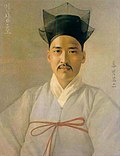 Jeongjagwan on the head
 -
 A Korean in mourning clothes
 -
 Korean men, 1871
 -
 Young Korean man of the middle class, 1904


Material and color
[edit]
The upper classes wore hanbok of closely woven ramie cloth or other high-grade lightweight materials in warm weather and of plain and patterned silks the rest of the year. Commoners were restricted by law as well as resources to cotton at best.
The upper classes wore a variety of colors, though bright colors were generally worn by children and girls and subdued colors by middle-aged men and women. Commoners were restricted by law to everyday clothes of white, but for special occasions they wore dull shades of pale pink, light green, gray, and charcoal. The color of the chima showed the wearer's social position and statement. For example, a navy color indicated that a woman had a son(s). Only the royal family could wear clothing with geumbak-printed patterns (gold leaf) on the bottom of the chima.
Headdresses
[edit]Both men and women wore their hair in a long braid until they were married, at which time the hair was knotted. A man's hair was knotted in a topknot called sangtu (상투) on the top of the head, and the woman's hair was rolled into a ball-shaped form or komeori and was set just above the nape of the neck.

A long pin, or binyeo (비녀), was worn in women's knotted hair as both a fastener and a decoration. The material and length of the binyeo varied according to the wearer's class and status. Women also wore a ribbon known as a daenggi (댕기) to tie and decorate braided hair. Women wore a jokduri on their wedding day and wore an ayam for protection from the cold. Men wore a gat, which varied according to class and status.

Before the 19th century, women of high social backgrounds and kisaeng wore wigs (kach'e). Like their Western counterparts, Koreans considered bigger and heavier wigs to be more desirable and aesthetic. These became awkward to wear to the point that the government banned them in 1788.[117]
Owing to the influence of Neo-Confucianism, it was compulsory for women throughout the entire society to wear headdresses (nae-oe-seugae) to avoid exposing their faces when going outside. Those headdresses may include suegaechima (a headdress that looked like a chima but was narrower and shorter in style, worn by the upper-class women and later by all classes of people in late Joseon), the jang-ot, and the neoul (which was only permitted for court ladies and noblewomen).[118]
Later development
[edit]Modern hanbok is the direct descendant of hanbok patterned after those worn by aristocratic women or by the people who were at least from the middle-class in the Joseon period,[81][119] specifically the late 19th century. Hanbok had gone through various changes and fashion fads during the five hundred years under the reigns of Joseon kings and eventually evolved to what is now considered typical hanbok.
Beginning in the late 19th century, hanbok was largely replaced by new Western imports like the Western suit and dress. Today, formal and casual wear are usually based on Western styles. However, hanbok is still worn for traditional occasions, and is reserved for celebrations like weddings, the Lunar New Year, annual ancestral rites, or the birth of a child.
Modern usage
[edit]Hanbok was featured in international haute couture; on the catwalk, in 2015 when Karl Lagerfeld dressed Korean models for Chanel, and during Paris Fashion Week in photography by Phil Oh.[120] It has also been worn by international celebrities, such as Britney Spears and Jessica Alba, and athletes, such as tennis player Venus Williams and football player Hines Ward.[121][unreliable source]
Hanbok is also popular among Asian-American celebrities, such as Lisa Ling and Miss Asia 2014, Eriko Lee Katayama.[122] It has also made appearances on the red carpet, and was worn by Sandra Oh at the SAG Awards, and by Sandra Oh's mother who made fashion history in 2018 for wearing a hanbok to the Emmy Awards.[123]
South Korea
[edit].jpg)
.jpg)
.jpg)
.jpg)
The South Korean government has supported the resurgence of interest in hanbok by sponsoring fashion designers.[124] Domestically, hanbok has become trendy in street fashion and music videos. It has been worn by prominent K-pop artists like Blackpink and BTS, notably in their music videos for "How You Like That" and "Idol."[125][unreliable source][126][unreliable source?]
In Seoul, tourist's wearing of hanbok makes their visit to the Five Grand Palaces (Changdeokgung, Changgyeonggung, Deoksugung, Gyeongbokgung and Gyeonghuigung) free of charge.
In Busan, the APEC South Korea 2005 provided hanbok for delegates of the 21 member economies of the Asia-Pacific Economic Cooperation.
North Korea
[edit]
.jpg)
.jpg)

Hanbok is also worn in present-day North Korea where it is known as chosŏnot (조선옷; 朝鮮옷).[127] The chosŏnot thus highlights the identity of the Korean ethnic and has been more actively promoted under the rule of Kim Jong Un.[127] The chosŏnot is currently typically worn during special occasions, e.g. weddings,[128]: 49 and when North Koreans celebrate the 60th, 70th, and 80th birthdays of their parents.[127] It is also mandated that women wear chosŏnot when attending National events, such as Kim Jong Il's birthday (16 February), International women's day (8 March), Kim Il Sung's birthday (15 April), Foundation Day (9 September).[128]: 78 White colored hanbok is often used as the color white has been the traditionally favored by the Korean people as the symbolism of pure spirit.[127]
The chima-jeogori remains the clothing of women, including female university students who are required to wear it as part of their university school uniforms.[127] The uniform of female university students has been a black-and-white chima-jeogori since the early to mid 2000s.[127] The chima can often be found at a length of about 30 cm from the ground for practical purposes in order to facilitate movements and to ensure that women could wear it during their daily workday with ease and comfort; this decrease in skirt length also gives a sense of modern style.[128]: 75
The chosŏnot patterns also have special meanings which are given by the North Koreans.[127] Generally, young people in North Korea like floral prints and bright colours, while the older generations favour simple styles of clothing and solid colours.[129]: 376 The chima-jeogori in North Korea is sometimes characterized by its use of floral patterns which are often added to the sleeves of the jeogori and to the chima.[127] Azaleas, in particular, are favoured in Yongbyon due to their association with the emotional poem Azaleas (《진달래꽃》) by Kim So-wol.[127] Men occasionally wear chosŏnot.[127]
However, chosŏnot are typically more expensive than ordinary clothing, and renting is available for people who cannot afford to purchase one; some are available for purchase at US$20 while the chosŏnot made in China with South Korean designs and fabrics are more expensive and can cost approximately US$3000.[127] The mid-2010s also saw the increased popularity of children dressing in chosŏnot by their parents.[127]
The custom of Korean costume was inscribed on UNESCO's Representative List of the Intangible Cultural Heritage by North Korea in 2024.[130]
History in North Korea
[edit]The 1950s and 1960s also saw women from the upper-class wear chosŏnot made out of rayon while a black-and-white chima-jeogori consisting of a black long-length chima and white jeogori were used in the 1950s and 1960s where it was generally worn by women;[131] this style can, however, be traced to a typical clothing style used in the Joseon period.[127] This combination is still representative of the ideal woman and remains the official outfit for women in North Korea to this day.[128]: 77 In the 1980s, the chosŏnot became the official attire of women when attending ceremonies while western-style clothing became the everyday, ordinary clothing.[131]
After the mid-1990s due to extreme economic contractions, women could purchase their chosŏnot in private markets and were allowed to choose their desired colours and designs.[127]
In 2001, Lee Young-Hee, a South Korean hanbok designer visited Pyongyang to hold a fashion show at the Pyeongyang Youth Center on 4 and 6 June;[129]: 262 and since the 2002, North Korea have held their own fashion show in Pyongyang every spring.[131] Since 2001, there have been an increase of shops specialized in the customization of chosŏnot in Pyongyang which was reported by the KBCS.[129]: 261 This increase was due to a project implemented by the public service bureau of the Pyongyang People's Committee to increase chosŏnot tailoring shops.[129]: 262 These shops are typically found in large cities, such as Pyeongyang and Gaesong but are rarely found in small cities and villages.[129]: 262
Modern usage by Korean diaspora
[edit]China
[edit]
In China, the hanbok is referred as chaoxianfu (Chinese: 朝鮮服; 조선옷; 朝鮮옷; Joseon-ot) and is recognized as being the traditional ethnic clothing of chaoxianzu (simplified Chinese: 朝鲜族; traditional Chinese: 朝鮮族; pinyin: cháoxiǎnzú; lit. 'Joseon (Korean) ethnic group') in China. Chaoxianzu is an official term and is recognized as one of the official 55 ethnic minorities in China.[132] People of the chaoxianzu ethnic group are not recent immigrants to China, but have a long history having lived in China for generations.[133]: 240 They share the same ethnic identity as the ethnic Korean people in both North and South Korea, but are counted as Chinese citizens by nationality under the Constitution of China. Their traditions are not entirely the same due to their unique historical experiences, geographical location and mixed identities.[132] The term chaoxianzu literally corresponds to Chosŏnjok (조선족; 朝鮮族), a non-official derogatory term in South Korea, to refer to Hangukgye Junggugin (lit. 'Korean-Chinese'), which is the actual legal term in South Korea.[134] In the Yanbian Korean Autonomous Prefecture, where most chaoxianzu reside,[132] the chaoxianfu was mostly worn on special occasions in the past;[133] however, by 2019, they had regained popularity and have become fashionable.[132]
Since the Chinese economic reform of China, there have been more exchanges with both Koreas leading to both the development and changes in chaoxianzu-style Chosŏn-ot in China;[132] some of designs of the chaoxianzu-style Chosŏn-ot have been influenced and inspired by both South Korean and North Korean hanbok designs.[133]: 246
Chaoxianzu people originally preferred to wear white as it represented cleanliness, simplicity, and purity; however, since the 20th century, the colours started to become brighter and more vivid as woven fabrics, such as polyester and nylon sateen, started to be introduced.[132] The "reform and opening up" of China also allowed for more exchanges with both Koreas, which lead to the both development and changes in the chaoxianfu of China.[132]
Following the chaoxianzu tradition, the chaoxianfu has an A-line in silhouette to give it the appearance of a mountain as per the tradition, women are the host of the family, and thus, women holding the household need to be stable; the chaoxianfu also covers the entire body.[132] The chaoxianzu have developed their own style of hanbok[135] due to the isolation for about 50 years from both North and South Korea.[133]: 240, 246 As a result, the styles of hanbok in South Korea, North Korea, and China, worn by the Korean people from these three countries have developed separately from each other. For example, Yemi Hanbok by Songok Ryu, an ethnic chaoxianzu from the Yanbian Korean Autonomous Prefecture, is unique in both style and business model as it can operate in both South Korea and North Korea.[133]: 240, 246 In terms of chaoxianfu design, Yemi Hanbok designs are based on Chinese-style designs.[133]: 246 [dubious – discuss]
Over the years, the women's chaoxianfu also changed in length for the jeogori, git, and goreum and changed in width for the git, dong-jeong, sleeves, and goreum. The git and barae have evolved from straight to curve patterns. The wrinkle arrangement, length, and silhouette of the chima have also evolved; some of the skirts were sometimes decorated with gold embroidery or gold leaf at the bottom hem.[135] The colours used were also very varied; for example, feminine colours such as pink, yellow, and deep red could be used.[135] The 1990s saw the use of gold leaf, floral prints, embroidery on the women's chaoxianfu; the use of gradient colours also emerged.[135] For men, their jeogori, baji, and sleeves were made longer; their baji also became wider. The durumagi continues to be worn, and the baeja and magoja are worn frequently in present-days.[135]
On 7 June 2008, the chaoxianfu were approved by the State Council of China to be included in the second layer of national intangible cultural heritage.[132] In 2011, the chaoxianfu was officially designated as being part of the intangible cultural heritage of China by the Chinese government; while the announcement was welcomed by the chaoxianzu people in China as a proud indicator of their equal membership in a multi-ethnic and multicultural country such as China, it received negative criticism from South Koreans who perceived it as a "scandalous appropriation of the distinctive national culture of Koreans".[136]: 239 In 2022, a girl from the chaoxianzu ethnic group wore a chaoxianfu on the 2022 Beijing Winter Olympics opening ceremony leading to an uproar from South Koreans who accused China of cultural appropriation.[134]
Social status
[edit]Especially from the Goryeo dynasty, the hanbok started to determine differences in social status (from people with the highest social status (kings), to those of the lowest social status (slaves)[137]) and gender through the many types, components,[137] colours,[138]: 132 and characteristics.[139] Although the modern hanbok does not express a person's status or social position, hanbok was an important element of distinguishment especially in the Goryeo and Joseon dynasties.[139] For example, farmers and commoners were not allowed to wear colour garments in their daily lives, excluding some categories of people, such as the shamans, gisaeng, and children, who were allowed to wear colourful clothing despite their social status.[138]: 132 Occasions when all people were allowed to wear colourful clothing were for special ceremonial occasions (e.g. wedding, birthday, holidays).[138]: 132
Clothes
[edit]Hwarot
[edit]Hwarot or hwal-ot was the full dress for a princess and the daughter of a king by a concubine, formal dress for the upper class, and bridal wear for ordinary women during the Goryeo and Joseon dynasties.[140] Popular embroidered patterns on hwarot were lotuses, phoenixes, butterflies, and the ten traditional symbols of longevity: the sun; mountains; water; clouds; rocks/stone; pine trees; the mushroom of immortality; turtles; white cranes, and deer.[141] Each pattern represented a different role within society, for example: a dragon represented an emperor while a phoenix represented a queen; floral patterns represented a princess and a king's daughter by a concubine, and clouds and cranes represented high ranking court officials.[140] All these patterns throughout Korean history had meanings of longevity, good luck, wealth and honor.[140] Hwarot also had blue, red, and yellow colored stripes in each sleeve; a woman usually wore a scarlet-colored skirt and yellow or green-colored Jeogori, a traditional Korean jacket.[140] Hwarot was worn over the Jeogori and skirt.[140] A woman also wore her hair in a bun, with an ornamental hairpin and a ceremonial coronet.[140] A long ribbon was attached to the ornamental hairpin, the hairpin is known as Yongjam (용잠).[140] In more recent times, people wear hwarot on their wedding day, and so the Korean tradition survives in the present day.[140]
Wonsam
[edit]Wonsam was a ceremonial overcoat for a married woman in the Joseon dynasty.[142] The Wonsam was also adopted from China and is believed to have been one of the costumes from the Tang dynasty which was bestowed in the Unified Three Kingdoms period.[78] It was mostly worn by royalty, high-ranking court ladies, and noblewomen and the colors and patterns represented the various elements of the Korean class system.[142] The empress wore yellow; the queen wore red; the crown princess wore a purple-red color;[138]: 132 meanwhile a princess, a king's daughter by a concubine, and a woman of a noble family or lower wore green.[142] All the upper social ranks usually had two colored stripes in each sleeve: yellow-colored Wonsam usually had red and blue colored stripes, red-colored Wonsam had blue and yellow stripes, and green-colored Wonsam had red and yellow stripes.[142] Lower-class women wore many accompanying colored stripes and ribbons, but all women usually completed their outfit with onhye or danghye, traditional Korean shoes.[142]
Dangui
[edit]Dangui or tangwi were minor ceremonial robes for the queen, a princess, or wife of a high ranking government official while it was worn during major ceremonies among the noble class in the Joseon dynasty.[141] The materials used to make dangui varied depending on the season, so upper-class women wore thick dangui in winter while they wore thinner layers in summer.[143] The dangui came in many colors, but yellow and/or green were most common. However the emperor wore purple dangui, and the queen wore red.[143] In the Joseon dynasty, ordinary women wore dangui as part of their wedding dress.[143]
Myeonbok and Jeokui
[edit]Myeonbok
[edit]Myeonbok were the king's religious and formal ceremonial robes while jeokui were the queen's equivalent during the Goryeo and Joseon dynasties.[144] Myeonbok was composed of Myeonryu-Gwan (면류관) and Gujang-bok (구장복).[144] Myonryu-Gwan had beads, which hung loose; these would prevent the king from seeing wickedness.[144] There were also wads of cotton in the left and right sides of Myeonryu-Gwan, and these were supposed to make the king oblivious to the influence of corrupt officials. Gujang-bok was black, and it bore nine symbols out of the Twelve ornaments, which all represented the king:[144]
- Dragon: A dragon's appearance paralleled how the king governed and subsequently brought balance to the world.[144]
- Fire: The king was expected to be intelligent and wise to govern the people effectively, like a guiding light represented by the fire.[144]
- Pheasant: The image of a pheasant represented magnificence.[144]
- Mountain: As a mountain is high, the king was on a par in terms of status and was deserving of respect and worship.[144]
- Tiger: A tiger represented the king's courage.[144]
- Monkey: A monkey symbolized wisdom.[144]
- Rice: As the people needed rice to live, the king was compared to this foodstuff as he had the responsibility of protecting their welfare.[144]
- Axe: This indicated that the king had the ability to save and take lives.[144]
- Water plant: Another depiction of the king's magnificence.[144]
Jeokui
[edit]Jeokui or tseogwi (Korean: 적의) was arranged through the use of different colors as a status symbol within the royal family.[145] The empress wore purple-red colored Jeokui, the queen wore pink, and the crown princess wore deep blue.[145] "Jeok" means pheasant, and so Jeokui often had depictions of pheasants embroidered onto it.[145]
Cheollik
[edit]
Cheollik (철릭) was a Korean adaptation of the Mongol tunic Terlig. The first recorded reference to the Terlig in Korea dates to the 15th century during the Joseon period. They were described as presents from the Ming dynasty or as military uniforms. A Joseon publication of a Goryeo period song Jeongseokga in the Akjang Gasa used the term Telik, referring to an officer's uniform. However, in surviving Goryeo literary sources, there is no reference to a term for clothing similar to Terlig in sound. Due to Mongol influence, some Korean vocabulary including official titles, falconry, and military terms originated in the Mongol language.[55]
The garment is presumed to have been worn from the mid-Goryeo period. By the early Joseon dynasty, it had already been adopted by various social strata for diverse functions, and it became widely popularized by the mid-Joseon period. While its applications changed thereafter, its most prevalent use until the end of the dynasty was as gongbok (official robes) for military officers and as siwibok (a uniform for royal escorts) during excursions outside the palace.[146]

The cheollik, unlike other forms of Korean clothing, is an amalgamation of a blouse with a kilt into a single item of clothing. The flexibility of the clothing allowed easy horsemanship and archery. During the Joseon dynasty, they continued to be worn by the king, and military officials for such activities. It was usually worn as a military uniform, but by the end of the Joseon dynasty, it had begun to be worn in more casual situations. A unique characteristic allowed the detachment of the cheollik's sleeves which could be used as a bandage if the wearer was injured in combat.[147]
Aengsam
[edit]Aengsam was the formal clothing for students during the national government exam and governmental ceremonies.[148] It was typically yellow, but for the student who scored the highest in the exam, they were rewarded with the ability to wear green Aengsam.[148] If the highest-scoring student was young, the king awarded him with red-colored Aengsam.[148] It was similar to the namsam but with a different colour.[149]
Accessories
[edit]
Binyeo
[edit]Binyeo was a traditional ornamental hairpin, and it had a different-shaped tip again depending on social status.[150] As a result, it was possible to determine the social status of the person by looking at the binyeo. Women in the royal family had dragon or phoenix-shaped binyeo while ordinary women had trees or Japanese apricot flowers.[151] Binyeo was a proof of marriage and considered a woman's expression of chastity and decency.[152]
Daenggi
[edit]Daenggi is a traditional Korean cloth ribbon used to tie and decorate braided hair.
.jpg)
Norigae
[edit]Norigae was a typical traditional accessory for women; it was worn by all women regardless of social ranks.[153][154] However, the social rank of the wearer determined the size and material of the norigae.[154]
Danghye
[edit]Danghye or tanghye (당혜) were shoes for married women in the Joseon dynasty.[155] Danghye were decorated with trees bearing grapes, pomegranates, chrysanthemums, or peonies: these were symbols of longevity.[156]
Danghye for a woman in the royal family were known as kunghye (궁혜), and they were usually patterned with flowers.[156]
Danghye for commoner women were known as onhye (온혜).[156]
Characteristics
[edit]Material
[edit]In Hanbok, various cotton fabrics are used as materials, and with the entry of Western civilization, the range of fabrics such as mixed fabrics has expanded. The use of materials also varies slightly depending on the jeogori and pants, and there is a big difference in the season.[157] In the case of jeogori, there are more than 10 types of general materials such as silk, jade, and general wool, and they use ramie or hemp in summer, and silk or Gapsa, Hangra, and Guksa cloth in spring and autumn.[158][159] The material used evenly throughout the four seasons was sesame, and silk, both ends, and silk were often used in the durumagi for adult men.[160] In the case of silk, which is one of the most widely used materials due to differences in lining and outer material, most of the silk jeogori was lined with silk, and if it was not possible, only the inside of the collar, the tip, and the sap were lined with silk. If this situation did not work out like this, the fine-grained cotton was used. In fact, more than half of the materials identified in the jeogori study were silk, followed by cotton and hemp.[161] In some cases, silk and cotton were lined with a mixture. When the jeogori was torn or broken, most of them were sewn with the same fabric, and a large piece was added to the elbow and sewn.[161] Just as in the fact that silk was used a lot in jeogori, silk, cotton, and literary arts were evenly used in various clothes, ranging from red ginseng, skirt, beoseon, and pants.
Misconception
[edit]Originally, hanbok chima(skirt) was worn with being tied around waist. It can be identified in paintings of Korea from 18th to 19th centuries.[162][163] Main misconception about hanbok is that hanbok has chima which resembled cloth for pregnant woman. This chima is not traditional hanbok. At about 1920, new chima was made to cover chest. This chima had strings which could be worn on the shoulder.[164][165] So this chima looked like that it started from over upper waist, almost from chest. This chima looked like cloth for pregnant woman. This chima did not exist in hanbok before about 1920. Traditional hanbok did not have this kind of chima before about 1920. Original hanbok chima was worn with being tied around waist.
-
Young people's outgoing, 19th century
-
 Weaving a mat, 18th century

Hanbok Wave
[edit]The Ministry of Culture, Sports and Tourism of South Korea, in partnership with the Korea Craft Design and Culture Promotion Agency, launched the Hanbok Wave initiative in 2020 to promote hanbok globally. In a statement, the ministry stated: "The interest in hanbok is rising around the world. Through collaborations with top Korean entertainers and artists who can showcase hanbok's traditional beauty and modern sensibility, we hope to make Korea’s traditional costume and hanbok-themed content more accessible and attractive."[166] The government will select four Korean hanbok makers to create designs inspired by the year's Hallyu Cultural Artist (muse). Once completed, the ministry will fund promotional campaigns, which will be featured on electronic billboards in Seoul and major cities abroad. Previous campaigns were held in cities such as New York, Paris and Milan.[166][167]

In 2025, the ministry appointed actor Park Bo-gum as the year's Hallyu Cultural Artist becoming the first male muse of the initiative.[169][170] The photos were unveiled during Chuseok with electronic billboards displayed in Myeongdong in Seoul, Times Square in Manhattan, Piazza del Duomo in Milan, Shinjuku in Tokyo, and Citadium Caumartin in Paris on October 6, 2025.[171][172] Harper's Bazaar Korea released four special edition covers featuring Park containing a 40-page pictorial of the actor wearing hanbok pieces designed by Dada Hanbok, OneOrigin, Mooroot, and Hanbok Moon.[173]
Hallyu Cultural Artists
[edit]- 2022: Yuna Kim, figure-skater[174]
- 2023: Bae Suzy, singer/actress[175]
- 2024: Kim Tae-ri, actress[176]
- 2025: Park Bo-gum, actor[177]
See also
[edit]
- List of Korean clothing
- Hanfu - traditional Chinese clothing
- Vietnamese clothing - traditional Vietnamese clothing
- Wafuku - traditional Japanese clothing
References
[edit]- ^ Korean Culture and Information Service, 2018, Ministry of Culture, Sports and Tourism of the Republic of Korea
- ^ "Minority Ethnic Clothing : Korean (Chaoxianzu) Clothing". 27 October 2022. Archived from the original on 27 October 2022. Retrieved 31 October 2024.
- ^
Ji-Yeon O. Jo (30 November 2017). "Koreans in the Commonwealth of Independent States". Homing: An Affective Topography of Ethnic Korean Return Migration. Nonolulu: University of Hawaii Press. p. 50. ISBN 9780824872519. Retrieved 22 July 2024.
[...] Koryŏ Saram [...] did their best to maintain Korean traditions - for example, observing major Korean holidays, wearing hanbok (traditional Korean clothing) on culturally important days, playing customary Korean games, and making traditional rice cakes with traditional Korean tools that they had crafted in diaspora.
- ^ The Dreams of the Living and the Hopes of the Dead-Goguryeo Tomb Murals, 2007, Ho-Tae Jeon, Seoul National University Press
- ^ a b Flags, color, and the legal narrative : public memory, identity, and critique. Anne Wagner, Sarah Marusek. Cham, Switzerland: Springer. 2021. p. 125. ISBN 978-3-030-32865-8. OCLC 1253353500.
The basic structure of the Hanbok dress was designed to facilitate ease of movement, incorporating many shamanistic motifs.
{{cite book}}: CS1 maint: others (link) - ^ "<Records of the Three Kingdoms>".
- ^ "<Book of Sui>". Archived from the original on 7 June 2023. Retrieved 20 June 2024.
- ^ "History of Song".
- ^ "《고려도경》(高麗圖經)".
- ^ Passport to Korean culture. Haeoe Hongbowŏn. Seoul, Korea: Korean Culture and Information Service. 2009. ISBN 978-89-7375-153-2. OCLC 680802927.
{{cite book}}: CS1 maint: others (link) - ^ a b Gwak, Sung Youn Sonya (2006). Be(com)ing Korean in the United States: Exploring Ethnic Identity Formation Through Cultural Practices. Cambria Press. ISBN 9781621969723.
- ^ Lopez Velazquez, Laura (2021). "Hanbok during the Goryeo and Joseon dynasty". Korea.net. Retrieved 21 August 2022.
- ^ 백의민족 (白衣民族) - Encyclopedia of Korean Culture.
- ^ "Veritable Records of the Joseon Dynasty". Archived from the original on 20 June 2024. Retrieved 20 June 2024.
- ^ "Veritable Records of the Joseon Dynasty". Archived from the original on 20 June 2024. Retrieved 20 June 2024.
- ^ "Veritable Records of the Joseon Dynasty". Archived from the original on 20 June 2024. Retrieved 20 June 2024.
- ^ Passport to Korean culture. Haeoe Hongbowŏn. Seoul, Korea: Korean Culture and Information Service. 2009. ISBN 978-89-7375-153-2. OCLC 680802927.
{{cite book}}: CS1 maint: others (link) - ^ 한복데이, 전국 5개 도시서 펼쳐진다. 쿠키뉴스 (in Korean). 15 September 2014. Retrieved 11 March 2022.
- ^ a b 역사 속의 우리 옷 변천사, 2009, Chonnam National University Press
- ^ 김, 여경 (2010). 2000년 이후 인쇄매체에 나타난 한복의 조형미 연구. ScienceON (in Korean). Retrieved 24 July 2021.
- ^ a b c "Traditional clothing". KBS Global. Archived from the original on 17 March 2008.
- ^ a b c d e f 저고리 (in Korean). Doosan Encyclopedia. Archived from the original on 15 March 2009. Retrieved 29 September 2008.
- ^ 저고리 (in Korean). Empas / Britannica. Archived from the original on 21 March 2007. Retrieved 29 September 2008.
- ^ a b 치마 (in Korean). Nate / Britannica. Archived from the original on 21 March 2007. Retrieved 7 January 2010.
- ^ "Jeogori Before 1910". Gwangju Design Biennale. Archived from the original on 24 February 2021. Retrieved 27 June 2009.
- ^ 단추. Encyclopedia of Korean Culture. Retrieved 9 July 2022.
- ^ a b 치마 (in Korean). Nate / EncyKorea. Archived from the original on 21 March 2007. Retrieved 7 January 2010.
- ^ "Important Folklore Materials:117-23". Cultural Heritage Administration. Archived from the original on 27 February 2012. Retrieved 7 January 2010.
- ^ "Important Folklore Materials: 229-1-4. Skirt belonging to a Jinju Ha clan woman, who died in 1646". Cultural Heritage Administration. Archived from the original on 27 February 2012. Retrieved 7 January 2010.
- ^ 금박(in Korean) - Encyclopedia of Korean Folk Culture.
- ^ "World Underwear History: Enlightenment Era". Good People Co. Ltd. Archived from the original on 7 May 2010. Retrieved 7 January 2010.
- ^ "World Underwear History: Enlightenment Era". Good People Co. Ltd. Archived from the original on 7 May 2010. Retrieved 7 January 2010.
- ^ "Recycle LACMA: Red Korean Skirt". Robert Fontenot. June 2009. Archived from the original on 21 July 2012. Retrieved 7 January 2010.
- ^ "Recycle LACMA: Purple Korean Skirt". Robert Fontenot. June 2009. Archived from the original on 21 July 2012. Retrieved 7 January 2010.
- ^ a b "Korea Information". Archived from the original on 6 April 2014. Retrieved 8 October 2014.
- ^ Voice, Ewha (1 September 2005). "Underwear Coming Out: No More a Taboo". Ewha Voice. Ehwa Voice. Retrieved 8 November 2013.
- ^ "About hanbok". han-style.com. Archived from the original on 21 September 2013. Retrieved 20 September 2013.
- ^ a b c 포 (袍) (in Korean). Encyclopedia of Korean Culture. Retrieved 23 April 2015.
- ^ a b c d 두루마기 (in Korean). Empas / Britannica. Retrieved 30 September 2008.
- ^ "두루마기 (in Korean)". Encyclopedia of Korean Culture.
{{cite web}}: CS1 maint: url-status (link) - ^ 최, 해율 (2007). "A Study on the Design of Historical Costume for Making Movie & multimedia-Focused on rich women's costume of Goryeo-yang and Mongol-pung in Thirteenth to Fourteenth Century-". 한국복식학회. 57 (1): 176–186. Archived from the original on 9 July 2022. Retrieved 9 July 2022.
- ^ Congwen Shen 沈從文. Research on Ancient Chinese Clothing 中國古代服飾研究.Hong Kong Publishing Company, 1981 香港:商務印書館,1981
- ^ "Men's Clothing". Life in Korea. Archived from the original on 5 July 2012. Retrieved 1 November 2008.
- ^ a b 까치두루마기 (in Korean). Nate / EncyKorea. Archived from the original on 10 June 2011. Retrieved 30 September 2008.
- ^ "Geocities.com". Julia's Cook Korean site. Archived from the original on 27 October 2009. Retrieved 29 November 2007.
- ^ 까치두루마기 (in Korean and English). Daum Korean-English Dictionary.[permanent dead link]
- ^ "Encyber.com". Retrieved 8 October 2014.[permanent dead link]
- ^ The Groom's Wedding Attire Archived 23 April 2009 at the Wayback Machine Academia Koreana of Keimyung University
- ^ "What are the traditional national clothes of Korea?". Archived from the original on 10 January 2016. Retrieved 8 October 2014.
- ^ "Hanboks (Traditional Clothing)". Headgear and Accessories Worn Together with Hanbok. Korea Tourism Organization. Archived from the original on 17 February 2012. Retrieved 6 October 2008.
- ^ Kim, In-Suk (1977). 심의고(深依考). Journal of the Korean Society of Costume. 1: 101–117. ISSN 1229-6880.
- ^ a b c d e f g h i j k l m Yu, Ju-Ri; Kim, Jeong-Mee (2006). "A Study on Costume Culture Interchange Resulting from Political Factors". Journal of the Korean Society of Clothing and Textiles. 30 (3): 458–469.
- ^ a b Kyu-Seong, Choi (2004). "A Study of People's Lives and Traditional Costumes in Goryeo Dynasty". The Research Journal of the Costume Culture. 12 (6): 1060–1069. ISSN 1226-0401. Archived from the original on 2 October 2021. Retrieved 7 August 2021.
- ^ Fashion, identity, and power in modern Asia. Kyunghee Pyun, Aida Yuen Wong. Cham, Switzerland. 2018. p. 116. ISBN 978-3-319-97199-5. OCLC 1059514121.
{{cite book}}: CS1 maint: location missing publisher (link) CS1 maint: others (link) - ^ a b Cho, Woohyun; Yi, Jaeyoon; Kim, Jinyoung (2015). "The dress of the Mongol Empire: Genealogy and diaspora of the Terlig". Acta Orientalia Academiae Scientiarum Hungaricae. 68 (3): 22–29. doi:10.1556/062.2015.68.3.2. ISSN 0001-6446.
- ^ a b c Choi, Hai-Yaul (2007). "A Study on the Design of Historical Costume for Making Movie & Multimedia -Focused on Rich Women's Costume of Goryeo-Yang and Mongol-Pung in the 13th to 14th Century-". Journal of the Korean Society of Costume. 57 (1): 176–186. ISSN 1229-6880. Archived from the original on 18 July 2021. Retrieved 14 March 2021.
- ^ a b c d e f g h i j Kim, Jinyoung; Lee, Jaeyeong; Lee, Jongoh (2015). ""GORYEOYANG" AND "MONGOLPUNG" in the 13th-14th CENTURIES". Acta Orientalia Academiae Scientiarum Hungaricae. 68 (3): 281–292. doi:10.1556/062.2015.68.3.3. ISSN 0001-6446. JSTOR 43957480. Archived from the original on 16 March 2021. Retrieved 18 February 2021.
- ^ 고려(高麗)의 원(元)에 대(對)한 공녀(貢女),유홍렬,震檀學報,1957
- ^ 옷의 역사 (in Korean). Daum / Global World Encyclopedia.[permanent dead link]
- ^ Misie Lander (January 2017). Hanbok: An Introduction to South Korea's National Dress
- ^ Myeong-Jong, Yoo (2005). The Discovery of Korea: History-Nature-Cultural Heritages-Art-Tradition-Cities. Discovery Media. p. 123. ISBN 978-8995609101.
- ^ Macdonald, Fiona, ed. (2004). Peoples of Eastern Asia. Marshall Cavendish. p. 366. ISBN 9780761475545. Retrieved 18 October 2019.
- ^ a b c d e f g h i Lee, Samuel Songhoon (2015). Hanbok: Timeless Fashion Tradition. Seoul Selection. ISBN 9781624120565. Retrieved 18 October 2019.
- ^ a b Korean Culture and Information Service (South Korea) (2014). Guide to Korean Culture: Korea's cultural heritage. 길잡이미디어. p. 90. ISBN 9788973755714. Retrieved 18 October 2019.
- ^ a b Condra, Jill, ed. (2008). The Greenwood Encyclopedia of Clothing Through World History, Volume II. Greenwood Publishing Group. p. 223. ISBN 9780313336645. Retrieved 18 October 2019.
- ^ Kim, Moon Ja, 2004, 7-15
- ^ a b Lee, Kyung-Ja, 2003
- ^ a b 김소희; 채금석 (2018). 스키타이 복식 유형 및 형태에 관한 연구 - 고대 한국과의 관계를 중심으로. 한국의상디자인학회지. 20 (1): 61–77. doi:10.30751/kfcda.2018.20.1.61.
- ^ Kim, Munja. 우리역사넷. National Institute of Korean History. Archived from the original on 1 October 2021. Retrieved 24 July 2021.
- ^ a b 김소희; 채금석 (2018). "Scythai's clothing type and style: Focusing on the relationship with ancient Korea". 한국의상디자인학회지. 20 (1): 61–77. doi:10.30751/kfcda.2018.20.1.61.
- ^ a b Chang, Youngsoo (Associate Professor, Department of Cultural Heritage, Gyeongju University) (2020). "Empirical Review of the Scythian Origin Theory of Ancient Korean Costumes : Analysis of Commonalities and Differences Between Artifacts of the two Costume Types" 한국 고대복식의 스키타이 복식 유래설에 대한 실증적 검토 - 유물에 나타난 두 복식유형간의 공통점 및 차이점 분석 -. 복식 (in Korean). 70 (2): 188–208. doi:10.7233/jksc.2020.70.2.188. S2CID 219652611. Archived from the original on 27 June 2023. Retrieved 21 August 2022.
{{cite journal}}: CS1 maint: multiple names: authors list (link) - ^ a b National Museum of Korea Editorial Team (Spring 2009). "National Museum of Korea Vol.07". Quarterly Magazine. Vol. 7, no. 7. Archived from the original on 26 June 2022. Retrieved 26 June 2022.
- ^ Nelson, 1993, p.7 & p.213-214
- ^ Korea Tourism Organization (20 November 2008). "The beauty of Korean tradition - Hanbok". Korea.net. Archived from the original on 28 June 2012. Retrieved 13 May 2009.
- ^ a b Encyclopedia of national dress : traditional clothing around the world. Jill Condra. Santa Barbara, Calif. 2013. p. 409. ISBN 978-0-313-37637-5. OCLC 843418851.
{{cite book}}: CS1 maint: location missing publisher (link) CS1 maint: others (link) - ^ 권, 준희 (2003). "The Jolpung(折風) shaped headgear of Koguryo(高句麗) and Shilla(新羅)". Journal of Korean Traditional Costume (in Korean). 6 (3): 6–84. ISSN 1598-8295. Archived from the original on 27 June 2023. Retrieved 9 July 2022.
- ^ Lee, Tae-ok. Cho, Woo-hyun. Study on Danryung structure. Proceedings of the Korea Society of Costume Conference. 2003. pp. 49-49.
- ^ a b c d Nam, Min-yi; Han, Myung-Sook (2000). "A Study on the Items and Shapes of Korean Shrouds". The International Journal of Costume Culture. 3 (2): 100–123. Archived from the original on 9 May 2021. Retrieved 21 February 2021.
- ^ National Research Institute of Cultural Heritage (2013). Gat : traditional headgear in Korea. Hyŏng-bak Pak, Eunhee Hwang, Kungnip Munhwajae Yŏn'guso. Daejeon, Korea: 길잡이미디어. ISBN 978-89-6325-987-1. OCLC 846696816.
- ^ a b Lee, Samuel Songhoon. (2013). Hanbok : Timeless fashion tradition. Seoul Selection. ISBN 978-89-97639-41-0. OCLC 871061483.
- ^ a b Pratt, Keith L. (1999). Korea : a historical and cultural dictionary. Richard Rutt, James Hoare. Richmond, Surrey: Curzon Press. p. 106. ISBN 978-0-7007-0464-4. OCLC 42675362.
- ^ a b c d e f A new history of Parhae. John B. Duncan, Tongbuga Yŏksa Chaedan. Leiden: Global Oriental. 2012. ISBN 978-90-04-24299-9. OCLC 864678409.
{{cite book}}: CS1 maint: others (link) - ^ Cho, Woo-hyun. "Characteristics of the Korean Costume and Its Development". 9 (3). Koreana.
{{cite journal}}: Cite journal requires|journal=(help)[permanent dead link] - ^ 유행과 우리옷 [Fashion and Korean clothing] (in Korean). Korea the sense. Archived from the original on 2 March 2012.
- ^ 김, 남정 (2000). 조선시대 치마에 관한 연구. Archived from the original on 6 August 2021. Retrieved 7 August 2021.
{{cite journal}}: Cite journal requires|journal=(help) - ^ "Hanbok". Korean Overseas Information Service. Archived from the original on 15 March 2010. Retrieved 18 May 2009.
- ^ "UriCulture.com". Archived from the original on 17 July 2011. Retrieved 8 October 2014.
- ^ Kim, Ki Sun, 2005. v. 5, 81-97.
- ^ "News.Naver.com". Archived from the original on 10 January 2016. Retrieved 8 October 2014.
- ^ "ChinaCulture.org". Archived from the original on 24 November 2014. Retrieved 8 October 2014.
- ^ Yang, Shaorong (2004). Traditional Chinese Clothing: Costumes, Adornments & Culture. Long River Press. p. 6. ISBN 978-1-59265-019-4.
- ^ Park, Hyunhee (2021). Soju : a global history. Cambridge. pp. 124–125. ISBN 978-1-108-89577-4. OCLC 1198087560.
{{cite book}}: CS1 maint: location missing publisher (link) - ^ 《续资治通鉴 卷二百一十四 元纪三十二》
- ^ Soh, Chung-Hee (2004). "Women's Sexual Labor and State in Korean History". Journal of Women's History. 15 (4): 170–177. doi:10.1353/jowh.2004.0022. ISSN 1527-2036. S2CID 144785547.
- ^ 《菽園雜記 卷10》
- ^ 《菽園雜記 卷10》
- ^ Arts of Korea. Yang-mo Chŏng, Judith G. Smith, Metropolitan Museum of Art. New York: Metropolitan Museum of Art. 1998. pp. 435–436. ISBN 0-87099-850-1. OCLC 38831761.
{{cite book}}: CS1 maint: others (link) - ^ a b c d Chae, Keum Seok; Kim, Eun Kyoung (2016). "The Study on Costume Shapes through Goryeo Dynasty Paintings -Comparison with Song and Yuan Style-". Journal of the Korean Society of Clothing and Textiles. 40 (6): 1116–1133. doi:10.5850/JKSCT.2016.40.6.1116. ISSN 1225-1151.
- ^ a b A companion to Korean art. J. P. Park, Burglind Jungmann, Juhyung Rhi. Hoboken, NJ. 2020. p. 192. ISBN 978-1-118-92702-1. OCLC 1154853080.
{{cite book}}: CS1 maint: location missing publisher (link) CS1 maint: others (link) - ^ Arts of Korea. Yang-mo Chŏng, Judith G. Smith, Metropolitan Museum of Art. New York: Metropolitan Museum of Art. 1998. p. 436. ISBN 0-87099-850-1. OCLC 38831761.
{{cite book}}: CS1 maint: others (link) - ^ 사대부 복식(Sadaebu Boksik), 한국민족문화대백과사전(In Encyclopedia of Korean Culture)|archive-url=https://folkency.nfm.go.kr/topic/detail/12013.
- ^ a b Guide to Korean culture. Haeoe Hongbowŏn. Seoul, Republic of Korea. 2013. p. 92. ISBN 978-89-7375-571-4. OCLC 882879939.
{{cite book}}: CS1 maint: location missing publisher (link) CS1 maint: others (link) - ^ a b "Five Centuries of Shrinking Korean Fashions". The Chosun Ilbo. Archived from the original on 23 June 2009. Retrieved 27 June 2009.
- ^ Miryang gobeomni bagik byeokhwamyo (Mural tomb of Bak Ik in Gobeop-ri, Miryang) Archived 4 October 2011 at the Wayback Machine. Cultural Heritage Administration. Accessed 15 July 2009.
- ^ Administration, Cultural Heritage. "Mural Tomb of Bak Ik, Miryang - Heritage Search". Cultural Heritage Administration. Archived from the original on 21 August 2022. Retrieved 21 August 2022.
- ^ a b Welters, Linda (2018). Fashion history : a global view. Abby Lillethun. London, UK. ISBN 978-1-4742-5363-5. OCLC 1004424828.
{{cite book}}: CS1 maint: location missing publisher (link) - ^ The Greenwood encyclopedia of clothing through world history. Jill Condra. Westport, Connecticut. 2008. pp. 222–223. ISBN 978-0-313-33662-1. OCLC 156808055.
{{cite book}}: CS1 maint: location missing publisher (link) CS1 maint: others (link) - ^ a b c d Murray, Anne Wood (Emeritus Curator of American Costume, Division of Costume, Department of Social and Cultural History, National Museum of American History, Smithsonian Institution, Washington, D.C.). "Dress - Korea". Encyclopædia Britannica. Archived from the original on 13 January 2020. Retrieved 10 March 2021.
In the 15th century, Korean women began to wear pleated skirts (chima) and longer chŏgori, a style that was undoubtedly introduced from China.
{{cite web}}: CS1 maint: multiple names: authors list (link) - ^ Guide to Korean culture. Haeoe Hongbowŏn. Seoul, Republic of Korea. 2013. p. 93. ISBN 978-89-7375-571-4. OCLC 882879939.
{{cite book}}: CS1 maint: location missing publisher (link) CS1 maint: others (link) - ^ Yang, Sunny (1997). Hanbok : the art of Korean clothing. Elizabeth, N.J.: Hollym. p. 61. ISBN 1-56591-082-6. OCLC 39614017.
- ^ Keum, Ki-Suk "The Beauty of Korean Traditional Costume" (Seoul: Yeorhwadang, 1994) ISBN 89-301-1039-8 p.43
- ^ "Contemporary Artwork of Korean Women". Archived from the original on 24 February 2012. Retrieved 27 June 2009.
- ^ a b c d 허윤희. 조선 여인 저고리 길이 300년간 2/3나 짧아져. 조선닷컴 (in Korean). Archived from the original on 4 January 2023. Retrieved 6 September 2019.
- ^ Han, Hee-sook (2004). "Women's Life during the Chosŏn Dynasty". International Journal of Korean History. 6 (1): 142. Archived from the original on 2 August 2019. Retrieved 6 September 2019.
- ^ a b c Pyun, Kyunghee; Wong, Aida Yuen (2018). Fashion, identity, and power in modern Asia. Cham, Switzerland: Springer. ISBN 978-3-319-97199-5. OCLC 1059514121.
- ^ a b c Ch'oe, Ŭn-su (2012). Gat : traditional headgear in Korea. Hyŏng-bak Pak, Eunhee Hwang, Kungnip Munhwajae Yŏn'guso. Daejeon, Korea. ISBN 978-89-6325-987-1. OCLC 846696816.
{{cite book}}: CS1 maint: location missing publisher (link) - ^ Pyun, Kyunghee; Kim, Minjee (20 April 2023). Dress History of Korea: Critical Perspectives on Primary Sources. Bloomsbury Publishing. p. 100. ISBN 978-1-350-14338-8. Retrieved 17 October 2025.
- ^ Cho, Seunghye (3 September 2017). "The Ideology of Korean Women's Headdresses during the Chosŏn Dynasty". Fashion Theory. 21 (5): 553–571. doi:10.1080/1362704X.2016.1251089. ISSN 1362-704X. S2CID 165117375.
- ^ Korean Culture and Information Service Ministry of Culture, Sports and Tourism (2009). Passport to Korean culture. Haeoe Hongbowŏn (2009 ed.). Seoul, Korea: Korean Culture and Information Service. p. 104. ISBN 978-89-7375-153-2. OCLC 680802927.
- ^ "The Story Behind Seoul's Latest Street Style Staple". Vogue. Archived from the original on 28 February 2019. Retrieved 17 October 2018.
- ^ "8 American Celebrities Wearing Hanbok". SweetandtastyTV. Archived from the original on 17 October 2018. Retrieved 17 October 2018.
- ^ "KIM MeHee hanbok couture". KIM MeHee hanbok couture. Archived from the original on 23 October 2022. Retrieved 17 October 2018.
- ^ "Sandra Oh's mother makes Emmys history by wearing traditional Korean hanbok to awards". Archived from the original on 17 October 2018. Retrieved 17 October 2018.
- ^ "Designers add a modern twist to hanbok style : Government is keen to show the world the versatility of Korea's traditional attire". Korea JoongAng Daily (in Korean). Archived from the original on 31 August 2018. Retrieved 17 October 2018.
- ^ "11 times BTS rocked traditional Korean clothing". SBS PopAsia. Archived from the original on 17 October 2018. Retrieved 17 October 2018.
- ^ "Here's Everything You Need To Know About BLACKPINK's Korean Hanbok Outfits In "How You Like That" MV". 26 June 2020. Archived from the original on 16 August 2020. Retrieved 26 September 2020.
- ^ a b c d e f g h i j k l m n "Hanbok in N. Korea". KBS World. Retrieved 21 August 2022.
- ^ a b c d Mysterious Pyongyang: Cosmetics, Beauty Culture and North Korea. Nam Sung-wook, Chae Su-lan, Lee Ga-young (editors). Springer Singapore. 2020. ISBN 9789811577031.
{{cite book}}: CS1 maint: others (link) - ^ a b c d e Yonhap News Agency, Seoul (27 December 2002). Yonhap News Agency (ed.). North Korea Handbook. M. E. Sharpe Incorporated. ISBN 9780765635235.
- ^ "Custom of Korean costume: traditional knowledge, skills and social practices in the Democratic People's Republic of Korea". UNESCO. Archived from the original on 31 January 2025. Retrieved 31 January 2025.
- ^ a b c "Changes in the Clothing Culture of North Korea under the Kim Jong Un Regime". Global North Korea (in Korean). Retrieved 23 August 2022.
- ^ a b c d e f g h i Jin, Wenlian (2020). Chaoxianzu's Traditions of Dress: An Exploration of Identity Within Contemporary Fashion Contexts (Thesis thesis). Auckland University of Technology. Archived from the original on 24 May 2023. Retrieved 26 August 2022.
- ^ a b c d e f Women entrepreneurs: inspiring stories from emerging economies and developing countries. Mauro F. Guillén. New York: Routledge. 2014. ISBN 978-1-136-32459-8. OCLC 857463468.
{{cite book}}: CS1 maint: others (link) - ^ a b Ahn, Yeong-chun. "[Column] The hanbok belongs to the Korean diaspora, too". The Hankyoreh. Archived from the original on 21 August 2022. Retrieved 21 August 2022.
- ^ a b c d e Lin, Huishun (2020). "A study on the Alteration of traditional costume of Korean Chinese (I) - Focused on the daily wear" 중국 조선족 전통복식의 변화연구 (I) - 일상복을 중심으로 -. 한국의상디자인학회지 (in Korean). 22 (4): 63–78.
- ^ Kim, Jaeeun (2016). Contested embrace : transborder membership politics in twentieth-century Korea. Stanford, California. ISBN 978-0-8047-9961-4. OCLC 951625687.
{{cite book}}: CS1 maint: location missing publisher (link) - ^ a b "Gale - Product Login". galeapps.gale.com. Archived from the original on 27 June 2023. Retrieved 10 April 2023.
- ^ a b c d Color and design. Marilyn Revell DeLong, Barbara Martinson. London: Berg Publishers. 2012. ISBN 978-1-84788-953-9. OCLC 853455231.
{{cite book}}: CS1 maint: others (link) - ^ a b Cho, Woo-hyun, "Characteristics of the Korean Costume and Its Development" Archived 31 December 2013 at the Wayback Machine, "Koreana", 1995
- ^ a b c d e f g h "≪C뉴스041≫ 조은아의 한복이야기 (26)". C뉴스041. Retrieved 10 April 2023.
- ^ a b "Traditional Korean Clothing". www.lifeinkorea.com. Archived from the original on 17 January 2013. Retrieved 10 April 2023.
- ^ a b c d e "≪C뉴스041≫ 조은아의 한복이야기 (25)". C뉴스041. Archived from the original on 10 April 2023. Retrieved 10 April 2023.
- ^ a b c "≪C뉴스041≫ 조은아의 한복이야기 (27)". C뉴스041. Retrieved 10 April 2023.
- ^ a b c d e f g h i j k l m 면복. terms.naver.com (in Korean). Archived from the original on 27 January 2023. Retrieved 10 April 2023.
- ^ a b c 왕실 여성들의 적의. terms.naver.com (in Korean). Archived from the original on 27 January 2023. Retrieved 10 April 2023.
- ^ "철릭 (in Korean)". Encyclopedia of Korean Culture.
{{cite web}}: CS1 maint: url-status (link) - ^ 철릭. terms.naver.com (in Korean). Archived from the original on 10 April 2023. Retrieved 10 April 2023.
- ^ a b c 앵삼. terms.naver.com (in Korean). Archived from the original on 10 April 2023. Retrieved 10 April 2023.
- ^ 난삼(襴(幱)衫). Encyclopedia of Korean Culture. Archived from the original on 29 March 2022. Retrieved 9 May 2021.
- ^ 비녀. terms.naver.com (in Korean). Retrieved 10 April 2023.
- ^ "≪C뉴스041≫ 조은아의 한복이야기 (21)". C뉴스041. Archived from the original on 10 April 2023. Retrieved 10 April 2023.
- ^ "≪문화저널21≫ 기혼여성들에게 꼭 필요했던 장신구 비녀". 문화저널21. Retrieved 26 March 2019.
- ^ 노리개. terms.naver.com (in Korean). Archived from the original on 10 April 2023. Retrieved 10 April 2023.
- ^ a b Yi, Kyŏng-ja (2005). Norigae : splendor of the Korean Costume. Lee Jean Young. Seoul, Korea: Ewha Womans University Press. pp. 12–13. ISBN 89-7300-618-5. OCLC 71358055.
- ^ 당혜. terms.naver.com (in Korean). Retrieved 10 April 2023.
- ^ a b c "≪C뉴스041≫ 조은아의 한복이야기 (11)". C뉴스041. Archived from the original on 2 May 2022. Retrieved 10 April 2023.
- ^ 아름다운 한복도 예절에 맞게 입어야 Archived 4 October 2013 at the Wayback Machine 오마이뉴스 2002-09-20
- ^ (그여자네)한복, 강렬한 원색 곱구나 Archived 4 October 2013 at the Wayback Machine 경향신문 2007-02-15
- ^ 추석 한복 멋내기 Archived 15 March 2017 at the Wayback Machine 서울신문 2007-06-28
- ^ 석주선, 《우리나라옷》, 광문출판사, 1966년, 10쪽
- ^ a b 조선초기 저고리의 복원적 고찰 Archived 25 March 2024 at the Wayback Machine 장인우, 숙명여자대학교 대학원 의류학과, 1985년, 72, 77, 78쪽
- ^ "신윤복 필 풍속도 화첩". 국가유산청 국가유산포털 (in Korean). Retrieved 28 October 2025.
- ^ "김홍도 필 풍속도 화첩". 국가유산청 국가유산포털 (in Korean). Retrieved 28 October 2025.
- ^ "어깨허리 치마의 보급". 매일신문 (in Korean). Retrieved 28 October 2025.
- ^ "양장의 선두 주자 여학생 교복". 우리역사넷 (in Korean). Retrieved 28 October 2025.
- ^ a b "Actor Park Bo-gum tapped to promote hanbok abroad - The Korea Times". www.koreatimes.co.kr. 15 April 2025. Retrieved 7 October 2025.
- ^ 이데일리 (5 October 2025). "박보검·수지·김연아…'한복 입은' 한류 스타들, 왜?". 이데일리 (in Korean). Retrieved 7 October 2025.
- ^ 이데일리 (29 July 2025). ""한국의 매력은 '네버엔딩'"…박보검, 한국관광 새 얼굴로 위촉". 이데일리 (in Korean). Retrieved 7 October 2025.
- ^ 조선일보 (6 October 2025). "박보검 한복 화보 영상, 뉴욕 타임스스퀘어·파리·도쿄·밀라노 수놓는다". 조선일보 (in Korean). Retrieved 7 October 2025.
- ^ "Gov't unveils Park Bo-gum photos to promote hanbok worldwide - The Korea Times". www.koreatimes.co.kr. 2 October 2025. Retrieved 7 October 2025.
- ^ "[잇슈 컬처] 한복 입은 박보검, 추석날 뉴욕 타임스스퀘어 장식". KBS 뉴스 (in Korean). Retrieved 7 October 2025.
- ^ 기자, 원성윤 (7 October 2025). "박보검, 한복의 매력으로 뉴욕·파리 등 세계 주요 도시 물들인다". 스포츠서울 (in Korean). Retrieved 7 October 2025.
- ^ HARPERSBAZAAR. "박보검, 남성 최초 '한복웨이브' 모델로 바자 스페셜 에디션 커버를 장식하다! | 하퍼스 바자 코리아". HARPERSBAZAAR (in Korean). Retrieved 7 October 2025.
- ^ "HANBOK WAVE". 5ELEVEN Magazine. 26 September 2022. Retrieved 7 October 2025.
- ^ "수지, 한복의 미 세계에 알린다‥레전드 화보 갱신하나". 수지, 한복의 미 세계에 알린다‥레전드 화보 갱신하나 - 손에 잡히는 뉴스 눈에 보이는 뉴스 - 뉴스엔 (in Korean). 15 June 2023. Retrieved 7 October 2025.
- ^ Daily, The Chosun (19 December 2024). "Kim Tae-ri to light up Times Square with hanbok on Christmas Eve". The Chosun Daily. Retrieved 7 October 2025.
- ^ "Actor Park Bo-gum will become the first male model of the "Hanbok Wave"". 매일경제. 15 April 2025. Retrieved 7 October 2025.
References
[edit]- An, Myung Sook (안명숙); Kim, Yong Ser (김용서) (in Korean) 1998. Hanʼguk poksiksa (한국복식사). Seoul. Yehaksa (예학사) ISBN 978-89-89668-11-4
- Kim, Ki Sun (김기선). (in Korean) 2005. Information about Mongolian pigtail 몽골의 辮髮에 대하여 Archived 15 January 2011 at the Wayback Machine. The Institute of Asian Ethno-Forms and Culture. v. 5, 81–97
- Kim, Moon Ja (in Korean), 2004. A study on the Source of Hanbok in ancient times and the position of Hanbok on the Globalism Archived 2 January 2011 at the Wayback Machine (고대 한복의 원류 및 세계화 속의 한복의 위치), Society of Korean Traditional Costume, v. 7.1, 7–15
- Lee, Kyung-Ja (이경자) (in Korean), 2003, Uri ot ŭi chŏnt'ong yangsik (우리옷의 전통양식 The Traditional Style of Korean Clothes) Ewha Womans University Press. ISBN 89-7300-514-6
- Levinson, David (2002). Encyclopedia of modern Asia, Volume 2. Charles Scribner's Sons. pp. 120–121. ISBN 978-0-684-80617-4.
- McCallion, Aleasha; Condra, Jill. 2008. The Greenwood Encyclopedia of Clothing Through World History. Greenwood Publishing Group. p. 221 – 228, ISBN 0-313-33664-4
- Nelson, Sarah. 1993. The archaeology of Korea. Cambridge University Press. ISBN 0-521-40783-4
- You, Soon Lye (유순례) (in Korean) 2006, Comparative Research on the Costume Aesthetic Korean & Mongolia (몽골과 한국의 전통복식 미의식 비교에 대한 연구), Society of Korean Traditional Costume, v. 6, 183–185
External links
[edit] Media related to Hanbok at Wikimedia Commons
- History of Hanbok (in Korean)
- Information about Hanbok (in Korean)
- Traditional Korean Clothing - Life in Korea
- Official Korea Tourism Organization - Hanbok Clothing Archived 13 October 2016 at the Wayback Machine

Timeline of clothing and fashion | ||
|---|---|---|
| Ancient |  | |
| Middle Ages |
| |
| 1500s–1820s Western fashion | ||
| 1830s–1910s Western fashion | ||
| 1920s–1950s Western fashion | ||
| 1960s–1990s fashion | ||
| 2000–present fashion | ||
| By country and region | ||
| By clothing | ||
Hanbok
View on GrokipediaHanbok (한복) is the traditional clothing of the Korean people, consisting primarily of a jeogori upper garment resembling a jacket, paired with gender-specific lower garments: a chima wrap-around skirt for women and baji loose pants for men.[1][2] This attire, often complemented by an overcoat called po, features straight silhouettes, high waists, and vibrant colors achieved through natural dyes, reflecting aesthetic principles of harmony and simplicity.[2][3] The term "hanbok," meaning "Korean clothing," emerged during the late 19th-century Gaehwagi reform period to distinguish indigenous dress from introduced Western styles.[4] Its form evolved from prototypes evident in Goguryeo-era tomb murals dating to the 5th century CE, where loose tunics and trousers appear, through adaptations in subsequent dynasties like Silla and Goryeo that incorporated elements from Tang and Song influences while retaining Korean proportions.[5][2] By the Joseon Dynasty (1392–1910), hanbok standardized into the version most associated with Korean tradition today, with women's jeogori shortening and skirts widening for mobility and modesty aligned with Neo-Confucian norms.[6][7] Worn historically for everyday use, hanbok denoted social status through fabric quality, colors, and accessories—such as silk for nobility versus cotton for commoners—and remains prominent in ceremonies, weddings, and cultural festivals, symbolizing ethnic identity amid modernization.[8][1]
Etymology and Terminology
Linguistic Origins
The term hanbok (한복) is a Sino-Korean compound word consisting of han (한; 韓), denoting "Korean" or referring to the Korean people and their cultural identity derived from ancient ethnonyms like the Samhan (Three Hans), and bok (복; 服), meaning "clothing" or "garment" in the sense of attire or dress.[9][10] This literal translation as "Korean clothing" reflects its function as a descriptor for traditional attire indigenous to the Korean peninsula, distinguishing it from foreign styles.[4] The word hanbok emerged in the late 19th century during the Gaehwagi (Enlightenment Period, roughly 1876–1910), a time of increasing exposure to Western and Japanese influences under the Korean Empire, when the need arose to specify native dress amid modernization efforts and colonial pressures.[4][8] Prior to this, traditional Korean garments were simply referred to generically as clothing without a unifying term like hanbok, as they constituted everyday wear without the necessity of ethnic differentiation; earlier records from the late Joseon Dynasty (e.g., 1881 Seungjeongwon documents) used phrases such as Joseon-ui (Joseon's attire) instead. By around 1900, Korean newspapers began systematically employing the hanja character han (韓) in compounds to denote Korean-specific items, formalizing hanbok in print to counter foreign sartorial impositions, including Japanese uniforms during early colonial rule.[10] In contemporary usage, hanbok predominates in South Korea, while North Korea employs chosŏn-ot (조선옷), meaning "Joseon clothes," reflecting ideological emphasis on the historical Joseon Dynasty as a foundational era; this divergence underscores post-1945 political separation but traces to shared pre-modern roots in peninsula-wide terminology.[11] The etymological roots of han link to ancient Korean self-designations, potentially from Proto-Koreanic terms evoking largeness or centrality, though its application in hanbok prioritizes national identity over archaic linguistics.[9]Regional Variations in Naming
In South Korea, traditional Korean clothing is designated as hanbok (한복), a compound term where han denotes "Korean" and bok means "clothing," emphasizing ethnic and cultural identity. This nomenclature gained prominence after the 1945 division of Korea, aligning with the Republic of Korea's adoption of terms rooted in broader Korean heritage.[12] In North Korea, the equivalent attire is termed Chosŏn-ot (조선옷) or Joseon-ot, literally "Joseon clothes," invoking the Joseon dynasty (1392–1910) as a foundational period of Korean history and state legitimacy under the Democratic People's Republic of Korea's ideological framework. This preference reflects post-1948 political divergence, where North Korean authorities favored Chosŏn—a historical endonym for Korea—to assert continuity with pre-modern dynastic traditions amid separation from the South.[13][12] Such naming distinctions extend to Korean diaspora communities, though less rigidly; ethnic Koreans in China (Chaoxianzu) often retain hanbok in cultural contexts but may adapt local Mandarin descriptors like "Chaoxian fuzhuang" (Korean clothing) in official or bilingual settings, influenced by assimilation policies since the mid-20th century. Within the Korean peninsula, no significant intra-regional variations in core terminology exist beyond North-South lines, as provincial dialects in South Korea uniformly employ hanbok for both everyday and ceremonial wear. These differences in naming, while semantically overlapping, highlight how post-colonial and Cold War-era state ideologies shaped linguistic preferences without altering the garments' fundamental components or cultural essence.[14]Historical Origins and Evolution
Prehistoric and Ancient Influences
Evidence of textile production in prehistoric Korea dates to the Neolithic period (c. 10,000–4,500 BC), where archaeological findings indicate early sericulture, or silk farming, alongside the use of plant fibers such as hemp and ramie for fabric manufacturing.[2] These materials formed the basis for rudimentary garments suited to the Korean Peninsula's temperate climate, emphasizing durability and functionality for agrarian and semi-nomadic lifestyles. Preservation challenges limit direct artifacts, but spindle whorls and loom weights from Neolithic sites suggest woven clothing with simple draped or wrapped forms, influencing later layered constructions in Hanbok.[15] Hanbok's core design elements, including trousers (baji) and belted jackets, derive from the attire of Eurasian Steppe nomadic peoples, considered ancestral to Korean ethnic groups, who prioritized mobility for horseback riding and protection against harsh continental weather.[16] This influence is evident in the practical separation of upper and lower garments, contrasting with skirt-dominant styles in sedentary Chinese traditions, and persisted through migrations into the peninsula during the Bronze Age (c. 1500–300 BC). Bronze Age sites yield indirect evidence via fiber-processing tools, reinforcing continuity in material use like ramie for underlayers, though specific garment shapes remain inferred from ethnographic parallels rather than extant relics. In ancient periods, such as Gojoseon (c. 2333–108 BC), textual records from Chinese sources describe Korean attire as utilizing silk, hemp, and early cotton, with garments fastened by belts and adapted for both ritual and daily wear, laying groundwork for stratified social distinctions in clothing.[17] Limited archaeological corroboration, including dolmen-era ornaments implying draped robes, points to shamanistic influences favoring flowing silhouettes for ceremonial purposes, which evolved into the voluminous forms seen in subsequent eras.[18] These prehistoric and ancient foundations emphasized natural fibers and equestrian practicality, shaping Hanbok's enduring silhouette amid minimal foreign stylistic impositions prior to intensified continental exchanges.Three Kingdoms Period
The proto-hanbok of the Three Kingdoms period (57 BCE–668 CE) featured an upper garment known as the jeogori, a jacket-like top that wrapped closed at the front, paired with lower garments of baji (trousers) for men or chima (skirts) for women, often supplemented by overcoats such as the durumagi or po.[2] No physical garments survive from this era, with knowledge derived primarily from textual records and artistic depictions, particularly the extensive mural paintings in Goguryeo tombs dating from the 4th to 6th centuries CE, which illustrate daily life, hunting scenes, and court activities.[19] In Goguryeo (37 BCE–668 CE), murals reveal men in tight-fitting baji suited for horseback riding, reflecting northern horsemen influences, topped with jeogori or durumagi, while women wore long chima skirts reaching the ground, sometimes over baji as undergarments, with pleated or striped variations indicating decorative elements.[19] Social status was conveyed through garment details, such as wider and longer baji for elites versus shorter skirts revealing pants for lower classes, and the use of silk fabrics evidenced in pre-period sericulture records extended into this time.[19] Multicolored saekdong stripes, later associated with children's or bridal attire, originated in Goguryeo, as seen in 5th-century tomb depictions like the Tomb of the Dancers.[2] Evidence for Baekje (18 BCE–660 CE) and Silla (57 BCE–935 CE) is sparser, lacking comparable mural traditions, but records suggest similar basic structures with jeogori reaching the waist, baji or chima lowers, and occasional robes, alongside a rank-based color system instituted by the 3rd century CE in Baekje.[20] Baekje attire emphasized diversity from Buyeo roots and overseas trade, incorporating hemp and silk textiles traced in archaeological tile impressions, while Silla styles showed early affinities to Tang Dynasty clothing due to diplomatic ties, though distinct from later unified Silla developments.[21] The left-to-right frontal fold of the jeogori, a enduring feature, emerged across kingdoms by the 6th century CE.[2]North-South States Period
The North-South States Period (698–935 CE) featured Unified Silla controlling the southern Korean Peninsula and Balhae dominating the north and parts of Manchuria, with traditional Korean attire reflecting both continuity from the Three Kingdoms era and increasing foreign influences. In Unified Silla, post-unification in 668 CE, clothing incorporated substantial Tang Dynasty elements, including for women long jackets fastened at the waist over extended skirts, as depicted in period artifacts and figurines. This Tang impact extended to high-waisted skirt ensembles akin to the qixiong ruqun, where the skirt's waistband sat above the natural waist, promoting a draped, elongated silhouette. Men's garments typically comprised wide-sleeved upper robes, trousers, and belts, with a codified color system denoting rank—violet for the highest officials, followed by red, blue, and yellow—rooted in earlier Silla conventions but reinforced through Chinese ritual influences.[18] In Balhae, evidence for attire is sparser due to fewer surviving artifacts, but early official clothing appears to have perpetuated Three Kingdoms styles, particularly Goguryeo precedents like extended jackets and skirts for women alongside pants for men, blending indigenous designs with potential northern adaptations. Tang influences also reached Balhae, including adoption of high-waisted skirts, though the kingdom's northern orientation likely preserved more rugged, practical elements suited to its expansive territory. Royalty and elites in both states employed luxurious accessories, such as gold belts evidenced in Silla tombs, symbolizing status and continuity in elite adornment. Overall, this period marked a transition toward more formalized, hierarchy-driven clothing systems, setting precedents for later dynastic evolutions while highlighting regional divergences between Silla's sinicized south and Balhae's hybrid north.Goryeo Dynasty
During the Goryeo Dynasty (918–1392), traditional Korean clothing evolved under influences from Chinese Song Dynasty aesthetics and later Yuan Mongol styles due to tributary relations and invasions beginning in 1231. Women's hanbok featured a chima skirt and jeogori jacket, often with an upper undergarment, overskirt, sash, and veil, as depicted in 14th-century Water-Moon Avalokitesvara paintings, reflecting layered, flowing silhouettes suited to Buddhist iconography and noble aesthetics.[22] These elements showed continuity from Unified Silla but incorporated narrower sleeves and elongated proportions akin to Song court attire, emphasizing elegance and status through silk fabrics dyed in vibrant hues for aristocracy.[23][2] Men's attire comprised baji trousers paired with a jeogori or durumagi outer coat, with formal officials donning the simui, a long robe with wide sleeves, as evidenced in portraits like that of scholar Yi Je-hyeon (1287–1367).[2] Fabrics included high-quality silks, ramie, and hemp, with silk production thriving via state-supported weaving techniques, enabling intricate patterns and colors that denoted social rank—nobles favoring multicolored silks while commoners used coarser hemp.[24] Post-1259 Yuan suzerainty introduced Mongolian-derived sleeveless overgarments like the beizi for court use, blending with indigenous forms during tribute missions.[2][25] Court ladies in late Goryeo adopted Tang- and Song-inspired robes with high waists and draped skirts, visible in mandala paintings, underscoring cultural exchanges via diplomacy and Buddhism.[26] Garment construction prioritized functionality for horseback riding and Confucian rituals, with accessories like sashes and belts reinforcing hierarchy, though archaeological relics remain scarce, relying on paintings and tomb artifacts for reconstruction.[27] This period marked hanbok's maturation into a symbol of Goryeo's cosmopolitan identity amid continental interactions.Joseon Dynasty Developments
The Joseon Dynasty (1392–1910) marked the maturation of hanbok as traditional Korean attire, with designs standardized to reflect Neo-Confucian values of simplicity, social hierarchy, and moral propriety. Basic components included the jeogori jacket for both sexes, paired with baji pants for men or chima skirts for women, often layered with overcoats like durumagi or po. These elements evolved from Goryeo precedents but adapted through shortened jackets, ribbon ties (otgoreum) replacing belts, and removable white collars, emphasizing aesthetic harmony and subdued dignity.[16][19][2] Sumptuary laws rigorously regulated hanbok to enforce class distinctions, restricting silk and vibrant colors—such as red, blue, green, or black with rank-specific insignia like dragons or phoenixes—to royalty and yangban elites, while commoners were limited to white ramie or hemp garments symbolizing purity and resilience. Women's silhouettes featured a slim upper body and voluminous lower skirt, achieved via underlayers like mujigi slips or daeshyum multi-layered petticoats, with jeogori lengths shortening progressively from waist-level early in the dynasty to sternum-length by the late period, prioritizing visual appeal over practicality as female outdoor activities declined. Men's overcoats diversified, including official dallryung robes for ceremonies and practical cheollik or bangryeong for military use, with post-1592 Japanese invasion adaptations reducing garment widths for functionality.[2][19][28] Fabrics comprised natural materials suited to function and status: silk damasks for courtly elaboration, linen or cotton for everyday durability, and mulberry paper linings for structural support against wind. Royal attire, such as the king's myeonbok ceremonial robe with myeollyugwan crown or the queen's jeokui pheasant-embroidered gown, incorporated jade accessories and sashes to denote ritual roles. In the 17th century, Silhak practical learning advocates critiqued rigid status clothing, fostering limited ostentation among elites, though overall conservatism persisted until late-dynasty ceremonial shifts toward intricate wedding styles influenced public adoption. By the mid-to-late Joseon, hanbok's tight jeogori and fuller chima or baji form solidified into the style enduring today.[2][19][16]Post-Dynastic Changes
Following the annexation of Korea by Japan in 1910, the colonial administration (1910–1945) actively discouraged Hanbok through policies favoring Japanese and Western attire to erode Korean cultural identity. Traditional white clothing, a staple of Joseon-era commoner dress, faced restrictions purportedly for sanitary reasons, yet its persistent wear evolved into a form of passive resistance against assimilation. Rural populations and women in particular continued using simplified Hanbok variants, though urban elites increasingly adopted imposed modern styles, leading to a gradual erosion of daily wear.[29][2][30] Post-liberation in 1945, South Korea's rapid industrialization and Western influences accelerated Hanbok's transition from everyday garment to ceremonial attire by the 1950s–1960s. Economic pressures and fabric shortages during the Korean War (1950–1953) further diminished its practicality, confining it to events like weddings, ancestral rites, and holidays such as Seollal and Chuseok. In North Korea, state-driven reforms under Kim Il-sung simplified Hanbok into utilitarian chollima-cut styles—shorter jackets and straighter pants—prioritizing labor mobility over aesthetics, with colors restricted to align with socialist uniformity.[31][32] Revival efforts intensified from the 1980s onward in South Korea, driven by cultural preservation movements and designers adapting Hanbok for contemporary use. Pioneers like Lee Young-hee shortened the chima skirt, introduced pants (baji) for women, and incorporated stretch fabrics for ease of movement, creating "modern Hanbok" suitable for office or casual wear while retaining core silhouettes. These changes, blending traditional po (wave-like folds) with Western tailoring, fueled fashion weeks and K-pop integrations, boosting exports—Hanbok-related industries generated over 1 trillion KRW annually by 2020. Debates persist over authenticity, with critics arguing modifications dilute historical forms, yet government subsidies and events like the annual Hanbok Fashion Show have sustained innovation, positioning Hanbok as a global cultural export.[2][31][33][34]Design Elements and Components
Upper Garments
The jeogori (저고리) serves as the foundational upper garment in hanbok, functioning as a jacket-like blouse for both men and women that covers the arms and torso.[2] It typically features a straight silhouette with short to medium-length sleeves and fastens at the front via goreum, ribbons or straps that tie across the chest.[35] Women's jeogori often exhibit greater decorative variety, including embroidered edges or contrasting fabric bands at the cuffs and collar known as banhoejang, while men's versions prioritize simplicity with longer lengths extending toward the hips.[2] Additional upper layers include the jokki or baji for men, a sleeveless vest worn beneath or over the jeogori to provide warmth or formality.[3] Overgarments such as the durumagi, a loose-fitting coat, or magoja, a shorter over-jacket, layer atop the jeogori for outdoor or ceremonial use, enhancing insulation and status display without altering the core jacket structure.[3] In formal contexts, specialized variants like the dangui—a pale, embroidered jacket—supplement the jeogori for women in palace attire.[1] These components emphasize mobility and layered functionality, adapting to seasonal needs through fabric choices detailed elsewhere.Lower Garments
The lower garments of hanbok are gender-specific, reflecting historical norms of mobility, modesty, and social distinction. For women, the chima serves as the principal lower garment, consisting of a wrap-around skirt formed from rectangular fabric panels that are pleated or gathered at the waist and secured with ties or a sash. This design produces a voluminous, flowing silhouette that typically reaches the ankles or floor, emphasizing grace and concealment of the lower body.[2] In the Joseon Dynasty (1392–1910 CE), chima length correlated with social class: yangban (aristocratic) women wore floor-length versions to signify status and propriety, whereas commoner women favored shorter hems for ease of movement in labor-intensive tasks.[36] Beneath the outer chima, multiple petticoat layers termed soksokgot provided additional volume and structural support, a convention prominent in late Joseon fashion where skirts assumed exaggerated fullness.[7] Men's lower garment, the baji, comprises loose trousers with tapered legs, often gathered and tied at the ankles for practicality during equestrian or physical activities. Crafted from durable fabrics like cotton or silk, baji originated in ancient Korean attire influenced by nomadic steppe cultures, initially serving unisex purposes before solidifying as male-specific by the Joseon period. [37] The roomy cut allowed freedom of motion while maintaining formality when paired with upper garments.[38] Historically, lower garment distinctions evolved from shared unisex elements. During the Goryeo Dynasty (918–1392 CE), both men and women donned spacious baji beneath or alongside chima, drawing from Tang and Song Chinese styles adapted to Korean contexts. Joseon-era sumptuary regulations, aimed at reinforcing Confucian gender hierarchies, standardized chima as women's exclusive outer lower wear, with baji reserved for men, accentuating a binary divide more rigid than in prior eras.[2] [39] Archaeological evidence from Three Kingdoms tombs, such as Goguryeo murals depicting servants in chima-like skirts, indicates early precedents for women's draped lowers, though pants predominated for practicality in warfare and horsemanship across classes.[40]Inner and Underwear Layers
The inner and underwear layers of hanbok, collectively termed sok-ot, formed the foundational base worn beneath the primary upper and lower garments during the Joseon dynasty (1392–1910), providing modesty, support, and structural volume. These layers varied by gender, social class, and occasion, with noblewomen employing multiple tiers to achieve the desired fullness in skirts, while commoners often utilized fewer or simpler pieces due to material constraints. Materials typically included white silk or ramie for elites and cotton for lower classes, reflecting economic disparities in access and quality.[41][42] For women, the sequence began with sokbaji (underpants), loose-fitting trousers tied at the waist and ankles with daenim straps, followed by sokchima (underskirt), which mirrored the outer chima in design but was layered—often multiple times by nobility—to enhance skirt volume and prevent transparency. Over these, sokjeogori (under jacket) was donned, a shorter version of the main jeogori secured with straps to cover the underskirt's waistband. Additional undergarments included darisokgot or godarisokgot, simple 1.5-meter cloths tied around the waist as breechcloths for both lower-body coverage and hygiene, and soksokgot, a petticoat-like slip with wide legs for added skirt support. Upper-body elements comprised heoritti, a tied band or corset-like wrap around the chest to conceal skin and provide support, evolving into decorated forms in later periods. Jolitmal served as a breastband for compression, while mujigi denoted colorful, multi-layered petticoats used ceremonially, with hues like pink for mature women.[41][43][42] Men's undergarments paralleled women's in simplicity, featuring sokbaji (undertrousers) tied similarly for mobility under the outer baji, and sokjeogori (under jacket), a loose, extended top fastened with otgoreum ribbons. Fundamental pieces like darisokgot or godarisokgot provided crotch coverage via tied cloths, essential for practicality in active pursuits, with ramie variants favored by aristocrats for breathability despite partial transparency. Unlike women's voluminous layering, men's focused on functionality, aligning with Confucian emphases on restrained attire, though elites occasionally adopted sheer materials as a status display.[42][43] Layering depth signified wealth, as affluent individuals could afford silk multiples for insulation and opacity, whereas peasants prioritized durability over excess, sometimes forgoing full sets. These underlayers ensured the outer hanbok's aesthetic integrity, preventing shifts during movement and maintaining Confucian ideals of propriety across Joseon's 518-year span.[41][42]Outerwear and Overgarments
Outerwear and overgarments in hanbok primarily function as protective layers against weather, enhancers of formality, and indicators of status, layered over the jeogori jacket and lower garments such as baji pants or chima skirts. These pieces evolved during the Joseon Dynasty (1392–1910) to emphasize practicality and Confucian ideals of modesty and hierarchy, with designs featuring straight silhouettes, minimal slits for ease of movement, and closures via ties or belts rather than buttons. Materials typically included silk for elites and cotton or ramie for commoners, often padded with cotton batting for winter variants to retain heat through insulation.[44][45] The po, a broad overcoat category, represents a foundational outer layer worn by both men and women, characterized by its loose, rectangular form that draped over the body and was secured at the waist with a ribbon or belt. Originating in earlier dynasties but standardized in Joseon, the po symbolized scholarly restraint among seonbi (Confucian literati), with oversized versions amplifying a sense of detachment from material excess; it measured approximately 140–160 cm in length for men, extending to the ankles for full coverage during outdoor travel or rituals. Women occasionally adopted shorter po variants for modesty in public settings.[46][47] Durumagi, a slitless subtype of po meaning "closed all around," emerged as a staple male outerwear from the mid-Joseon period onward, featuring narrow sleeves and a front closure tied at the chest to prevent wind entry, thus prioritizing thermal efficiency in Korea's temperate climate with cold winters averaging -5°C in Seoul. Worn over jeogori and baji, it reached knee or calf length, constructed from wool, cotton, or silk blends for durability; historical records indicate its use in ancestral rites and daily errands by yangban (noble) class men, reflecting causal adaptations to sedentary lifestyles and horseback restrictions. Female equivalents were rarer but appeared in padded forms for elite winter attire.[45][44] Magoja, a shorter jacket-like overgarment, differs by its fitted shoulders and long sleeves, fastened with a single ribbon at the neckline and designed for layering directly atop jeogori without bulk. Introduced in late Joseon as an urban adaptation, it spanned about 70–80 cm in length, offering lightweight warmth suitable for transitional seasons; both genders utilized it, though men's versions often incorporated vests (baekja) underneath for added structure. Its prevalence in 19th-century merchant classes underscores functional evolution toward mobility in growing commercial hubs like Hanyang (modern Seoul).[48][12] Specialized overgarments like simui, a ceremonial robe for officials and scholars, featured wide sleeves and embroidered ranks, donned over standard hanbok for court audiences to visually encode bureaucratic hierarchy as per Joseon sumptuary laws limiting colors and motifs to indigo or black for non-royals. Such pieces, documented in Goryeo-to-Joseon portraits from the 14th–15th centuries, prioritized symbolic rigidity over comfort, with fabric weights exceeding 1 kg to convey gravitas during rituals.[46]Children's Variants
Children's hanbok adheres to the core silhouette of adult attire, comprising a jeogori jacket, baji pants for boys, and chima skirts for girls, but incorporates simplifications for mobility and ease of wear. Ties on the jeogori wrap around the chest rather than knotting directly at the side, aiding caregivers in dressing young children. Fabrics feature vibrant, multicolored patterns—often in patchwork or stripes—to symbolize vitality, prosperity, and protection against evil spirits, a practice rooted in beliefs that bright hues embody healthy energy and repel misfortune.[49] Distinctive elements include the saekdong jeogori, a jacket with rainbow-striped sleeves crafted from five colors, reserved exclusively for children to invoke longevity and harmony; this multicolored motif originated in the Goguryeo period (37 BCE–668 CE) and persisted through later dynasties.[2][3] The kkachi durumagi, a loose overcoat with magpie-inspired designs denoting good fortune, is worn as an outer layer during Lunar New Year (Seollal) or first birthday (dol) rituals, emphasizing ceremonial auspiciousness.[49] For infants, specialized wrappers like the nubi podaegi—quilted from repurposed fine cotton or silk—provide bundled warmth, while the baenaet jeogori uses loose threading on a quilted jacket to symbolize enduring life. Boys under age five don hogeon headgear shaped like tigers to foster bravery, and coming-of-age markers include the samkyusam, a four-panel coat adorned with gold leaf longevity symbols. During the Joseon dynasty (1392–1897), these variants aligned with Confucian rites, prioritizing familial milestones and spiritual safeguarding over adult status distinctions.[49]Materials, Colors, and Symbolism
Fabrics and Production
Traditional hanbok fabrics were primarily derived from natural fibers suited to Korea's climate, including silk for elite garments, ramie and hemp for everyday wear among commoners, and cotton introduced later for versatility.[2][50] Ramie, known as mosi in Korean, provided a lustrous yet breathable texture ideal for summer attire, while hemp offered durability for labor-intensive activities.[51][52] Cotton, adopted more widely after its introduction from China around the 14th century, was used for muslin and padded winter layers through techniques like wadding soft fibers between fabric sheets and stitching them in fine lines.[53][54] Silk production, central to high-status hanbok, traces back to sericulture practices in the Neolithic period (circa 10,000–4,500 BCE), with evidence of silk farming and fabric manufacturing in ancient Korean societies.[2] Weaving techniques ranged from simple plain (tabby) weaves to complex patterns like damasks, gauze, and brocades, often hand-produced on looms using these fibers.[2] Hemp fabric production remained prominent until the early 20th century as one of Korea's four core textiles alongside silk, ramie, and cotton, reflecting localized cultivation and processing methods adapted to regional agriculture.[55] Dyeing and finishing processes emphasized natural materials and resists for colorfastness and patterns, including block printing, tie-dyeing, wax- or starch-resist methods, and application of thin gold leaf for decorative effects on silk and other base fabrics.[2] Common natural dyes derived from plants like indigo for blues, arrowroot and yellow earth for earth tones, and sources such as brazilwood (brazilin), gromwell root (shikonin), or onion skins (quercetin) were applied to silk in controlled baths, typically at temperatures around 40°C for 30 minutes to achieve vibrant, light-stable hues suitable for ceremonial wear.[56][57] These labor-intensive techniques, often performed by specialized artisans, ensured fabrics aligned with hanbok's aesthetic of fluid draping and symbolic purity, though regional variations existed based on available resources.[2]Color Usage and Meanings
Traditional Hanbok incorporated the obangsaek system of five cardinal colors—blue, red, yellow, white, and black—derived from East Asian cosmology, representing the five directions, seasons, and elements for achieving harmony between yin and yang.[58] These colors symbolized balance and were applied in patterns like saekdong striped fabrics for children's clothing to promote growth and ward off misfortune.[58]| Color | Direction/Element | Symbolism |
|---|---|---|
| Blue | East/Wood | Youth, hope, spring, utopia[58] |
| Red | South/Fire | Authority, happiness, exorcism, prosperity[58][18] |
| Yellow | Center/Earth | Holiness, wealth, fertility, nobility[58] |
| White | West/Metal | Purity, integrity, resilience, national identity[58][2] |
| Black | North/Water | Dignity, formality, death[58] |