
Recent from talks
Bull-baiting
Knowledge base stats:
Talk channels stats:
Members stats:
Bull-baiting
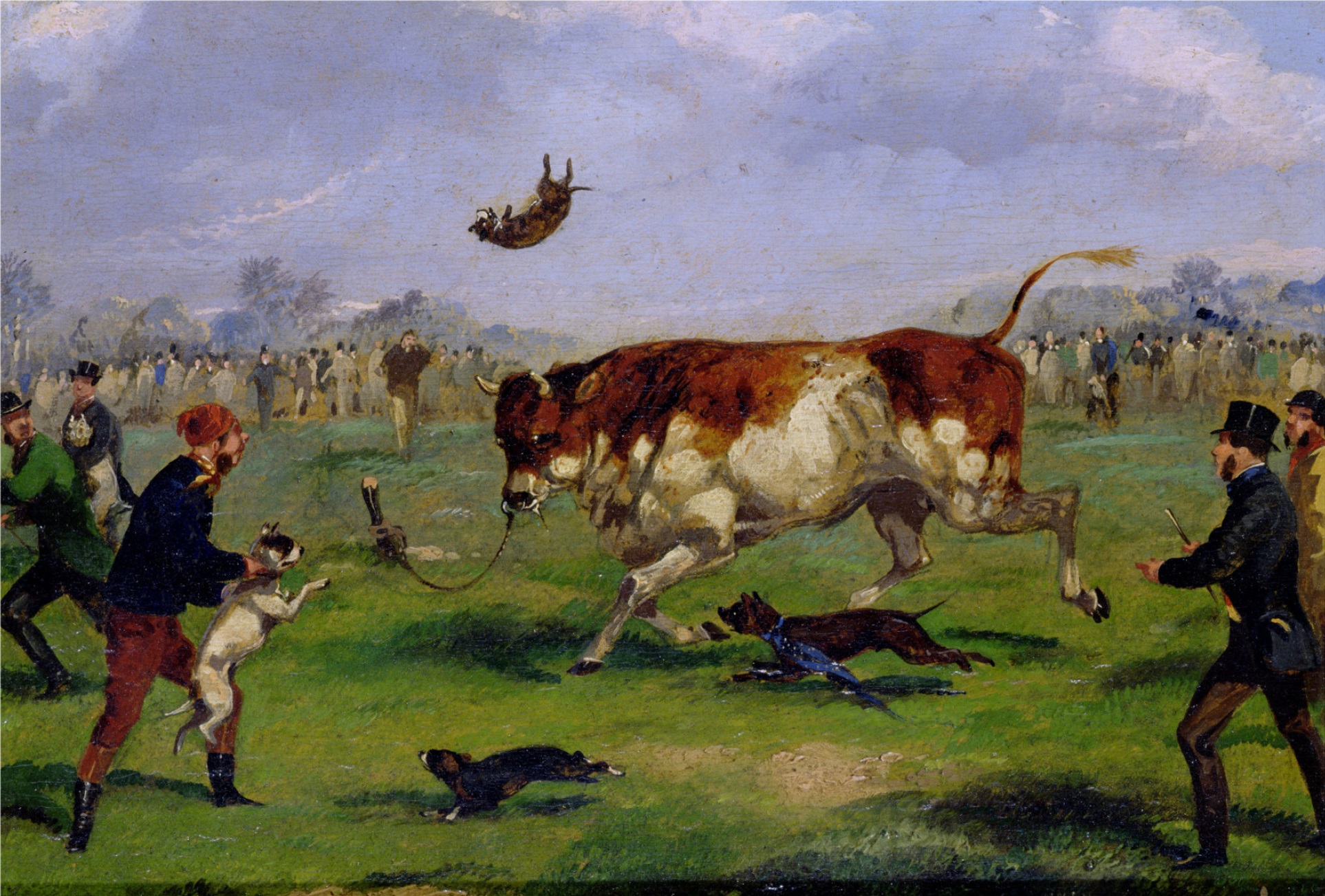
Bull-baiting (or bullbaiting) is a blood sport involving pitting a bull against dogs with the aim of attacking and subduing the bull by biting and holding onto its nose or neck, which often resulted in the death of the bull.
The origin of baiting in England may have come from ancient pagan rituals, and appears to have been carried on as a required method of butchering bull-beef in the 14th century. However, the earliest known bull-baiting as commercial entertainment in London was around 1540, and the first permanent arena was in 1562. Historically, however, English authors have often claimed a more ancient origin of the sport, as early as the 12th century, presumably to lend it a more ancient and venerable history, going as far as to suggest that the circular shape of the Elizabethan theaters came about because they were first used as baiting arenas, although these claims have been discredited.
Crowds in London during the Royal Entry of James VI and I in March 1604 were entertained by bull-baiting. During the time of Queen Anne, bull-baiting was practiced in London at Hockley-in-the-Hole, twice a week – and was also reasonably common in provincial towns, for instance at Birmingham's Bull Ring. At Tutbury, a bull was tied to an iron stake so that it could move within a radius of about 30 feet (9 m). The object of the sport was for the dogs to immobilize the bull.
Before the event started, the bull's nose was blown full of pepper to enrage it before the baiting. The bull was often placed in a hole in the ground. A variant of bull-baiting was "pinning the bull", where specially-trained dogs would set upon the bull one at a time, a successful attack resulting in the dog fastening his teeth strongly in the bull's snout. The extinct Old English Bulldog was specially bred for this sport.
Bull-baiting was not only practiced as a form of recreation; there was a long-held belief that baiting improved the meat quality and tenderness when consumed. By the early nineteenth century, the sport began to die out, both because the baiting caused a public nuisance and because of new concerns about animal cruelty.
The Bull Baiting at Wokingham was advertised in the newspaper in 1774:
BULL BAITING. On Wednesday next, being St. Thomas's Day, Two Bulls will be baited in the Market-Place, Wokingham, which will be run for, a very handsome MOROCCO COLLAR, stitched with Silver, and a Silver Plate for a Label, of a Guinea and Half Value. Each Dog is to be let three Times at the first Bull, four Times at the second, and only one Dog run at a Time. The Owner of each Dog that runs, pays One Shilling for Entrance. Proper Judges will be appointed before running to determine who may be the Winner, A good Ordinary at the King's Inn, between the Times of Baiting the Bulls.
Bull baiting advertised in 1780 appears to indicate that it was organized by a local hostelry:
Hub AI
Bull-baiting AI simulator
(@Bull-baiting_simulator)
Bull-baiting
Bull-baiting (or bullbaiting) is a blood sport involving pitting a bull against dogs with the aim of attacking and subduing the bull by biting and holding onto its nose or neck, which often resulted in the death of the bull.
The origin of baiting in England may have come from ancient pagan rituals, and appears to have been carried on as a required method of butchering bull-beef in the 14th century. However, the earliest known bull-baiting as commercial entertainment in London was around 1540, and the first permanent arena was in 1562. Historically, however, English authors have often claimed a more ancient origin of the sport, as early as the 12th century, presumably to lend it a more ancient and venerable history, going as far as to suggest that the circular shape of the Elizabethan theaters came about because they were first used as baiting arenas, although these claims have been discredited.
Crowds in London during the Royal Entry of James VI and I in March 1604 were entertained by bull-baiting. During the time of Queen Anne, bull-baiting was practiced in London at Hockley-in-the-Hole, twice a week – and was also reasonably common in provincial towns, for instance at Birmingham's Bull Ring. At Tutbury, a bull was tied to an iron stake so that it could move within a radius of about 30 feet (9 m). The object of the sport was for the dogs to immobilize the bull.
Before the event started, the bull's nose was blown full of pepper to enrage it before the baiting. The bull was often placed in a hole in the ground. A variant of bull-baiting was "pinning the bull", where specially-trained dogs would set upon the bull one at a time, a successful attack resulting in the dog fastening his teeth strongly in the bull's snout. The extinct Old English Bulldog was specially bred for this sport.
Bull-baiting was not only practiced as a form of recreation; there was a long-held belief that baiting improved the meat quality and tenderness when consumed. By the early nineteenth century, the sport began to die out, both because the baiting caused a public nuisance and because of new concerns about animal cruelty.
The Bull Baiting at Wokingham was advertised in the newspaper in 1774:
BULL BAITING. On Wednesday next, being St. Thomas's Day, Two Bulls will be baited in the Market-Place, Wokingham, which will be run for, a very handsome MOROCCO COLLAR, stitched with Silver, and a Silver Plate for a Label, of a Guinea and Half Value. Each Dog is to be let three Times at the first Bull, four Times at the second, and only one Dog run at a Time. The Owner of each Dog that runs, pays One Shilling for Entrance. Proper Judges will be appointed before running to determine who may be the Winner, A good Ordinary at the King's Inn, between the Times of Baiting the Bulls.
Bull baiting advertised in 1780 appears to indicate that it was organized by a local hostelry:
Recent media