Hubbry Logo
Buster CrabbeBuster CrabbeMain
Open search
Buster Crabbe
Community hub
Buster Crabbe
logo
8 pages, 0 posts
0 subscribers
Be the first to start a discussion here.
Buster Crabbe
Buster Crabbe
from Wikipedia

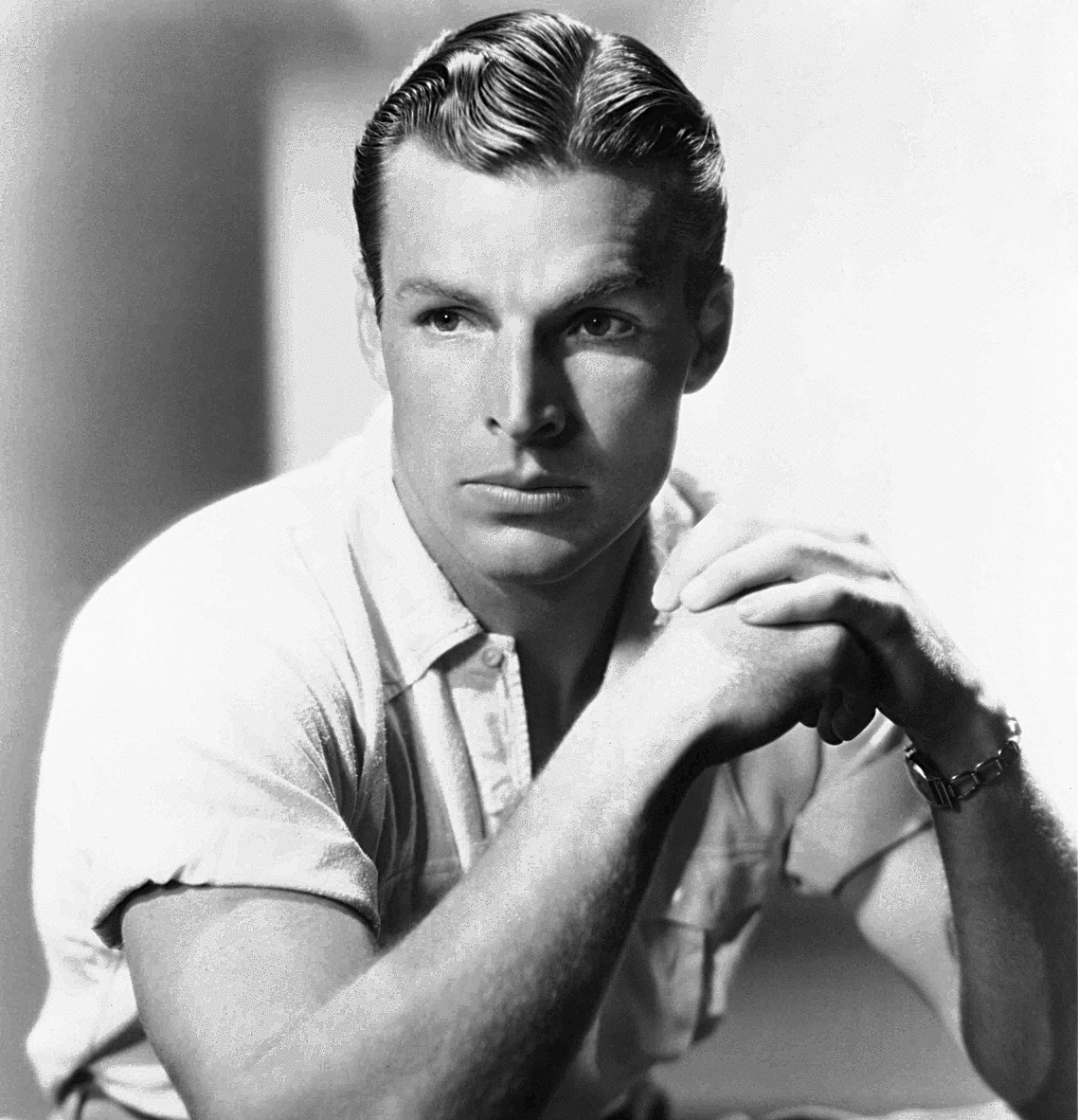
Clarence Linden "Buster" Crabbe II (/ˈkræb/; February 7, 1908 – April 23, 1983) was an American two-time Olympic swimmer and film and television actor.[1] He won the 1932 Olympic gold medal for 400-metre freestyle swimming event, which launched his career on the silver screen and later television. He starred in a variety of popular feature films and movie serials released between 1933 and the 1950s,[2] portraying the top three syndicated comic-strip heroes of the 1930s: Tarzan, Flash Gordon, and Buck Rogers.

Key Information

Early life

[edit]

Crabbe was born February 7, 1908,[3] to Edward Clinton Simmons Crabbe, a real estate broker, and Lucy Agnes (née McNamara) Crabbe, in Oakland, California. He had a brother, Edward Clinton Simmons Crabbe Jr. (1909–1972). Crabbe grew up in Hawaii and graduated from Punahou School in Honolulu. He then attended the University of Southern California, where he was the school's first All-American swimmer (1931) and a 1931 NCAA freestyle titlist. He also became a member of the Sigma Chi fraternity before graduating from USC in 1931.

Olympic Games

[edit]
Crabbe at age 20 at the 1928 Olympics in Amsterdam
Olympic medal record
Representing the United States
Men's swimming
Gold medal – first place 1932 Los Angeles 400 m freestyle
Bronze medal – third place 1928 Amsterdam 1500 m freestyle

Crabbe competed in two Olympic Games as a swimmer. At the 1928 Summer Olympics in Amsterdam, he won the bronze medal for the 1,500 metres freestyle, and at the 1932 Summer Olympics in Los Angeles, he won the gold medal for the 400 metres freestyle when he beat Jean Taris of France by a tenth of a second.[4][5]

Acting career

[edit]

Hollywood

[edit]
Crabbe watches "Jack", one of the lions in King of the Jungle, eating lunch in a Hollywood restaurant in 1933. Crabbe became a lion tamer while working on that adventure film.

He is credited in some films as "Larry Crabbe" or "Larry (Buster) Crabbe". His role in the Tarzan serial Tarzan the Fearless (1933) began a career in which Crabbe starred in more than a hundred films. In King of the Jungle (1933), Jungle Man (1941), and the serial King of the Congo (1952), he played typical "jungle man" roles. He starred in several popular films at this time, including The Sweetheart of Sigma Chi (1933), alongside Betty Grable, Search for Beauty (1934), and Daughter of Shanghai (1937) credited as Larry Crabbe.

In 1936, he was selected over several stars to play Flash Gordon in the first, very successful Universal Pictures Flash Gordon serial, which was followed by two sequels released in 1938 and 1940. The series was later edited and shown extensively on American television during the 1950s and 1960s, then fully restored for home video release. He also starred as Buck Rogers for Universal, playing the role with dark hair, unlike his blonde hair for Flash Gordon. In 1939 Crabbe reunited with Grable for a lead role in the mainstream comedy Million Dollar Legs.

Crabbe starred at the Billy Rose's Aquacade at the New York World's Fair during its second year (1940), replacing fellow Olympic swimmer and Tarzan actor Johnny Weissmuller.[citation needed] In 1943, Al Sheehan recruited Crabbe to perform as part of the Aqua Follies, a water ballet show including diving acts.[6]

During World War II, Crabbe was put under contract by Producers Releasing Corporation for lead roles from 1942 to 1946. He portrayed a Western folk-hero version of Billy the Kid in 13 films, and Billy Carson in 23, along with Al St. John as his sidekick. As a 34-year-old married man, Crabbe had a draft deferment, but made Army training films for the field artillery at Ft. Sill, Oklahoma, along with St. John.[7] Crabbe also played some jungle roles for the studio.

Following the war, Crabbe appeared opposite Weissmuller as a rival in two jungle films, Swamp Fire (1946) and Captive Girl (1950). For his final multi-chapter movie serial, Crabbe returned to the jungle playing the role of Thun'da in King of the Congo (1952).

Television

[edit]
Buster Crabbe with real-life son Cullen on Captain Gallant of the Foreign Legion, ca. 1955

Crabbe was frequently featured in archival footage in the children's television program, The Gabby Hayes Show. Prior to his playing "Captain Gallant", Crabbe had hosted the local New York City-based children's film wraparound television series, The Buster Crabbe Show. It was set against the backdrop of a ranch foreman's bunk house and featured Crabbe engaging his viewers with games, stories, craftmaking, hobbies, informational segments, and interviews with guest performers and personalities. This was in-between the reruns of old movie serials, westerns, and comedies. The Buster Crabbe Show was seen weekday evenings on WOR-TV (Channel 9) in New York City from Monday, March 12, 1951, to Friday, October 3, 1952. The series name was changed to Buster's Buddies! and returned to the NYC airways on WJZ-TV (Channel 7) (now WABC) on Monday, September 21, 1953. The WJZ TV version of the series included a studio audience of kids, becoming more of a kids' variety show. Despite the addition of the studio audience and Crabbe's personality, Buster's Buddies! was not a hit, and it was canceled on Friday, March 26, 1954.[8]

On September 28, 1952, Sports Final with Buster Crabbe debuted on WNBT-TV in New York City. Crabbe gave updates sports news from 11:15 to 11:20 p.m. Eastern Time on Sundays.[9]

Crabbe starred in the syndicated television series, Captain Gallant of the Foreign Legion (1955 to 1957) as Captain Michael Gallant; the adventure series aired on NBC. His real-life son, Cullen Crabbe, appeared in the series as the character "Cuffy Sanders".

Crabbe made regular television appearances, including an episode of the 1979 series Buck Rogers in the 25th Century, in which he played a retired fighter pilot named "Brigadier Gordon", in honor of Flash Gordon. When Rogers (Gil Gerard) praises his flying, Gordon replies "I've been doing that sort of thing since before you were born", not realizing Buck was actually born over 500 years earlier. (Indeed, Crabbe first played Buck Rogers in 1939, six years before Gerard's birth.) Rogers responds "You think so?" to which Gordon replies "Young man, I know so!"

He was also in a TV spot for Continental Airlines, where Crabbe spies himself in an old Flash Gordon short being shown on board: "I think I know that guy. He used to be my idol."

Later years

[edit]

Crabbe's Hollywood career waned somewhat in the 1950s and 1960s, and he became a stockbroker and businessman during this period. According to David Ragan's Movie Stars of the '30s, Crabbe owned a Southern California swimming pool-building company in later years. In the mid-1950s, Crabbe purchased the Adirondack campus of the Adirondack-Florida School,[10] which advertised itself as a swim camp, called Camp Meenahga, for boys aged eight to fourteen, with most of the campers coming from Montreal.[11] He was also the aquatics director at the Concord Resort Hotel in New York State's Catskill Mountains.[12]

Newspaper ad published September 1989

During this period, Buster joined the swimming pool company Cascade Industries in Edison, New Jersey. In his capacity as Vice President of Sales, promoter, and spokesman for Cascade, "the world's first 'package pool' company", he attended shopping mall openings and fairgrounds, combining the promotion of his swim camps and Cascade's vinyl liner for in-ground swimming pools. A pool line was named after him, and swimming pools were sold by "Buster Crabbe Dealers" throughout the eastern seaboard and southern states from 1952 until 1990.

Though he followed other pursuits, he never stopped acting. But his career in the 1950s, and later, was limited to low-budget films, including westerns such as Gunfighters of Abilene (1960) co-starring Barton MacLane, Arizona Raiders (1965) co-starring Audie Murphy, and The Bounty Killer (1965) co-starring Dan Duryea and Rod Cameron. Crabbe appeared as the father of a young swimmer in the comedy Swim Team (1979), and as a sheriff in the low-budget horror film Alien Dead (1980), followed by The Comeback Trail (1982), one year before his death. Crabbe also appeared in television commercials[13] for Hormel Chili, Icy Hot, and the Magic Mold Bodyshirt, an early version of male shapewear, which purportedly helped in weight loss. Through Icy Hot, he was actively involved in arthritis education. Despite his numerous film and television appearances, he is best remembered today as one of the original cinema action heroes of the 1930s and 1940s.

In the 1950s, two published comic book series were named after him. Eastern Color published 12 issues of Buster Crabbe Comics from 1951 to 1953, followed by Lev Gleason's four issues of The Amazing Adventures of Buster Crabbe in 1954.

In 1965, he was inducted into the International Swimming Hall of Fame. During his senior swimming career, Crabbe set 16 world and 35 national records.[14] He continued swimming through his sixties and in 1971 set a world record in his age group.[15]

Personal life

[edit]

In 1933, he married Adah Virginia Held (1912–2004) and gave himself a year to make it as an actor. If he did not find employment as an actor in that period, he planned to start law school at the University of Southern California.[citation needed]

Crabbe and his wife had two daughters, Caren Lynn ("Sande") and Susan, and a son, Cullen. In 1957, Sande died of anorexia nervosa aged 20.[16]

He is the maternal grandfather of the college football coach Nick Holt.[17]

Death

[edit]

In 1983, at age 75, Crabbe died of a heart attack at his home in Scottsdale, Arizona.[2] He is interred at Green Acres Memorial Park in Scottsdale.[18]

Selected filmography

[edit]
Year Title Role
1933 King Of The Jungle Kaspa
1933 Tarzan the Fearless Tarzan
1934 Badge of Honor Bob Gordon
You're Telling Me! Bob Murchison
1936 Flash Gordon Flash Gordon
The Arizona Raiders "Laramie" Nelson
1938 Flash Gordon's Trip to Mars Flash Gordon
Red Barry Red Barry
1939 Buck Rogers Buck Rogers
1940 Flash Gordon Conquers the Universe Flash Gordon
1941–46 Billy the Kid (film series) Billy the Kid / Billy Carson
1946 Swamp Fire Mike Kalavich
1947 Last of the Redmen Magua
The Sea Hound Captain Silver
1950 Pirates of the High Seas Jeff Drake
1952 King of the Congo Captain Roger Drum and "Thun'da"
1956 Gun Brothers Chad Santee
1957 The Lawless Eighties Linc Prescott
1958 Badman's Country Wyatt Earp
1960 Gunfighters of Abilene Kip Tanner
1965 Arizona Raiders Captain Andrews
The Bounty Killer Mike Clayman
1978 Swim Team Rock Sands
1980 Alien Dead Sheriff Kowalski
1982 The Comeback Trail Duke Montana

References and notes

[edit]

See also

[edit]
[edit]
Revisions and contributorsEdit on WikipediaRead on Wikipedia
from Grokipedia
Clarence Linden "Buster" Crabbe (February 7, 1908 – April 23, 1983) was an American Olympic swimmer and renowned for his athletic prowess and prolific Hollywood career in film serials and Westerns. Born in , Crabbe initially gained fame as a competitive , setting 16 world records and 35 national records while winning 18 championships. He competed in the Olympics twice, earning a in the 1,500-meter freestyle at the 1928 Games and a in the 400-meter freestyle at the 1932 Los Angeles Games, where he was the only U.S. ist in men's . His Olympic success propelled him into , leading to a contract with shortly after the 1932 Games. Crabbe's most notable roles came in science-fiction and adventure serials during the 1930s and 1940s, where he portrayed the only actor to play , , and on screen. He first embodied the jungle hero as in the 1933 serial , produced by Sol Lesser. Crabbe then starred as in three Universal serials— (1936), Flash Gordon's Trip to Mars (1938), and (1940)—becoming synonymous with the character from Alex Raymond's . In 1939, he took on the role of in the Universal serial , further cementing his status as the "King of Serials." Beyond these iconic parts, Crabbe appeared in over 100 films, including Westerns where he played in a series of low-budget features for PRC in the 1940s, and later transitioned to television roles in shows like Captain Gallant of the Foreign Legion (1955–1957). Inducted into the in 1968, Crabbe's dual legacy as an athlete and entertainer spanned decades until his death from a heart attack in .

Early Life and Education

Birth and Family Background

Clarence Linden Crabbe II, known professionally as Buster Crabbe, was born on February 7, 1908, in . His father, Edward Clinton Simmons Crabbe, worked as a broker before taking a position that prompted a family move. His mother was Lucy Agnes McNamara. Crabbe had one younger sibling, a brother named Edward Clinton Simmons Crabbe Jr. (1909–1972), who was known as "Buddy." The family, including the two boys, lived in a boarding house in Oakland during Crabbe's early infancy. Around 1910, when Crabbe was approximately 18 months old, the family relocated to , where his father became an overseer on a pineapple plantation. This move immersed the Crabbe children in Hawaii's outdoor environment from a young age, fostering an early exposure to the islands' active lifestyle and aquatic surroundings that later contributed to Crabbe's passion for . The family nicknamed him "Buster" during his childhood, a moniker that stuck throughout his life and career.

Childhood and Introduction to Swimming

Following the family's relocation to Hawaii around age two due to financial hardships faced by his father in the mainland real estate market, Clarence Linden "Buster" Crabbe II grew up in , where the island's pervasive aquatic environment shaped his early years. The Crabbe family maintained a modest lifestyle, with his father serving as an overseer on a and his mother managing the household, while emphasizing physical activity as a means of health and self-reliance amid limited resources. Crabbe attended local schools before enrolling at the Honolulu Military Academy, which later merged with , where he thrived in outdoor pursuits like horseback riding, track, and team sports, reflecting the family's commitment to fitness in 's tropical setting. Crabbe's introduction to swimming occurred at Waikiki Beach, where he and his younger brother, Edward "Buddy," learned the basics through informal play in the ocean waters, deeply influenced by Hawaii's longstanding traditions of and open-water . These traditions, rooted in Native Hawaiian practices and popularized by local icons, encouraged young residents to view the sea as an extension of daily life rather than a formal sport. Crabbe quickly developed proficiency by diving for coins tossed by tourists from nearby ships and beachgoers, a practical exercise that sharpened his endurance, breath control, and comfort in rough surf conditions. This natural aptitude led to early involvement in organized water activities, as evidenced by Crabbe qualifying for the swimming team's trip to in his mid-teens, a role he took to accompany his brother after their father deemed solo travel too risky. By high school at Punahou, his skills had progressed to competitive levels, earning him three varsity letters in and captaincy of the 1927 team, where he contributed to local meets amid the school's emphasis on multifaceted athletic development. The family's modest means and focus on physical robustness, combined with Hawaii's coastal lifestyle, fostered Crabbe's seamless transition from recreational splashing to structured aquatic pursuits.

Swimming Career

Collegiate and Amateur Achievements

After graduating from in in 1927, where he served as captain of the swimming team during his senior year, Clarence "Buster" Crabbe enrolled at the (USC) on a swimming scholarship, beginning his collegiate career around that time. At USC, Crabbe emerged as a dominant force in collegiate , earning All-American honors in as the university's first recipient in the sport. That year, he captured the NCAA title in the 440-yard freestyle with a time of 5:02.0, contributing significantly to USC's team performance at the championships despite claiming the unofficial team crown. His collegiate achievements highlighted his prowess in longer freestyle distances, building on the foundational interest in he developed during his youth in . Throughout his amateur career from 1927 to 1932, Crabbe excelled at the national level, winning multiple (AAU) titles in freestyle events, including the 400-meter freestyle in 1928, 1930, and 1931. In total, he amassed 18 AAU national championships across various distances. Crabbe's record-setting performances were equally impressive; he established 16 world records and 35 national records in freestyle events ranging from 200 yards to the mile, solidifying his status as one of the era's premier swimmers before turning professional.

Olympic Performances

Clarence "Buster" Crabbe, having established strong collegiate records at the , earned selection for the U.S. Olympic team for the 1928 Summer Games in . At the 1928 Olympics, Crabbe competed in the men's freestyle events, facing the rigors of transatlantic travel from the , which involved lengthy ship voyages typical for American athletes of the era. His training regimen emphasized endurance in open-water conditions, drawing from his Hawaiian roots and USC coaching under programs that built stamina through daily mile swims. In the 400-meter freestyle, he placed fourth with a time of 5:05.4, narrowly missing the podium behind Argentina's Zorrilla, Australia's , and Sweden's Arne Borg. Crabbe secured a in the 1,500-meter freestyle, finishing third in 20:28.8, behind Borg's gold-medal time of 19:51.8. Following his 1928 performance, Crabbe intensified his preparation for the 1932 Games, returning to USC to complete his degree while adding 20 pounds of muscle through rigorous weight training and extended pool sessions to counter the physical demands of longer distances. Held in his adopted hometown of , the presented fewer travel obstacles but heightened pressure amid Japan's dominance in men's . Crabbe broke through in the 400-meter freestyle, winning in a world-record time of 4:48.4, edging France's Jean Taris by 0.1 seconds. He also competed in the 1,500-meter freestyle, placing fifth with a time of 20:02.7. This victory marked him as the only U.S. male swimmer to claim that year, amid a Japanese sweep of the other men's events. Crabbe retired from amateur competition immediately after the 1932 Olympics, concluding a career highlighted by Olympic success that elevated his public profile as a national athletic figure.

Transition to Acting

Early Film Roles

Following his win in the 400-meter freestyle at the 1932 Los Angeles Olympics, Buster Crabbe's athletic prowess and handsome features attracted Hollywood attention, leading to a contract with shortly thereafter. A studio talent scout selected him from among 40 Olympians for during the Games, and Crabbe was the only one signed. Crabbe made his film debut in 1933's King of the Jungle, portraying Kaspa the Lion Man, a raised by animals after his parents' death, in a role reminiscent of . The film, directed by H. Bruce Humberstone, cast the 25-year-old swimmer as a brought to civilization, emphasizing his physicality through scenes involving lions and survival in the African wilds. Publicity highlighted his Olympic background to draw audiences, though the production required him to work closely with trained lions, adding to the role's demands. In the ensuing years, Crabbe took on minor supporting parts while under contract, including a small role as a college student in the 1932 Columbia comedy That's My Boy, which predated his Olympic triumph and marked his first on-screen appearance. He followed with a featured role in the 1934 Paramount comedy Search for Beauty, playing Olympic swimmer Don Jackson, who unwittingly fronts a shady health magazine scam alongside Ida Lupino. These early assignments often leveraged his real-life athletic image rather than demanding complex dramatic skills. Transitioning from competitive to presented significant hurdles for Crabbe, who entered the industry without any formal training or prior experience in performance. Lacking acting lessons, he relied on his natural charisma and physical presence. Despite these challenges, his Olympic fame provided opportunities to build a foothold in Hollywood.

Breakthrough in Hollywood

Crabbe's portrayal of in the 1933 serial Tarzan the Fearless, produced independently by Sol Lesser as a rival to MGM's Tarzan films, marked a pivotal moment in his career. In the 12-chapter production, directed by Robert F. Hill, Crabbe embodied the ape-raised jungle hero who rescues a young woman and her father from tribal threats, showcasing his athletic build and swimming-honed physique in action sequences. This role, condensed into a for theatrical release, immediately typecast him as an athletic hero, capitalizing on his recent Olympic to position him as a credible rival to in the public imagination. Under his ongoing Paramount contract, which lasted approximately seven years until 1940, Crabbe transitioned from minor roles in films like The Thundering Herd to leading parts in B-movies that highlighted his physicality and charm. He gained increased visibility through a series of adventure and lighthearted productions, solidifying his status as a rising star in Hollywood's low-budget sector. Paramount loaned him out occasionally, but the studio's support amplified his opportunities, with roles emphasizing his heroic persona derived from jungle exploits. In The Sweetheart of Sigma Chi (1933), a pre-Code directed by Edwin L. Marin, Crabbe played Bob North, a shy rower who falls for a flirtatious sorority girl, allowing him to display a comedic side amid campus antics and romantic rivalries. These performances balanced his by revealing versatility, though his core appeal remained rooted in physical prowess. Publicity for Crabbe during this period heavily promoted him as the "Olympic ," leveraging his 1932 in the 400-meter freestyle to draw fans fascinated by his real-life athletic achievements and on-screen heroism. Studio campaigns, including a Paramount poll where typists favored him over candidates like and Max Baer for King of the Jungle, underscored his appeal as a wholesome, virile figure, boosting his popularity among Depression-era audiences seeking escapist idols. This marketing strategy enhanced his fan base, emphasizing his swimming background as authentic credential for roles and contributing to his breakthrough as a reliable B-movie lead.

Film Career

Adventure Serials and Sci-Fi Roles

Buster Crabbe's transition to acting capitalized on his athletic physique from his Olympic swimming career, making him an ideal choice for physically demanding roles in adventure serials. His breakthrough came in science fiction serials, where he embodied heroic archetypes that influenced the genre's visual and narrative style. In 1936, Crabbe starred as the titular hero in Universal Pictures' Flash Gordon, a 13-chapter serial directed by Frederick Stephani and Ray Taylor, in which he portrayed a polo player transported to the planet Mongo to battle the tyrannical Emperor Ming the Merciless, played by Charles Middleton. The production featured innovative special effects for the era, including miniature models for rocket ships and elaborate costumes that defined the space opera aesthetic, such as Flash's form-fitting tunic and Dale Arden's (Jean Rogers) flowing gowns. These elements, combined with cliffhanger action sequences involving ray guns, aerial dogfights, and monstrous creatures, helped popularize the serial format as a staple of Saturday matinees and left a lasting imprint on science fiction imagery in film and comics. Three years later, Crabbe reprised his futuristic hero persona in Universal's (1939), a 12-chapter serial also directed by and Saul Goodkind, where he played the 20th-century pilot awakened after 500 years of to combat the dictator Killer Kane on a dystopian . The serial's fast-paced episodes emphasized gadgetry like atomic pistols and disintegrator rays, further solidifying Crabbe's image as the quintessential sci-fi adventurer and contributing to the cross-pollination between pulp comics and cinema. Crabbe continued in adventure serials into the 1950s, including Columbia Pictures' King of the Congo (1952), a 15-chapter production directed by Spencer Gordon Bennet and Wallace Grissell, in which he portrayed Thunda, a jungle lord protecting a hidden uranium mine from spies. Similarly, in Pirates of the High Seas (1950), another 15-chapter Columbia serial directed by Bennet and Thomas Carr, Crabbe played seafaring captain Jeff Drake hunting for stolen diamonds amid pirate threats in the Pacific. These later works, often re-released under titles like Pirate Island in the 1950s, showcased Crabbe's versatility in high-stakes action while echoing the episodic thrills that made his earlier sci-fi roles culturally resonant.

Westerns and Supporting Parts

Following his success in adventure serials, Buster Crabbe transitioned into the western genre, becoming a staple of low-budget B-westerns during the 1940s. He starred in 13 films as the heroic outlaw Billy the Kid for Producers Releasing Corporation (PRC) from 1941 to 1943, portraying the character as a wrongly accused gunslinger fighting corruption in the American West. These quick-paced productions, directed primarily by Sam Newfield, featured Crabbe alongside comic sidekick Al "Fuzzy" St. John and emphasized action over historical accuracy, with typical plots involving land grabs, bandit gangs, and frontier justice. A representative entry is Billy the Kid Wanted (1941), Crabbe's debut in the role, where he thwarts swindlers targeting homesteaders. The series evolved under PRC, with Crabbe continuing in 23 additional films from 1943 to 1946, but now as the renamed Billy Carson to distance the character from the infamous and allow for more flexible storytelling. These later entries maintained the formula of high-stakes chases, saloon shootouts, and moral dilemmas, solidifying Crabbe's image as a rugged, athletic hero in cinema. After PRC's collapse in 1947, Crabbe appeared in serials such as The Sea Hound (1947) for and lead roles in independent westerns like The Dalton Gang (1949) for Lippert Productions. Crabbe also took supporting parts in higher-profile westerns, leveraging his physical presence and screen charisma. By the late and into the , Crabbe shifted toward character acting in westerns and adjacent genres, appearing as authoritative figures or allies rather than primary heroes. In drama-infused westerns like Badman's Country (), he portrayed legendary lawman , aiding (George Montgomery) against outlaws in a tale of frontier showdowns. He occasionally ventured into comedic supporting roles, such as the bumbling deputy in lighthearted oaters, but remained rooted in action-oriented narratives that capitalized on his enduring persona from the PRC era.

Television and Later Acting

Television Series

Buster Crabbe began transitioning to television in the early 1950s, including hosting The Buster Crabbe Show (1951–1952) on WOR-TV, where he introduced clips from his serials, along with guest appearances in . These early forays, along with spots on shows like , allowed Crabbe to adapt his film-honed skills to the nascent medium, often in shorter formats that demanded quick pacing and minimal sets. Crabbe's most prominent television role came as the star of the syndicated adventure series Captain Gallant of the Foreign Legion, which aired from 1955 to 1957. In the show, he portrayed Captain Michael Gallant, a heroic American officer in the stationed in , battling bandits and maintaining order while raising an orphaned boy played by his real-life son, Cullen Crabbe, as Cuffy Sanders. The series emphasized themes of heroism, camaraderie, and family bonds, with Gallant serving as both a military leader and paternal figure to Cuffy. Comprising 65 half-hour episodes, Captain Gallant was filmed on location in , particularly , to capture authentic settings and reduce production costs compared to Hollywood shoots. This approach highlighted the logistical challenges of television production, including lower budgets that limited and crew resources relative to Crabbe's earlier film serials, yet leveraged his experience in fast-paced westerns to deliver action-oriented storytelling suited to the small screen.

Guest Appearances and Final Projects

Following the success of his television series, Crabbe made sporadic guest appearances on various anthology programs during the late , showcasing his versatility in dramatic roles beyond westerns and adventures. In , he appeared in an episode of Gulf Playhouse titled "A Gift from ," a drama produced by Fred Coe. Two years later, in 1955, Crabbe starred as an ex-ballplayer in the Kraft Theatre episode "Million Dollar Rookie," a about pressures written by Mel Goldberg, which aired on and highlighted his ability to portray everyday heroes. These roles demonstrated Crabbe's continued presence in the , though his commitments increasingly shifted toward business ventures. As the 1960s progressed, Crabbe's acting work became even more intermittent, with fewer on-screen opportunities as he focused on family and entrepreneurial pursuits amid advancing age. He occasionally took on supporting parts in low-budget films, such as the role of Kowalski in the 1980 horror film The Alien Dead, a Florida-shot production that marked one of his rare forays into genre fare outside his serial heyday. In television, Crabbe made nostalgic cameos that nodded to his legacy; notably, in 1979, he guest-starred as the authoritative Brigadier Gordon in the Buck Rogers in the 25th Century episode "Planet of the Slave Girls," a two-part adventure that reunited him thematically with his sci-fi roots. Crabbe's final projects reflected this tapering involvement, blending humor with his enduring cowboy persona. In 1981, he appeared as Jake O'Brien, an old stuntman friend, in the B.J. and the Bear episode "S.T.U.N.T.," assisting with a shoot in a lighthearted nod to his own career. His last film role came in The Comeback Trail (1982, filmed in 1974), where he played Duke Montana, a fit but aging Western star targeted in a comedic by shady producers; the low-budget , directed by Harry Hurwitz, was released and praised for Crabbe's graceful athleticism at age 74. By the late 1970s, health concerns and his growing emphasis on manufacturing and had largely sidelined acting, leading to a gradual retirement from the screen after over four decades in the industry.

Military Service and Business Ventures

World War II Service

During , Buster Crabbe, then 34 years old and married, qualified for a draft deferment but actively supported the U.S. military by touring the nation with his own Buster Crabbe's Aquaparade, a water show, and by producing and starring in training films for the Army's branch at , . Working alongside his longtime collaborator Al "Fuzzy" St. John, Crabbe's efforts focused on educational content to prepare soldiers for combat, leveraging his acting experience to make the material engaging and effective. This work represented a direct contribution to the war effort, blending his Hollywood skills with national defense needs. Crabbe's involvement at lasted several months, during which he helped create instructional sequences on operations and tactics, aiding the training of thousands of recruits. Although not in active , his role was recognized as valuable service, reflecting the broader of entertainers to bolster military readiness. This period coincided with his ongoing film commitments, but the training projects temporarily shifted his focus from commercial productions. Upon the war's end in , Crabbe returned to full-time .

Post-War Business and Fitness Activities

Following , Buster Crabbe leveraged his Olympic background to enter the business world, founding a company in the mid-1950s that bore his name and specialized in custom residential installations. The venture, known as Buster Crabbe Pools, quickly grew into a recognized with operations expanding to multiple locations nationwide, promoting pools not just as recreational features but as tools for enhancing physical health through regular . Crabbe remained a dedicated advocate for fitness throughout his later years, producing and hosting televised exercise programs to encourage public participation in . In the 1950s, he co-hosted the short-format show Figure Fashioning with his on New York’s WOR-TV, offering weekday morning routines focused on and conditioning. He continued such efforts into subsequent decades, conducting additional broadcasts that highlighted and general athletics as accessible paths to . Demonstrating his enduring commitment to the sport, Crabbe maintained competitive into his sixties; in 1971, at age 63, he set a world age-group record in the 400-meter freestyle. His promotional work further capitalized on his expertise to inspire broader interest in athletic pursuits.

Personal Life

Marriage and Family

Buster Crabbe married his college sweetheart, Adah Virginia Held, on April 13, 1933, in . The couple enjoyed a stable and enduring partnership that lasted 50 years, until Crabbe's death in 1983. Held, born in 1912 in , provided consistent emotional support throughout Crabbe's fluctuating career in , , and later business ventures, helping to anchor their family amid frequent relocations and professional demands. The Crabbes had three children: daughters Caren Lynn "Sande" Crabbe (born July 14, 1936) and Susan Ann Crabbe (born 1938), and son Cullen Held Crabbe (born 1944). Sande, who struggled with , tragically passed away in 1957 at age 20, weighing only 60 pounds at the time. Susan later married William C. Fletcher, becoming Susan Ann Crabbe Fletcher, while Cullen pursued interests aligned with his father's endeavors. Although the family had no additional sons, son-in-law Fletcher became involved in Crabbe's business activities, contributing to the management of family enterprises. The Crabbes emphasized a close-knit dynamic, with the children often accompanying their father on location shoots or tours when possible, fostering resilience in the face of Hollywood's uncertainties. The family primarily resided in during Crabbe's peak acting years in and , where they maintained a home in Beverly Hills that served as a stable base amid his productions and travel. In 1951, they relocated to , for nearly two decades to support Crabbe's work in aquatics and theater, before eventually settling in , in later years, where the warmer climate suited their aging lifestyle. Adah played a pivotal role in sustaining this mobility, managing household logistics and child-rearing during Crabbe's extended absences for commitments, which allowed him to focus on his professional obligations without domestic disruptions. During , while Crabbe served in the U.S. Navy and toured nationwide with his aquashow to entertain troops and civilians, Adah Held managed the home front in , overseeing the care of their young children—including Sande (aged 5 to 9) and Susan (aged 3 to 7), as well as the infant Cullen born in 1944—amid wartime rationing and uncertainties. Her efforts extended to later acting tours in the and , where she coordinated family support from afar, ensuring correspondence and stability that bolstered Crabbe's morale and performance. This steadfast partnership not only sustained their immediate family but also contributed to Crabbe's ability to maintain career focus across decades.

Interests and Community Involvement

Buster Crabbe maintained an active lifestyle centered on , daily and playing regularly even in his seventies, which he credited for his vitality after quitting decades earlier. He also enjoyed , viewing these pursuits as integral to his enduring health and energy. Demonstrating his commitment to youth fitness, Crabbe owned and directed Camp Meenahga, a for boys on Lake in New York's Adirondacks starting in 1954, where and skin diving formed the core of the program's activities to build and athletic skills. He personally coached and led clinics at resorts like the Concord Hotel in Kiamesha Lake and community centers such as the Durland Scout Center in , inspiring young participants through hands-on instruction. Crabbe's community involvement extended to supporting Olympic sports, as he served on the organizing committee for the 1984 Los Angeles Games and participated in events honoring past Olympians, including leading a procession of athletes into the Coliseum on July 30, 1982, during the 50th anniversary ceremonies of the 1932 Olympics. His philanthropy included contributions to Olympic initiatives and children's sports foundations, aligning with his passion for promoting athletic development among the young. Throughout his later years, Crabbe adhered to a health-conscious regimen emphasizing exercise and balanced nutrition, authoring Buster Crabbe's Energistics in 1976 to share simple, effective shape-up routines accessible to . This dedication not only sustained his own well-being but also served as a model for advocacy.

Death and Legacy

Final Years and Death

In his later years, Buster Crabbe settled in , where he focused on business ventures, including serving as a spokesman for a swimming pool manufacturer and promoting his books through national tours. He had been a resident of the area since the , enjoying a quieter life away from Hollywood. In the early 1980s, Crabbe experienced ongoing heart problems, though he rarely complained about any discomfort. On April 23, 1983, he suffered a fatal heart attack at his home in Scottsdale at the age of 75; the death was described as sudden, with Crabbe having appeared in good health beforehand. A private family service was held following his death, after which he was buried at Green Acres Memorial Park in Scottsdale. Crabbe was survived by his wife of over 50 years, to whom he had been married since 1933.

Cultural Impact and Honors

Buster Crabbe's enduring legacy as the quintessential serial hero of the and stems from his charismatic portrayals in science fiction and adventure serials, where he embodied athletic prowess and moral fortitude against fantastical threats. His roles, such as in the 1936 Universal serial, pioneered spectacular visual effects like miniature rocket ships and elaborate sets, influencing the aesthetic and narrative structure of sci-fi cinema and later television adaptations by emphasizing heroic quests and suspense. These performances helped define the adventure genre's blend of pulp excitement and visual innovation, inspiring subsequent works in , , and that drew on similar episodic heroism. Crabbe's contributions to both sports and entertainment earned him significant honors during his lifetime. In 1960, he received a star on the in the television category, located at 6901 , recognizing his extensive work in serials and syndicated shows. Five years later, in 1965, he was inducted into the inaugural class of the , celebrating his Olympic achievements, including the 1932 in the 400-meter freestyle, alongside 16 world records and 35 national records. Posthumously, Crabbe's image has remained vibrant through ongoing reruns of his classic serials on cable networks and releases, which continue to introduce his adventurous persona to new audiences. Biographies and documentaries frequently emphasize his rare duality as an Olympic champion turned Hollywood leading man, underscoring his transition from athletic excellence to on-screen heroism. In , the City of Oakland declared as Buster Crabbe Day to honor his legacy as a native son and Olympic champion. As one of the few Olympic gold medalists to attain Hollywood stardom—alongside figures like —Crabbe symbolizes the era's American ideal of physical vitality and indomitable spirit in the face of adversity.

References

Add your contribution
Related Hubs
User Avatar
No comments yet.