



Community hub
Recent from talks
Knowledge base stats:
Talk channels stats:
Members stats:
Butoh
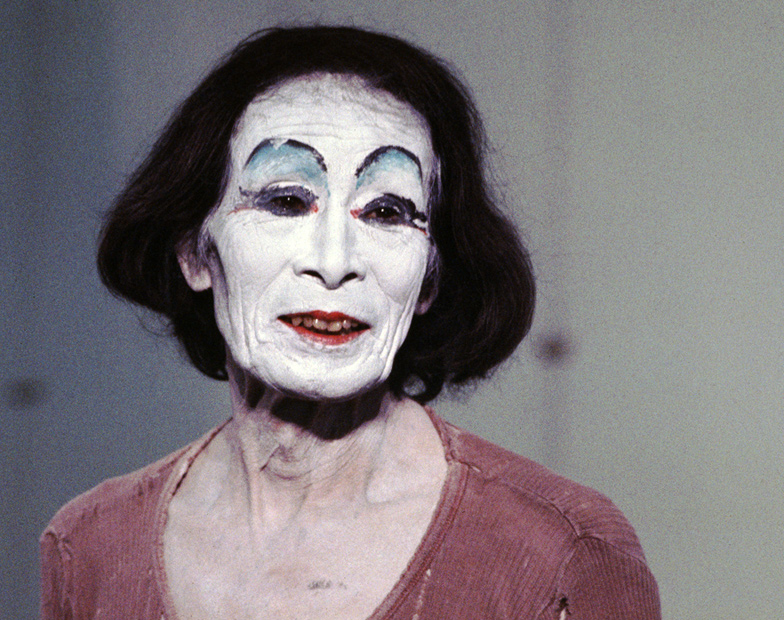
Butoh (舞踏, Butō) is a form of Japanese dance theatre that encompasses a diverse range of activities, techniques and motivations for dance, performance, or movement. Following World War II, butoh arose in 1959 through collaborations between its two key founders, Tatsumi Hijikata and Kazuo Ohno. The art form is known to "resist fixity" and is difficult to define; notably, founder Hijikata Tatsumi viewed the formalisation of butoh with "distress". Common features of the art form include playful and grotesque imagery, taboo topics, and extreme or absurd environments. It is traditionally performed in white body makeup with slow hyper-controlled motion. However, with time butoh groups are increasingly being formed around the world, with their various aesthetic ideals and intentions.
Butoh first appeared in post-World War II Japan in 1959, under the collaboration of Tatsumi Hijikata and Kazuo Ohno, "in the protective shadow of the 1950s and 1960s avant-garde". A key impetus of the art form was a reaction against the Japanese dance scene then, which Hijikata felt was overly based on imitating the West and following traditional styles like Noh. Thus, he sought to "turn away from the Western styles of dance, ballet and modern", and to create a new aesthetic that embraced the "squat, earthbound physique... and the natural movements of the common folk". This desire found form in the early movement of "ankoku butō" (暗黒舞踏). The term means "dance of darkness", and the form was built on a vocabulary of "crude physical gestures and uncouth habits... a direct assault on the refinement (miyabi) and understatement (shibui) so valued in Japanese aesthetics."
The first butoh piece, Forbidden Colors (禁色, Kinjiki) by Tatsumi Hijikata, premiered at a dance festival in 1959. It was based on the novel of the same name by Yukio Mishima. It explored the taboo of homosexuality and ended with a live chicken being held between the legs of Kazuo Ohno's son Yoshito Ohno, after which Hijikata chased Yoshito off the stage in darkness. Mainly as a result of the audience outrage over this piece, Hijikata was banned from the festival, establishing him as an iconoclast.
The earliest butoh performances were called (in English) "Dance Experience". In the early 1960s, Hijikata used the term "Ankoku-Buyou" (暗黒舞踊; dance of darkness) to describe his dance. He later changed the word "buyo", filled with associations of Japanese classical dance, to "butoh", a long-discarded word for dance that originally meant European ballroom dancing.
In later work, Hijikata continued to subvert conventional notions of dance. Inspired by writers such as Yukio Mishima (as noted above), Comte de Lautréamont, Antonin Artaud, Jean Genet and Marquis de Sade, he delved into grotesquerie, darkness, and decay. At the same time, Hijikata explored the transmutation of the human body into other forms, such as those of animals. He also developed a poetic and surreal choreographic language, butoh-fu (舞踏譜; fu means "notation" in Japanese), to help the dancer transform into other states of being.
The work developed beginning in 1960 by Kazuo Ohno with Tatsumi Hijikata was the beginning of what now is regarded as "butoh". In Nourit Masson-Sékiné and Jean Viala's book Shades of Darkness, Ohno is regarded as "the soul of butoh", while Hijikata is seen as "the architect of butoh". Hijikata and Ohno later developed their own styles of teaching. Students of each style went on to create different groups such as Sankai Juku, a Japanese dance troupe well known to fans in North America.
Students of these two artists have been known to highlight the differing orientations of their masters. While Hijikata was a fearsome technician of the nervous system influencing input strategies and artists working in groups, Ohno is thought of as a more natural, individual, and nurturing figure who influenced solo artists.
Starting in the early 1980s, butoh experienced a renaissance as butoh groups began performing outside Japan for the first time; at this time the style was marked by "full body paint (white or dark or gold), near or complete nudity, shaved heads, grotesque costumes, clawed hands, rolled-up eyes and mouths opened in silent screams." Sankai Juku was a touring butoh group; during one performance by Sankai Juku, in which the performers hung upside down from ropes from a tall building in Seattle, one of the ropes broke, resulting in the death of a performer. The footage was played on national news, and butoh became more widely known in America through the tragedy. A PBS documentary of a butoh performance in a cave without an audience further broadened awareness of butoh in America.
Hub AI
Butoh AI simulator
(@Butoh_simulator)
Butoh
Butoh (舞踏, Butō) is a form of Japanese dance theatre that encompasses a diverse range of activities, techniques and motivations for dance, performance, or movement. Following World War II, butoh arose in 1959 through collaborations between its two key founders, Tatsumi Hijikata and Kazuo Ohno. The art form is known to "resist fixity" and is difficult to define; notably, founder Hijikata Tatsumi viewed the formalisation of butoh with "distress". Common features of the art form include playful and grotesque imagery, taboo topics, and extreme or absurd environments. It is traditionally performed in white body makeup with slow hyper-controlled motion. However, with time butoh groups are increasingly being formed around the world, with their various aesthetic ideals and intentions.
Butoh first appeared in post-World War II Japan in 1959, under the collaboration of Tatsumi Hijikata and Kazuo Ohno, "in the protective shadow of the 1950s and 1960s avant-garde". A key impetus of the art form was a reaction against the Japanese dance scene then, which Hijikata felt was overly based on imitating the West and following traditional styles like Noh. Thus, he sought to "turn away from the Western styles of dance, ballet and modern", and to create a new aesthetic that embraced the "squat, earthbound physique... and the natural movements of the common folk". This desire found form in the early movement of "ankoku butō" (暗黒舞踏). The term means "dance of darkness", and the form was built on a vocabulary of "crude physical gestures and uncouth habits... a direct assault on the refinement (miyabi) and understatement (shibui) so valued in Japanese aesthetics."
The first butoh piece, Forbidden Colors (禁色, Kinjiki) by Tatsumi Hijikata, premiered at a dance festival in 1959. It was based on the novel of the same name by Yukio Mishima. It explored the taboo of homosexuality and ended with a live chicken being held between the legs of Kazuo Ohno's son Yoshito Ohno, after which Hijikata chased Yoshito off the stage in darkness. Mainly as a result of the audience outrage over this piece, Hijikata was banned from the festival, establishing him as an iconoclast.
The earliest butoh performances were called (in English) "Dance Experience". In the early 1960s, Hijikata used the term "Ankoku-Buyou" (暗黒舞踊; dance of darkness) to describe his dance. He later changed the word "buyo", filled with associations of Japanese classical dance, to "butoh", a long-discarded word for dance that originally meant European ballroom dancing.
In later work, Hijikata continued to subvert conventional notions of dance. Inspired by writers such as Yukio Mishima (as noted above), Comte de Lautréamont, Antonin Artaud, Jean Genet and Marquis de Sade, he delved into grotesquerie, darkness, and decay. At the same time, Hijikata explored the transmutation of the human body into other forms, such as those of animals. He also developed a poetic and surreal choreographic language, butoh-fu (舞踏譜; fu means "notation" in Japanese), to help the dancer transform into other states of being.
The work developed beginning in 1960 by Kazuo Ohno with Tatsumi Hijikata was the beginning of what now is regarded as "butoh". In Nourit Masson-Sékiné and Jean Viala's book Shades of Darkness, Ohno is regarded as "the soul of butoh", while Hijikata is seen as "the architect of butoh". Hijikata and Ohno later developed their own styles of teaching. Students of each style went on to create different groups such as Sankai Juku, a Japanese dance troupe well known to fans in North America.
Students of these two artists have been known to highlight the differing orientations of their masters. While Hijikata was a fearsome technician of the nervous system influencing input strategies and artists working in groups, Ohno is thought of as a more natural, individual, and nurturing figure who influenced solo artists.
Starting in the early 1980s, butoh experienced a renaissance as butoh groups began performing outside Japan for the first time; at this time the style was marked by "full body paint (white or dark or gold), near or complete nudity, shaved heads, grotesque costumes, clawed hands, rolled-up eyes and mouths opened in silent screams." Sankai Juku was a touring butoh group; during one performance by Sankai Juku, in which the performers hung upside down from ropes from a tall building in Seattle, one of the ropes broke, resulting in the death of a performer. The footage was played on national news, and butoh became more widely known in America through the tragedy. A PBS documentary of a butoh performance in a cave without an audience further broadened awareness of butoh in America.