


Community hub
Recent from talks
Contribute something to knowledge base
Content stats: 0 posts, 0 articles, 1 media, 0 notes
Members stats: 0 subscribers, 0 contributors, 0 moderators, 0 supporters
Subscribers
Supporters
Contributors
Moderators
Hub AI
Buyid dynasty AI simulator
(@Buyid dynasty_simulator)
Hub AI
Buyid dynasty AI simulator
(@Buyid dynasty_simulator)
Buyid dynasty
The Buyid dynasty or Buyid Empire was a Zaydi and later Twelver Shi'a dynasty of Daylamite origin. Founded by Imad al-Dawla, they mainly ruled over central and southern Iran and Iraq from 934 to 1062. Coupled with the rise of other Iranian dynasties in the region, the approximate century of Buyid rule represents the period in Iranian history sometimes called the Iranian Intermezzo.
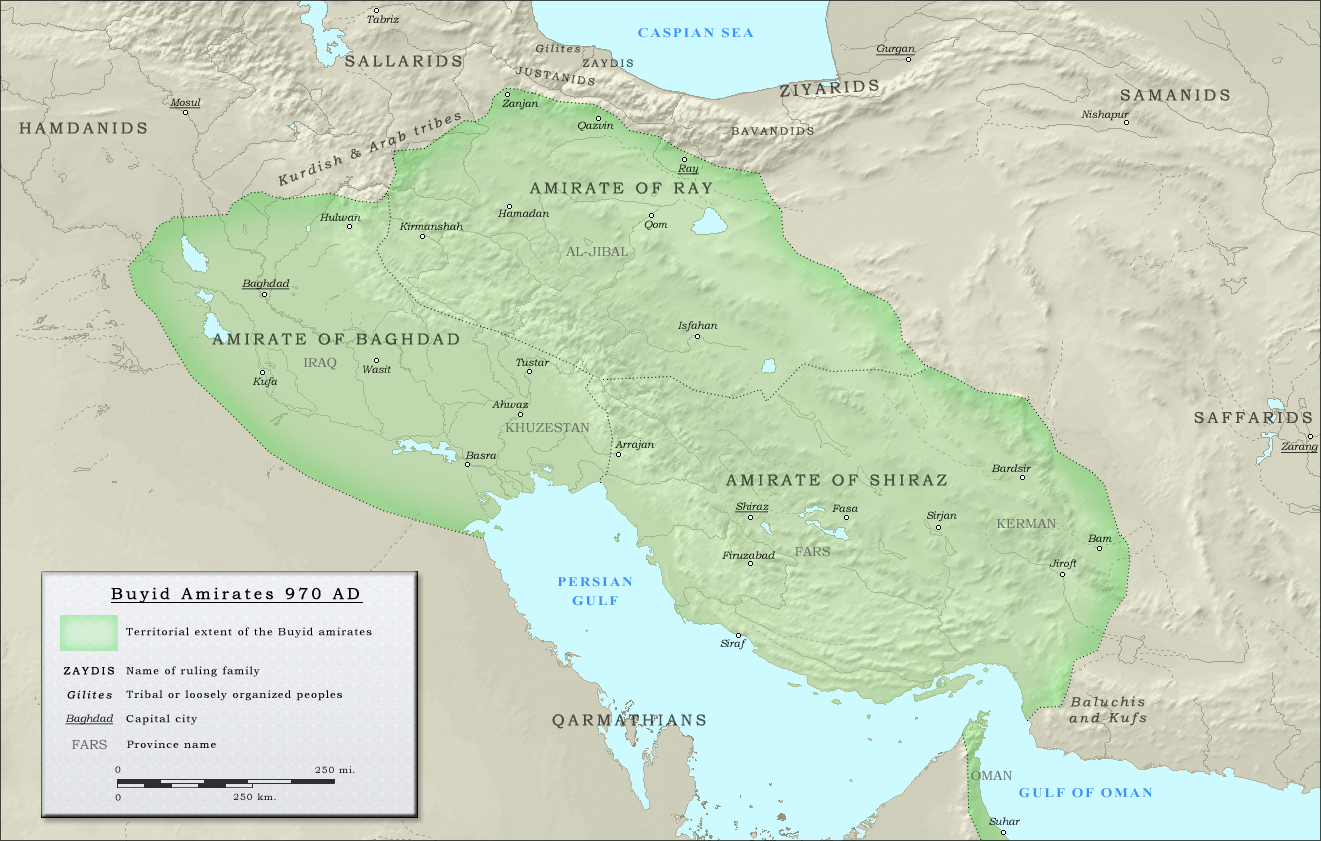
The Buyid dynasty was founded by Ali ibn Buya, who in 934 conquered Fars and made Shiraz his capital. He received the laqab or honorific title of Imad al-Dawla (lit. 'Fortifier of the State'). His younger brother, Hasan ibn Buya (r. 935–976) conquered parts of Jibal in the late 930s, and by 943 managed to capture Ray, which he made his capital. Hasan was given the laqab of Rukn al-Dawla (lit. 'Pillar of the State'). In 945, the youngest brother, Ahmad ibn Buya, conquered Iraq and made Baghdad his capital. He was given the laqab Mu'izz al-Dawla.
As Iranians of Daylamite provenance, the Buyids consciously revived symbols and practices of the Sasanian Empire. Beginning with Imad al-Dawla, some of the Buyid rulers used the ancient Sasanian title of Shahanshah, literally "king of kings". The Buyids had many inscriptions carved at the Achaemenid ruins of Persepolis, thus suggesting a form of veneration of the site, which the Buyids thought was built by the mythical Iranian king Jamshid.
The Buyid dynasty reached its zenith under Fannā Khusraw (r. 949–983), whose laqab was Adud al-Dawla. who is remembered for his open-mindedness and building projects such as the Band-e Amir dam near Shiraz. Under him, the Buyid realm stretched from the Byzantine border in Syria in the west to the borders of Khorasan in the east.
Although the Buyids were initially Zaydi Shia, they became Twelver Shia following the Major Occultation of Muhammad al-Mahdi after the death of his fourth agent in 941. Regardless, the Buyids were known for supporting the Sunni Abbasid caliphs and being tolerant of the Sunni population, who formed the majority of their realm. They were, by contrast, unfriendly towards the Fatimid Caliphate centered in Egypt, who were Isma'ilis.
Contrary to the Samanids, who ruled over a mostly Sunni Muslim population in Central Asia, the Buyid realm was populated by many Zoroastrians and Christians (primarily of the Church of the East). Because of this, many records written under the Buyids were composed in Middle Persian, Syriac and Arabic.
The word Būya (Buwayh in Arabic) is a Middle Persian name ending in the diminutive ـویه (Middle Persian -ōē, modern Persian -ūyeh, Arabic -uwayh). The Buyids were descendants of Panah-Khusrow, a Zoroastrian from Daylam. He had a son named Buya, who was a fisherman from Lahijan, and later left Zoroastrianism and converted to Islam. Buya later had three sons, named Ahmad, 'Ali, and Hasan, who would later carve out the Buyid kingdom together. The Buyids claimed royal lineage from Bahram V (r. 420–438), the King of Kings (shahanshah) of the Sasanian Empire.
The founder of the dynasty, 'Ali ibn Buya, was originally a soldier in the service of the Daylamite warlord Makan ibn Kaki, but later changed his allegiance to the Iranian ruler Mardavij, who had established the Ziyarid dynasty, and was himself related to the ruling dynasty of Gilan, a region bordering Daylam. 'Ali was later joined by his two younger brothers, Hasan ibn Buya and Ahmad ibn Buya. In 932, 'Ali was given Karaj as his fief, and thus was able to enlist other Daylamites into his army. However, 'Ali's initiative proved too much for Mardavij, who planned to have him killed, but 'Ali was informed of Mardavij's plan by the latter's own vizier. The brothers, with 400 of their Daylamite supporters, then fled to Fars, where they managed to take control of Arrajan. However, the Buyids and the Abbasid general Yaqut shortly fought for control of Fars, with the Buyids eventually emerging victorious. This victory opened the way for the conquest of the capital of Fars, Shiraz.
Buyid dynasty
The Buyid dynasty or Buyid Empire was a Zaydi and later Twelver Shi'a dynasty of Daylamite origin. Founded by Imad al-Dawla, they mainly ruled over central and southern Iran and Iraq from 934 to 1062. Coupled with the rise of other Iranian dynasties in the region, the approximate century of Buyid rule represents the period in Iranian history sometimes called the Iranian Intermezzo.
The Buyid dynasty was founded by Ali ibn Buya, who in 934 conquered Fars and made Shiraz his capital. He received the laqab or honorific title of Imad al-Dawla (lit. 'Fortifier of the State'). His younger brother, Hasan ibn Buya (r. 935–976) conquered parts of Jibal in the late 930s, and by 943 managed to capture Ray, which he made his capital. Hasan was given the laqab of Rukn al-Dawla (lit. 'Pillar of the State'). In 945, the youngest brother, Ahmad ibn Buya, conquered Iraq and made Baghdad his capital. He was given the laqab Mu'izz al-Dawla.
As Iranians of Daylamite provenance, the Buyids consciously revived symbols and practices of the Sasanian Empire. Beginning with Imad al-Dawla, some of the Buyid rulers used the ancient Sasanian title of Shahanshah, literally "king of kings". The Buyids had many inscriptions carved at the Achaemenid ruins of Persepolis, thus suggesting a form of veneration of the site, which the Buyids thought was built by the mythical Iranian king Jamshid.
The Buyid dynasty reached its zenith under Fannā Khusraw (r. 949–983), whose laqab was Adud al-Dawla. who is remembered for his open-mindedness and building projects such as the Band-e Amir dam near Shiraz. Under him, the Buyid realm stretched from the Byzantine border in Syria in the west to the borders of Khorasan in the east.
Although the Buyids were initially Zaydi Shia, they became Twelver Shia following the Major Occultation of Muhammad al-Mahdi after the death of his fourth agent in 941. Regardless, the Buyids were known for supporting the Sunni Abbasid caliphs and being tolerant of the Sunni population, who formed the majority of their realm. They were, by contrast, unfriendly towards the Fatimid Caliphate centered in Egypt, who were Isma'ilis.
Contrary to the Samanids, who ruled over a mostly Sunni Muslim population in Central Asia, the Buyid realm was populated by many Zoroastrians and Christians (primarily of the Church of the East). Because of this, many records written under the Buyids were composed in Middle Persian, Syriac and Arabic.
The word Būya (Buwayh in Arabic) is a Middle Persian name ending in the diminutive ـویه (Middle Persian -ōē, modern Persian -ūyeh, Arabic -uwayh). The Buyids were descendants of Panah-Khusrow, a Zoroastrian from Daylam. He had a son named Buya, who was a fisherman from Lahijan, and later left Zoroastrianism and converted to Islam. Buya later had three sons, named Ahmad, 'Ali, and Hasan, who would later carve out the Buyid kingdom together. The Buyids claimed royal lineage from Bahram V (r. 420–438), the King of Kings (shahanshah) of the Sasanian Empire.
The founder of the dynasty, 'Ali ibn Buya, was originally a soldier in the service of the Daylamite warlord Makan ibn Kaki, but later changed his allegiance to the Iranian ruler Mardavij, who had established the Ziyarid dynasty, and was himself related to the ruling dynasty of Gilan, a region bordering Daylam. 'Ali was later joined by his two younger brothers, Hasan ibn Buya and Ahmad ibn Buya. In 932, 'Ali was given Karaj as his fief, and thus was able to enlist other Daylamites into his army. However, 'Ali's initiative proved too much for Mardavij, who planned to have him killed, but 'Ali was informed of Mardavij's plan by the latter's own vizier. The brothers, with 400 of their Daylamite supporters, then fled to Fars, where they managed to take control of Arrajan. However, the Buyids and the Abbasid general Yaqut shortly fought for control of Fars, with the Buyids eventually emerging victorious. This victory opened the way for the conquest of the capital of Fars, Shiraz.
Recent media
Recent media