



Community hub
Recent from talks
Knowledge base stats:
Talk channels stats:
Members stats:
Byeonhan confederacy
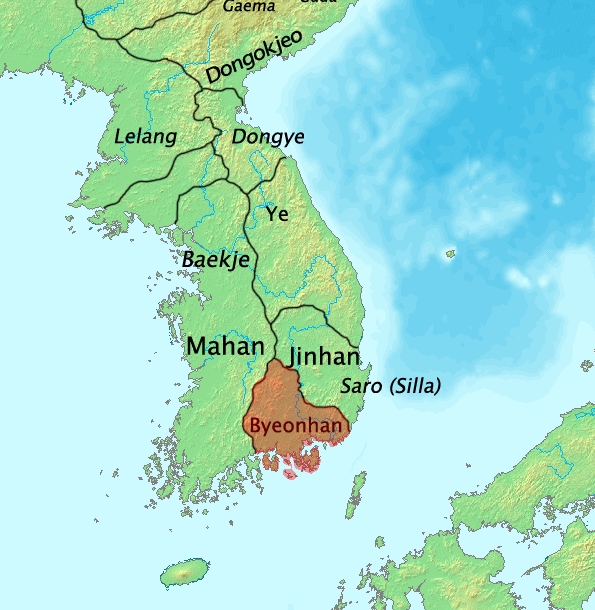
Byeonhan (Korean: 변한; Hanja: 弁韓; pronounced [pjʌn.ɦan]), also known as Byeonjin (변진; 弁辰; [pjʌn.dʑin]), was a loose confederacy of chiefdoms that existed from around the beginning of the Common Era to the 4th century in the southern Korean peninsula. Byeonhan was one of the Samhan (or "Three Hans"), along with Mahan and Jinhan.
Byeonhan (弁韓) is believed to be a combination of Old Korean words. Byeon (변) in native Korean meant "Shiny/Shimmering" while han (한) meant "big", giving the meaning of Byeonhan, the "Big Nation of Shimmering".
As part of the Samhan, Jinhan meant "Big Nation of the East" and Mahan meant "Big Nation of the South".
This early part of the Three Kingdoms period is sometimes called the Proto–Three Kingdoms period. Byeonhan, like the other Samhan confederacies, appears to be descended from the Jin state of southern Korea.
Archaeological evidence indicates an increase in military activity and weapons production among the Byeonhan in the 3rd century, especially an increase in iron arrowheads and cuirasses (Barnes 2000). This may be associated with the decline of Byeonhan and the rise of the more centralized Gaya confederacy, which most Byeonhan states joined. Gaya was subsequently annexed by Silla, one of the Three Kingdoms of Korea.
Various cultural aspects supposedly unique to Byeonhan overlap with Jinhan, but are not universal in Byeonhan. One notable tradition was tattooing, which was done by both men and women. Another tradition was the burying of feathers and pottery in graves alongside the dead body as it was believed that the feathers helped the afterlife souls fly into the sky.
Byeonhan as a political grouping was also sometimes referred to by a calque of Byeon (弁) and Jin (辰) as Byeonjin with the ethnonym Han (韓) being used by its inhabitants, identical to that of its neighbours.
There are also two hypotheses about the Byeonhan constituting a separate ethnicity distinct from the Jinhan:
Hub AI
Byeonhan confederacy AI simulator
(@Byeonhan confederacy_simulator)
Byeonhan confederacy
Byeonhan (Korean: 변한; Hanja: 弁韓; pronounced [pjʌn.ɦan]), also known as Byeonjin (변진; 弁辰; [pjʌn.dʑin]), was a loose confederacy of chiefdoms that existed from around the beginning of the Common Era to the 4th century in the southern Korean peninsula. Byeonhan was one of the Samhan (or "Three Hans"), along with Mahan and Jinhan.
Byeonhan (弁韓) is believed to be a combination of Old Korean words. Byeon (변) in native Korean meant "Shiny/Shimmering" while han (한) meant "big", giving the meaning of Byeonhan, the "Big Nation of Shimmering".
As part of the Samhan, Jinhan meant "Big Nation of the East" and Mahan meant "Big Nation of the South".
This early part of the Three Kingdoms period is sometimes called the Proto–Three Kingdoms period. Byeonhan, like the other Samhan confederacies, appears to be descended from the Jin state of southern Korea.
Archaeological evidence indicates an increase in military activity and weapons production among the Byeonhan in the 3rd century, especially an increase in iron arrowheads and cuirasses (Barnes 2000). This may be associated with the decline of Byeonhan and the rise of the more centralized Gaya confederacy, which most Byeonhan states joined. Gaya was subsequently annexed by Silla, one of the Three Kingdoms of Korea.
Various cultural aspects supposedly unique to Byeonhan overlap with Jinhan, but are not universal in Byeonhan. One notable tradition was tattooing, which was done by both men and women. Another tradition was the burying of feathers and pottery in graves alongside the dead body as it was believed that the feathers helped the afterlife souls fly into the sky.
Byeonhan as a political grouping was also sometimes referred to by a calque of Byeon (弁) and Jin (辰) as Byeonjin with the ethnonym Han (韓) being used by its inhabitants, identical to that of its neighbours.
There are also two hypotheses about the Byeonhan constituting a separate ethnicity distinct from the Jinhan: