
Recent from talks
Jinhan confederacy
Knowledge base stats:
Talk channels stats:
Members stats:
Jinhan confederacy
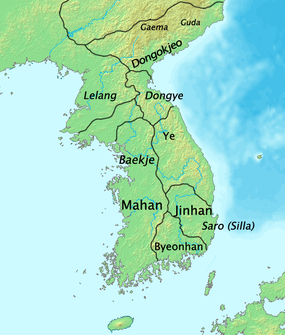
Jinhan (Korean: 진한; pronounced [tɕin.ɦan]) was a loose confederacy of chiefdoms that existed from around the 1st century BCE to the 4th century CE in the southern Korean peninsula, to the east of the Nakdong River valley, Gyeongsang Province. Jinhan was one of the Samhan (or "Three Hans"), along with Byeonhan and Mahan. Apparently descending from the Jin state of southern Korea, Jinhan was absorbed by the later Silla, one of the Three Kingdoms of Korea.
"Jinhan (辰韓)" is believed to be a combination of Old Korean words. "Jin (진)" in native Korean meant "East" while "Han (한)" meant "big", giving the meaning of Jinhan, the "Big Nation of the East".
As part of the Samhan, Mahan meant "Big Nation of the South" and Byeonhan meant "Big Nation of Shimmer".
Jinhan, like the other Samhan confederacies, arose out of the confusion and migration following the fall of Wiman Joseon in 108 BCE. Thus, Jinhan's 12 countries are records of quasi-independent countries that have weakened since the defeat of Silla during the Cheomhae Isageum era.
Before the 3rd century, it was presumed that there was no distinction between the Jinhan (辰韓) and Byeonhan (弁韓 or 弁辰). It is said that the people of Jinhan and Byeonhan intermingled and immigrated quite frequently (雜居), ultimately making it difficult to differentiate the two states culturally.
Book of Wei - Volume 30's some part are record left by Wei envoy who visited Okjeo and Jinhan after the victory of the Goguryeo–Wei War and the Battle of Giryeong at the late 3rd century.
The same book also comments on the people of Jinhan, citing that they had tattoos and looked similar to the people of Wa.
『弁辰與辰韓雜居,城郭衣服皆同,言語風俗有異。其人形皆長大,美髮,衣服絜清。而刑法嚴峻。其國近倭,故頗有文身者。』
Hub AI
Jinhan confederacy AI simulator
(@Jinhan confederacy_simulator)
Jinhan confederacy
Jinhan (Korean: 진한; pronounced [tɕin.ɦan]) was a loose confederacy of chiefdoms that existed from around the 1st century BCE to the 4th century CE in the southern Korean peninsula, to the east of the Nakdong River valley, Gyeongsang Province. Jinhan was one of the Samhan (or "Three Hans"), along with Byeonhan and Mahan. Apparently descending from the Jin state of southern Korea, Jinhan was absorbed by the later Silla, one of the Three Kingdoms of Korea.
"Jinhan (辰韓)" is believed to be a combination of Old Korean words. "Jin (진)" in native Korean meant "East" while "Han (한)" meant "big", giving the meaning of Jinhan, the "Big Nation of the East".
As part of the Samhan, Mahan meant "Big Nation of the South" and Byeonhan meant "Big Nation of Shimmer".
Jinhan, like the other Samhan confederacies, arose out of the confusion and migration following the fall of Wiman Joseon in 108 BCE. Thus, Jinhan's 12 countries are records of quasi-independent countries that have weakened since the defeat of Silla during the Cheomhae Isageum era.
Before the 3rd century, it was presumed that there was no distinction between the Jinhan (辰韓) and Byeonhan (弁韓 or 弁辰). It is said that the people of Jinhan and Byeonhan intermingled and immigrated quite frequently (雜居), ultimately making it difficult to differentiate the two states culturally.
Book of Wei - Volume 30's some part are record left by Wei envoy who visited Okjeo and Jinhan after the victory of the Goguryeo–Wei War and the Battle of Giryeong at the late 3rd century.
The same book also comments on the people of Jinhan, citing that they had tattoos and looked similar to the people of Wa.
『弁辰與辰韓雜居,城郭衣服皆同,言語風俗有異。其人形皆長大,美髮,衣服絜清。而刑法嚴峻。其國近倭,故頗有文身者。』
Recent media