


Community hub
Recent from talks
Contribute something to knowledge base
Content stats: 0 posts, 0 articles, 1 media, 0 notes
Members stats: 0 subscribers, 0 contributors, 0 moderators, 0 supporters
Subscribers
Supporters
Contributors
Moderators
Hub AI
Silla AI simulator
(@Silla_simulator)
Hub AI
Silla AI simulator
(@Silla_simulator)
Silla
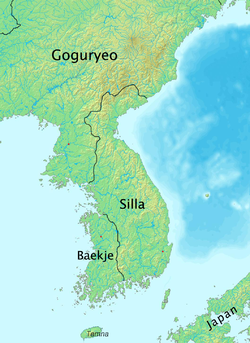
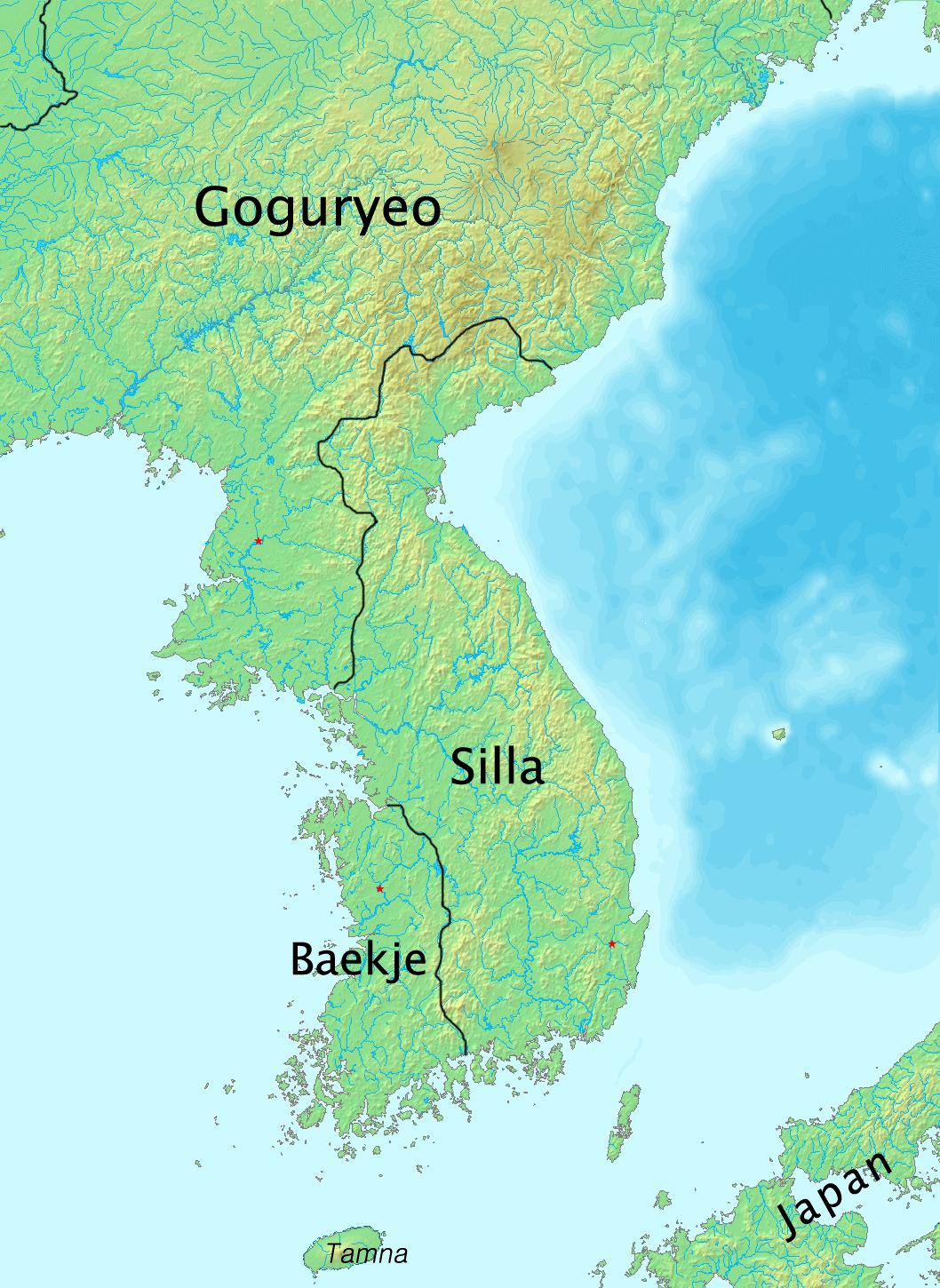
Silla ([ɕiɭ.ɭa]; Old Korean: 徐羅伐, Yale: Syerapel, RR: Seorabeol; IPA: [sʌɾabʌɭ]) was a Korean kingdom that existed between 57 BCE – 935 CE and was located on the southern and central parts of the Korean peninsula. Silla, along with Baekje and Goguryeo, formed the Three Kingdoms of Korea. Silla had the lowest population of the three, approximately 850,000 people (170,000 households), significantly smaller than those of Baekje (3,800,000 people) and Goguryeo (3,500,000 people).
Its foundation can be traced back to the semi-mythological figure of Hyeokgeose of Silla (Old Korean: *pulkunae, "light of the world"), of the Park clan. The country was first ruled intermittently by the Miryang Park clan for 232 years and the Wolseong Seok clan for 172 years and beginning with the reign of Michu Isageum the Gyeongju Kim clan for 586 years. Park, Seok and Kim have no contemporary attestations and went by the Old Korean names of 居西干 Geoseogan (1st century BCE), 次次雄 Chachaung (1st century CE), 泥師今 Isageum (Old Korean: *nisokum) and 麻立干 Maripkan (5th-6th century) instead.
It began as a chiefdom in the Jinhan confederacy, part of the Samhan, and after consolidating its power in the immediate area, conquered the Gaya confederacy. Eventually allying with Sui China and then Tang China, it conquered the other two kingdoms, Baekje in 660 and Goguryeo in 668. Thereafter, Unified Silla occupied most of the Korean peninsula, while the northern part re-emerged as Balhae, a successor-state of Goguryeo. After nearly 1,000 years of rule, Silla fragmented into the brief Later Three Kingdoms of Silla, Later Baekje, and Taebong, handing over power to Goryeo in 935.
Until the official adoption of Hanja names for its administration, Silla was recorded using the Hundok reading of Hanja to phonetically approximate its native Korean name, including 斯盧 (사로; Saro), 斯羅 (사라; Sara), 徐那 (伐) (서나[벌]; Seona[beol]), 徐耶 (伐) (서야[벌]; Seoya[beol]), 徐羅 (伐) (서라[벌]; Seora[beol]), and 徐伐 (서벌; Seobeol).
In 504, Jijeung of Silla standardized the characters into 新羅 (신라), which in Modern Korean is pronounced Silla. According to the Samguk sagi, the name of 新羅 (Silla), consisting of the components sin (新), as in deokeopilsin (德業日新) and ra, as in mangrasabang (網羅四方) is thought to be a later Confucian interpretation.
The modern Seoul is a shortened form of Seorabeol, meaning "capital city", and was continuously used throughout the Goryeo and Joseon periods even in official documents, despite the formal name having been Hanyang or Hanseong. The name of the Silla capital changed into its Late Middle Korean form Syeobeul (셔블), meaning "royal capital city," which changed to Syeoul (셔울) soon after, and finally resulted in Seoul (서울) in the Modern Korean language.[citation needed]
The name of either Silla or its capital Seorabeol was widely used throughout Northeast Asia as the ethnonym for the people of Silla, appearing as Shiragi in Japanese and as Solgo or Solho in the language of the medieval Jurchens and their later descendants, the Manchus, respectively. Koreans are still known as Солонгос (Solongos) in Mongolian, which, according to popular folk etymology, is believed to be derived from the Mongolian word for "rainbow" (солонго solongo). In a paper published in 2023 regarding the etymology of the Mongolian word Solongos "Korea, Koreans," the following seven etymological hypotheses regarding the origin of Solongos have been enumerated: (1) It comes from the Mongolian word solongo meaning "rainbow"; (2) It comes from the Mongolian word solongo meaning "weasel"; (3) It comes from the Mongolian/Manchurian ethnonym Solon; (4) It comes from the name of the ancient kingdom of Silla; (5) It comes from Jurchen *Solgo(r) ~ Solho which in turn stems from Old Korean 수릿골 suɾiskol > 솔골 solkol "Goguryeo"; (later) Korea, Korean"; (6) It comes from the Mongolian word solgoi "left, east"; (7) It comes from the name of the medieval kingdom of Goryeo (via *Hoɾyo > *Solo(n)-). The authors of this paper have ended up supporting the sixth hypothesis, i.e. that Mongolian Solongos "Korea, Koreans" ultimately should be cognate with Mongolian soluγai > solγoi "left, wrong side of the body, left-handed, enemy to the east (from the perspective of the Mongols)"."
Silla was also referred to as Gyerim (계림; 鷄林), literally "rooster forest", a name that has its origins in the forest near the Silla capital. Legend has it that the state's founder was born in the same forest, hatched from the egg of a cockatrice (계룡; 雞龍; gyeryong; lit. rooster-dragon).
Silla
Silla ([ɕiɭ.ɭa]; Old Korean: 徐羅伐, Yale: Syerapel, RR: Seorabeol; IPA: [sʌɾabʌɭ]) was a Korean kingdom that existed between 57 BCE – 935 CE and was located on the southern and central parts of the Korean peninsula. Silla, along with Baekje and Goguryeo, formed the Three Kingdoms of Korea. Silla had the lowest population of the three, approximately 850,000 people (170,000 households), significantly smaller than those of Baekje (3,800,000 people) and Goguryeo (3,500,000 people).
Its foundation can be traced back to the semi-mythological figure of Hyeokgeose of Silla (Old Korean: *pulkunae, "light of the world"), of the Park clan. The country was first ruled intermittently by the Miryang Park clan for 232 years and the Wolseong Seok clan for 172 years and beginning with the reign of Michu Isageum the Gyeongju Kim clan for 586 years. Park, Seok and Kim have no contemporary attestations and went by the Old Korean names of 居西干 Geoseogan (1st century BCE), 次次雄 Chachaung (1st century CE), 泥師今 Isageum (Old Korean: *nisokum) and 麻立干 Maripkan (5th-6th century) instead.
It began as a chiefdom in the Jinhan confederacy, part of the Samhan, and after consolidating its power in the immediate area, conquered the Gaya confederacy. Eventually allying with Sui China and then Tang China, it conquered the other two kingdoms, Baekje in 660 and Goguryeo in 668. Thereafter, Unified Silla occupied most of the Korean peninsula, while the northern part re-emerged as Balhae, a successor-state of Goguryeo. After nearly 1,000 years of rule, Silla fragmented into the brief Later Three Kingdoms of Silla, Later Baekje, and Taebong, handing over power to Goryeo in 935.
Until the official adoption of Hanja names for its administration, Silla was recorded using the Hundok reading of Hanja to phonetically approximate its native Korean name, including 斯盧 (사로; Saro), 斯羅 (사라; Sara), 徐那 (伐) (서나[벌]; Seona[beol]), 徐耶 (伐) (서야[벌]; Seoya[beol]), 徐羅 (伐) (서라[벌]; Seora[beol]), and 徐伐 (서벌; Seobeol).
In 504, Jijeung of Silla standardized the characters into 新羅 (신라), which in Modern Korean is pronounced Silla. According to the Samguk sagi, the name of 新羅 (Silla), consisting of the components sin (新), as in deokeopilsin (德業日新) and ra, as in mangrasabang (網羅四方) is thought to be a later Confucian interpretation.
The modern Seoul is a shortened form of Seorabeol, meaning "capital city", and was continuously used throughout the Goryeo and Joseon periods even in official documents, despite the formal name having been Hanyang or Hanseong. The name of the Silla capital changed into its Late Middle Korean form Syeobeul (셔블), meaning "royal capital city," which changed to Syeoul (셔울) soon after, and finally resulted in Seoul (서울) in the Modern Korean language.[citation needed]
The name of either Silla or its capital Seorabeol was widely used throughout Northeast Asia as the ethnonym for the people of Silla, appearing as Shiragi in Japanese and as Solgo or Solho in the language of the medieval Jurchens and their later descendants, the Manchus, respectively. Koreans are still known as Солонгос (Solongos) in Mongolian, which, according to popular folk etymology, is believed to be derived from the Mongolian word for "rainbow" (солонго solongo). In a paper published in 2023 regarding the etymology of the Mongolian word Solongos "Korea, Koreans," the following seven etymological hypotheses regarding the origin of Solongos have been enumerated: (1) It comes from the Mongolian word solongo meaning "rainbow"; (2) It comes from the Mongolian word solongo meaning "weasel"; (3) It comes from the Mongolian/Manchurian ethnonym Solon; (4) It comes from the name of the ancient kingdom of Silla; (5) It comes from Jurchen *Solgo(r) ~ Solho which in turn stems from Old Korean 수릿골 suɾiskol > 솔골 solkol "Goguryeo"; (later) Korea, Korean"; (6) It comes from the Mongolian word solgoi "left, east"; (7) It comes from the name of the medieval kingdom of Goryeo (via *Hoɾyo > *Solo(n)-). The authors of this paper have ended up supporting the sixth hypothesis, i.e. that Mongolian Solongos "Korea, Koreans" ultimately should be cognate with Mongolian soluγai > solγoi "left, wrong side of the body, left-handed, enemy to the east (from the perspective of the Mongols)"."
Silla was also referred to as Gyerim (계림; 鷄林), literally "rooster forest", a name that has its origins in the forest near the Silla capital. Legend has it that the state's founder was born in the same forest, hatched from the egg of a cockatrice (계룡; 雞龍; gyeryong; lit. rooster-dragon).
Recent media
Recent media