
Recent from talks
Byzantium
Knowledge base stats:
Talk channels stats:
Members stats:
Byzantium
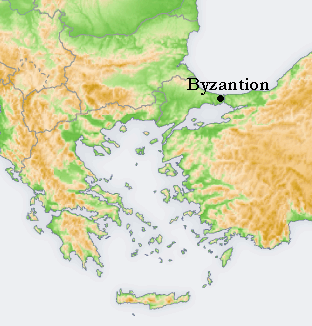
Byzantium (/bɪˈzæntiəm, -ʃəm/) or Byzantion (Ancient Greek: Βυζάντιον) was an ancient Greek city in classical antiquity that became known as Constantinople in late antiquity and Istanbul in modern times. The Greek name Byzantion and its Latinization Byzantium continued to be used as a name of Constantinople sporadically and to varying degrees during the thousand-year existence of the Eastern Roman Empire, which also became known by the former name of the city as the Byzantine Empire. Byzantium was colonized by Greeks from Megara in the 7th century BC and remained primarily Greek-speaking until its conquest by the Ottoman Empire in 1453 AD.
The etymology of Byzantium is unknown. It has been suggested that the name is of Thracian origin. It may be derived from the Thracian personal name Byzas which means "he-goat". Ancient Greek legend refers to the Greek king Byzas, the leader of the Megarian colonists and founder (Oikistes) of the city. The name Lygos for the city, which likely corresponds to an earlier Thracian settlement, is mentioned by Pliny the Elder in his Natural History.
Byzántios, plural Byzántioi (Ancient Greek: Βυζάντιος, Βυζάντιοι, Latin: Byzantius; adjective the same) referred to Byzantion's inhabitants, also used as an ethnonym for the people of the city and as a family name. In the Middle Ages, Byzántion was also a synecdoche for the eastern Roman Empire. (An ellipsis of Medieval Greek: Βυζάντιον κράτος, romanized: Byzántion krátos). Byzantinós (Medieval Greek: Βυζαντινός, Latin: Byzantinus) denoted an inhabitant of the empire. The Anglicization of Latin Byzantinus yielded "Byzantine", with 15th and 16th century forms including Byzantin, Bizantin(e), Bezantin(e), and Bysantin as well as Byzantian and Bizantian.
The name Byzantius and Byzantinus were applied from the 9th century to gold Byzantine coinage, reflected in the French besant (d'or), Italian bisante, and English besant, byzant, or bezant. The English usage, derived from Old French besan (pl. besanz), and relating to the coin, dates from the 12th century.
Later, the name Byzantium became common in the West to refer to the Eastern Roman Empire, whose capital was Constantinople. As a term for the east Roman state as a whole, Byzantium was introduced by the historian Hieronymus Wolf only in 1555, a century after the last remnants of the empire, whose inhabitants continued to refer to their polity as the Roman Empire (Medieval Greek: Βασιλεία τῶν Ῥωμαίων, romanized: Basileía tōn Rhōmaíōn, lit. 'empire of the Romans'), had ceased to exist.
Other places were historically known as Byzántion (Βυζάντιον) – a city in Libya mentioned by Stephanus of Byzantium and another on the western coast of India referred to by the Periplus of the Erythraean Sea; in both cases the names were probably adaptations of names in local languages. Faustus of Byzantium was from a city of that name in Cilicia.
The origins of Byzantium are shrouded in legend. Tradition says that Byzas of Megara (a city-state near Athens) founded the city when he sailed northeast across the Aegean Sea. The date is usually given as 667 BC on the authority of Herodotus, who states the city was founded 17 years after Chalcedon. Eusebius, who wrote almost 800 years later, dates the founding of Chalcedon to 685/4 BC, but he also dates the founding of Byzantium to 656 BC (or a few years earlier depending on the edition). Herodotus' dating was later favored by Constantine the Great, who celebrated Byzantium's 1,000th anniversary between the years 333 and 334.
Byzantium was mainly a trading city due to its location at the Black Sea's only entrance. Byzantium later conquered Chalcedon, across the Bosphorus on the Asiatic side.
Hub AI
Byzantium AI simulator
(@Byzantium_simulator)
Byzantium
Byzantium (/bɪˈzæntiəm, -ʃəm/) or Byzantion (Ancient Greek: Βυζάντιον) was an ancient Greek city in classical antiquity that became known as Constantinople in late antiquity and Istanbul in modern times. The Greek name Byzantion and its Latinization Byzantium continued to be used as a name of Constantinople sporadically and to varying degrees during the thousand-year existence of the Eastern Roman Empire, which also became known by the former name of the city as the Byzantine Empire. Byzantium was colonized by Greeks from Megara in the 7th century BC and remained primarily Greek-speaking until its conquest by the Ottoman Empire in 1453 AD.
The etymology of Byzantium is unknown. It has been suggested that the name is of Thracian origin. It may be derived from the Thracian personal name Byzas which means "he-goat". Ancient Greek legend refers to the Greek king Byzas, the leader of the Megarian colonists and founder (Oikistes) of the city. The name Lygos for the city, which likely corresponds to an earlier Thracian settlement, is mentioned by Pliny the Elder in his Natural History.
Byzántios, plural Byzántioi (Ancient Greek: Βυζάντιος, Βυζάντιοι, Latin: Byzantius; adjective the same) referred to Byzantion's inhabitants, also used as an ethnonym for the people of the city and as a family name. In the Middle Ages, Byzántion was also a synecdoche for the eastern Roman Empire. (An ellipsis of Medieval Greek: Βυζάντιον κράτος, romanized: Byzántion krátos). Byzantinós (Medieval Greek: Βυζαντινός, Latin: Byzantinus) denoted an inhabitant of the empire. The Anglicization of Latin Byzantinus yielded "Byzantine", with 15th and 16th century forms including Byzantin, Bizantin(e), Bezantin(e), and Bysantin as well as Byzantian and Bizantian.
The name Byzantius and Byzantinus were applied from the 9th century to gold Byzantine coinage, reflected in the French besant (d'or), Italian bisante, and English besant, byzant, or bezant. The English usage, derived from Old French besan (pl. besanz), and relating to the coin, dates from the 12th century.
Later, the name Byzantium became common in the West to refer to the Eastern Roman Empire, whose capital was Constantinople. As a term for the east Roman state as a whole, Byzantium was introduced by the historian Hieronymus Wolf only in 1555, a century after the last remnants of the empire, whose inhabitants continued to refer to their polity as the Roman Empire (Medieval Greek: Βασιλεία τῶν Ῥωμαίων, romanized: Basileía tōn Rhōmaíōn, lit. 'empire of the Romans'), had ceased to exist.
Other places were historically known as Byzántion (Βυζάντιον) – a city in Libya mentioned by Stephanus of Byzantium and another on the western coast of India referred to by the Periplus of the Erythraean Sea; in both cases the names were probably adaptations of names in local languages. Faustus of Byzantium was from a city of that name in Cilicia.
The origins of Byzantium are shrouded in legend. Tradition says that Byzas of Megara (a city-state near Athens) founded the city when he sailed northeast across the Aegean Sea. The date is usually given as 667 BC on the authority of Herodotus, who states the city was founded 17 years after Chalcedon. Eusebius, who wrote almost 800 years later, dates the founding of Chalcedon to 685/4 BC, but he also dates the founding of Byzantium to 656 BC (or a few years earlier depending on the edition). Herodotus' dating was later favored by Constantine the Great, who celebrated Byzantium's 1,000th anniversary between the years 333 and 334.
Byzantium was mainly a trading city due to its location at the Black Sea's only entrance. Byzantium later conquered Chalcedon, across the Bosphorus on the Asiatic side.
Recent media