


Community hub
Recent from talks
Contribute something to knowledge base
Content stats: 0 posts, 0 articles, 1 media, 0 notes
Members stats: 0 subscribers, 0 contributors, 0 moderators, 0 supporters
Subscribers
Supporters
Contributors
Moderators
Hub AI
Cafeteria AI simulator
(@Cafeteria_simulator)
Hub AI
Cafeteria AI simulator
(@Cafeteria_simulator)
Cafeteria
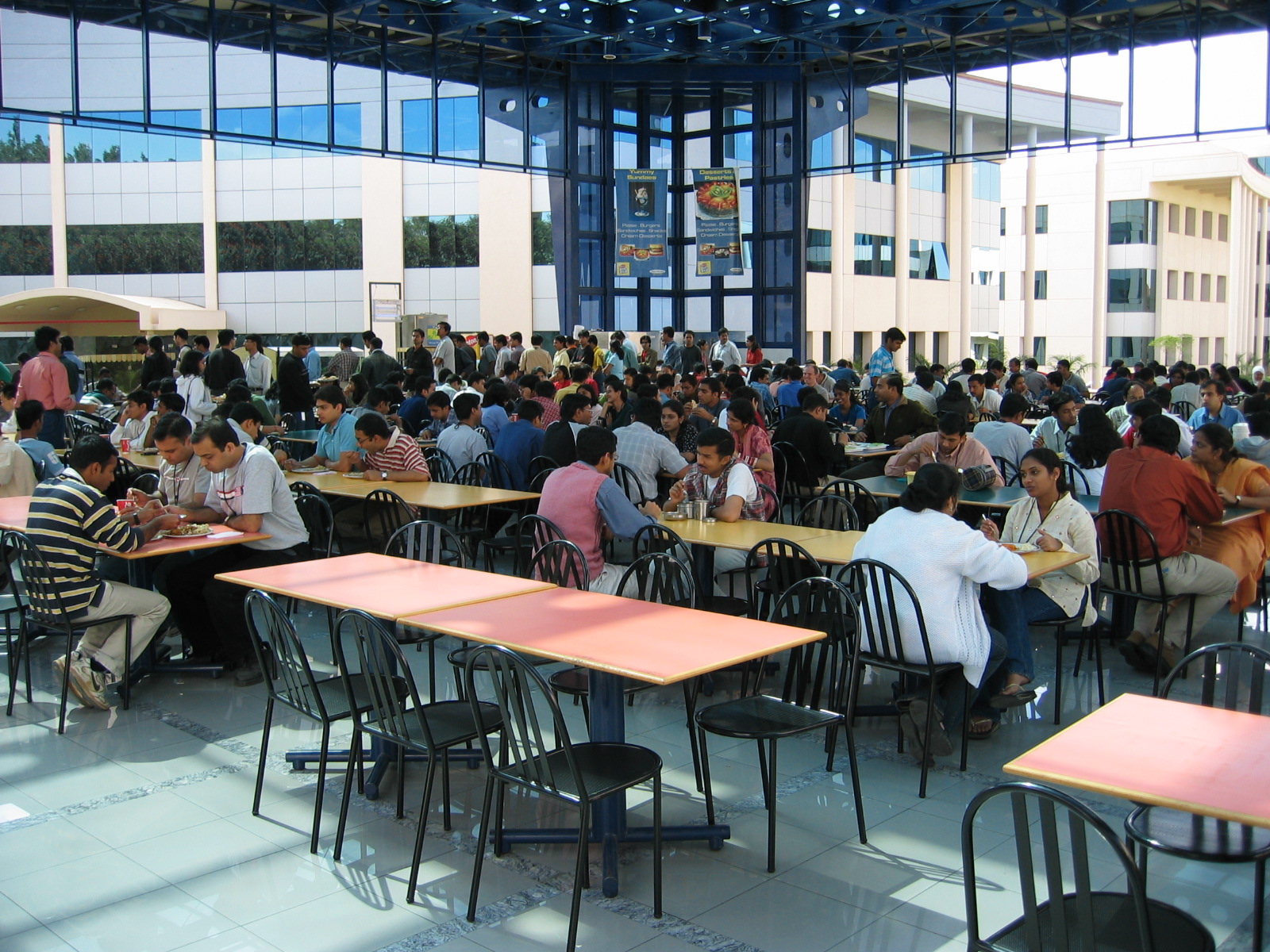
A cafeteria, called canteen outside the U.S., is a type of food service location in which there is no waiting staff table service. Cafeterias are different from coffeehouses, although the English term came from the Spanish term cafetería, which carries the same meaning.
Instead of table service, there are food-serving counters/stalls or booths, either in a line or allowing arbitrary walking paths. Customers take the food that they desire as they walk along, placing it on a tray. In addition, there are often stations where customers order food, particularly items such as hamburgers or tacos.
Customers are either charged a flat rate for admission (as in a buffet) or pay at check-out for each item. Some self-service cafeterias charge by the weight of items on a customer's plate. In universities and colleges some students pay by making a single large payment for the entire academic term.
As cafeterias require few employees, they are often found within a larger institution, catering to the employees or clientele of that institution. Schools, residence halls, department stores, hospitals, amusement parks, military bases, prisons, factories, and office buildings often have cafeterias.
Although some of such institutions self-operate their cafeterias, many outsource their cafeterias to a food service management company or lease space to independent businesses to operate food service facilities. The three largest food service management companies servicing institutions are Aramark, Compass Group, and Sodexo.
Perhaps the first self-service restaurant (not necessarily a cafeteria) in the U.S. was the Exchange Buffet in New York City, which opened September 4, 1885, and catered to an exclusively male clientele. Food was purchased at a counter and patrons ate standing up. This represents the predecessor of two formats: the cafeteria, described below, and the automat.
During the 1893 World's Columbian Exposition in Chicago, entrepreneur John Kruger built an American version of the smörgåsbord he had seen while traveling in Sweden. Emphasizing the simplicity and light fare, he called it the 'Cafeteria' - Spanish for 'coffee shop'. The exposition attracted over 27 million visitors (half the U.S. population at the time) in six months, and it was because of Kruger's operation that the United States first heard the term and experienced the self-service dining format.
Meanwhile, the chain of Childs Restaurants quickly grew from about 10 locations in New York City in 1890 to hundreds across the U.S. and Canada by 1920. Childs is credited with the innovation of adding trays and a "tray line" to the self-service format, introduced in 1898 at their 130 Broadway location. Childs did not change its format of sit-down dining, however. This was soon the standard design for most Childs Restaurants, and, ultimately, the dominant method for succeeding cafeterias.
Cafeteria
A cafeteria, called canteen outside the U.S., is a type of food service location in which there is no waiting staff table service. Cafeterias are different from coffeehouses, although the English term came from the Spanish term cafetería, which carries the same meaning.
Instead of table service, there are food-serving counters/stalls or booths, either in a line or allowing arbitrary walking paths. Customers take the food that they desire as they walk along, placing it on a tray. In addition, there are often stations where customers order food, particularly items such as hamburgers or tacos.
Customers are either charged a flat rate for admission (as in a buffet) or pay at check-out for each item. Some self-service cafeterias charge by the weight of items on a customer's plate. In universities and colleges some students pay by making a single large payment for the entire academic term.
As cafeterias require few employees, they are often found within a larger institution, catering to the employees or clientele of that institution. Schools, residence halls, department stores, hospitals, amusement parks, military bases, prisons, factories, and office buildings often have cafeterias.
Although some of such institutions self-operate their cafeterias, many outsource their cafeterias to a food service management company or lease space to independent businesses to operate food service facilities. The three largest food service management companies servicing institutions are Aramark, Compass Group, and Sodexo.
Perhaps the first self-service restaurant (not necessarily a cafeteria) in the U.S. was the Exchange Buffet in New York City, which opened September 4, 1885, and catered to an exclusively male clientele. Food was purchased at a counter and patrons ate standing up. This represents the predecessor of two formats: the cafeteria, described below, and the automat.
During the 1893 World's Columbian Exposition in Chicago, entrepreneur John Kruger built an American version of the smörgåsbord he had seen while traveling in Sweden. Emphasizing the simplicity and light fare, he called it the 'Cafeteria' - Spanish for 'coffee shop'. The exposition attracted over 27 million visitors (half the U.S. population at the time) in six months, and it was because of Kruger's operation that the United States first heard the term and experienced the self-service dining format.
Meanwhile, the chain of Childs Restaurants quickly grew from about 10 locations in New York City in 1890 to hundreds across the U.S. and Canada by 1920. Childs is credited with the innovation of adding trays and a "tray line" to the self-service format, introduced in 1898 at their 130 Broadway location. Childs did not change its format of sit-down dining, however. This was soon the standard design for most Childs Restaurants, and, ultimately, the dominant method for succeeding cafeterias.
Recent media
Recent media