



Community hub
Recent from talks
Knowledge base stats:
Talk channels stats:
Members stats:
Cairn
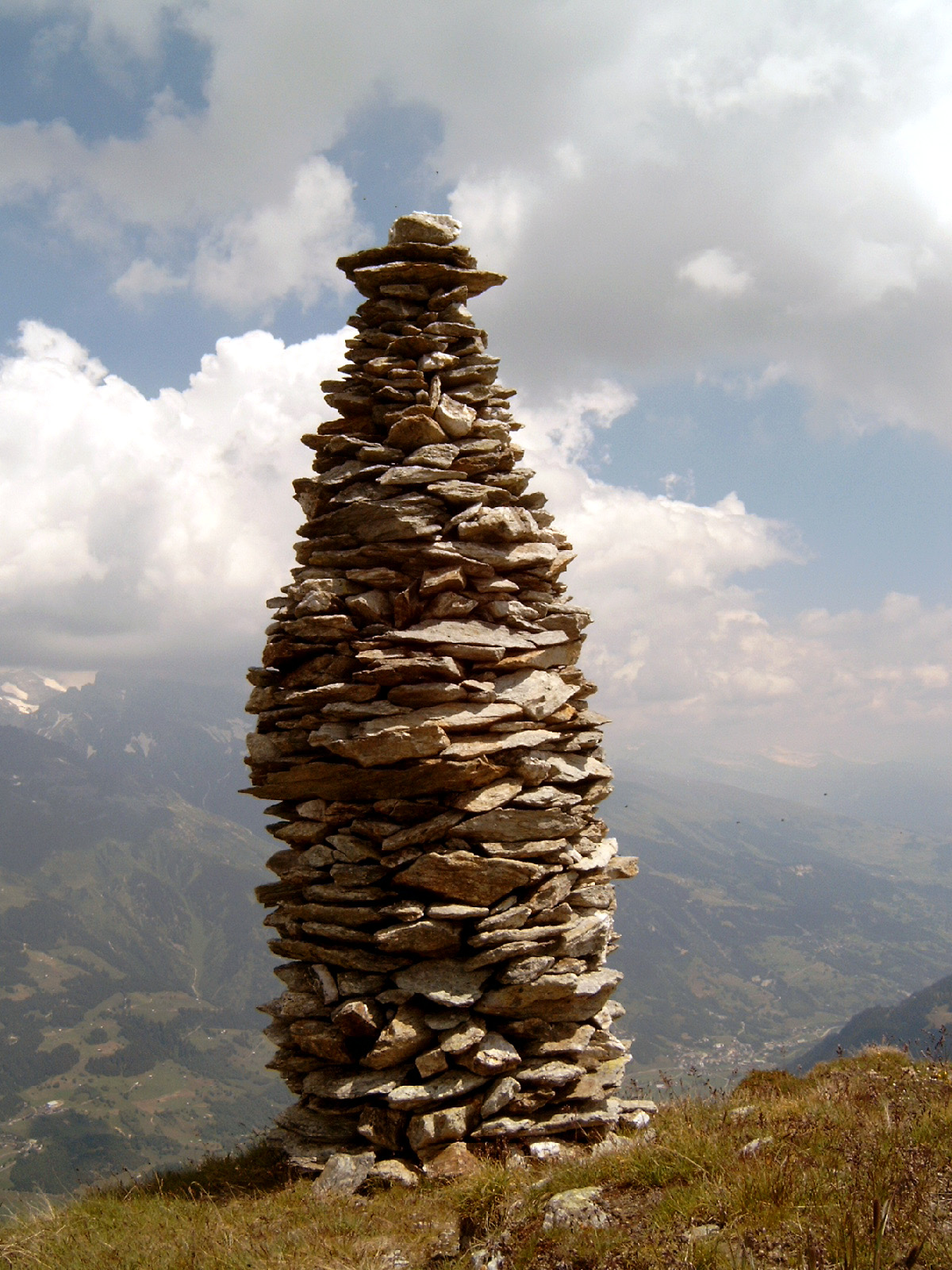
A cairn is a human-made pile (or stack) of stones raised for a purpose, usually as a marker or as a burial mound. The word cairn comes from the Irish: carn [ˈkʰaːrˠn̪ˠ] (plural cairn [ˈkʰaːrˠɲ]).
Cairns have been and are used for a broad variety of purposes. In prehistory, they were raised as markers, as memorials and as burial monuments (some of which contained chambers).
In the modern era, cairns are often raised as landmarks, especially to mark the summits of mountains, and as trail markers. They vary in size from small piles of stones to entire artificial hills, and in complexity from loose conical rock piles to elaborate megalithic structures. Cairns may be painted or otherwise decorated, whether for increased visibility or for religious reasons.
The building of cairns for various purposes goes back into prehistory in Eurasia, ranging in size from small rock sculptures to substantial human-made hills of stone (some built on top of larger, natural hills). The latter are often relatively massive Bronze Age or earlier structures which, like kistvaens and dolmens, frequently contain burials; they are comparable to tumuli (kurgans), but of stone construction instead of earthworks. Cairn originally could more broadly refer to various types of hills and natural stone piles, but today is used exclusively of artificial ones.
The word cairn derives from Irish (with the same meaning), which is essentially the same as the corresponding words in other native Celtic languages of Ireland, Brittany and Britain, , including Welsh carn (and carnedd), Breton karn, Irish carn, and Cornish karn or carn. Cornwall (Kernow) itself may actually be named after the cairns that dot its landscape, such as Cornwall's highest point, Brown Willy Summit Cairn, a 5 m (16 ft) high and 24 m (79 ft) diameter mound atop Brown Willy hill in Bodmin Moor, an area with many ancient cairns. Burial cairns and other megaliths are the subject of a variety of legends and folklore throughout Ireland and Britain. In Ireland, it is traditional to carry a stone up from the bottom of a hill to place on a cairn at its top. In such a fashion, cairns would grow ever larger. An old Scottish Gaelic blessing is Cuiridh mi clach air do chàrn, "I'll put a stone on your cairn". In Highland folklore it is recounted that before Highland clans fought in a battle, each man would place a stone in a pile. Those who survived the battle returned and removed a stone from the pile. The stones that remained were built into a cairn to honour the dead.[citation needed] Cairns in the region were also put to vital practical use. For example, Dún Aonghasa, an all-stone Iron Age Irish hill fort on Inishmore in the Aran Islands, is still surrounded by small cairns and strategically placed jutting rocks, used collectively as an alternative to defensive earthworks because of the karst landscape's lack of soil.[citation needed] In February 2020, ancient cairns dated back to 4,500 year-old used to bury the leaders or chieftains of Neolithic tribes people were revealed in the Cwmcelyn in Blaenau Gwent by the Aberystruth Archaeological Society.
In Scandinavia, cairns have been used for centuries as trail and sea marks, among other purposes, the most notable being the Three-Country Cairn. In Iceland, cairns were often used as markers along the numerous single-file roads or paths that crisscrossed the island; many of these ancient cairns are still standing, although the paths have disappeared. In Norse Greenland, cairns were used as a hunting implement, a game-driving "lane", used to direct reindeer towards a game jump.[full citation needed]
In the mythology of ancient Greece, cairns were associated with Hermes, the god of overland travel. According to one legend, Hermes was put on trial by Hera for slaying her favorite servant, the monster Argus. All of the other gods acted as a jury, and as a way of declaring their verdict they were given pebbles, and told to throw them at whichever person they deemed to be in the right, Hermes or Hera. Hermes argued so skillfully that he ended up buried under a heap of pebbles, and this was the first cairn. In Croatia, in areas of ancient Dalmatia, such as Herzegovina and the Krajina, they are known as gromila.[citation needed]
In Portugal, a cairn is called a moledro. In a legend the moledros are enchanted soldiers, and if one stone is taken from the pile and put under a pillow, in the morning a soldier will appear for a brief moment, then will change back to a stone and magically return to the pile. The cairns that mark the place where someone died or cover the graves alongside the roads where in the past people were buried are called Fiéis de Deus. The same name given to the stones was given to the dead whose identity was unknown.
Hub AI
Cairn AI simulator
(@Cairn_simulator)
Cairn
A cairn is a human-made pile (or stack) of stones raised for a purpose, usually as a marker or as a burial mound. The word cairn comes from the Irish: carn [ˈkʰaːrˠn̪ˠ] (plural cairn [ˈkʰaːrˠɲ]).
Cairns have been and are used for a broad variety of purposes. In prehistory, they were raised as markers, as memorials and as burial monuments (some of which contained chambers).
In the modern era, cairns are often raised as landmarks, especially to mark the summits of mountains, and as trail markers. They vary in size from small piles of stones to entire artificial hills, and in complexity from loose conical rock piles to elaborate megalithic structures. Cairns may be painted or otherwise decorated, whether for increased visibility or for religious reasons.
The building of cairns for various purposes goes back into prehistory in Eurasia, ranging in size from small rock sculptures to substantial human-made hills of stone (some built on top of larger, natural hills). The latter are often relatively massive Bronze Age or earlier structures which, like kistvaens and dolmens, frequently contain burials; they are comparable to tumuli (kurgans), but of stone construction instead of earthworks. Cairn originally could more broadly refer to various types of hills and natural stone piles, but today is used exclusively of artificial ones.
The word cairn derives from Irish (with the same meaning), which is essentially the same as the corresponding words in other native Celtic languages of Ireland, Brittany and Britain, , including Welsh carn (and carnedd), Breton karn, Irish carn, and Cornish karn or carn. Cornwall (Kernow) itself may actually be named after the cairns that dot its landscape, such as Cornwall's highest point, Brown Willy Summit Cairn, a 5 m (16 ft) high and 24 m (79 ft) diameter mound atop Brown Willy hill in Bodmin Moor, an area with many ancient cairns. Burial cairns and other megaliths are the subject of a variety of legends and folklore throughout Ireland and Britain. In Ireland, it is traditional to carry a stone up from the bottom of a hill to place on a cairn at its top. In such a fashion, cairns would grow ever larger. An old Scottish Gaelic blessing is Cuiridh mi clach air do chàrn, "I'll put a stone on your cairn". In Highland folklore it is recounted that before Highland clans fought in a battle, each man would place a stone in a pile. Those who survived the battle returned and removed a stone from the pile. The stones that remained were built into a cairn to honour the dead.[citation needed] Cairns in the region were also put to vital practical use. For example, Dún Aonghasa, an all-stone Iron Age Irish hill fort on Inishmore in the Aran Islands, is still surrounded by small cairns and strategically placed jutting rocks, used collectively as an alternative to defensive earthworks because of the karst landscape's lack of soil.[citation needed] In February 2020, ancient cairns dated back to 4,500 year-old used to bury the leaders or chieftains of Neolithic tribes people were revealed in the Cwmcelyn in Blaenau Gwent by the Aberystruth Archaeological Society.
In Scandinavia, cairns have been used for centuries as trail and sea marks, among other purposes, the most notable being the Three-Country Cairn. In Iceland, cairns were often used as markers along the numerous single-file roads or paths that crisscrossed the island; many of these ancient cairns are still standing, although the paths have disappeared. In Norse Greenland, cairns were used as a hunting implement, a game-driving "lane", used to direct reindeer towards a game jump.[full citation needed]
In the mythology of ancient Greece, cairns were associated with Hermes, the god of overland travel. According to one legend, Hermes was put on trial by Hera for slaying her favorite servant, the monster Argus. All of the other gods acted as a jury, and as a way of declaring their verdict they were given pebbles, and told to throw them at whichever person they deemed to be in the right, Hermes or Hera. Hermes argued so skillfully that he ended up buried under a heap of pebbles, and this was the first cairn. In Croatia, in areas of ancient Dalmatia, such as Herzegovina and the Krajina, they are known as gromila.[citation needed]
In Portugal, a cairn is called a moledro. In a legend the moledros are enchanted soldiers, and if one stone is taken from the pile and put under a pillow, in the morning a soldier will appear for a brief moment, then will change back to a stone and magically return to the pile. The cairns that mark the place where someone died or cover the graves alongside the roads where in the past people were buried are called Fiéis de Deus. The same name given to the stones was given to the dead whose identity was unknown.