




Community hub
Recent from talks
Contribute something to knowledge base
Content stats: 0 posts, 0 articles, 1 media, 0 notes
Members stats: 0 subscribers, 0 contributors, 0 moderators, 0 supporters
Subscribers
Supporters
Contributors
Moderators
Sequoia sempervirens
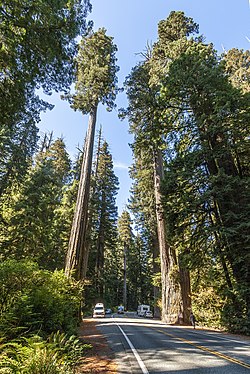
Sequoia sempervirens (/səˈkwɔɪ.ə ˌsɛmpərˈvaɪrənz/) is the sole living species of the genus Sequoia in the cypress family Cupressaceae (formerly treated in Taxodiaceae). Common names include coast redwood, coastal redwood and California redwood. It is an evergreen, long-lived, monoecious tree living 1,200–2,200 years or more. This species includes the tallest living trees on Earth, reaching up to 115.9 m (380.1 ft) in height (without the roots) and up to 8.9 m (29 ft) in diameter at breast height. These trees are also among the longest-living trees on Earth. Before commercial logging and clearing began by the 1850s, this massive tree occurred naturally in an estimated 810,000 ha (2,000,000 acres) along much of coastal California (excluding southern California where rainfall is not sufficient) and the southwestern corner of coastal Oregon within the United States. Being the tallest tree species, with a small range and an extremely long lifespan, many redwoods are preserved in various state and national parks; many of the largest specimens have their own official names.
The name sequoia sometimes refers to the subfamily Sequoioideae, which includes S. sempervirens along with Sequoiadendron (giant sequoia) and Metasequoia (dawn redwood). Here, the term redwood on its own refers to the species covered in this article but not to the other two species.
The coast redwood normally reaches a height of 60 to 100 m (200 to 330 ft), but can be more than 110 m (360 ft) in some cases, with a trunk diameter of 9 m (30 ft). Historically, the American naturalist, physician and founder member of the California Academy of Sciences, William P. Gibbons (1812–1897) described in 1893 the hollow shell of a coast redwood in the Oakland Hills of Alameda County with diameter of 9.9 metres (32 ft) at breast height. This tree's girth is rivalled by the "Fieldbrook Stump" of Humboldt County with a diameter of 9.8 metres (32 ft) at 1.5 metres (4.9 ft) from the ground. This stump is still intact, with numerous healthy stump shoots encircling it.
Coast redwoods have a conical crown, with horizontal to slightly drooping branches. The trunk is remarkably straight. The bark can be very thick, up to 35 cm (1.15 ft), and quite soft and fibrous, with a bright red-brown color when freshly exposed (hence the name redwood), weathering darker. The root system is composed of shallow, wide-spreading lateral roots.
The leaves are variable, being 15–25 mm (5⁄8–1 in) long and flat on young trees and shaded lower branches in older trees. The leaves are scalelike, 5–10 mm (1⁄4–3⁄8 in) long on shoots in full sun in the upper crown of older trees, with a full range of transition between the two extremes. They are dark green above and have two blue-white stomatal bands below. Leaf arrangement is spiral, but the larger shade leaves are twisted at the base to lie in a flat plane for maximum light capture.
The species is monoecious, with pollen and seed cones on the same plant. The seed cones are ovoid, 15–32 mm (9⁄16–1+1⁄4 in) long, with 15–25 spirally arranged scales; pollination is in late winter with maturation about 8–9 months after. Each cone scale bears three to seven seeds, each seed 3–4 mm (1⁄8–3⁄16 in) long and 0.5 mm (1⁄32 in) broad, with two wings 1 mm (1⁄16 in) wide. The seeds are released when the cone scales dry and open at maturity. The pollen cones are ovular and 4–6 mm (3⁄16–1⁄4 in) long.
Its genetic makeup (chromosome count is 2n=66) is unusual among conifers, being a hexaploid (6n) and possibly allopolyploid (AAAABB). Both the mitochondrial and chloroplast genomes of the redwood are paternally inherited. According to Guinness the Coast Redwood has the largest known genome of any plant examined up to the year 2020, totaling 26.5 gigabases.
Scottish botanist David Don described the redwood as Taxodium sempervirens, the "evergreen Taxodium", in his colleague Aylmer Bourke Lambert's 1824 work A description of the genus Pinus. Austrian botanist Stephan Endlicher erected the genus Sequoia in his 1847 work Synopsis coniferarum, giving the redwood its current binomial name of Sequoia sempervirens. It is unknown how Endlicher derived the name Sequoia. See Sequoia Etymology.
Sequoia sempervirens
Sequoia sempervirens (/səˈkwɔɪ.ə ˌsɛmpərˈvaɪrənz/) is the sole living species of the genus Sequoia in the cypress family Cupressaceae (formerly treated in Taxodiaceae). Common names include coast redwood, coastal redwood and California redwood. It is an evergreen, long-lived, monoecious tree living 1,200–2,200 years or more. This species includes the tallest living trees on Earth, reaching up to 115.9 m (380.1 ft) in height (without the roots) and up to 8.9 m (29 ft) in diameter at breast height. These trees are also among the longest-living trees on Earth. Before commercial logging and clearing began by the 1850s, this massive tree occurred naturally in an estimated 810,000 ha (2,000,000 acres) along much of coastal California (excluding southern California where rainfall is not sufficient) and the southwestern corner of coastal Oregon within the United States. Being the tallest tree species, with a small range and an extremely long lifespan, many redwoods are preserved in various state and national parks; many of the largest specimens have their own official names.
The name sequoia sometimes refers to the subfamily Sequoioideae, which includes S. sempervirens along with Sequoiadendron (giant sequoia) and Metasequoia (dawn redwood). Here, the term redwood on its own refers to the species covered in this article but not to the other two species.
The coast redwood normally reaches a height of 60 to 100 m (200 to 330 ft), but can be more than 110 m (360 ft) in some cases, with a trunk diameter of 9 m (30 ft). Historically, the American naturalist, physician and founder member of the California Academy of Sciences, William P. Gibbons (1812–1897) described in 1893 the hollow shell of a coast redwood in the Oakland Hills of Alameda County with diameter of 9.9 metres (32 ft) at breast height. This tree's girth is rivalled by the "Fieldbrook Stump" of Humboldt County with a diameter of 9.8 metres (32 ft) at 1.5 metres (4.9 ft) from the ground. This stump is still intact, with numerous healthy stump shoots encircling it.
Coast redwoods have a conical crown, with horizontal to slightly drooping branches. The trunk is remarkably straight. The bark can be very thick, up to 35 cm (1.15 ft), and quite soft and fibrous, with a bright red-brown color when freshly exposed (hence the name redwood), weathering darker. The root system is composed of shallow, wide-spreading lateral roots.
The leaves are variable, being 15–25 mm (5⁄8–1 in) long and flat on young trees and shaded lower branches in older trees. The leaves are scalelike, 5–10 mm (1⁄4–3⁄8 in) long on shoots in full sun in the upper crown of older trees, with a full range of transition between the two extremes. They are dark green above and have two blue-white stomatal bands below. Leaf arrangement is spiral, but the larger shade leaves are twisted at the base to lie in a flat plane for maximum light capture.
The species is monoecious, with pollen and seed cones on the same plant. The seed cones are ovoid, 15–32 mm (9⁄16–1+1⁄4 in) long, with 15–25 spirally arranged scales; pollination is in late winter with maturation about 8–9 months after. Each cone scale bears three to seven seeds, each seed 3–4 mm (1⁄8–3⁄16 in) long and 0.5 mm (1⁄32 in) broad, with two wings 1 mm (1⁄16 in) wide. The seeds are released when the cone scales dry and open at maturity. The pollen cones are ovular and 4–6 mm (3⁄16–1⁄4 in) long.
Its genetic makeup (chromosome count is 2n=66) is unusual among conifers, being a hexaploid (6n) and possibly allopolyploid (AAAABB). Both the mitochondrial and chloroplast genomes of the redwood are paternally inherited. According to Guinness the Coast Redwood has the largest known genome of any plant examined up to the year 2020, totaling 26.5 gigabases.
Scottish botanist David Don described the redwood as Taxodium sempervirens, the "evergreen Taxodium", in his colleague Aylmer Bourke Lambert's 1824 work A description of the genus Pinus. Austrian botanist Stephan Endlicher erected the genus Sequoia in his 1847 work Synopsis coniferarum, giving the redwood its current binomial name of Sequoia sempervirens. It is unknown how Endlicher derived the name Sequoia. See Sequoia Etymology.
Recent media
Recent media