
Recent from talks
Calochortus nuttallii
Knowledge base stats:
Talk channels stats:
Members stats:
Calochortus nuttallii
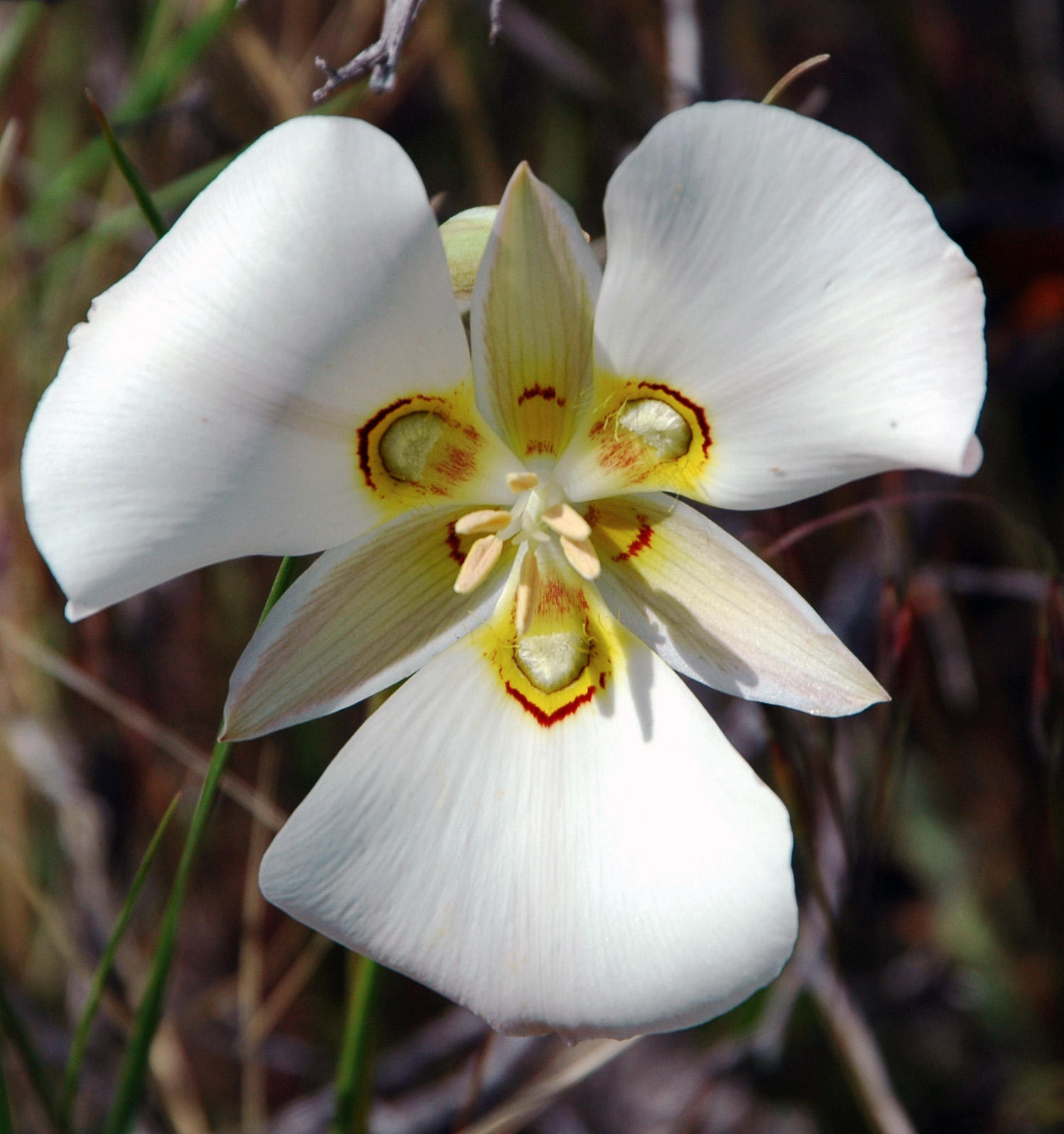
Calochortus nuttallii, also known as the sego lily, is a bulbous perennial plant that is endemic to the Western United States. The common name of sego comes from a similar Shoshone word. It is the state flower of Utah.
The plant is native to a number of western states, being found throughout Utah and Wyoming, large parts of eastern Nevada, and parts of Idaho, Montana, North Dakota, South Dakota, Nebraska, Colorado, Arizona, and New Mexico. It grows in dry, brushy or grassy slopes and desert high country.
Calochortus nuttallii are around 15–45 cm (6–18 inches) in height and have linear leaves.
Plants have 1 to 4 flowers, each with 3 white petals (and 3 sepals) which are tinged with lilac (occasionally magenta) and have a purplish band radiating from the yellow base. A yellow petaled form with deep purple bands is known from Petrified Forest National Park. The yellow petaled form was also observed in a "super bloom" near the Orange Cliffs District of Glen Canyon National Recreation Area, on the north side of the Colorado River near Hite, Utah in May 2019. The plant blooms in early summer, with flowers that can be up to 3 inches across.
Calochortus nuttallii is a species within the genus Calochortus, in a sub-group generally referred to as Mariposa Lilies. The specific epithet nuttallii, named for the English botanist and zoologist, Thomas Nuttall, was ascribed to the species by the American botanists John Torrey and Asa Gray when it was officially described in 1857.
A number of former varieties of Calochortus nuttallii have been reclassified as distinct species:
The common name "sego lily" is believed to be derived from a Shoshoni language word for the species, sikoo.
Native Americans had culinary uses for the bulbs, seeds, and flowers of the plant. Bulbs were roasted, boiled, or made into a porridge by the Hopi, Havasupai, Navajo, Southern Paiute, Gosiute, and Ute peoples. The Hopi used the yellow flower ceremonially.
Hub AI
Calochortus nuttallii AI simulator
(@Calochortus nuttallii_simulator)
Calochortus nuttallii
Calochortus nuttallii, also known as the sego lily, is a bulbous perennial plant that is endemic to the Western United States. The common name of sego comes from a similar Shoshone word. It is the state flower of Utah.
The plant is native to a number of western states, being found throughout Utah and Wyoming, large parts of eastern Nevada, and parts of Idaho, Montana, North Dakota, South Dakota, Nebraska, Colorado, Arizona, and New Mexico. It grows in dry, brushy or grassy slopes and desert high country.
Calochortus nuttallii are around 15–45 cm (6–18 inches) in height and have linear leaves.
Plants have 1 to 4 flowers, each with 3 white petals (and 3 sepals) which are tinged with lilac (occasionally magenta) and have a purplish band radiating from the yellow base. A yellow petaled form with deep purple bands is known from Petrified Forest National Park. The yellow petaled form was also observed in a "super bloom" near the Orange Cliffs District of Glen Canyon National Recreation Area, on the north side of the Colorado River near Hite, Utah in May 2019. The plant blooms in early summer, with flowers that can be up to 3 inches across.
Calochortus nuttallii is a species within the genus Calochortus, in a sub-group generally referred to as Mariposa Lilies. The specific epithet nuttallii, named for the English botanist and zoologist, Thomas Nuttall, was ascribed to the species by the American botanists John Torrey and Asa Gray when it was officially described in 1857.
A number of former varieties of Calochortus nuttallii have been reclassified as distinct species:
The common name "sego lily" is believed to be derived from a Shoshoni language word for the species, sikoo.
Native Americans had culinary uses for the bulbs, seeds, and flowers of the plant. Bulbs were roasted, boiled, or made into a porridge by the Hopi, Havasupai, Navajo, Southern Paiute, Gosiute, and Ute peoples. The Hopi used the yellow flower ceremonially.
Recent media