Hubbry Logo
Camera WorkCamera WorkMain
Open search
Camera Work
Community hub
Camera Work
logo
8 pages, 0 posts
0 subscribers
Be the first to start a discussion here.
Contribute something
Camera Work
Camera Work
from Wikipedia

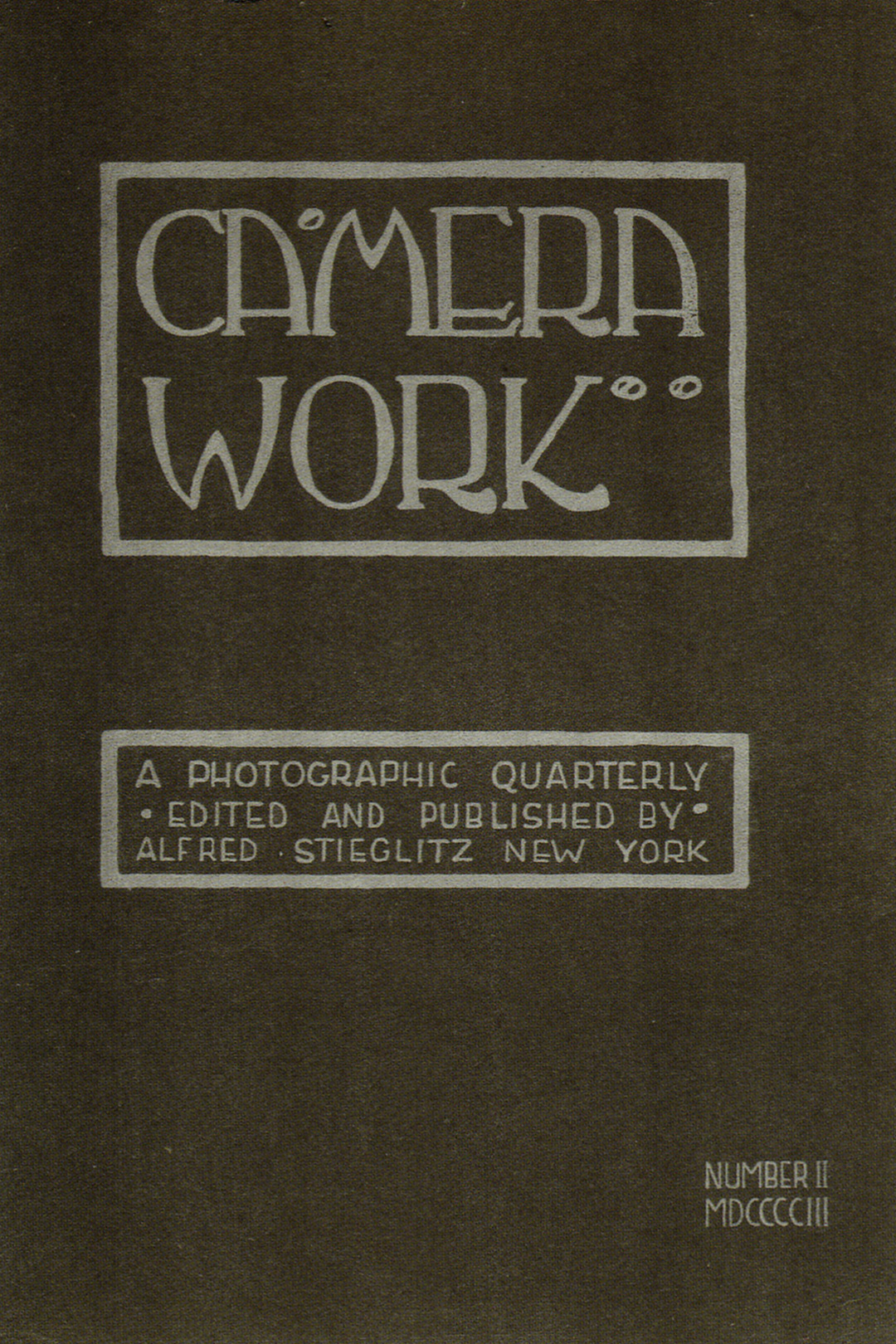
Cover of Camera Work, No 2, 1903. Cover design by Edward Steichen.

Camera Work was a quarterly photographic journal published by Alfred Stieglitz from 1903 to 1917. The journal presented photogravures and had the goal to establish photography as a fine art. Camera Work was called "consummately intellectual",[1] and, "a portrait of an age [in which] the artistic sensibility of the nineteenth century, was transformed into the artistic awareness of the present day."[2]

Background

[edit]

Alfred Stieglitz was an American photographer, editor and publisher active in the 20th century.[3] He believed photography was a new field of expression and creation, equivalent to fine art. He promoted this philosophy, a component of Pictorialism,[4] by writing articles and organizing photography exhibitions. During his five-year tenure as editor of the journal Camera Notes, published by the Camera Club of New York, he attempted to change the perspective among the club's more traditional members that photography was merely technical. In 1902, he resigned as editor of Camera Notes due to his failure to change the club's view of photography as an art form.[5]

Alfred Stieglitz, by Alvin Langdon Coburn. Published in Camera Work No 21, 1908

At the encouragement of close friend and fellow photographer Joseph Keiley, among others, Stieglitz developed the idea of a independent photography magazine lacking conservative influences. In August 1902, he printed a two-page prospectus "in response to the importunities of many serious workers in photographic fields that I should undertake the publication of an independent magazine devoted to the furtherance of modern photography."[5] He stated the magazine would be self-published, and "owing allegiance only to the interests of photography."[5] The name Camera Work was a reference to the phrasing in his prospectus, meant to distinguish artistic photographers from the old-school technicians which frustrated him. To emphasize the journal's independent nature, every cover was imprinted with "Camera Work: A Photographic Quarterly, Edited and Published by Alfred Stieglitz, New York".[6]

Design and production

[edit]
The Red Man, by Gertrude Käsebier. Published in Camera Work No 1, 1903

Stieglitz appointed Edward Steichen to design the cover, a plain gray-green background with the magazine's title, acknowledgement of Stieglitz's editorial control, issue number, and date, in an Art Nouveau-style typeface that Steichen created specifically for the journal. The advertisements at the back of each issue were also creatively designed and presented, often by Stieglitz himself. Eastman Kodak took the back cover ad for almost every issue, using the same typeface Steichen had designed for the cover at Stieglitz's insistence.[7]

Gravures were produced from the photographers' original negatives whenever possible, or occasionally from the original prints. If the gravure came from a negative, this fact was noted in the accompanying text, and these gravures were noted to be original prints.[7]

Stieglitz personally tipped-in the photogravures in every issue, touching up dust spots or scratches when necessary.[8] This assured only the highest standards in all copies of the magazine, but sometimes delayed mailing. Stieglitz would not allow anyone else to tip in. When a set of prints failed to arrive for a Photo-Secession exhibition in Brussels, gravures from the magazine were hung instead. Because of their high visual quality, most viewers assumed they were looking at the original photographs.[5]

Before the first issue was printed, Stieglitz received 68 subscriptions for the new publication. Stieglitz insisted that 1000 copies of each issue be printed, regardless of the number of subscriptions. Under financial duress, he reduced the number to 500 for the final two issues. As of the first issue, the subscription rate was US $4 yearly or US $2 for single issues.[7]

Publishing history

[edit]
Self-portrait, by Edward Steichen. Published in Camera Work No 2, 1903

Camera Work was published as a series of 50 issues between 1903 and 1917.

1903–1906

[edit]

The inaugural issue of Camera Work was dated January 1903, but was actually mailed on 15 December 1902. In it, Stieglitz set forth the mission of the new journal:

"Photography being in the main a process in monochrome, it is on subtle gradations of tone and value that its artistic beauty so frequently depends. It is therefore highly necessary that reproductions of photographic work must be made with exceptional care, and discretion of the spirit of the original is to be retained, though no reproductions can do justice to the subtleties of some photographs. Such supervision will be given to the illustrations that will appear in each number of Camera Work. Only examples of such works as gives evidence of individuality and artistic worth, regardless of school, or contains some exceptional feature of technical merit, or such as exemplifies some treatment worthy of consideration, will find recognition in these pages. Nevertheless, the Pictorial will be the dominating feature of the magazine."[9]

In his first editorial, Stieglitz expressed gratitude to a group of photographers to whom he was indebted. He listed them in the following order: Robert Demachy, Will Cadby, Edward Steichen, Gertrude Käsebier, Frank Eugene, James Craig Annan, Clarence H. White, William Dyer, Eva Watson, Frances Benjamin Johnston, and R. Child Baley.[10] Over the next fourteen years, he published many of their photographs.[5]

Boy with Camera Work, by Clarence H. White. Published in Camera Work No 9, 1905

During this early period, Stieglitz used Camera Work to expand the same vision and aesthetics that he had promoted in Camera Notes. He used the services of the same three assistant editors who worked with him on Camera Notes: Dallett Fuguet, Joseph Keiley, and John Francis Strauss. Over the years, both Fuguet and Keiley contributed extensively to the journal through their own articles and photographs.[11] Strauss’ role appears to have been more in the background. Neither Stieglitz nor his associate editors received a salary for their work, nor were any photographers paid for having their work published.[5]

One of the purposes of the new journal was to serve as a vehicle for the Photo-Secession, an invitation-only group that Stieglitz founded in 1902 to promote photography as an art form.[7] Much of the work published in Camera Work came from the Photo-Secession exhibitions he hosted, and soon rumors circulated that the magazine was intended only for those involved in the Photo-Secession. In 1904, Stieglitz attempted to counter this idea by publishing a full-page notice in the journal in order to correct the "erroneous impression…that only the favored few are admitted to our subscription list." He then went on to say, "…although it is the mouthpiece of the Photo-Secession that fact will not be allowed to hamper its independence in the slightest degree."[9]

While making this proclamation in the journal, Stieglitz continued to unabashedly promote the Photo-Secession in its pages. In 1905, he wrote, "the most important step in the history of the Photo-Secession," was taken with the opening of his photography gallery that year. "Without the flourish of trumpets, without the stereotypes, press-view or similar antiquated functions, the Secessionists and a few friends informally opened the Little Galleries of the Photo-Secession at 291 Fifth Avenue, New York."[8]

Lenore, by Joseph Keiley. Published in Camera Work No 17, 1907

1907–1909

[edit]

Throughout its publication, it is impossible to view Camera Work separately from the rest of Stieglitz's life. He lived to promote photography as an art form and to challenge the norms of how art may be defined.[5] As his own successes increased, either from recognition of his own photos or through his efforts to organize international exhibitions of photography, the content of Camera Work reflected these changes. Articles began to appear with such titles as "Symbolism and Allegory" (Charles Caffin, No 18 1907) and "The Critic as Artist" (Oscar Wilde, No 27 1909), and the focus of Camera Work turned from primarily American content to a more international scope.

Stieglitz also continued to intertwine the walls of his galleries with the pages of his magazine. Stieglitz's closest friends (Steichen, Demachy, White, Käsebier and Keiley) were represented in both, while many others were granted one but not the other.[10] Increasingly, a single photographer was given the preponderance of coverage in an issue, and in doing so Stieglitz relied more and more on his small circle of old supporters. This led to increased tensions among Stieglitz and some of his original colleagues, and when Stieglitz began to introduce paintings, drawings and other art forms in his gallery, many photographers saw it as the breaking point in their relationship with Stieglitz.

In 1909, Stieglitz was notified about yet another sign of the increasingly difficult times. London's Linked Ring, which for more than a decade Stieglitz had looked to as model for the Photo-Secession, finally dissolved in antipathy.[5] Stieglitz knew this signaled the end of an era, but rather than be set back by these changes, he began making plans to integrate Camera Work even further into the realm of modern art.

1910–1914

[edit]
Photograph - New York, by Paul Strand. Published in Camera Work No 49/50, 1917

In January, 1910, Stieglitz abandoned his policy of reproducing only photographic images, and in issue 29 he included four caricatures by Mexican artist Marius de Zayas. From this point on Camera Work would include both reproductions of and articles on modern painting, drawing and aesthetics, and it marked a significant change in both the role and the nature of the magazine. This change was brought about by a similar transformation at Stieglitz's New York gallery, which had been known as the Little Galleries of the Photo-Secession until 1908. That year he changed the name of the gallery to "291", and he began showing avant-garde modern artists such as Auguste Rodin and Henri Matisse along with photographers. The positive responses he received at the gallery encouraged Stieglitz to broaden the scope of Camera Work as well, although he decided against any name change for the journal.[2]

This same year a huge retrospective exhibition of the Photo-Secession was held at the Albright-Knox Art Gallery in Buffalo, New York. More than 15,000 people visited the exhibition over its four-week showing, and at the end the Gallery purchased twelve prints and reserved one room for the permanent display of photography. This was the first time a museum in the U.S. acknowledged that photography was in fact an art form, and, in many ways, it marked the beginning of the end for the Photo-Secession.[2]

After the Buffalo show Stieglitz began showcasing more and more art in Camera Work. In 1911, a double issue was devoted to reproductions and analysis of Rodin's drawings, and analysis of the work of Paul Cézanne and Pablo Picasso. While this was a very bold move to promote modern art, it did not sit well with the photographers who still made up most of the subscription list. Half of the existing subscribers immediately cancelled their subscriptions.[2]

By 1912, the number of subscriptions had dropped to 304. The shift away from photography to a mix of other art and photography had cost Stieglitz many subscribers,[7] but he did not change his editorial direction. To inflate the issues' marketplace value and attract subscribers, Stieglitz began to destroy unwanted copies. The price of back issues soon increased substantially, but the number of paid subscriptions continued to dwindle.[7]

1915–1917

[edit]

By 1915, the cultural changes and the economic effects of the war finally took its toll on Camera Work. The number of subscribers dwindled to just thirty-seven, and both the costs and even the availability of the paper on which it was printed became challenging. Coupled with the public's decreased interest in pictorial photography, these problems simply became too much for Stieglitz to bear. He published issue 47 in January, 1915, and devoted most of it what Steichen referred to as a "project in self-adulation".[2] Three years earlier Stieglitz had asked many of his friends to tell him what his gallery "291" meant to them. He received sixty-eight replies and printed all of them, unedited (including Steichen's previously mentioned opinion), in issue 47. As another sign of the changing times, only four of the comments came from photographers – all of the rest were from painters, illustrators and art critics.[5] It was the only issue that did not include an illustration of any kind.

Issue 48 did not appear until October 1916, sixteen months later. In the interim, two important events occurred. At the insistence of his friend Paul Haviland, Stieglitz began releasing another journal, 291, which was intended to bring attention to his gallery of the same name. This effort occupied much of Stieglitz's time and interest from the summer of 1915 until the last issue was published in early 1916. In April 1916, Stieglitz finally met Georgia O'Keeffe, although the latter had gone to see exhibits at "291" since 1908. The two immediately were attracted to each other, and Stieglitz began devoting more and more of his time to their developing relationship.

In issue 48, Stieglitz introduced the work of a young photographer, Paul Strand, whose photographic vision was indicative of the aesthetic changes now at the heart of Camera Work's demise. Strand shunned the soft focus and symbolic content of the Pictorialists and instead strove to create a new vision that found beauty in the clear lines and forms of ordinary objects. By publishing Strand's work, Stieglitz was hastening the end of the aesthetic vision he had championed for so long.[11]

In June 1917, the final issue of Camera Work was published. This issue was devoted almost entirely to Strand's photographs. Even after the difficulties of publishing the last two issues, Stieglitz did not indicate he was ready to give up; he included an announcement that the next issue would feature O’Keefe's work. Soon after publishing this issue, however, Stieglitz realized that he could no longer afford to publish Camera Work or to run "291" due to the effect of the war and the changes in the New York art scene. He ceased publication of both journals with no formal announcement or notice.

After ending publication, Stieglitz had several thousand unsold copies of Camera Work, along with more than 8,000 unsold copies of 291. He sold most of these in bulk to a ragman, and gave away or destroyed the rest. Almost all extant copies came from original subscribers' collections.

Legacy

[edit]

For most of its life, Camera Work was universally praised by both photographers and critics. Critics wrote the following upon the first publication of Camera Work:

"When Camera Notes was at its height, it seemed impossible for it to be surpassed. We can only say that in this case it has been passed, that Stieglitz has out-Stieglitzed Stieglitz and that, in producing Camera Work he has beaten that record which he himself held, which no one else has ever approached."[12]
"For Camera Work as a whole we have no words of praise too high, it stands alone; and of Mr. Alfred Stieglitz American photographers may well be proud. It is difficult to estimate how much he has done for the good of photography, working for years against opposition and without sympathy, and it is to his extraordinary capacity for work, his masterful independence which compels conviction, and his self-sacrificing devotion that we owe the beautiful work before us."[13]

Despite Stieglitz's initial statement that Camera Work "owes allegiance to no organization or clique",[9] in the end it was primarily a visual showcase for his work and that of his close friends. Of the 473 photographs published in Camera Work during its fifteen-year publication, 357 were the work of just fourteen photographers: Stieglitz, Steichen, Frank Eugene, Clarence H. White, Alvin Langdon Coburn, J. Craig Annan, Hill & Adamson, Baron Adolf de Meyer, Heinrich Kühn, George Seeley, Paul Strand, Robert Demachy, Gertrude Käsebier and Anne Brigman. The remaining 116 photographs came from just thirty-nine other photographers.[5]

Three complete sets of Camera Work have notably sold at auction: a complete set of all 50 in original binding sold at Sotheby's in October 2011 for $398,500;[14] in 2007, a second complete set, kept in contemporary clamshell cases, sold for $229,000;[15] and a complete set bound into book volumes sold in October 2016 for $187,500.[16]

[edit]

See Also

[edit]

Notes

[edit]
[edit]
Revisions and contributorsEdit on WikipediaRead on Wikipedia
from Grokipedia
Camera Work was a quarterly photographic journal founded, edited, and published by American photographer from 1903 to 1917, spanning 50 issues that played a pivotal role in elevating to the status of . It emerged as the unofficial organ of the , a group Stieglitz established in 1902 to promote artistic independent of commercial or technical constraints. The journal's luxurious design, featuring an cover by and high-quality photogravures for precise tonal reproduction, distinguished it from earlier publications like Stieglitz's Camera Notes. In its early years, Camera Work primarily showcased the works of members, including , , Clarence H. White, and , emphasizing pictorialist approaches that infused photographs with emotional and aesthetic depth. Over time, the publication evolved to reflect broader modernist influences, introducing American audiences to European artists such as , , and through reproductions and critical essays. Contributions from writers like and further enriched its content, blending visual art with intellectual discourse. The journal's final double issue (Nos. 49–50, June 1917) marked a significant shift by featuring Paul Strand's straight portfolio, including works like Porch Railings, Twin Lakes, , signaling the transition from to more direct, unmanipulated modernist styles. Through its 14-year run, Camera Work not only documented the maturation of as an artistic medium but also influenced gallery exhibitions at Stieglitz's Little Galleries of the (291), fostering a legacy of innovation in American visual culture.

Introduction and Overview

Founding and Purpose

In 1902, Alfred Stieglitz resigned as editor of Camera Notes, the journal of the Camera Club of New York, following prolonged power struggles and opposition to his vision of elevating photography to the status of fine art, which clashed with the club's more conservative membership and their reluctance to fully embrace artistic innovation. This departure marked a pivotal moment, as Stieglitz immediately founded the Photo-Secession, an invitation-only group of photographers dedicated to advancing pictorial photography as a legitimate artistic medium independent of institutional constraints. The launch of Camera Work was announced through a prospectus distributed in August 1902, with the first issue printed in December 1902 and dated January 1903, explicitly aimed at establishing photography—particularly —as a form untainted by commercial or technical preoccupations. Stieglitz articulated this mission in the inaugural issue's introduction, stating, "Only examples of such works as gives evidence of individuality and artistic worth... will find recognition in these pages. Nevertheless, the Pictorial will be the dominating feature of the magazine," emphasizing subjective expression and aesthetic merit over mere documentation. The journal served as the primary organ of the , providing a platform free from the editorial conservatism that had hindered Camera Notes. Stieglitz personally assumed the roles of editor, publisher, and financier for Camera Work, drawing on his European experiences, including his 1894 election to the Linked Ring society in —a pioneering group that advocated for photography's artistic potential and profoundly shaped his commitment to pictorial ideals. His financial self-support ensured creative autonomy, allowing the journal to prioritize high artistic standards without advertiser influence or compromise. From the outset, Camera Work operated on a subscription-based model priced at $4 annually or $2 per single issue, targeting a discerning audience of artists, collectors, and intellectuals who shared Stieglitz's passion for photography's elevation to . This selective approach fostered a dedicated readership attuned to the journal's emphasis on individual expression and cultural significance.

Publication Details

Camera Work was issued quarterly from its inaugural publication in January 1903 until its final combined issue in June 1917, comprising 50 regular issues along with three special numbers. Each issue generally contained 12 to 20 pages of text supplemented by plates of photogravures, with the overall production emphasizing high-quality reproductions over mass circulation. The journal's pricing was set at $4 for an annual subscription or $2 for a single issue, reflecting its niche appeal to a dedicated . Initial print runs stood at 1,000 copies per issue, though this decreased to around 500 in later years as circulation waned, while subscribers numbered in the low hundreds at its peak in the early years. Distribution occurred primarily via direct mail to subscribers across the and , eschewing widespread commercial sales in favor of targeted dissemination. Physically, the journal measured approximately 9 by 12 inches, bound in a format that highlighted its elegant, artisanal production. Alfred Stieglitz's self-funding underpinned these logistics, enabling the venture's independence despite limited revenue.

Historical Development

Early Years (1903–1906)

The first issue of Camera Work was released in January 1903, marking the official launch of Alfred Stieglitz's quarterly journal dedicated to advancing as an independent art form. This inaugural number featured high-quality reproductions of works by prominent members, including Gertrude Käsebier's portrait The Manger and images by Arthur Radclyffe Dugmore, alongside contributions from Stieglitz himself. The journal utilized the process to ensure faithful tonal reproduction, emphasizing the aesthetic qualities of the originals. From its outset, Camera Work emphasized American pictorialist photography, showcasing soft-focus, atmospheric images that prioritized and artistic composition over documentary precision. Stieglitz's editorial statements in the first issue articulated a manifesto-like tone, declaring that the journal would include "only examples of such work as gives evidence of individuality, and of artistic worth," while asserting photography's from other media like . In the prospectus dated August 25, 1902, Stieglitz further advocated for the medium's independence, stating that Camera Work would owe "allegiance only to the interests of photography." This vision positioned the journal as a platform for pictorialists seeking recognition for photography's unique expressive potential, distinct from imitative practices. The issues from 1903 to 1904 continued this foundational tone, introducing works by other affiliates such as Clarence H. in the third issue and reinforcing the group's commitment to elevating photography's status through curated selections. Stieglitz's hands-on involvement in editing, image selection, and production oversight shaped the journal's rigorous standards, though this intensive approach limited its scope primarily to American voices in these early years, with only selective inclusion of international pictorialists like Frederick H. Evans. Challenges included constrained distribution beyond U.S. borders, reflecting the nascent 's domestic focus and Stieglitz's deliberate curation to build a cohesive American pictorialist identity.

Middle Period (1907–1909)

During the middle period of Camera Work, the journal expanded its scope by incorporating more international contributions, particularly from European Pictorialists, beginning with the 1907 issue that featured works by Scottish photographer James Craig Annan. This broadening reinforced the ongoing affiliation with the group through shared exhibitions and thematic consistency. , a Luxembourg-born Pictorialist closely associated with , also saw increased prominence, reflecting the journal's effort to bridge American and European photographic traditions. Editorially, Stieglitz shifted toward deeper explorations of , using Camera Work to defend against emerging critiques favoring photographic realism and mechanical precision. In response to accusations that the journal had deviated from the Photo-Secession's original mission of artistic elevation, Stieglitz emphasized 's capacity for personal expression and emotional depth, countering realism's documentary focus through essays and reproductions that highlighted photography's interpretive potential. This defensive stance underscored the period's internal tensions within photographic circles, as Stieglitz positioned Camera Work as a bastion for the movement's principles amid growing debates on the medium's artistic legitimacy. A pivotal event was the April 1908 special issue (No. 22) dedicated to Edward Steichen's photographs, which showcased his refined color sensibilities and painterly compositions, including autochromes and halftones that exemplified Pictorialist innovation. Rising production costs for high-quality photogravures prompted minor format adjustments, such as refined layout efficiencies, to maintain the journal's presentation without compromising its quarterly . Subscriber numbers remained , typically below 1,000 but consistently supporting operations around several hundred dedicated readers, while critical acclaim grew in art circles for Camera Work's role in advancing photography's status as .

Expansion and Challenges (1910–1914)

During the period from 1910 to 1914, Camera Work underwent a notable expansion in scope, incorporating non-photographic content to reflect Alfred Stieglitz's evolving vision of modernism. This diversification was evident in the journal's pivot toward contemporary European art, culminating in the special August 1912 issue dedicated to , , and , which featured reproductions of drawings and paintings by Matisse and Picasso alongside Stein's textual portraits. These inclusions marked a departure from the journal's initial focus on , embracing a broader artistic dialogue that aligned with exhibitions at Stieglitz's gallery, 291. The 1913 issues further extended this trend, reproducing additional modernist works and signaling Stieglitz's commitment to integrating within the . This shift, however, sparked debates among critics regarding the boundaries of photography as an art form, with some accusing Stieglitz of diluting the journal's original mission by prioritizing and over photographic innovation. The inclusion of non-photographic material alienated traditional subscribers, who preferred content centered on pictorialist , contributing to a significant decline in readership amid rising production costs and changing artistic interests. By this time, the journal's international appeal began to wane as economic pressures mounted. Key events underscored both the journal's ambitions and emerging challenges. The October 1910 issue (No. 32) highlighted the work of , featuring a photogravure of his urban landscape, which exemplified the Photo-Secession's continued emphasis on atmospheric and symbolic imagery. By 1914, the onset of introduced disruptions, particularly affecting contributions from European artists and photographers, as transatlantic exchanges became logistically difficult and costly. Financial strains intensified during these years, as Stieglitz personally funded the publication without relying on , a deliberate choice to maintain but one that exacerbated deficits from high-quality printing and distribution. Steichen's influence on cover designs, with their minimalist elegance, persisted briefly into this period, aiding visual cohesion amid the content's broadening.

Final Years (1915–1917)

By 1915, Camera Work experienced a marked reduction in publication frequency and scope, shifting from its quarterly rhythm to more irregular releases amid the escalating impacts of . The journal increasingly emphasized emerging American modernists, culminating in the final double issue (Nos. 49–50, June 1917), which was devoted entirely to Paul Strand's pioneering "straight " works, such as Porch Railings, Twin Lakes, , showcasing unmanipulated, direct depictions that rejected pictorialist softness. Wartime paper shortages further contributed to the journal's irregular output during this period, straining production and limiting its distribution. By the final issue, the subscriber count had dwindled to just 37, reflecting broader economic pressures and shifting artistic interests. A pivotal moment came with issue No. 48 (October 1916), which served as a bridge to by featuring Paul Strand's early photographs alongside influences like works by Picasso and Braque, as well as archaic Mexican artifacts, signaling Stieglitz's evolving vision. The journal's official cessation was announced in the June 1917 issue, marking the end of its 50-issue run after 14 years. In reflecting on Camera Work's conclusion, Stieglitz viewed it as a natural pivot toward his intensified focus on Gallery 291 activities, where he could more directly champion modernist developments beyond print publication.

Design and Production

Cover and Layout

The cover of Camera Work featured an design by , consisting of a hand-drawn title in elegant embossed on gray-green paper. This design, inspired by the and figures like , was introduced with the inaugural issue in January 1903 and remained unchanged across all 50 issues through 1917. Internally, Camera Work followed a consistent structure starting with a title page, followed by editorial notes and a list of plates, then the unbound photogravure plates hand-tipped into place. Each plate occupied its own dedicated page amid the journal's pages, prioritizing visual prominence with limited accompanying text. The photogravures were integrated directly into this layout to highlight their tonal subtlety and artistic merit. Alfred Stieglitz emphasized handmade assembly to uphold aesthetic integrity, personally supervising the printing of photogravures—often on delicate Japanese tissue—and ensuring they were hand-tipped into the issues. This approach avoided major redesigns over the journal's lifespan, preserving a unified emphasis on photography as .

Printing and Reproduction Techniques

Camera Work employed high-quality as its primary reproduction technique for images, printing directly from the original negatives to achieve rich tonal depth and permanence characteristic of the intaglio process. These photogravures were hand-pulled in limited runs, typically starting at editions of 1,000 copies in early years but declining to fewer than 500 by the journal's end, by specialized firms such as the Manhattan Photogravure Company in New York and T. and R. Annan and Sons in . The process involved reticulated powder on metal plates with acid, allowing for silky, dense impressions using oil-based carbon inks, which ensured the reproductions' archival stability and aesthetic fidelity to the photographers' intentions. Alfred Stieglitz personally oversaw the manual tipping-in of each photogravure plate using glue, a labor-intensive method applied to every copy to secure the delicate prints and prevent damage during handling or binding. This technique mounted the plates—often double-layered on thin Japanese tissue for enhanced delicacy—onto heavier facing pages, contributing to the journal's reputation for superior craftsmanship and longevity. The photogravures varied in size, reaching up to 8 x 10 inches, and were produced on handmade Japanese paper, such as kozo from Gifu prefecture, to preserve fine details and tonal gradations. Over the 50 issues published from 1903 to 1917, a total of 473 photogravures appeared, showcasing the technical rigor Stieglitz demanded. The journal's text was printed using letterpress on heavyweight, cream-colored laid paper, often watermarked with manufacturers like "ENFIELD S.CO 1887," providing a sturdy base that complemented the tipped-in plates without compromising their prominence. The elaborate photogravure production significantly drove up expenses, exacerbating Stieglitz's financial burdens as subscriber numbers fell from a peak of around 600 to just 36 by 1917, forcing him to subsidize the publication personally. No color photogravures were used, maintaining a focus on monochrome reproductions to emphasize photography's artistic equivalence to other fine arts.

Content and Themes

Camera Work showcased a total of 473 photographic images across its 50 issues from 1903 to 1917, emphasizing high-quality reproductions to elevate as . Of these, 357 plates were contributed by just 14 core artists, underscoring the journal's focus on a select group of affiliates. dominated the contributions with 121 plates, often featuring his own urban New York scenes and portraits that captured the city's dynamism. followed with 65 plates, with 28, Clarence H. White with 27, and with 11, each bringing distinct visions that shaped the journal's aesthetic evolution. The featured works traced a stylistic progression from early Pictorialist soft-focus techniques to later straight photography approaches. Initial issues highlighted atmospheric, painterly images, such as Steichen's 1904 moonlit landscape "The Pond—Moonlight" (published in issue 14, 1906), which evoked impressionistic moods through gum prints and subtle tonalities. By the journal's later years, contributions shifted toward sharper, more objective forms, exemplified by Strand's 1917 abstractions like "Abstraction—Porches and Chimneys," which emphasized geometric forms and direct rendering without manipulation. Notable series included Steichen's comprehensive supplement in issue 14 (1906), presenting 16 of his symbolist-inspired works; Alvin Langdon Coburn's cloud studies in issue 40 (1912), exploring atmospheric abstractions; and the inclusion of women photographers such as Eva Watson-Schütze, whose soft-focus portraits added diversity to the male-dominated roster. Thematically, the images prioritized landscapes for their evocative natural beauty, intimate portraits revealing personal character, and urban scenes documenting modern life, reflecting the Photo-Secession's aim to blend art and observation. Later issues also incorporated reproductions of non-photographic works, such as paintings and drawings by European modernists, broadening the journal's scope to avant-garde art.

Essays and Critical Writings

Camera Work featured a rich array of textual content that complemented its visual reproductions, serving as a platform for intellectual discourse on photography's artistic potential. Alfred Stieglitz contributed unsigned editorials to nearly every issue, passionately advocating for photography's autonomy as a fine art independent of painting or other media. In the inaugural 1903 issue, Stieglitz outlined the Photo-Secession's manifesto, emphasizing the medium's unique expressive capabilities and rejecting commercial or technical limitations. These editorials, often brief but incisive, shaped the journal's mission to elevate photography beyond mere documentation. Guest essays enriched the publication, drawing from prominent critics and writers to broaden the conversation. contributed two innovative word portraits in the 1912 special issue: "" and "," which explored the innovative spirits of these modern artists through experimental prose, linking photographic modernism to broader currents. Across its 50 issues from 1903 to 1917, Camera Work published around 100 such articles and essays, blending original contributions with occasional reprints to foster ongoing dialogue. The writings consistently engaged key themes that defined the journal's evolution. Early pieces debated manipulation versus realism, promoting the ideals of the , founded by Stieglitz to champion personal vision and aesthetic innovation against institutional conservatism. These discussions urged photographers to embrace "straight" techniques that highlighted the camera's truthful capture over artistic embellishments, thereby asserting photography's legitimacy as an autonomous art form. By 1913–1914, the content shifted toward , incorporating essays on and European influences that mirrored Stieglitz's growing interest in non-pictorial approaches, as seen in writings that paralleled the journal's inclusion of works by artists like . In style, the essays employed concise, passionate , typically spanning 1–3 pages, to convey urgency and conviction without academic formality. Lacking any peer-review process, the texts reflected Stieglitz's curatorial vision, prioritizing rhetorical force over detached analysis to inspire readers and practitioners alike. These writings often referenced accompanying as exemplars of the principles under discussion, reinforcing the symbiotic relationship between text and image in advancing photographic theory.

Legacy and Influence

Impact on Photographic Art

Camera Work played a pivotal role in elevating from a niche photographic practice to a central element of mainstream art discourse in the early , by showcasing high-quality photogravures that emphasized emotional expression, , and atmospheric effects akin to . Through its luxurious production and inclusion of critical essays, the journal bridged 19th-century Pictorialist traditions—rooted in emulating fine arts—with emerging , gradually incorporating straighter, more objective approaches in later issues. This evolution helped legitimize photography's artistic potential, positioning it alongside and sculpture in cultural conversations. The journal's influence extended to key institutions, directly inspiring the establishment of the Little Galleries of the (291) in 1905, where Stieglitz mounted exhibitions of photographers featured in Camera Work, thereby integrating the medium into art spaces. It also shaped U.S. education and exhibitions by advocating for photography's inclusion in curricula and museum programs, fostering a generation of artists who viewed the camera as a tool for personal vision rather than mere documentation. These efforts promoted widespread exhibitions that highlighted photography's aesthetic independence, influencing educational institutions to treat it as a discipline. Contemporary critics acclaimed Camera Work for its intellectual rigor and artistic merit; Charles Caffin, a prominent American , praised its contributions in essays published within the journal, highlighting the superior quality and expressive depth of the featured works. Over time, the publication received long-term credit for launching the careers of key figures like , whose early pictorial images were prominently displayed, and , whose straight photography in issues 47 and 49–50 marked a shift toward and propelled his recognition. The final issue's exclusive dedication to Strand's work exemplified this modernist turn in one concise statement of progression. Across its 50 issues, Camera Work reproduced 473 images that collectively form a foundational canon of early modern , serving as exemplars of the medium's evolving possibilities. These works spurred ongoing debates on medium specificity, challenging viewers to consider photography's unique capacities for realism and distinct from other arts, thus enriching theoretical discussions in the field.

Modern Recognition and Archives

Following the cessation of Camera Work in 1917, the journal's issues have been preserved in major institutional collections, ensuring their availability for research and study. Complete sets are held by the as part of the Collection, which includes original photogravures and related materials from the journal's run. The maintains a comprehensive holding in its Department of Photographs, encompassing 349 publications associated with Stieglitz, including multiple issues of Camera Work such as No. 1 (1903) and No. 48 (1914). Similarly, the houses materials related to Stieglitz's work, including references to Camera Work in its Prints and Photographs Division and manuscript collections. Digital accessibility has greatly expanded since the 2010s, with full scans of the journal's 50 issues available through platforms like , which provides digitized volumes from its catalog for access. These resources have addressed historical gaps in dissemination, making Camera Work's content widely available beyond rare physical copies. As of 2025, additional full digital editions are accessible via the and University's arthistoricum.net platform. Scholarly interest in Camera Work has sustained its recognition through dedicated publications and exhibitions. The 2013 Taschen edition, Alfred Stieglitz: Camera Work, edited by Pam Roberts, reproduces all 473 photographs from the journal's issues, providing a comprehensive visual archive with contextual essays. In 2012, the Museum of Art mounted the "Camera Work: Stieglitz, Steichen, Strand, and Company," featuring original photogravures and highlighting the journal's role in advancing as . The journal's rarity has driven high auction values for complete sets, underscoring its collectible status. A full set of all 50 issues sold at in October 2011 for $398,500, reflecting demand among collectors and institutions. Another complete set, bound into volumes, fetched $187,500 at in October 2016. No major auction sales of complete sets have been recorded since 2016, though individual issues and subsets continue to appear in the market. Modern reprints and online databases, such as those from and the Modernist Journals Project, have further bridged accessibility gaps by offering affordable facsimiles and searchable digital editions.

References

Add your contribution
Related Hubs
Contribute something
User Avatar
No comments yet.