



Community hub
Recent from talks
Contribute something to knowledge base
Content stats: 0 posts, 0 articles, 1 media, 0 notes
Members stats: 0 subscribers, 0 contributors, 0 moderators, 0 supporters
Subscribers
Supporters
Contributors
Moderators
Hub AI
Canadian Arctic Rift System AI simulator
(@Canadian Arctic Rift System_simulator)
Hub AI
Canadian Arctic Rift System AI simulator
(@Canadian Arctic Rift System_simulator)
Canadian Arctic Rift System
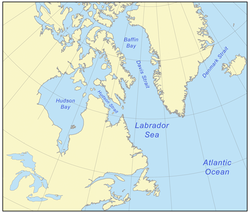
The Canadian Arctic Rift System is a major North American geological structure extending from the Labrador Sea in the southeast through Davis Strait, Baffin Bay and the Arctic Archipelago in the northwest. It consists of a series of interconnected rifts that formed during the Paleozoic, Mesozoic and Cenozoic eras. Extensional stresses along the entire length of the rift system have resulted in a variety of tectonic features, including grabens, half-grabens, basins and faults.
Development of the Canadian Arctic Rift System was accompanied by two plate tectonic episodes that originated on opposite sides of the North American plate and were propagated toward each other. Both were strongly controlled by pre-existing structures, which either guided the propagating faults or impeded their growth. The rift system is now inactive apart from minor adjustments that are indicated by occasional earthquakes in Baffin Bay and the Labrador Sea.
The Canadian Arctic Rift System is a branch of the Mid-Atlantic Ridge that extends 4,800 km (3,000 mi) into the North American continent. It is an incipient structure that diminishes in degree of development northwestward, bifurcates at the head of Baffin Bay and disappears into the Arctic Archipelago. The rift system is mainly an extensional structure, which has allowed Greenland and Canada to rotate apart and form intervening seaways. The segment extending from the Labrador Sea to Baffin Bay is sometimes referred to as the Labrador Sea–Baffin Bay rift system or the North Atlantic–Labrador Sea rift system.
Two rifting episodes created the Canadian Arctic Rift System. The first is referred to as the Boreal Rifting Episode which followed compression and exposure brought on by the Ellesmerian orogeny. The second is referred to as the Eurekan Rifting Episode and created most of the structures that comprise the Canadian Arctic Rift System. Both rifting episodes were active simultaneously from the Early Cretaceous to mid-Tertiary.
The Boreal Rifting Episode began in the Late Devonian and emanated southeastward from the Canada Basin into the North American continent. It caused uplift of the Pearya Geanticline and Sverdrup Rim, as well as crustal extension which led to thinning and subsidence of the regional lithosphere. The rifting extended only into the area that would be occupied by the future central Queen Elizabeth Islands and was aborted there due to interfering structural trends. In the extreme west, in the Banks Island area, extension of the Boreal Rifting Episode continued uninterrupted until the mid-Tertiary.
The Eurekan Rifting Episode commenced in the Early Cretaceous as the Boreal Rifting Episode declined. Crustal stretching began at the south end of the rift system 130 million years ago, during which supercontinent Laurasia was in the process of breaking apart. Rifting began from the Atlantic Ocean then propagated northwest where the Labrador Sea started opening in the Late Cretaceous. Seafloor spreading commenced in the southern Labrador Sea 75–60 million years ago, during which Greenland moved north relative to mainland North America. This northward movement gave rise to compressive forces between northern Greenland and the Arctic Archipelago, setting the stage for the Eurekan orogeny. Seafloor spreading reached the northern Labrador Sea 60–40 million years ago and Greenland moved simultaneously past Ellesmere Island along the Nares Strait. Approximately 170 km (110 mi) of Paleocene separation occurred between Greenland and Baffin Island, producing oceanic crust within Baffin Bay.
With the commencement of active seafloor spreading in the Norwegian Sea during the Early Eocene, the direction of seafloor spreading changed in both the Labrador Sea and Baffin Bay. Continued spreading in the Norwegian Sea eventually separated Greenland from Eurasia, resulting in the creation of the Greenland plate and the South Greenland triple junction. By this time spreading within Baffin Bay and the Labrador Sea had slowed and became oblique, eventually ceasing between 45 and 36 million years ago.
The final phase of rifting was marked by continental extension in the mid-Tertiary. It breached the North American continent and reached the Arctic Ocean, resulting in the formation of the Parry and Nares submarine rift valleys, the Queen Elizabeth Islands and the Queen Elizabeth Islands Subplate. This rifting lasted until the Early Miocene or later.
Canadian Arctic Rift System
The Canadian Arctic Rift System is a major North American geological structure extending from the Labrador Sea in the southeast through Davis Strait, Baffin Bay and the Arctic Archipelago in the northwest. It consists of a series of interconnected rifts that formed during the Paleozoic, Mesozoic and Cenozoic eras. Extensional stresses along the entire length of the rift system have resulted in a variety of tectonic features, including grabens, half-grabens, basins and faults.
Development of the Canadian Arctic Rift System was accompanied by two plate tectonic episodes that originated on opposite sides of the North American plate and were propagated toward each other. Both were strongly controlled by pre-existing structures, which either guided the propagating faults or impeded their growth. The rift system is now inactive apart from minor adjustments that are indicated by occasional earthquakes in Baffin Bay and the Labrador Sea.
The Canadian Arctic Rift System is a branch of the Mid-Atlantic Ridge that extends 4,800 km (3,000 mi) into the North American continent. It is an incipient structure that diminishes in degree of development northwestward, bifurcates at the head of Baffin Bay and disappears into the Arctic Archipelago. The rift system is mainly an extensional structure, which has allowed Greenland and Canada to rotate apart and form intervening seaways. The segment extending from the Labrador Sea to Baffin Bay is sometimes referred to as the Labrador Sea–Baffin Bay rift system or the North Atlantic–Labrador Sea rift system.
Two rifting episodes created the Canadian Arctic Rift System. The first is referred to as the Boreal Rifting Episode which followed compression and exposure brought on by the Ellesmerian orogeny. The second is referred to as the Eurekan Rifting Episode and created most of the structures that comprise the Canadian Arctic Rift System. Both rifting episodes were active simultaneously from the Early Cretaceous to mid-Tertiary.
The Boreal Rifting Episode began in the Late Devonian and emanated southeastward from the Canada Basin into the North American continent. It caused uplift of the Pearya Geanticline and Sverdrup Rim, as well as crustal extension which led to thinning and subsidence of the regional lithosphere. The rifting extended only into the area that would be occupied by the future central Queen Elizabeth Islands and was aborted there due to interfering structural trends. In the extreme west, in the Banks Island area, extension of the Boreal Rifting Episode continued uninterrupted until the mid-Tertiary.
The Eurekan Rifting Episode commenced in the Early Cretaceous as the Boreal Rifting Episode declined. Crustal stretching began at the south end of the rift system 130 million years ago, during which supercontinent Laurasia was in the process of breaking apart. Rifting began from the Atlantic Ocean then propagated northwest where the Labrador Sea started opening in the Late Cretaceous. Seafloor spreading commenced in the southern Labrador Sea 75–60 million years ago, during which Greenland moved north relative to mainland North America. This northward movement gave rise to compressive forces between northern Greenland and the Arctic Archipelago, setting the stage for the Eurekan orogeny. Seafloor spreading reached the northern Labrador Sea 60–40 million years ago and Greenland moved simultaneously past Ellesmere Island along the Nares Strait. Approximately 170 km (110 mi) of Paleocene separation occurred between Greenland and Baffin Island, producing oceanic crust within Baffin Bay.
With the commencement of active seafloor spreading in the Norwegian Sea during the Early Eocene, the direction of seafloor spreading changed in both the Labrador Sea and Baffin Bay. Continued spreading in the Norwegian Sea eventually separated Greenland from Eurasia, resulting in the creation of the Greenland plate and the South Greenland triple junction. By this time spreading within Baffin Bay and the Labrador Sea had slowed and became oblique, eventually ceasing between 45 and 36 million years ago.
The final phase of rifting was marked by continental extension in the mid-Tertiary. It breached the North American continent and reached the Arctic Ocean, resulting in the formation of the Parry and Nares submarine rift valleys, the Queen Elizabeth Islands and the Queen Elizabeth Islands Subplate. This rifting lasted until the Early Miocene or later.
Recent media
Recent media