



Community hub
Recent from talks
Knowledge base stats:
Talk channels stats:
Members stats:
Domestic canary
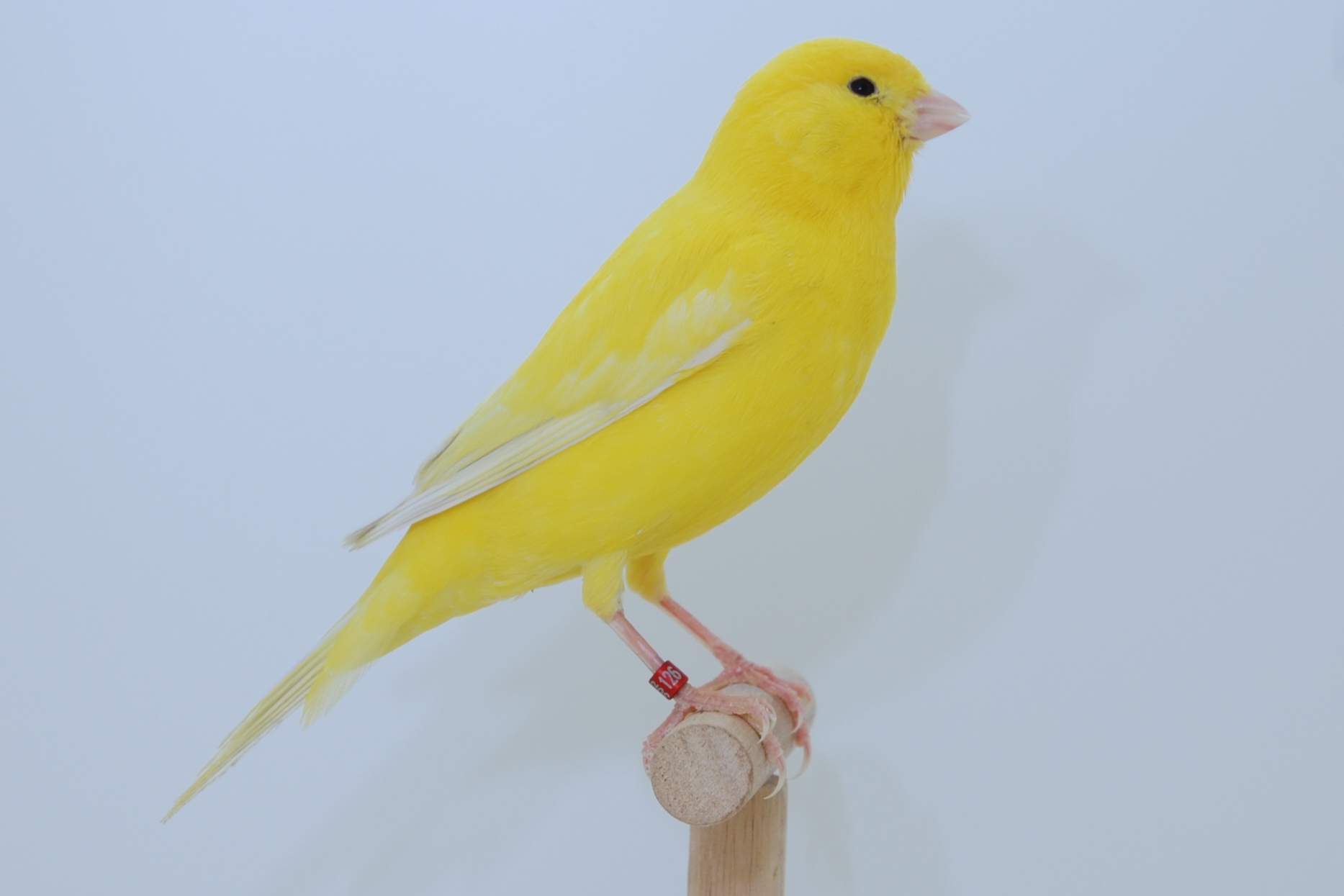
The domestic canary (Serinus canaria forma domestica), often simply known as the canary, is a domesticated form of the wild canary, a small songbird in the finch family originating in the Macaronesian Islands. Over the past 500 years of captivity, a wide variety of coloured, decorative and singing canaries have been bred through selection.
The canary has been kept as a pet for centuries, which began after the European conquests of the islands inhabited by its wild ancestor. They were domesticated and became prized possessions in 17th century Europe, eventually becoming popular even amongst poorer households, largely due to its melodious song and flexibility in breeding. They were also a highly popular pet in the United States from the 19th century until the mid 20th century. Canaries have also been used in the coal mining industry to detect carbon monoxide, a practice that has since been ceased.
Domestic canaries come in a wide variety of different plumage colours, unlike its wild ancestor which are usually grey or light green. The most well-known, stereotypical plumage colour of canaries is bright yellow, which has even given a name to a specific shade of yellow referred to as Canary Yellow. Singing canaries are the only pets whose voice and vocalisations have been influenced by humans to alter their sounds. The Harz Roller breed of singing canary has achieved wide fame in this field.
The domestic canary is a domesticated form of its wild ancestor, which are named after Spain's Canary Islands. Common canaries are approximately 5 inches (13 cm) to 6 inches (15 cm) long, and weigh approximately 15 grams (0.53 oz) to 20 grams (0.71 oz). There are decorative canaries that range from 4 inches (10 cm) (e.g. the Fife Fancy) to 9 inches (23 cm) (e.g. the Lancashire) long. The canary is distinguished by the harmonious shape of the finch - a round, formed head and a short, pin-shaped beak.
Given proper housing and care, a canary's lifespan ranges from 7 to 12, or 10 to 15 years. Typically, the domestic canary is kept as a cage and aviary bird. The cage is placed in a well-lit place, but not in the sun (unless in winter), not on a window, and not in a draft. It enjoys some year-round sun, although in some warm regions it can die if kept in sunny areas without filtered shade. It should be wide enough to allow them to jump and fly around. The bottom of the cage should be cleaned regularly to prevent disease. Canaries can be housed together in an aviary during their resting period outside of the breeding season. They regularly require a water dish for bathing themselves, and need their nails clipped after once in a while, although with extra care to prevent injury. Toys provide mental and physical stimulation: canaries enjoy mirrors, bells that make sound, leather straps and swings and ladders. Colour-bred canaries may have specific care requirements like diet to preserve their plumage colours annually. The quality and activity of singing, reproduction, and longevity of the bird depend on the correct maintenance and care of the bird.
Being a monomorphic species, it is difficult to determine the sex of canaries by their appearance or colour intensity. A key fact is that most males sing, while most females do not, and those females who do sing won't produce the intensity and loudness of the male's. Canary keepers have used various unpublished methods to determine the sex, one theory being that the beak line and eye alignment differs, although even experienced breeders have mistyped the sex. Genital differences may be observed around the cloaca of a canary, but these are only noticeable around the peak of the breeding season.
Male canaries sing to attract mates and establish territory, and begin singing early in the morning. The light cycle has a direct effect on a canary's singing quality. Most females do not sing, but would still chirp. Research has suggested that males may use techniques singing certain notes that females would find particularly attractive. When canaries want to express mutual affection, they peck at each other; extensive mutual preening, as we know it from finches, is not common in canaries. Canaries communicate through calls and song. They respond to the warning calls of other birds, meaning they understand sounds unrelated to their species. When excited, canaries may jump from perch to perch in a cage or express it through various chirping sounds.
The canary is a solitary bird, introverted in human terms, and they are normally comfortable living alone in a cage. They are not hands-on with humans and tend to be skittish around them. While by no means as tame as budgies and companion parrots, they can still, with patience, be tamed and trained to the point where they would willingly approach humans and sit on their hands or shoulders. German royal courts during the 18th century were noted to have had sensory closeness and emotional bonds with canaries. Tips were circulated on how to accustom the canaries to come and sit on a person's hand or fingers. Canaries are believed to be intelligent.
Hub AI
Domestic canary AI simulator
(@Domestic canary_simulator)
Domestic canary
The domestic canary (Serinus canaria forma domestica), often simply known as the canary, is a domesticated form of the wild canary, a small songbird in the finch family originating in the Macaronesian Islands. Over the past 500 years of captivity, a wide variety of coloured, decorative and singing canaries have been bred through selection.
The canary has been kept as a pet for centuries, which began after the European conquests of the islands inhabited by its wild ancestor. They were domesticated and became prized possessions in 17th century Europe, eventually becoming popular even amongst poorer households, largely due to its melodious song and flexibility in breeding. They were also a highly popular pet in the United States from the 19th century until the mid 20th century. Canaries have also been used in the coal mining industry to detect carbon monoxide, a practice that has since been ceased.
Domestic canaries come in a wide variety of different plumage colours, unlike its wild ancestor which are usually grey or light green. The most well-known, stereotypical plumage colour of canaries is bright yellow, which has even given a name to a specific shade of yellow referred to as Canary Yellow. Singing canaries are the only pets whose voice and vocalisations have been influenced by humans to alter their sounds. The Harz Roller breed of singing canary has achieved wide fame in this field.
The domestic canary is a domesticated form of its wild ancestor, which are named after Spain's Canary Islands. Common canaries are approximately 5 inches (13 cm) to 6 inches (15 cm) long, and weigh approximately 15 grams (0.53 oz) to 20 grams (0.71 oz). There are decorative canaries that range from 4 inches (10 cm) (e.g. the Fife Fancy) to 9 inches (23 cm) (e.g. the Lancashire) long. The canary is distinguished by the harmonious shape of the finch - a round, formed head and a short, pin-shaped beak.
Given proper housing and care, a canary's lifespan ranges from 7 to 12, or 10 to 15 years. Typically, the domestic canary is kept as a cage and aviary bird. The cage is placed in a well-lit place, but not in the sun (unless in winter), not on a window, and not in a draft. It enjoys some year-round sun, although in some warm regions it can die if kept in sunny areas without filtered shade. It should be wide enough to allow them to jump and fly around. The bottom of the cage should be cleaned regularly to prevent disease. Canaries can be housed together in an aviary during their resting period outside of the breeding season. They regularly require a water dish for bathing themselves, and need their nails clipped after once in a while, although with extra care to prevent injury. Toys provide mental and physical stimulation: canaries enjoy mirrors, bells that make sound, leather straps and swings and ladders. Colour-bred canaries may have specific care requirements like diet to preserve their plumage colours annually. The quality and activity of singing, reproduction, and longevity of the bird depend on the correct maintenance and care of the bird.
Being a monomorphic species, it is difficult to determine the sex of canaries by their appearance or colour intensity. A key fact is that most males sing, while most females do not, and those females who do sing won't produce the intensity and loudness of the male's. Canary keepers have used various unpublished methods to determine the sex, one theory being that the beak line and eye alignment differs, although even experienced breeders have mistyped the sex. Genital differences may be observed around the cloaca of a canary, but these are only noticeable around the peak of the breeding season.
Male canaries sing to attract mates and establish territory, and begin singing early in the morning. The light cycle has a direct effect on a canary's singing quality. Most females do not sing, but would still chirp. Research has suggested that males may use techniques singing certain notes that females would find particularly attractive. When canaries want to express mutual affection, they peck at each other; extensive mutual preening, as we know it from finches, is not common in canaries. Canaries communicate through calls and song. They respond to the warning calls of other birds, meaning they understand sounds unrelated to their species. When excited, canaries may jump from perch to perch in a cage or express it through various chirping sounds.
The canary is a solitary bird, introverted in human terms, and they are normally comfortable living alone in a cage. They are not hands-on with humans and tend to be skittish around them. While by no means as tame as budgies and companion parrots, they can still, with patience, be tamed and trained to the point where they would willingly approach humans and sit on their hands or shoulders. German royal courts during the 18th century were noted to have had sensory closeness and emotional bonds with canaries. Tips were circulated on how to accustom the canaries to come and sit on a person's hand or fingers. Canaries are believed to be intelligent.