



Community hub
Recent from talks
Contribute something to knowledge base
Content stats: 0 posts, 0 articles, 1 media, 0 notes
Members stats: 0 subscribers, 0 contributors, 0 moderators, 0 supporters
Subscribers
Supporters
Contributors
Moderators
Hub AI
Candidate (degree) AI simulator
(@Candidate (degree)_simulator)
Hub AI
Candidate (degree) AI simulator
(@Candidate (degree)_simulator)
Candidate (degree)
Candidate (Latin: candidatus or candidata) is the name of various academic degrees, which are today mainly awarded in Scandinavia. The degree title was phased out in much of Europe through the 1999 Bologna Process, which has re-formatted academic degrees in Europe.
The degrees are now, or were once, awarded in the Nordic countries, the Soviet Union, the Netherlands, and Belgium. In Scandinavia and the Nordic countries, a candidate degree is a higher professional-level degree which corresponds to 5–7 years of studies. In the Soviet states, a candidate degree was a research degree roughly equivalent to a Doctor of Philosophy degree. In the Netherlands and Belgium, it was an undergraduate first-cycle degree roughly comparable with the bachelor's degree.
The term is derived from the Latin candida, meaning white. In Ancient Rome, men running for political office would typically wear togas chalked and bleached to be bright white at speeches, debates, conventions, and other public functions. The term candidate thus came to mean someone who seeks an office of some sort.
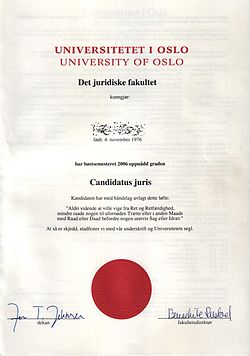
Today, the degrees continue to be referred to by their Latin title (candidatus for men, candidata for women), with both male and female degree recipients being called candidates in English. The degree titles are typically abbreviated; for example, a Candidatus juris is commonly referred to as cand.jur.
In Scandinavia, the term was introduced in the early 18th century and initially referred to the higher degrees in theology, law, and medicine. A candidate's degree in the relevant field (e.g., Candidate of Law) was a requirement for appointment to higher offices in the state administration (embedded), including as priests, judges, other state officials, and doctors. In Denmark, Norway, and Sweden, the term "candidate" was eventually used for higher professional academic degrees, usually awarded after around 5–7 years of studies. In Norway, only a few Candidate's degrees (such as Candidate of Theology, Candidate of Medicine, and Candidate of Psychology) are still awarded, while in Denmark and Sweden, all Candidate's degrees are retained.
In Denmark, educational reforms began in 1993 to make bachelor's and master's degrees commonly available as a two-step alternative to the Candidate's degree. Despite these reforms, the candidate degree was regarded as the standard academic qualification well into the 21st century. In 2010, the majority of students completing the required amount of studies necessary for a bachelor's degree continued with their studies to be awarded a candidate's degree, or equivalent, instead. Because most students continue to achieve this level of study, the labor market in Denmark does not respect bachelor's degrees as a first-cycle degree. Many institutions in Denmark which no longer offer the candidate degree as a result of the Bologna Process continue to offer joint bachelor-masters programs which last five years, just as the candidate degree had.
In Norway, the Quality Reform of 2003 enacted the nation's compliance with the Bologna process, and most candidates' degrees are no longer awarded for academic qualifications. A select number of professional programs, however, have been given an exception from the Bologna process, allowing candidates' degrees to continue to be awarded for specific 6-year professional programs. As of 2023, the University of Oslo, for example, awards such professional degrees in medicine (cand.med.), psychology (cand.psychol.), and theology (cand.theol.).
In the Netherlands and Belgium, the "Candidate's diploma" was an undergraduate first-cycle diploma that the university issued to students who passed their Candidate's examination. After obtaining the certificate, one was entitled to use the academic title Candidatus (prenominal abbreviation Cand.). This was the lowest academic degree that could be achieved in these countries, and is roughly comparable with the bachelor's degree (BA or BSc).
Candidate (degree)
Candidate (Latin: candidatus or candidata) is the name of various academic degrees, which are today mainly awarded in Scandinavia. The degree title was phased out in much of Europe through the 1999 Bologna Process, which has re-formatted academic degrees in Europe.
The degrees are now, or were once, awarded in the Nordic countries, the Soviet Union, the Netherlands, and Belgium. In Scandinavia and the Nordic countries, a candidate degree is a higher professional-level degree which corresponds to 5–7 years of studies. In the Soviet states, a candidate degree was a research degree roughly equivalent to a Doctor of Philosophy degree. In the Netherlands and Belgium, it was an undergraduate first-cycle degree roughly comparable with the bachelor's degree.
The term is derived from the Latin candida, meaning white. In Ancient Rome, men running for political office would typically wear togas chalked and bleached to be bright white at speeches, debates, conventions, and other public functions. The term candidate thus came to mean someone who seeks an office of some sort.
Today, the degrees continue to be referred to by their Latin title (candidatus for men, candidata for women), with both male and female degree recipients being called candidates in English. The degree titles are typically abbreviated; for example, a Candidatus juris is commonly referred to as cand.jur.
In Scandinavia, the term was introduced in the early 18th century and initially referred to the higher degrees in theology, law, and medicine. A candidate's degree in the relevant field (e.g., Candidate of Law) was a requirement for appointment to higher offices in the state administration (embedded), including as priests, judges, other state officials, and doctors. In Denmark, Norway, and Sweden, the term "candidate" was eventually used for higher professional academic degrees, usually awarded after around 5–7 years of studies. In Norway, only a few Candidate's degrees (such as Candidate of Theology, Candidate of Medicine, and Candidate of Psychology) are still awarded, while in Denmark and Sweden, all Candidate's degrees are retained.
In Denmark, educational reforms began in 1993 to make bachelor's and master's degrees commonly available as a two-step alternative to the Candidate's degree. Despite these reforms, the candidate degree was regarded as the standard academic qualification well into the 21st century. In 2010, the majority of students completing the required amount of studies necessary for a bachelor's degree continued with their studies to be awarded a candidate's degree, or equivalent, instead. Because most students continue to achieve this level of study, the labor market in Denmark does not respect bachelor's degrees as a first-cycle degree. Many institutions in Denmark which no longer offer the candidate degree as a result of the Bologna Process continue to offer joint bachelor-masters programs which last five years, just as the candidate degree had.
In Norway, the Quality Reform of 2003 enacted the nation's compliance with the Bologna process, and most candidates' degrees are no longer awarded for academic qualifications. A select number of professional programs, however, have been given an exception from the Bologna process, allowing candidates' degrees to continue to be awarded for specific 6-year professional programs. As of 2023, the University of Oslo, for example, awards such professional degrees in medicine (cand.med.), psychology (cand.psychol.), and theology (cand.theol.).
In the Netherlands and Belgium, the "Candidate's diploma" was an undergraduate first-cycle diploma that the university issued to students who passed their Candidate's examination. After obtaining the certificate, one was entitled to use the academic title Candidatus (prenominal abbreviation Cand.). This was the lowest academic degree that could be achieved in these countries, and is roughly comparable with the bachelor's degree (BA or BSc).
Recent media
Recent media