
Recent from talks
Canis
Knowledge base stats:
Talk channels stats:
Members stats:
Canis
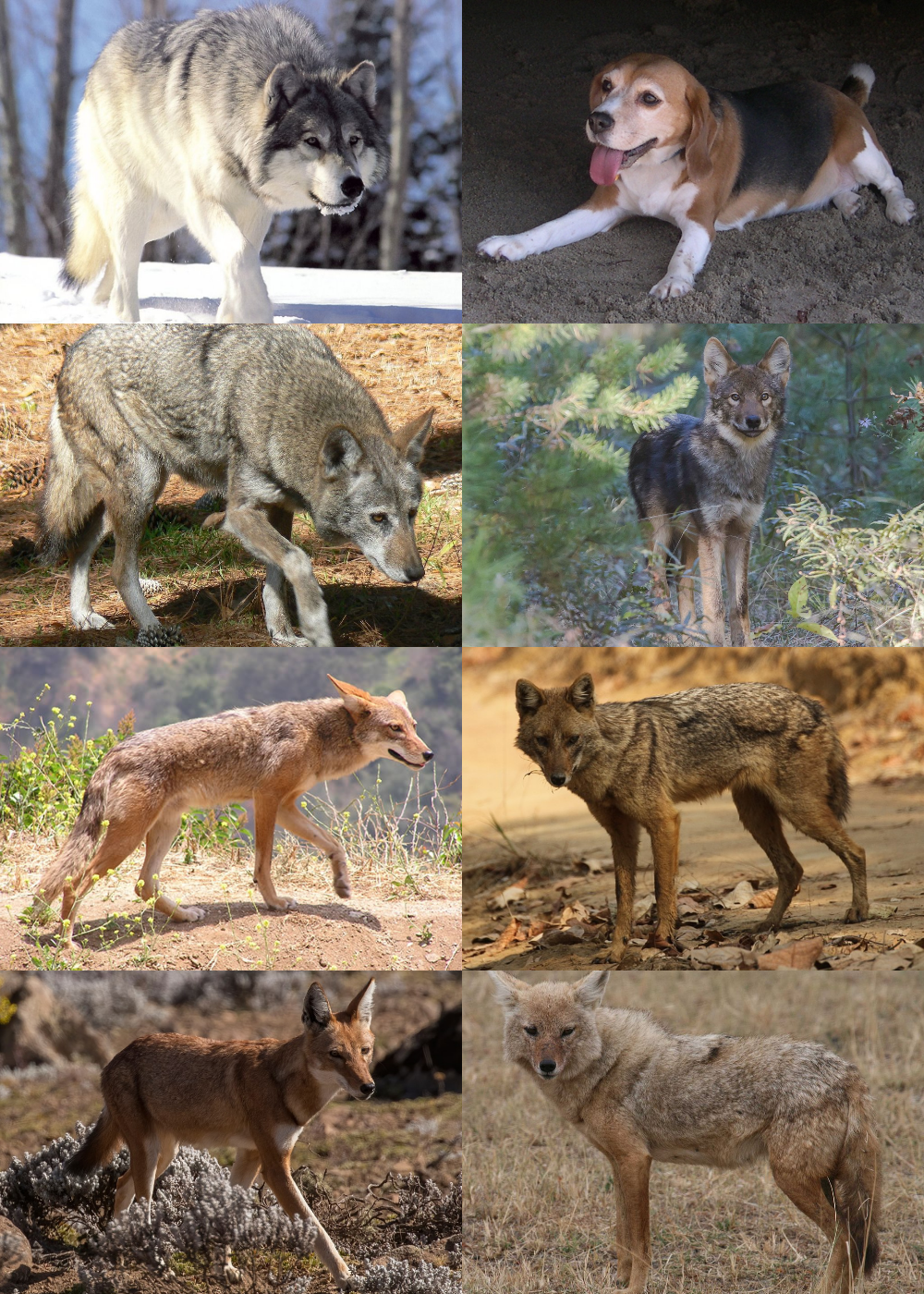
Canis is a genus of the Caninae which includes multiple extant species, such as wolves, dogs, coyotes, and golden jackals. Species of this genus are distinguished by their moderate to large size, their massive, well-developed skulls and dentition, long legs, and comparatively short ears and tails.
The genus Canis (Carl Linnaeus, 1758) was published in the 10th edition of Systema Naturae and included the dog-like carnivores: the domestic dog, wolves, coyotes and jackals. All species within Canis are phylogenetically closely related with 78 chromosomes and can potentially interbreed. In 1926, the International Commission on Zoological Nomenclature (ICZN) in Opinion 91 included Genus Canis on its Official Lists and Indexes of Names in Zoology. In 1955, the ICZN's Direction 22 added Canis familiaris as the type species for genus Canis to the official list.
Canis is primitive relative to Cuon, Lycaon, and Xenocyon in its relatively larger canines and lack of such dental adaptations for hypercarnivory as m1–m2 metaconid and entoconid small or absent; M1–M2 hypocone small; M1–M2 lingual cingulum weak; M2 and m2 small, may be single-rooted; m3 small or absent; and wide palate.
The cladogram below is based on the DNA phylogeny of Lindblad-Toh et al. (2005), modified to incorporate recent findings on Canis species,
In 2019, a workshop hosted by the IUCN/SSC Canid Specialist Group recommends that because DNA evidence shows the side-striped jackal (Canis adustus) and black-backed jackal (Canis mesomelas) to form a monophyletic lineage that sits outside of the Canis/Cuon/Lycaon clade, that they should be placed in a distinct genus, Lupulella Hilzheimer, 1906 with the names Lupulella adusta and Lupulella mesomelas.
The fossil record shows that feliforms and caniforms emerged within the clade Carnivoramorpha 43 million YBP. The caniforms included the fox-like genus Leptocyon, whose various species existed from 24 million YBP before branching 11.9 million YBP into Vulpes (foxes) and Canini (canines). The jackal-sized Eucyon existed in North America from 10 million YBP and by the Early Pliocene about 6-5 million YBP the coyote-like Eucyon davisi invaded Eurasia. The canids that had emigrated from North America to Eurasia – Eucyon, Vulpes, and Nyctereutes – were small to medium-sized predators during the Late Miocene and Early Pliocene but they were not the top predators.
For Canis populations in the New World, Eucyon in North America gave rise to early North American Canis which first appeared in the Miocene (6 million YBP) in south-western United States and Mexico. By 5 million YBP the larger Canis lepophagus, ancestor of wolves and coyotes, appeared in the same region.
Hub AI
Canis AI simulator
(@Canis_simulator)
Canis
Canis is a genus of the Caninae which includes multiple extant species, such as wolves, dogs, coyotes, and golden jackals. Species of this genus are distinguished by their moderate to large size, their massive, well-developed skulls and dentition, long legs, and comparatively short ears and tails.
The genus Canis (Carl Linnaeus, 1758) was published in the 10th edition of Systema Naturae and included the dog-like carnivores: the domestic dog, wolves, coyotes and jackals. All species within Canis are phylogenetically closely related with 78 chromosomes and can potentially interbreed. In 1926, the International Commission on Zoological Nomenclature (ICZN) in Opinion 91 included Genus Canis on its Official Lists and Indexes of Names in Zoology. In 1955, the ICZN's Direction 22 added Canis familiaris as the type species for genus Canis to the official list.
Canis is primitive relative to Cuon, Lycaon, and Xenocyon in its relatively larger canines and lack of such dental adaptations for hypercarnivory as m1–m2 metaconid and entoconid small or absent; M1–M2 hypocone small; M1–M2 lingual cingulum weak; M2 and m2 small, may be single-rooted; m3 small or absent; and wide palate.
The cladogram below is based on the DNA phylogeny of Lindblad-Toh et al. (2005), modified to incorporate recent findings on Canis species,
In 2019, a workshop hosted by the IUCN/SSC Canid Specialist Group recommends that because DNA evidence shows the side-striped jackal (Canis adustus) and black-backed jackal (Canis mesomelas) to form a monophyletic lineage that sits outside of the Canis/Cuon/Lycaon clade, that they should be placed in a distinct genus, Lupulella Hilzheimer, 1906 with the names Lupulella adusta and Lupulella mesomelas.
The fossil record shows that feliforms and caniforms emerged within the clade Carnivoramorpha 43 million YBP. The caniforms included the fox-like genus Leptocyon, whose various species existed from 24 million YBP before branching 11.9 million YBP into Vulpes (foxes) and Canini (canines). The jackal-sized Eucyon existed in North America from 10 million YBP and by the Early Pliocene about 6-5 million YBP the coyote-like Eucyon davisi invaded Eurasia. The canids that had emigrated from North America to Eurasia – Eucyon, Vulpes, and Nyctereutes – were small to medium-sized predators during the Late Miocene and Early Pliocene but they were not the top predators.
For Canis populations in the New World, Eucyon in North America gave rise to early North American Canis which first appeared in the Miocene (6 million YBP) in south-western United States and Mexico. By 5 million YBP the larger Canis lepophagus, ancestor of wolves and coyotes, appeared in the same region.
Recent media